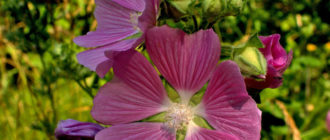
Primrose, or primrose, is a beautifully flowering small herbaceous perennial. Growing it from seed allows you to create a new variety at home without spending a lot of money. If you follow all the rules, you'll grow a healthy plant with a long flowering period, not overfed and free from diseases and pests, as is often the case with store-bought varieties.
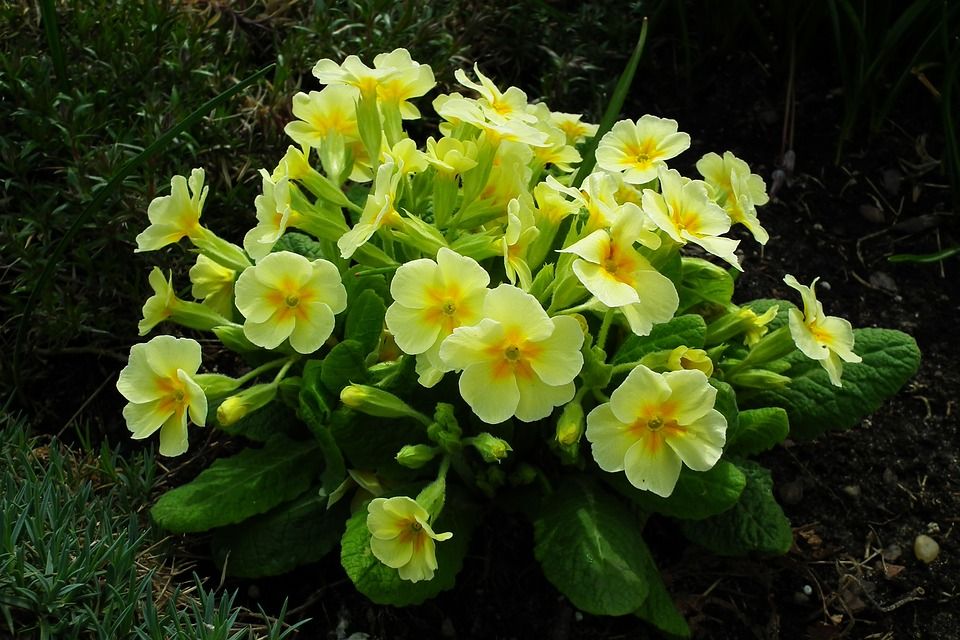
The name comes from the Latin word "primus," meaning "first," which is also reflected in the Russian language. The plant blooms in early spring.
Content
Characteristics of primrose
The primrose is a low-growing plant, reaching up to 20 cm in height, and comes in a variety of colors. The root system is fibrous and located near the soil surface. The leaves are gathered in a rosette at the soil level. Lanceolate or rounded, they come in a variety of colors, with a rough or smooth surface.
Flowers appear as early as April. The flowering period lasts about 1.5 months. If there's a lack of moisture, it may end early, leaving only green leaves on the surface, covering the ground throughout the season.
It grows on all continents except arid areas. It is found in mountainous areas and has alpine varieties. Popular types: finely toothed, stemless, Japanese, orchid and others.
Growing Primrose from Seeds at Home: Step-by-Step Instructions
The best time to germinate seeds is mid-winter, then primroses will bloom in late summer.
Preparing soil and containers for planting
To grow primrose, prepare soil and planting containers.
- The boxes are treated with a solution of manganese.
- Purchase expensive, properly processed soil that is free of weed seeds and pests. Alternatively, create your own soil mix. Use turf, sand, and leaf mold in a 1:1:2 ratio.
- The containers are washed with a weak solution of potassium permanganate and filled with prepared soil.
- The soil is lightly moistened. Primrose seeds are small, so they are not buried in the soil but scattered evenly over it.
- The boxes are covered with plastic wrap, checked and ventilated periodically. Seedlings emerge within two weeks at a temperature of 15°C.
Methods of seed preparation
If gardeners collect the seeds themselves, they sow them immediately after collection, as they quickly lose their germination capacity.
When purchasing in winter, before planting, carefully read the instructions on the packaging and adhere to the deadlines.
When sowing, it's essential to prepare the seeds. There are several ways to ensure rapid germination of primrose seeds:
- stratification;
- moisturizing;
- hardening.
Stratification
First, stratification is used to speed up germination. This process is close to the natural course of events in nature. Seeds in open ground, having ripened, fall to the ground, where they are covered by snow for the winter, then warmed by the spring sun, awakening them to life.
Stratifying the seeds is essential. To do this, place them in the freezer for 10 days or place the boxes on the balcony. Then plant them.
Moisturizing
The seedlings are placed in a vegetable drawer at a temperature above 0°C for 24 hours. To ensure rapid germination, the seeds are soaked in a biostimulant solution, then placed on a damp cloth, covered, and wait for roots to appear. Once this occurs, they are planted in the soil, covered, and placed in a slightly cold place for 5 days or refrigerated.
Other methods
The simplest and fastest method is daily hardening. During the day, the seeds are left in pots in a warm place, and at night, they are placed on a closed balcony or in a greenhouse.
Sowing dates
For seeds collected from a garden plot, sow immediately after they ripen, towards the end of summer. For store-bought seeds, sow in late January or early February.
Conditions for seed germination
For seeds to germinate, certain conditions must be created:
| Factor | Conditions |
| Location | A very bright place, but not in direct sunlight. Some varieties are germinated in complete darkness. |
| Temperature conditions | +16…+18 °C. |
| Humidity | Moderate, do not allow over-watering or dry seeds. |
Planting and caring for seedlings
The conditions for growing seedlings are slightly different.
| Factor | Conditions |
| Lighting | A bright place, slightly shaded with diffused light. |
| Temperature conditions | +20…+25 °C. |
| Humidity | Moderate, covered containers are ventilated, and if the soil is dry, they are sprayed. |
| Watering | This is done periodically, since primroses are early flowers and when they germinate, the soil is filled with moisture. |
| Top dressing | The first one is carried out after 10 days, then they are fed simultaneously with watering with liquid fertilizers. |
Picking seedlings
This is done when the plants have three pairs of true leaves. Any excess plants are inspected.
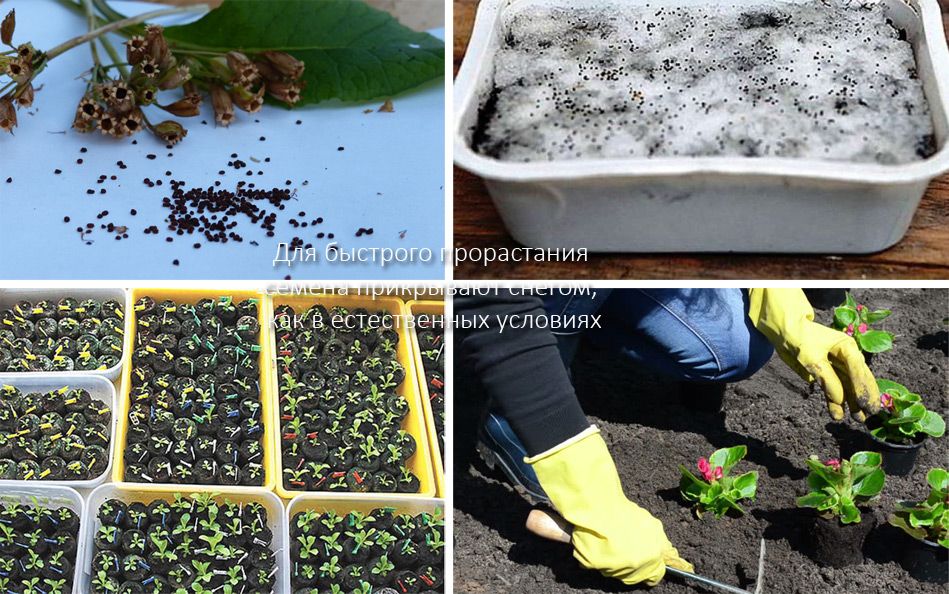
If they are not wilted and undamaged, they are planted in separate pots for subsequent germination.
Planting seedlings in open ground
After some time, the transplant is repeated. Then, care is given as for other plants. The seedlings are inspected for damage and pests. If any are present, preventative measures are taken. Fertilize with mineral fertilizer every 10 days. Once the seedlings have established themselves, they are transplanted into flowerbeds.
When 6 leaves appear, primroses are transplanted into the ground, leaving 30 cm between plants. The rosettes of leaves are not buried, the roots are covered with soil, but not very deeply, since primroses have a small root system.
The plantings are marked by writing the plant variety name on the inserted markers. The roots are watered, and the soil is compacted.
Further care of seedlings
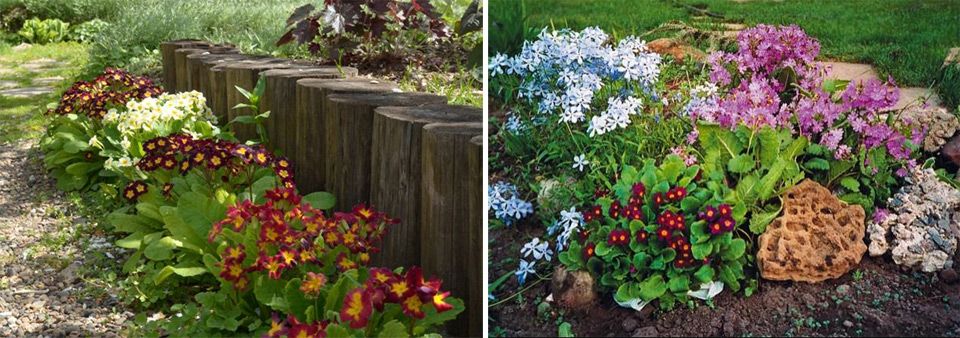
Besides their beauty in spring, primroses also protect the soil. Over time, the flowers expand and become like a green carpet that protects the soil from drying out. Weeds are virtually impossible to grow beneath it.
Watering should be done every two weeks or whenever the soil dries out. In dry weather, pour up to 1 liter of water under the bush.
Apply root and foliar fertilizers weekly, alternating between mineral fertilizers and pest control products. Fertilizing is stopped after flowering.
First-year plants are watered and fertilized thoroughly, but remember that flowering may not occur in the first year. Therefore, fertilizing is stopped in mid-September. If the plantings are older, replant the seedlings every four years.
After flowering, which ends in late June, primroses continue with simple care. Faded flowers are removed, the soil around the plant is loosened to prevent compaction, and mulch is applied, preferably wood shavings.
The flowers themselves, as they grow, act as a natural mulch for other plants. Leaves are not pruned in the fall. Since the root system is close to the surface, the green rosettes cover the roots.