Rudbeckia (black-eyed Susan, sun hat) is a herbaceous plant belonging to the Asteraceae family. It is native to the northern regions of America and most European and African countries.
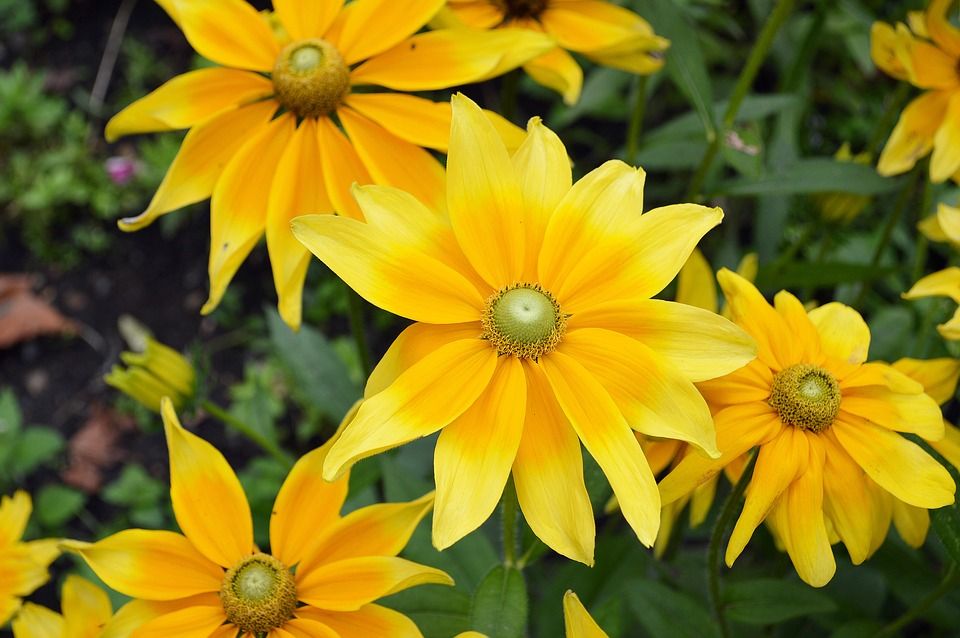
There are 40 varieties of this flower. The shrub received its official name thanks to Swiss botanists, the Rudbecks.
Content
Description of Rudbeckia
The stems are erect or branched, heavily pubescent, reaching 2-3 m. The foliage is entire, pinnately dissected, with some specimens being oval or ovoid, and about 20 cm long. The petioles are long along the base of the trunk, while those above are sessile.
Basket-shaped inflorescences are about 15-17 cm in size. Color ranges from deep yellow to purple-black.
The fruit resembles an elongated achene with a small crown. The seeds are glossy and dark gray. They remain viable for two to three years.
Many people consider rudbeckia and echinacea to be the same plant, but this is a misconception. They have similar appearances and are found on the same continent, but that's all.
Unlike the latter plant, black-eyed Susan has no medicinal properties.
Types and varieties of rudbeckia
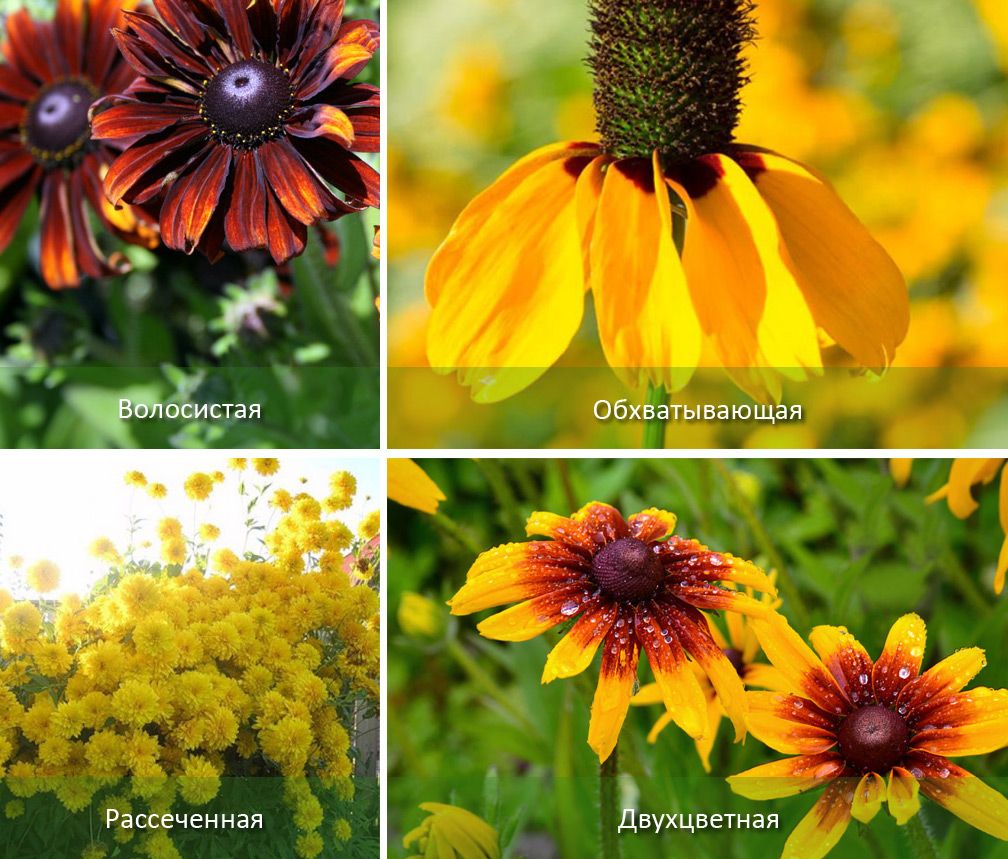
Rudbeckia species are classified based on their lifespan. Among the rudbeckia varieties suitable for growing as annuals are the following:
| View | Description | Varieties |
| Hairy (shaggy) | A low-growing annual plant, suitable for planting in Siberia. The trunk is covered with stiff hairs. The buds range in color from rich yellow to dark brown. The leaves are large, lanceolate, reaching 13 cm in length. |
|
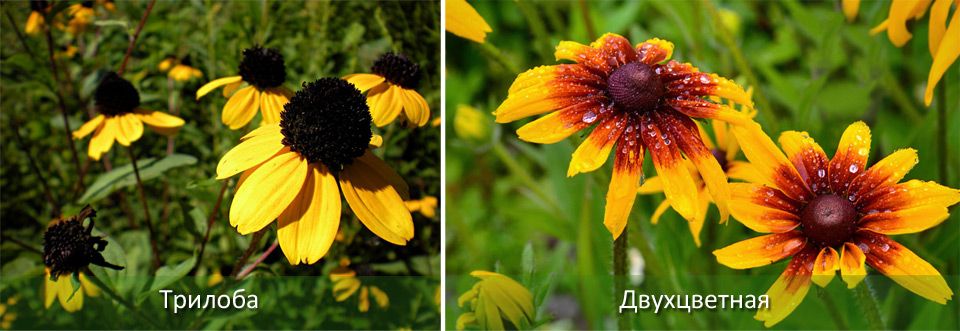
| Two-tone | The trunk is branched, reaching 70 cm. Flowers are arranged in two rows, yellow or pinkish. It blooms continuously, until the first frost. |
|
| Triloba | The stem grows up to 140 cm. The lower leaves are oval, have three lobes, dark green. | They do not stand out. |
| Beautiful (wonderful) | Color: yellow-brown. Flowering period: from mid-July to October. | |
| Enveloping | A shrub about 80 cm tall. Flowers are yellow or dark brown. The leaves are opposite, with serrated edges. | |
| Dissected | The trunk is 200 cm tall and has a highly branched horizontal root system. The inflorescences are 10-12 cm in size and bright yellow in color. |
|
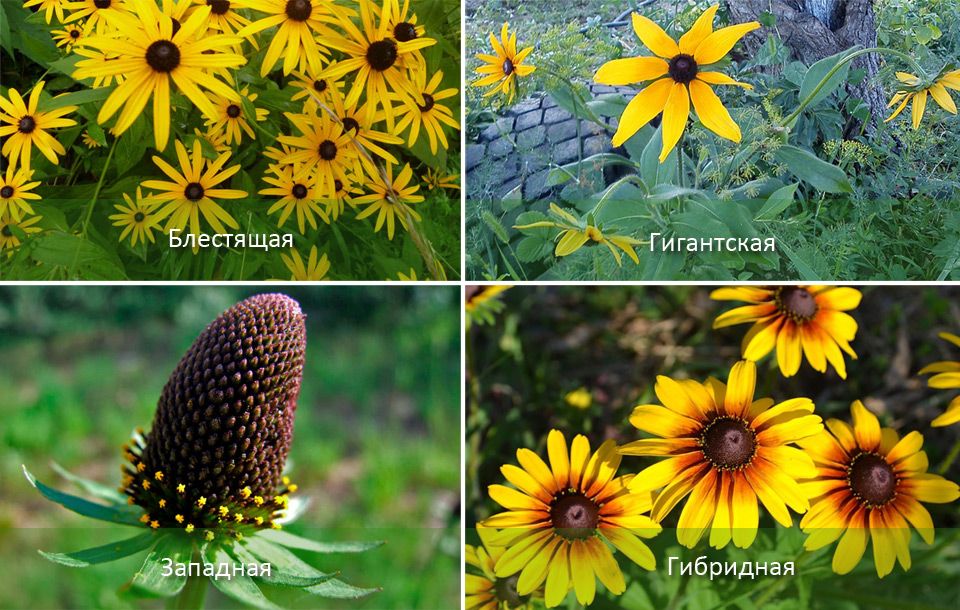
Among the perennial rudbeckias, there are also several interesting varieties:
| View | Description | Care Features | Varieties |
| Brilliant (radiant) | Frost-resistant, it has an erect stem reaching 60 cm. The foliage is elongated and tapering. The orange and red buds are approximately 9 cm in diameter, with star-shaped inflorescences. Flowering lasts from early summer to mid-autumn. | Plant in fertile, well-drained soil in a sunny location. Weeds and dead leaves are removed regularly. |
|
| Giant | Native to northern America, it grows up to 1.5 m. The foliage is glaucous-green and covered with a waxy coating. The buds are rich yellow. It blooms from late July to early September. | Plant in partial shade or full sun. After the growing season, remove all flower stalks. | They do not stand out. |
| Western | A drought-resistant herbaceous plant, the trunk grows up to 1.5 m. The buds are cone-shaped or cone-shaped. It blooms from mid-June to early autumn. | Grow in well-lit, draft-free areas. Ideal soil is moist loam. |
|
| Hybrid | The stem grows up to 1.2 m, is strong, heavily branched, and pubescent. The foliage is oval or oval-shaped. The inflorescences range from 20 to 25 cm in size, and are brownish-yellow or brownish-purple. | Place in well-lit areas with moist and loosened soil. Fertilize twice per season. Remove spent blooms regularly. |
|
Growing annual rudbeckia from seeds
Annual rudbeckia is obtained from seeds, using seedlings, or directly planted in open ground.
To ensure that the seedlings are strong and healthy, you need to follow the sowing technology.
Sowing
Sowing seeds in open soil is a common method of growing rudbeckia in Russia. However, the downside of this method is that it takes a year for a full-fledged flower to appear. To ensure a healthy plant, gardeners must adhere to specific planting timing and techniques.
Planting dates
Seeds are sown in midsummer. The optimal time for sowing is considered to be from late June to July 20th. Flowering is not expected until the following year.
Landing rules
When choosing this method of planting, the plants follow this plan:
- the soil is loosened in advance and mineral substances are added to it;
- create grooves 1.5-2 cm deep and place them at the same distance;
- the seeds are evenly spread out, keeping a distance of 15 cm between future bushes;
- the planting material is sprinkled with a thin layer of dry soil;
- The bed is thoroughly watered and sprayed with a spray bottle, doing this extremely carefully so as not to wash away the planting material.
Once planted, don't forget about care: remove weeds, weed the spaces between the rows, and loosen the soil. By September, small rosettes of leaves will emerge from the beds, and by next year, they will have become full-fledged shrubs.
Seedling
The seedling method is used by gardeners in the northern regions.
Seeds are sown in the first half of spring (March–early April):
- They are planted in special containers and covered with a thin layer of soil on top, and lightly sprayed with water from a spray bottle (it should be warm and settled).
- Cover the container with plastic wrap and move it to a room with a temperature of 20 to 22°C. The first sprouts appear within 14 days.
- The plants are regularly watered, ventilated, and the film is cleaned of condensation. After two permanent leaves have formed, they are repotted so that there is sufficient space between them.
- Once the flowers have established themselves, they are hardened off by moving them to a loggia or veranda for 2-3 hours every day.
Planting and caring for rudbeckia in open ground
When the seedlings are fully formed (last ten days of May - beginning of June, after the absence of recurrent frosts), they are transplanted into the garden, where they require certain care:
- Watering. The plant should be planted in a well-lit area, so the soil should be monitored regularly. During active growth, water twice a week.
- Pruning. To ensure abundant and long-lasting flowering, regularly remove spent blooms. During cold weather, remove the shrubs completely, covering the remaining roots with dried leaves and spruce branches.
- Fertilizing. To ensure normal development, fertilize twice a season. Initially, use a complex mineral fertilizer, applied in March to accelerate the formation of strong and vigorous rhizomes. The next fertilizing is done 20 days later (a tablespoon of nitrophoska per 10 liters of liquid).
Features of growing perennial rudbeckia
Perennial varieties of black-eyed Susan are grown only by sowing seeds directly into the soil. The best time to plant is late spring or early summer, when the soil has warmed up well. Otherwise, the steps are the same as for annuals, except that the seeds are spaced 30-40 cm apart.
In the fall, the bushes are pruned and moved to their permanent location. The flowers are then trimmed and mulched to protect the rhizomes from frost damage. Flowering is expected next year.
Propagation of Rudbeckia
Another option for propagating the sun cap is root division. This is done every 5-6 years. The mature bush is removed from the soil and divided into several parts. The new plants are then planted in the ground, spacing them 30-40 cm apart.
This method is best when the flower is actively growing. The optimal time is early spring or fall.
Diseases and pests of rudbeckia
During the cultivation of rudbeckia, it may be attacked by insects or diseases.
| Symptoms | Cause | Elimination measures |
| A loose white coating on the stem. | Powdery mildew. | Spray with a one percent solution of copper sulfate. |
| Brown spots on leaves, weakening and falling off. | Leaf nematode. | Treat with Bazamid, Nemaphos, or Nemagon. Severely affected plants are dug up and destroyed. In the case of annual specimens, all plant remains are burned in the fall, the soil is thoroughly dug up and watered with a strong solution of potassium permanganate. |
| Holes in the leaves. | Larvae and caterpillars. | They are harvested by hand. The plant is treated with any fungicide. |
If pests or diseases are detected and eliminated in a timely manner, the plant will delight you with its healthy and flourishing appearance for a long time.
Rudbeckia is one of the most undemanding shrubs, so even minimal care from gardeners (timely watering, pruning, and fertilizing) will protect it from insects and diseases.