Bergenia is a perennial plant in the Saxifrage family, known since the 18th century. Another name is "elephant ears." It is native to Siberia. Its distribution includes Central Asia, Mongolia, Korea, China, the Altai Mountains, and Primorsky Krai. It prefers riverbanks, stream banks, cliffs, rocky slopes, and forests. The plant has many beneficial properties.
Content
Characteristics of the Bergenia flower
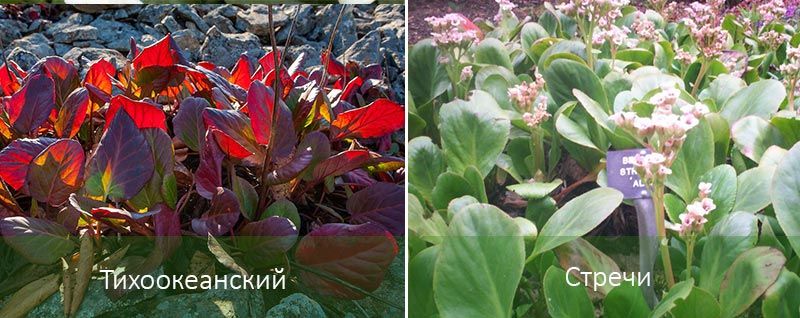
Bergenia (Bergenia spp., or Bergenia spp.) has basal leaf blades. These are decorative after flowering. The blades are leathery, wide, oval, circular, or elliptical in shape, with serrated edges. In summer, they are dark green and glossy, turning chestnut, red-brown, crimson, or bright bronze in autumn. The leaves are 3-35 cm long and 2.5-30 cm wide. They are arranged on petioles and formed into a basal rosette, with membranous stipules forming at the base. The leaves emerge after flowering, grow throughout the summer, and do not die back in winter.
The plant's stem is thick, smooth, leafless, 15-50 cm long, and dark pink in color. The rhizome is thick, dark brown, shallow, and grows longitudinally, reaching up to 3.5 cm in thickness and several meters in length.
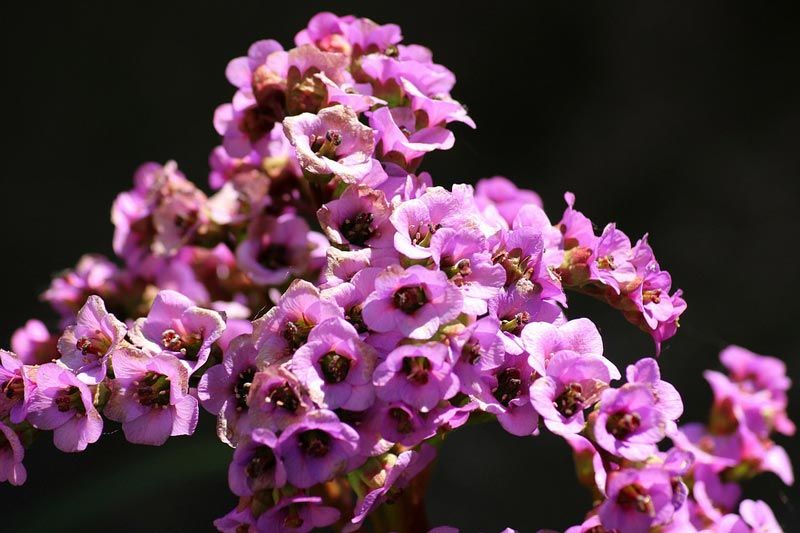
Fragrant flowers are gathered in paniculate inflorescences, located on a tall peduncle. The shape is bell-shaped, cup-shaped. They bloom in late March and continue until the end of May. Colors include snow-white, pink, fuchsia, and purple. The fruit is a capsule containing small black seeds.
Types and varieties of bergenia
There are 10 species of plants classified into one genus, the first three of which are the most common in ornamental gardening.
| View | Description / Height (m) | Leaves |
Flowers / Flowering period |
| Thick-leaved (medicinal, Mongolian) | Early blooming, shade-tolerant, and demanding of moisture, it is used to make a medicinal tea. 0.2-0.5. |
Heart-shaped, round, hard, 20 cm wide, 30 cm long. Light green in summer and spring, brown and shiny in autumn. |
Dark pink. Purple-red. Lilac. Soft pink. End of April. |
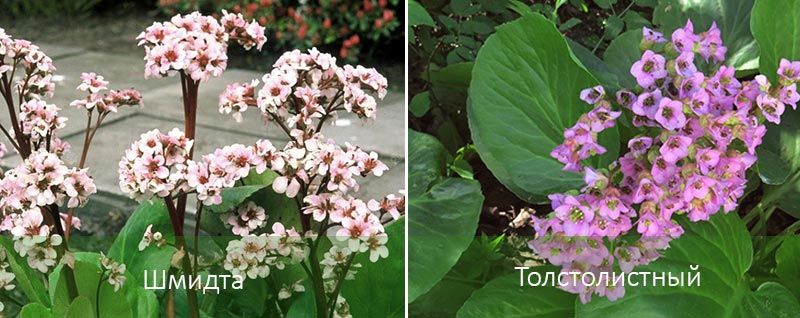
| Heart-leaved | Large, capable of wintering under the snow. 0.6. |
Dense, coarse, heart-shaped. Light green in summer, turning reddish-brown and shiny in autumn. | Lilac-pink.
May. |
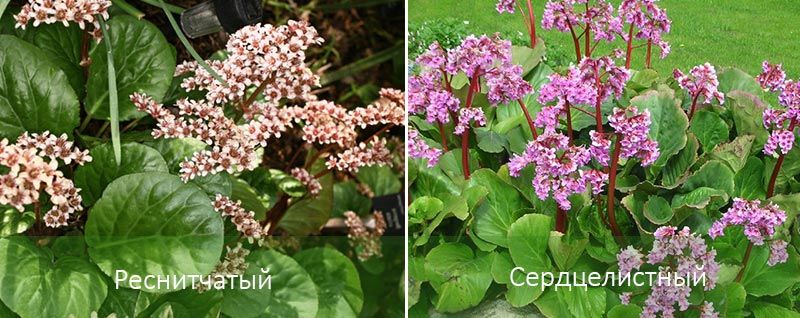
| Ciliated | From Tibet and the Himalayas, loves shady forests and mountain ledges.
0.3. |
Round, hairy, with a pinkish border, 2.5 cm long. | White, creamy pink, fragrant.
April. |
| Pacific | Distributed in the Far East, light-loving, grows among stones.
0.4. |
Up to 20 cm in diameter, oval-shaped, with ribbed edges, they are green in summer and turn reddish-burgundy in autumn. In winter, at -18°C, they die off. | Lilac, May to June. |
| Stretches | Tolerant of temperature fluctuations and drafts. Native to Afghanistan and Asia.
0.3. |
Ovate, 3-5 cm in diameter, 8-10 cm long. Serrated, sharp at the edges, glossy. They survive well under snow. |
Purple-red, white-pink. From May to September. |
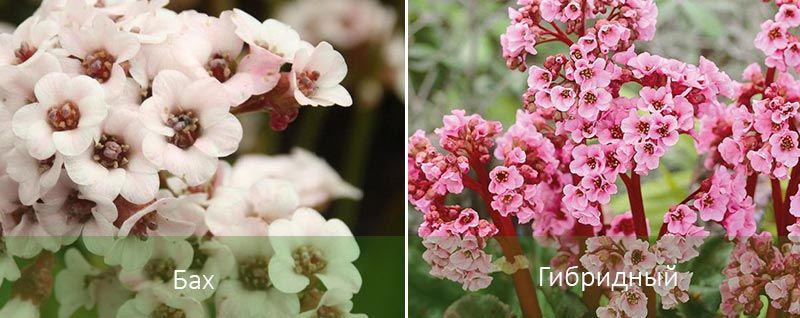
| Hybrid | Obtained by crossing different species. | The leaves of most are large, wavy, violet-green, purple, and yellow. | Of various colors. |
| Schmidt | A hybrid of ciliate and thick-leaved. 0.3 |
Elliptical, 15 cm long and 25 cm wide, on long petioles, pointed at the edges. Green and green-blue in autumn. | Scarlet.
End of April. |
| Bach | Dutch. Frost-resistant.
0.3-0.4 |
Dark green, brown in October. |
White. May-June. |
Thick-leaved varieties
| Variety | Height (cm) | Flowers | Flowering period |
| Purpurea | 50 | Purple-red. | May-June. |
| Giderruspe | 200 | Soft pink. | |
| Senor | 40 | Purple. | May. |
Heart-leaved varieties
| Variety | Height (cm) | Flowers | Flowering period |
| Red Star | 50 | Carmine pink. | May. |
| Morning Light | 35 | Light pink, darker in the middle. | |
| Cordifolia | 30-40 | Dark pink. | April-May. |
Varieties of Strechi
| Variety | Height (cm) | Flowers | Flowering period |
| Gazebo | 20 | Slightly pink. | April-May. |
| Beethoven | 40 | Pink and white. | |
| Alba | 5-100 | Snow-white. | May. |
Hybrid Varieties
| Variety | Height (cm) | Flowers | Flowering period |
| Bressingame White | 30 | Large, white. | May-June. |
| Baby Doll | Light pink. | ||
| Eden Dark Margin | Purple-red. | ||
| Magic Giant | 35 | Pearl. | April-May. |
| Lanur Glow | 40 | Eggplant pink. | June-August. |
Growing Bergenia flowers
Bergenia can be a beautiful addition to any garden, and is popular in landscape design for flower beds, borders, and rock gardens. While the flower isn't fussy, planting and caring for it outdoors requires proper agricultural practices.
Sowing seeds
Seeds are purchased or collected from bushes. To do this, select a wilted but large inflorescence, place a bag over it, and cut it off. The harvesting season is September. They are dried for several weeks in a ventilated area, then shaken out and cleaned. They are stored in cloth bags.
Sow in early spring in a wide wooden container with a drainage layer of sand and small pebbles at the bottom. Use commercial potting soil for sowing. Make furrows 0.5 cm deep and 3 cm apart. Water with warm water, and once absorbed, scatter the seeds evenly. Place in partial shade, with temperatures between 18 and 19°C and humidity of 75%.
Sometimes seeds are sown in November and placed under snow for stratification. In March, they are moved to a warmer location and planted in late April.
Caring for seedlings
Seedlings are expected in three weeks. Loosen the soil regularly, especially when a crust forms. Water sparingly and ventilate the area. Protect from direct sunlight to prevent sunburn. Fertilizer is not required; a growth activator will do. Thin out the seedlings after a month. Transplant the seedlings in May into a prepared box, spacing them 5-7 cm apart and 15 cm between rows. Before planting outdoors, harden them off outdoors or on a balcony, increasing the time each day. Once the seedlings have been exposed to fresh air for a day, it's time to transplant them into the garden.
Planting in open ground
At the end of summer, bergenia is planted outdoors. It prefers a location with light, loose, slightly alkaline soil in partial shade. This is necessary to prevent the roots from drying out. Exposure to direct sunlight may prevent the plant from forming flowers, but the leaves will remain lush.
First, dig holes 6-8 cm deep. Place them in a 40x40 staggered pattern. Place a mixture of turf, loam, humus, and sand (1:1:2:1) at the bottom. The seedling, complete with root ball, is then transshipped deeper into the hole. Mulch the soil with straw and sawdust. The plant develops slowly, blooming in the 3rd or 4th year.
Flower care
Caring for the flower is not difficult. In the fall, remove dry foliage and blossoms, and in the spring, remove last year's leaves, broken, weak, and overgrown shoots. Mulch the soil. In dry weather, the bushes require repeated watering: when buds are forming, during flowering, and after another 2-3 weeks.
It's important to prevent the plant from drying out or becoming waterlogged. No watering is required during rainfall.
Fertilize twice: in the spring, after flowering, and in the fall. Use complex mixtures, such as "Kemira" – 1 tablespoon per bucket of water per 2 square meters of area. The second time, use superphosphate – 20 g per 10 liters of water (1 square meter).
In cold regions, although the plant is frost-hardy, some varieties may not survive the cold. Bushes are covered with fallen leaves and spruce branches.
Propagation and transplantation of bergenia
The plant is propagated by seeds and division. The newly formed rosettes with roots are dug up without damaging the mother plant. Choose a healthy, 4-5-year-old bush with large leaves. This procedure is usually carried out after flowering, from May to August. Each division, 10-20 cm long, should have at least three buds. The leaves are torn off, leaving the smallest ones. Dig holes 3-5 cm deep, spaced 30-40 cm apart. Water thoroughly for the first three weeks. After rooting, the plant will develop a rosette of leaves and will bloom only after two years.
The plant can survive for many years in one location, gradually expanding and covering more and more space. In such cases, repotting is recommended every 5-6 years. In early September, the bush is divided and replanted. It requires ample watering for the first few days.
Diseases and pests of bergenia
The plant is rarely susceptible to diseases and pests.
Stagnant moisture increases the risk of ramularia, a fungal infection. The leaves become covered with brown, bordered spots on the top and a white coating on the bottom. They then dry out. Affected leaf blades are removed. Treatment with Bordeaux mixture, Fundazol, and copper sulfate helps.
Shrubs growing in the shade are susceptible to spittlebugs. Dense grass provides a breeding ground for their larvae. The insects secrete a foam similar to saliva. To combat them, use laundry soap, wormwood infusion, Malathion, and Intavir, treating the plants twice on dry, warm days after flowering.
Roundworms or nematodes lay their larvae in the form of balls on the roots. When replanting, they are treated as a preventative measure. When the pests have completely attacked the plant, it is dug up, the rhizome is soaked in a solution of potassium permanganate, and replanted in a new location. The soil where the bush grew is treated with insecticides. Nothing else is planted there for the entire year.
Top.tomathouse.com recommends: Bergenia – a flower for making a healing drink
The plant's rhizome, leaves, flowers, and fruits possess medicinal properties. Due to its tannins, trace elements, and vitamin C, bergenia is widely used for medicinal purposes. The plant has anti-inflammatory, healing, disinfectant, and diuretic properties.
Preparations are made in June-July. The root is washed and dried and can be stored for up to four years. The leaves are collected only in spring or fall, washed, dried, and crushed. They are stored in a cloth bag.
Decoctions are prepared from dried leaves, and tea is made from last year's leaves that have wintered under the snow, but not young ones, as they are toxic and will harm the body.
Bergenia is used for women's diseases, sore throats, stomach problems, headaches, and is used in dentistry.
The medicinal properties of bergenia vary depending on the region where it grows. Mongolian tea helps with a weakened immune system. In Tibet, it is used to treat colds, bronchitis, rheumatism, and tuberculosis. Siberian folk medicine recommends bergenia for ailments of the mouth, throat, and gastrointestinal tract. The rhizome powder is used to treat wounds. A tea brewed from the plant's leaves boosts male potency, relieves stress, invigorates, improves metabolism, and eliminates toxins. Water infusions, tinctures, and extracts are popular.
The plant can be harmful if you don't know its contraindications. Bergenia is not recommended for people with hypotension, cardiac arrhythmia, a tendency toward allergies, or constipation. It is also not recommended for pregnant or breastfeeding women.