Alyssum is a herbaceous groundcover plant in the Brassicaceae or Cruciferae family. It grows as both perennials and annuals. It is common in Europe, North Africa, Asia, and southern Siberia. There are over 100 species of alyssum. It is popular among gardeners because it is easy to grow, drought-resistant, and frost-tolerant.
Content
Description and characteristics of alyssum
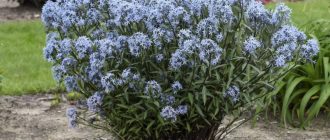
Alyssum (also known as borage) has dense, semi-woody stems that can be erect, ascending, or creeping. The flower forms a dense subshrub ranging from 10 cm to a meter in height and up to 1.5 meters in width. The leaves are thick, petiolate, oblong, oval, and covered with silvery fuzz. Reaching 15-40 cm in height, the buds are formed by four petals arranged crosswise, united in inflorescences.
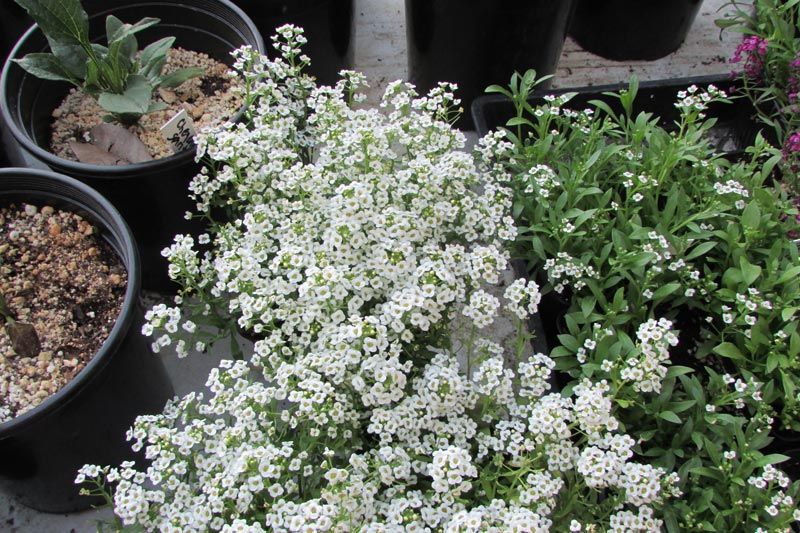
The flowers are small clusters of snow-white, gold, pink, lilac, and yellow. They bloom in May and continue until late autumn, producing excellent honey. The honey aroma of some varieties of alyssum extends for several meters.
The fruit is a pod with flat seeds that remain viable for three years. The rhizome is superficial with adventitious roots.
Forming a fluffy carpet, alyssum is used in landscape design for parks and squares, flowerbeds, rockeries, and borders. It is also used to decorate hanging planters, pots, and containers.
Alyssum contains alkaloids, organic acids, and flavonoids, and has medicinal properties. Its decoction is used for colds, its infusion is used for facial care, and its dried parts are used in aromatherapy.
Types and varieties of alyssum
Species and varieties vary in height and color palette.
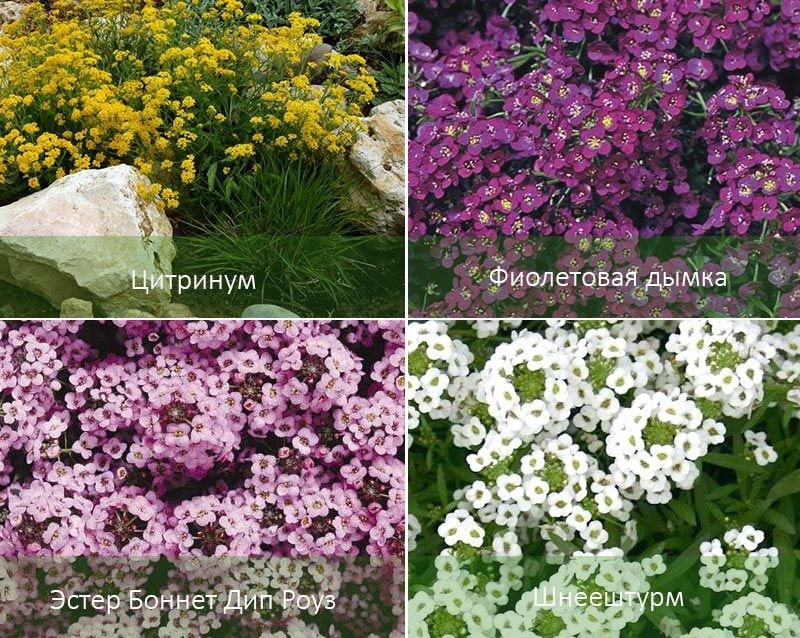
| View | Description | Varieties | Flowers |
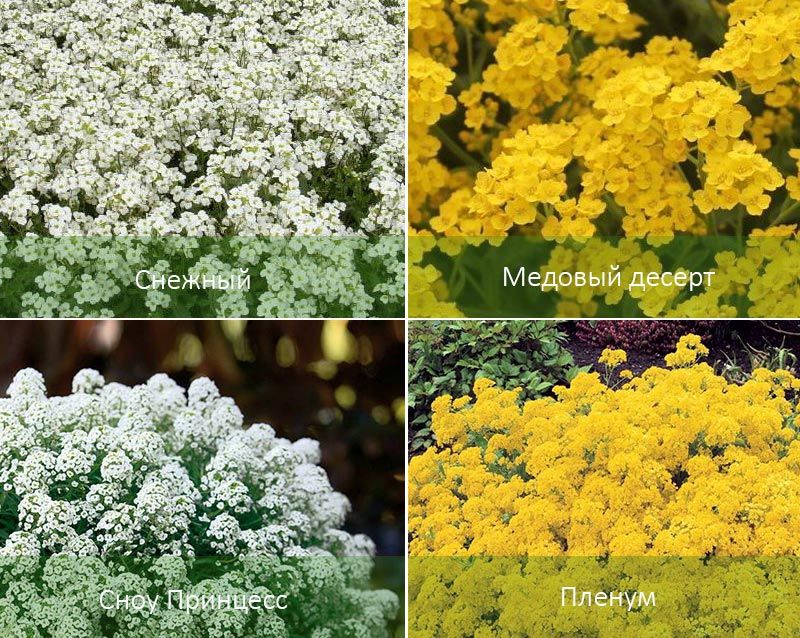
| Rocky | Height: 28-30 cm. Leaves do not fall even in winter. Flowers are paniculate, bloom in April-May, and fade early. | Citrinum | Lemon yellow. |
| Plenum | Terry, golden yellow. | ||
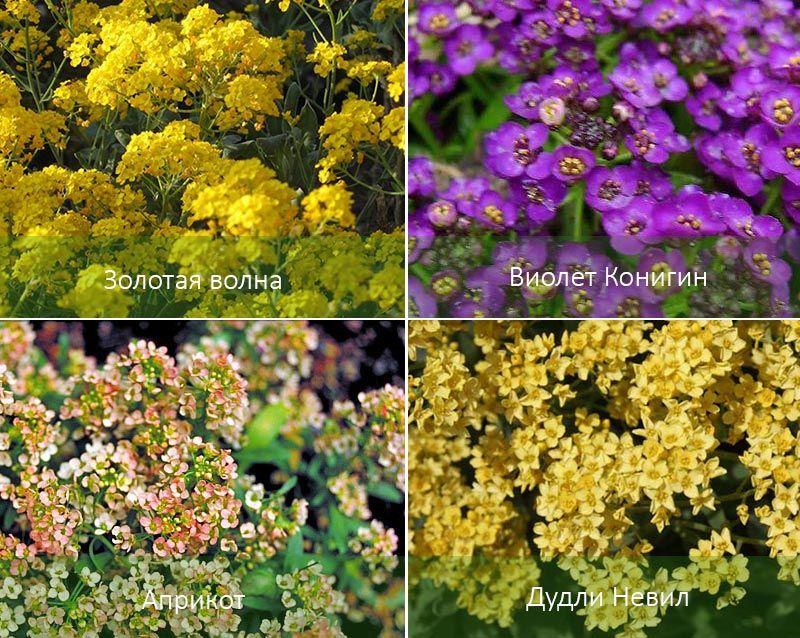
| Dudley Neville | Yellow-brown. | ||
| Golden painting | They bloom after two years, golden yellow. | ||
| Aphrodite | Purple. | ||
| Compactnum | Small, fragrant, yellow. | ||
| Nautical | In the temperate zone, it is common as an annual plant, growing up to 25 cm tall. The stems form compact rosettes. It blooms from May until frost. | Schneesturm | Large, white. |
| Purple haze | Purple. | ||
| Esther Bonnet Deep Rose | Small, bright, lilac-pink. | ||
| Violet Konigin | Purple. | ||
| Apricot | Pink-salmon. | ||
| Ampelous | A popular plant for planters, its highly branched and long stems form a huge ball of flowers. It blooms from July to October. | Snow | White, blooming like a carpet. |
| Snow Princess | Small, snow-white, very fragrant. | ||
| Gmelin (mountain) | The branches are prostrate and ascending. The leaves are pubescent. The inflorescences, in the form of a raceme, bloom in May and August. | Honey dessert | Small, yellow. |
| Golden Wave | Bright yellow. |
Climate conditions for alyssum
Annuals are characterized by long flowering periods, while perennials are resistant to low temperatures. The unpretentious alyssum thrives in both warm and harsh climates.
There are species that adapt well to northern regions, where alyssum seedlings are planted. In warm climates, the seeds are sown directly into the ground, and the plant delights with blooms more than once a season.
Methods of planting alyssum
Alyssum is planted using seedlings and seeds. Seedlings are first prepared in a greenhouse and then placed in a flowerbed when sunny, warm weather arrives. Alternatively, you can sow the seeds directly.
Growing Alyssum from Seeds
When grown from seeds, alyssum will bloom in 1.5 months.
Another option is to sow them in November. This will allow for stratification, and the spring seedlings will be healthier. However, they may die in cold climates.
The soil for the seeds is dug over, cleared of weeds, loosened, and watered if necessary. They can be planted in a permanent location or initially in a separate bed. The seeds are placed in furrows, moistened, and covered with plastic wrap. Weed regularly. Seedlings emerge within a week at a temperature of 16°C. They are thinned to a distance of more than 10 cm and fertilized with mineral mixtures.
In November, seeds are sown before winter, in 1-2 cm furrows. Sand is added, the dry seeds are placed in, and a layer of soil is sprinkled on top. The following season, seedlings emerge. If it's cold, they are covered with plastic. Then, when the seedlings have grown, they are planted in the chosen plot.
Growing alyssum from seedlings
In colder regions, seedlings are prepared as early as mid-March. Seeds are sown in containers, using potting soil purchased from a specialty store or in pots filled with peat. Choose containers with drainage holes. These are scattered and left in the light. Cover with plastic wrap and ventilate regularly. Provide bright light, a temperature of 10 to 15°C, moderate humidity, and water. Fertilize when the first true leaf appears. Transplant when 2-3 leaves have formed. To harden off, regularly take the seedlings outside for a few minutes.
Planting alyssum in open ground
Planting and care in open ground differs in site selection, timely watering, and fertilizing. Seedlings or seeds are planted in the spring, from April to June, in a sunny area with adequate moisture, and neutral, slightly alkaline soil.
The flower loves to grow near a rocky path or decorative paving stones. In overly fertile soil, it produces dense foliage and few flowers.
When to plant alyssum
The planting month depends on the region, usually May-June. The flower is planted in the flowerbed only after all frost has passed and the soil has warmed.
Landing features
When growing outdoors, consider the flower variety to dig a suitable hole for root development. Sand is added to dense soil. Maintain a distance of 25-40 cm between plants.
Caring for alyssum
Water the plant generously, especially in hot weather, but it doesn't like stagnant moisture. This should be done when the soil has dried out to a depth of 2-3 cm. Remove weeds and loosen the soil regularly. An automatic irrigation system is also used.
Perennials are fertilized with a solution of urea and Agricola (1 tablespoon per 10 liters). Before flowering, they require complex mixtures; twice a season is sufficient. Annuals prefer frequent feedings, up to four times. These are applied to the roots in the morning.
Pruning alyssum
In spring, old flower stalks, dried leaves, and weak, diseased stems are removed from perennial plants. After summer flowering, shoots are pruned back to 50-80 mm, creating a beautiful, compact bush.
Alyssum after flowering
Once the alyssum has finished blooming, it's ready for winter. The annual plant is removed, and the perennial plant is cut back by two-thirds, and the soil around it is loosened.
Seed collection
In September and early October, the seeds are collected from the flower. Dry, windless weather is chosen for collection. A blanket is usually spread under the bush and the inflorescences are rubbed by hand. The seeds are dried and stored in paper bags or cloth sacks until the next season.
Wintering of perennials
Don't prune before the onset of cold weather. Alyssum can die if the temperature drops to -15°C, so cover the plant with dry leaves, apply mulch under the bushes, and cover them with snow when it appears. This way, the plant survives the winter.
Reproduction of alyssum
The flower is propagated by cuttings, dividing the bush, seeds, and is also capable of self-seeding.
The first method is not very popular: cuttings from mature plants are placed in a container of water. They are then rooted in a container of soil.
When dividing a bush, it is dug up, divided into parts and planted at a distance of 30 cm.
The seed method was discussed above.
Diseases and pests of alyssum
The flower can be susceptible to fungal diseases, and it is also sometimes attacked by pests.
| Pest or disease | Manifestations on leaves | Methods of elimination |
| Late blight (brown rot) | Lots of brownish-gray spots. | They are treated with copper oxychloride and fungicides – Ordan, Tanox. |
| Viral mosaic | In mosaic spots, shoots become weak. | Infected bushes are destroyed and the soil is changed. |
| Downy mildew (peronosporosis) | Small red, purple or brown spots. | Treated with Oxyhom, Ordan, Bordeaux mixture. |
| Powdery mildew | White coating on all parts of the plant. | Spray with Topaz. |
| Cruciferous flea beetle | Black bugs with a green tint gnaw. | Use Actellic and vinegar essence (1 tbsp. and 10 liters of water). |
| Mealybug | White insects and plaque on the plant. | Treated with Fitoverm and Aktara. |
| Turnip white butterfly | The shoots are weak and withered, and pale green insects are visible. | Entobacterin is used. |
| Cabbage moth | They dry out and growth stops. | Spray with Lepidocide. |
| Caterpillars | They destroy leaf blades and shoots. | Use a solution of tobacco with soap, chamomile, and Kinmix. |