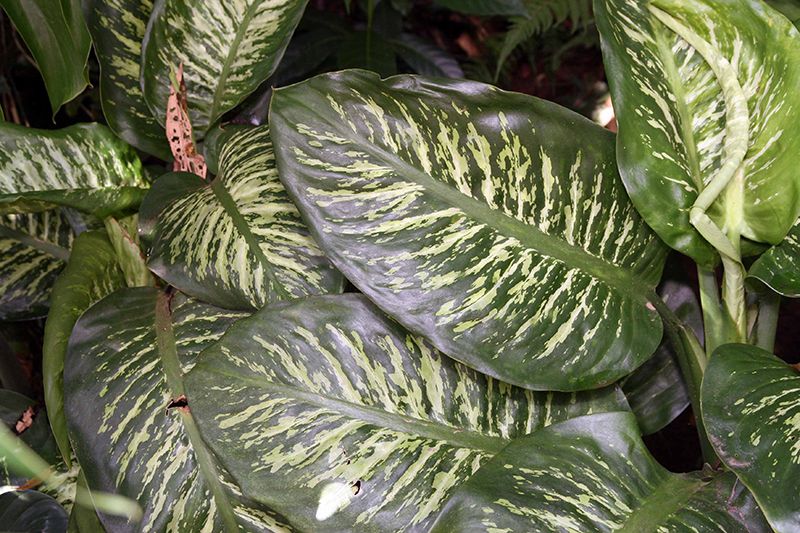
Austrian botanist Heinrich Wilhelm Schott, searching for unique and beautiful plants for the Imperial Botanical Garden at Schönbrunn Palace in Vienna, studied and classified several previously unknown species of tropical flora. He was drawn to the large, dark green leaves with contrasting white speckles. Thus, from the South American tropics, the flower migrated to greenhouses and homes everywhere. It was named after Josef Dieffenbach, head gardener of the Imperial Palace Orangery in Vienna.
For over 100 years, this exotic flower has been growing not only in its historical homeland, but also adorns apartments and offices around the world. This plant, a member of the Araceae family, has never adapted to cold climates. It still requires warmth, humidity, and bright light. This is worth considering when choosing a dieffenbachia for interior landscaping.
Description of the species
The plant has a thick stem with numerous large, spotted leaves. The shoots are usually located at the top, which is why over time, the dieffenbachia resembles a real tree, with a lush, dense rosette at the top and a long, bare trunk at the bottom. However, some species have multiple growth zones and resemble a bush. It can reach a height of just over two meters. Like other aroids, it blooms in a spadix. Small orange berries form in the place of the inflorescence. This rarely happens indoors; to ensure a full growing cycle, the plant requires very careful and professional care.
Thanks to its large leaves, the plant is very useful as a natural air filter. It's not for nothing that the Amazon rainforest is called the lungs of the planet. The amount of oxygen produced by large-leaved evergreens is colossal.
Currently, about fifty varieties are known to botanists. All of them share a characteristic feature: toxicity. This is because dieffenbachia sap contains large amounts of caustic enzymes and calcium oxalate crystals.
It can cause an allergic reaction if it comes into contact with skin, and severe burns if it comes into contact with mucous membranes. Therefore, it's best to avoid keeping the plant in homes with pets or small children, and wear rubber gloves when handling and pruning.
Indoor subspecies
Despite the wide variety of dieffenbachia cultivars, most do not thrive in captivity. Those most tolerant of artificial lighting, temperature fluctuations, and dry air became the progenitors of ornamental indoor varieties.
| Name | Description and characteristics of the species |
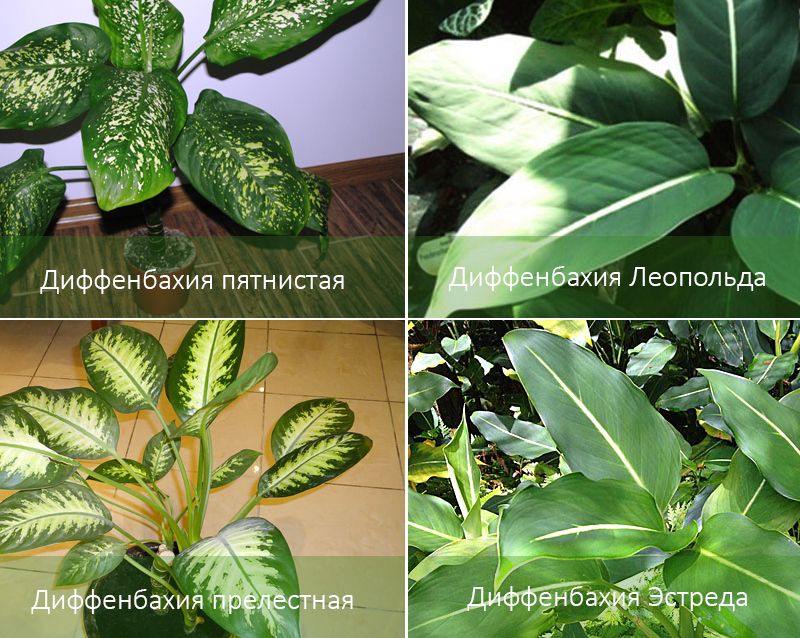
| Dieffenbachia maculata (cultivated varieties: Camilla, Tropic Snow, Bauze) | A massive plant up to a meter tall with broad, lanceolate leaves. Its characteristic coloration is dark green with contrasting light spots, which can range in size from small dots to large veins that cover almost the entire surface. |
| Dieffenbachia amabilis (Seguina) | A shade-tolerant plant with a large, lush rosette of broad (up to 18 cm across) spotted leaves. Unlike its relatives, it tolerates dry air better and is undemanding of its microclimate. |
| Dieffenbachia Leopoldii | It has dark emerald leaves with a characteristic light stripe along the central vein. Purple speckles may also appear on the surface and stem. This is a low-growing, bushy plant. |
| Dieffenbachia Ørstedii | A bushy subspecies with pointed, very light leaves. |
You can accurately identify the variety and avoid confusion with other plants by comparing it with a photo.
Plant care rules
When growing dieffenbachia, remember that the flower's native land is the humid tropical forests of South America. Provided with the appropriate microclimate, it grows quite quickly, producing one new leaf approximately once a week.
Despite the flower's capriciousness, only a few simple conditions are required, making it ideal for offices, large apartments, and the lobbies of public institutions.
| Content parameter | Required conditions |
| Lighting | The more pronounced the pattern, the higher the light requirements of the variety. Moderate daylight is sufficient for solid-colored varieties. Direct sunlight should be avoided. |
| Moisturizing | Spraying should be done daily, using warm, filtered water. Placing the plant near heating devices is highly discouraged. |
| Watering | Avoid allowing the soil to become dry. The soil should be moist, but not overwatered. Dieffenbachia also dislikes dampness. |
| Temperature conditions | The thermometer shouldn't drop below 17 degrees Celsius. The optimal temperature for summer is 22 to 28 degrees Celsius, and for winter: 18 to 22 degrees Celsius. |
| Transfer | Infrequently, in proportion to the growth of the root. |
| Fertilizer | It's best to feed the plant with nitrogen-based or complex fertilizers designed for indoor tropical plants with decorative foliage. This should be done from early spring to late fall, once every two weeks, using a half-strength fertilizer diluted thoroughly in water for irrigation. |
| Soil | The plant prefers slightly acidic, well-drained soil mixtures. Ideal mixtures include sand, peat, moss, perlite, and crushed bark with charcoal. |
| Cultivation | As the dieffenbachia grows, it needs to be pruned. The crown with the rosette is separated from the trunk, washed, and rooted. The remaining stem is divided into sections containing dormant buds. These sections can be used to produce new shoots. |
Dieffenbachia loves open spaces and clean, fresh air. It can be placed on loggias and verandas during the warmer months, but avoid drafts or leaving it outside during sudden temperature changes at night.
Nuances during transplantation
As the root system grows, the dieffenbachia will need to be transplanted into a larger pot.
You can determine when the time has come by the following signs:
- New shoots and leaves stopped appearing.
- New leaves are smaller in size.
- If the microclimate is maintained, the soil dries out quickly.
You need to prepare for the transplant in advance, purchase a pot or tub with a diameter 2-3 centimeters larger than the previous one.
To create drainage, buy expanded clay, and for backfill, buy fresh specialized soil.
Early spring is considered the optimal time to relocate the plant. At this time, the plant is still in its winter dormancy. Fertilizing should begin later to avoid waking the dieffenbachia prematurely and causing injury.
Planting a flower in a new container is done as follows:
- A 2-4 cm layer of expanded clay is placed on the bottom of the new pot.
- The dieffenbachia is removed, the blackened and dried roots are carefully cut off, and the cut sites are treated with antiseptic and antifungal agents.
- Place it carefully in a new tub and gradually add fresh sterilized soil around the edges, compacting it slightly.
- Water with settled water at room temperature.
Young plants typically require repotting about once a year. They grow vigorously, and their root system quickly fills the container. Older plants only need repotting when the trunk has become overgrown and bare.
Rejuvenation
A bare, long trunk makes the plant difficult to care for, requiring additional support. Furthermore, its decorative appeal is greatly diminished, as a bare stem grows upward instead of a lush bush.
There are two ways to restore the aesthetic appearance of dieffenbachia:
- By pinching the growth point at the top, which will likely awaken dormant buds on the trunk and force the flower to produce new shoots.
- By pruning the top of the plant and then rooting it. To do this, cut the top off approximately a couple of centimeters from the node containing the dormant buds. The oozing stem is patted dry and sprinkled with activated charcoal. It can then be replanted in a new pot with loose, moisture-retentive soil. It is important not to overwater the new plant to prevent root and trunk rot before the roots have developed. The remaining nodes of the long stem can be divided into cuttings and replanted. These will produce new dieffenbachias, indistinguishable from the mother plant.
Reproduction
Achieving natural flowering and seed maturation indoors is very difficult. Dieffenbachia reproduces well vegetatively. Cuttings can be taken at any time after cultivating an adult plant. It's best to pinch off a single growing point to create offshoots no earlier than 3-4 years after planting.
It is better to root layers and cuttings in an improvised greenhouse, which can be replaced by a transparent plastic bag or film.
Plant care errors and their signs
A healthy dieffenbachia delights its owners with lush, vibrant foliage. If cultivation guidelines are not followed, the plant will signal a problem through its appearance.
| Changes | Possible reasons |
| The ends dry out and crumble. |
|
| Leaves turning pale, loss of contrast |
|
| Small deformed leaves | Too alkaline soil |
| The lower leaves dry up and fall off. | A cramped pot |
| Pale and softened stem | Root rot |
| The leaves are curling |
|
| Brown edges |
|
| Yellow leaves |
|
Diseases and parasites
With proper and adequate care, dieffenbachia has good immunity to viruses, fungi, bacteria, and pests. However, improper care or proximity to an infected plant can lead to disease. It's important to combat pathogens promptly. Delay can result in the death of the plant and the infection of other houseplants.
Any sign indicating weakness of the stem and leaves should be a reason for preventive and treatment measures.
| Pathogen | Characteristic signs of infection | Help |
| Soft rot | The leaves turn pale and wither, the stem cracks at the base, the flower stops growing and looks withered, and the soil may smell moldy. | It cannot be cured, but you can try to root the top or get a layer from a healthy part of the stem after pruning. |
| Bacterial leaf spot | Yellow spots with a darkish, clear border. | Treat with fungicides. |
| Phytophthora | Dark rot rises from the roots, the plant weakens and withers. | The flower will have to be completely destroyed. |
| Anthracnose | Weeping dark spots appear on the leaves. | Cut off the infected parts, make the air drier than usual, and systematically treat the remaining healthy leaves and stems with a fungicide solution. |
| Aphid | The leaves begin to deform and turn yellow, and a sticky coating appears. | Wash the plant with soapy water, treat it with special pesticides or tobacco dust. |
| Scale insect | The appearance of light brown plaques on the trunk and sticky secretions. | All pests must be removed manually, the affected areas must be lubricated with alcohol or kerosene, and the entire plant must be treated with insecticides. |
| mealybug | Cloudy thick secretions on the petioles and in the veins. | Treat with mineral oil and specialized preparations. |
| Spider mite | Characteristic small brown spots on the leaves, dry areas and thin webbing on the petioles. | Wash with soapy water and spray with a special agent. |
| Thrips | Whitish coloration of certain areas of the plant, withered and drying leaves. | Treat thoroughly and repeatedly with strong insecticides. |
Top.tomathouse.com warns: Dieffenbachia is poisonous
The plant's milky sap is non-toxic. It does not cause severe poisoning, central nervous system (CNS) or respiratory problems.
However, the high content of bioactive substances can seriously irritate the skin and mucous membranes. Therefore, the flower could harm a child or pet who, out of curiosity, breaks it off or bites it.
This does not pose a threat to health, but just in case, it is necessary to take measures to prevent the development of chemical burns and allergies.
Growing dieffenbachia indoors is beneficial; it perfectly purifies the air, absorbing phenol, formaldehyde, and heavy metals. The phytoncides it releases inhibit the spread of viruses and bacteria through the air. Perhaps this is why the plant is so common in the hallways of medical facilities.