Drimiopsis, or Ledeburgia, is an evergreen deciduous flower in the Hyacinthaceae family. It is native to southern Africa. There are 22 species, each characterized by dark green spots on their leaves.
Description
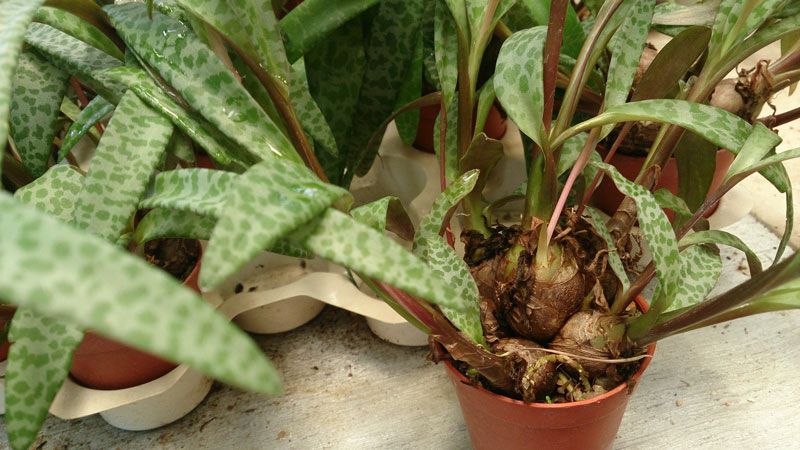
The bulb of the drimiopsis is oblong, covered with brown scales, most of which protrudes above the soil.
The foliage is dense, thick, and glossy, and can be uniform in color or spotted (most commonly). The shape is heart-shaped and oval, with a pointed tip. The leaves are up to 20 centimeters long, with petioles of 10 cm. The height is up to half a meter.
The flowers are small, gray-pink or pale green, and borne in a spike. A single inflorescence contains up to thirty flowers, each five millimeters in diameter. They emit a fragrance reminiscent of lily-of-the-valley.
Types for home cultivation
There are two types of drimiopsis that can be grown indoors:
| View | Description |
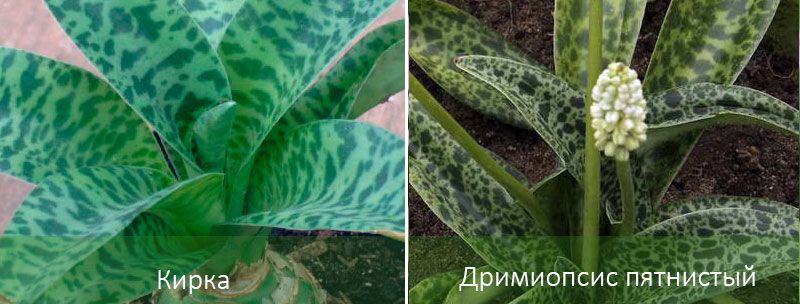
| Pick | The bulb is white and rounded. The foliage is lanceolate and stiff. The color is bright green, with dark green spots. The petioles are small and may be absent entirely. The flowers are small, white, and gathered in a spike. Flowering occurs from early March to September. |
| Drimiopsis maculata | The bulb is elongated and dark green. The leaves are heart-shaped and oval, green, with corrugated edges. The petiole is long, reaching 15 cm. The flowers are small, gray, beige, yellow, and white. The inflorescence is a raceme. Flowering occurs from April to July. |
Home care
Home care for Drimiopsis may vary depending on the season:
| Season | Humidity | Lighting | Temperature |
| Spring-summer | Dry air isn't particularly important for drimiopsis; it easily tolerates dry air, especially if planted nearby with other houseplants. Spraying with water, washing, and wiping the foliage should only be done in extreme heat. | It is recommended to place the plant in partial shade. Exposure to direct sunlight will cause sunburn. | Optimal conditions are +20-+25 degrees Celsius. Tolerates temperatures above +30 degrees Celsius. |
| Autumn-Winter | Bright, diffused light is required; artificial lighting lamps are used to extend daylight hours. | Temperatures drop to +12-+16 degrees, minimum readings are +6-+8. |
Repotting: choosing a pot, soil composition, watering
A young flower is repotted annually, while an adult plant's pot is changed every three years.
The container for growing drimiopsis must be deep and wide, this is necessary to create plenty of space for the bulbs.
The planting soil should be nutrient-rich, light, and loose. The following mixtures can be used:
- mix fertile turf and leaf soil, rotted branches, coarse sand - all components are taken in equal proportions;
- Combine universal soil for tropical flowers (2 parts) and fine sand, vermiculite, perlite (1 part each).
Next, you can begin replanting the plant:
- A mixture of expanded clay, fine charcoal particles, crushed brick, and coarse sand is poured into the bottom of a new plant container. This creates a drainage layer, approximately three centimeters thick. Freshly prepared potting soil is poured on top (taking up more than half the pot). Next, the soil needs to be watered.
- The Drimiopsis is carefully removed from its old container, and excess soil is removed from the bulbs. The offshoots are separated, but this must be done carefully to minimize damage.
- All rotten roots and scales are removed. The cuts are treated with crushed activated charcoal.
- A hole is made in the ground, and more than half of the bulb is placed in it.
- The soil is compacted and moistened.
From March to September, the plant needs regular watering, using settled, soft water. In the fall, watering is stopped, and in the winter, it's resumed, but in minimal quantities (once every couple of weeks).
Top dressing
Fertilizing is recommended only during the growing season. During this time, drimiopsis should be watered every two weeks using a liquid fertilizer formulated specifically for bulbous plants. Fertilizers designed for succulents or cacti are suitable. Follow the instructions on the packaging strictly.
Reproduction
Drimiopsis reproduces in three ways:
- baby bulbs;
- seeds;
- cuttings (used only in the case of Drimiopsis kirkii).
Mistakes in care and their correction
When caring for drimiopsis at home, a number of mistakes arise that require immediate correction:
| Problem | Cause | Correction |
| Falling leaves | Lack of nutrients, need for replanting. | During the growing season, the plant requires regular feeding. Mature drimiopsis require repotting every 2-3 years. |
| Reduction in leaf size, thinning and upward stretching of stems | Poor lighting. | The plant should be placed closer to a window. If only artificial lighting is used, it should be combined with natural light. |
| Blackening of the base of leaves and petioles | Excessive watering, temperature conditions uncomfortable for the plant. | It is necessary to change the watering regime and adjust the room temperature. |
| Covering the soil with a layer of white plaque | Moisture stagnation occurs in the pot due to an insufficient drainage layer or a substrate that does not allow water and air to pass through well. | The plant needs to be replanted into another pot where the above errors will be corrected. |
| Yellowing of leaves | Burns. | The plant needs to be protected from exposure to direct sunlight. |
| Wilting of foliage | Insufficient watering, low air humidity. | Increase the air humidity level and adjust the watering regime. |
Diseases, pests
Even with the highest quality care for drimiopsis, the possibility of damage from diseases and insects cannot be ruled out:
| Diseases and pests | Signs | Deliverance |
| Root rot | The petioles turn black and become covered with mucus, and there is a rotten smell. | The plant is repotted, and all damaged roots are removed. Any fungicides are added to the soil during repotting. |
| Stagonosporosis | The bulb becomes covered with small cracks of red or crimson color. | Reduce watering frequency, and keep the plant relatively dry for a month. Remove any damaged parts from the bulb, and sprinkle the cut surface with crushed activated charcoal. |
| Scale insect | Rapidly swelling, yellow-red, round growths appear. | Apply a lather of laundry soap to the foliage and rinse off after an hour with a warm shower. Spray the flower and soil with Fufanon and Metaphos. |
| Spider mite | A barely noticeable thread appears on the petioles, and black dots appear on the underside of the leaves. | A soap-alcohol solution is applied to the leaves and washed off in the shower after 25-40 minutes. |
Top.tomathouse.com recommends: The beneficial effects of Drimiopsis
Almost nothing is known about the signs and superstitions associated with drimiopsis.
The only thing that can be said is that this plant is perfect for those born under the sign of Pisces; the flower has a beneficial effect on them, calming them and increasing their resistance to stress.