
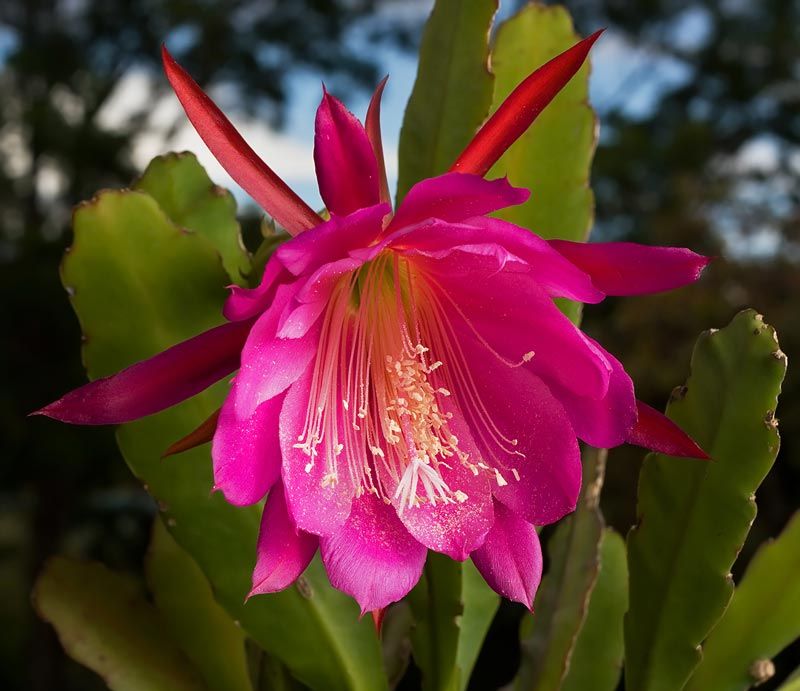
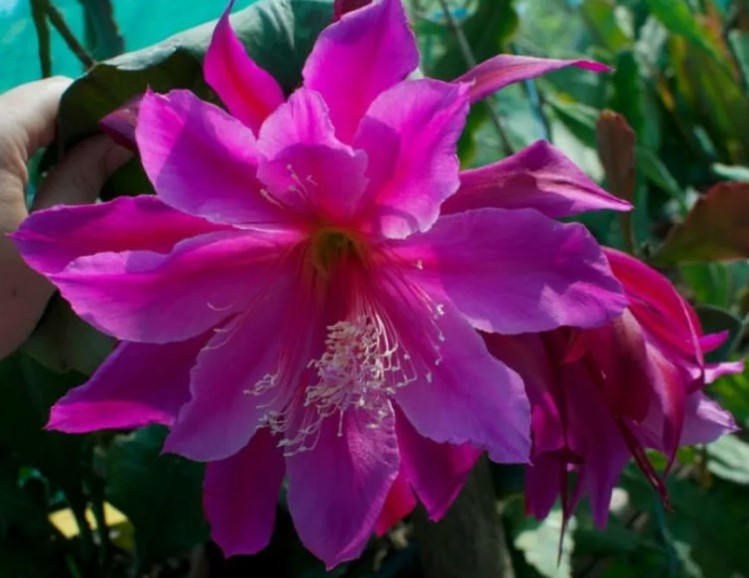
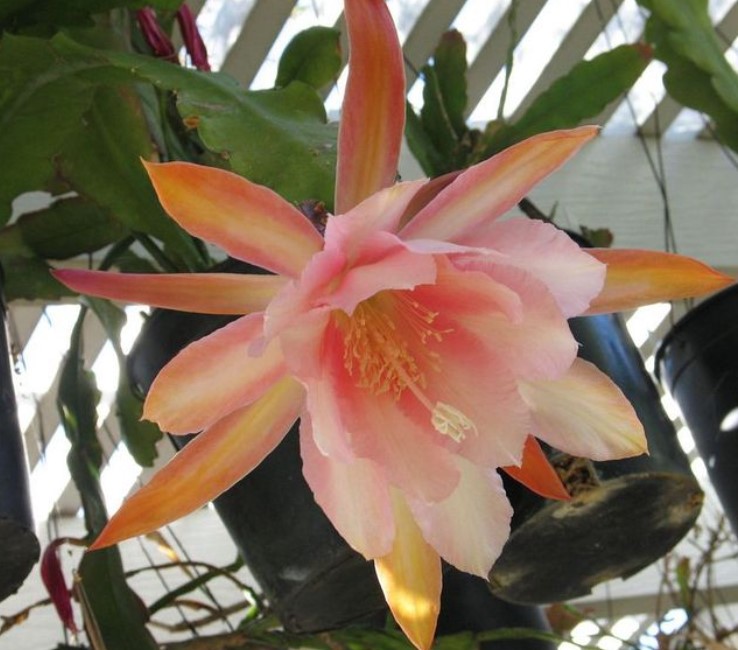
Epiphyllum is a succulent perennial flower from the cactus family, genus Epiphyta. There are two dozen species in the wild. Translated from Greek, it means "flower on leaves." It is native to South and Central America, subtropical Africa, and Mexico. There, it grows on tree trunks and branches. Unlike plants that derive energy from the tissues of their host, it feeds on its own. It is used as a houseplant and as a decorative ornament for gardens, balconies, and loggias.
Content
Description of Epiphyllum
The thick, long, and flexible stems of epiphyllum are flat, with a prominent central vein and serrated sides. They can also be triangular or wavy. The shoots branch out, forming a dense bush. The base becomes woody over the years, covered with brown bark. Areoles with short, bristly spines are located on the edges of the stems.
The number of aerial roots increases with high humidity. The buds are tubular, reaching up to 40 cm in length for some varieties. They open at night and close in the morning. Flowers in shades of vanilla, white, pink, and red exude a pleasant aroma. They appear in spring and summer, and some varieties in autumn. The fruits are large and edible; they grow indoors only if cross-pollinated. They resemble plums in shape and size, and taste like strawberries and pineapples.
Types and varieties of epiphyllum
Varieties are characterized by size, number of buds, and color. There are nearly two hundred species.
| Variety | Description |
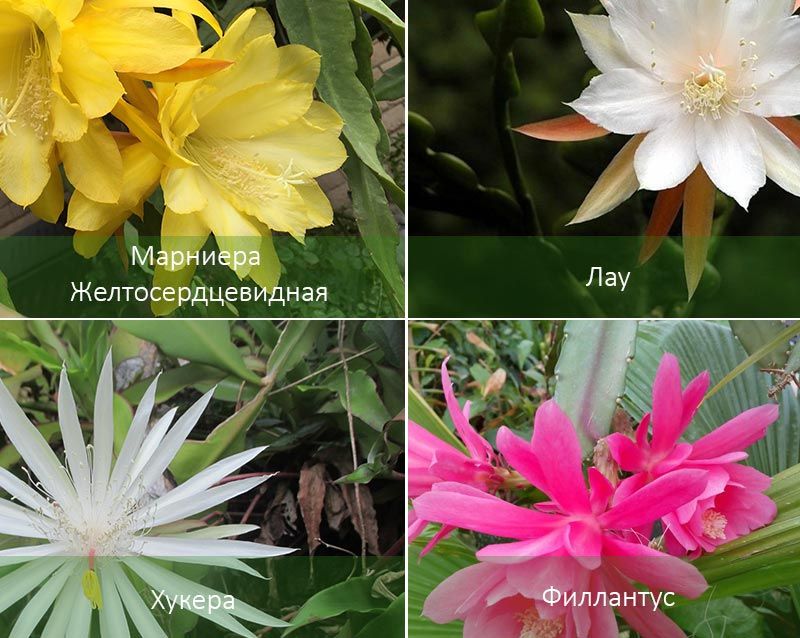
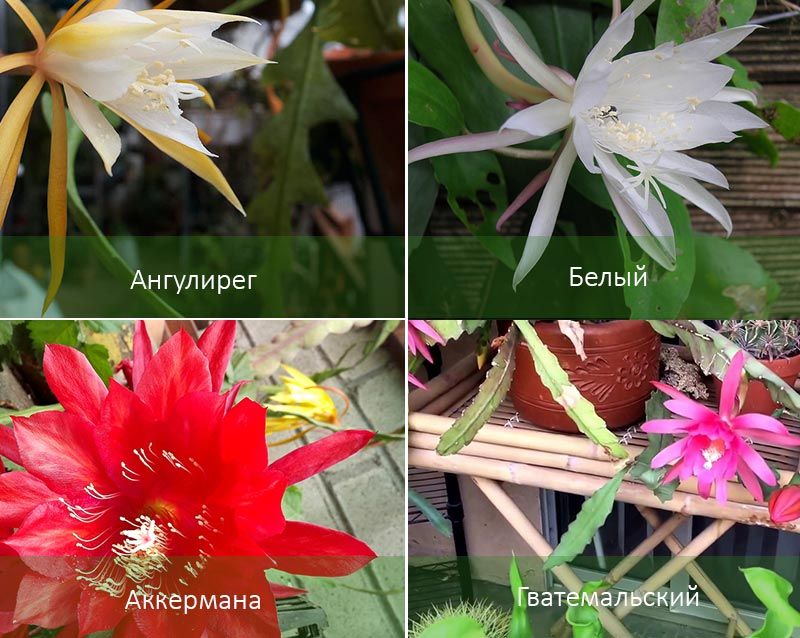
| Yellow-hearted Marniera (Selenicereus) (Epiphyllum Marniera)
|
It stands out for its spreading shoots and large, long flowers up to 25 cm. |
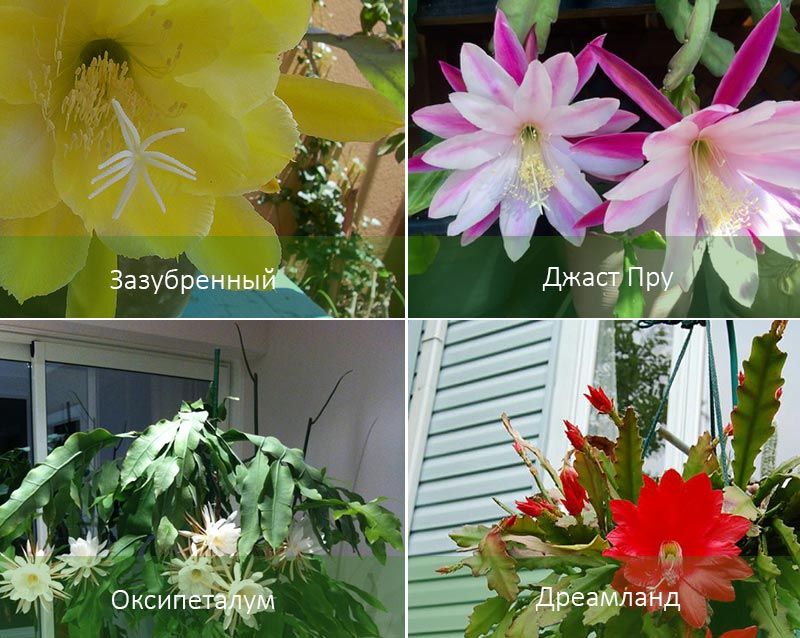
| Epiphyllum oxypetalum
|
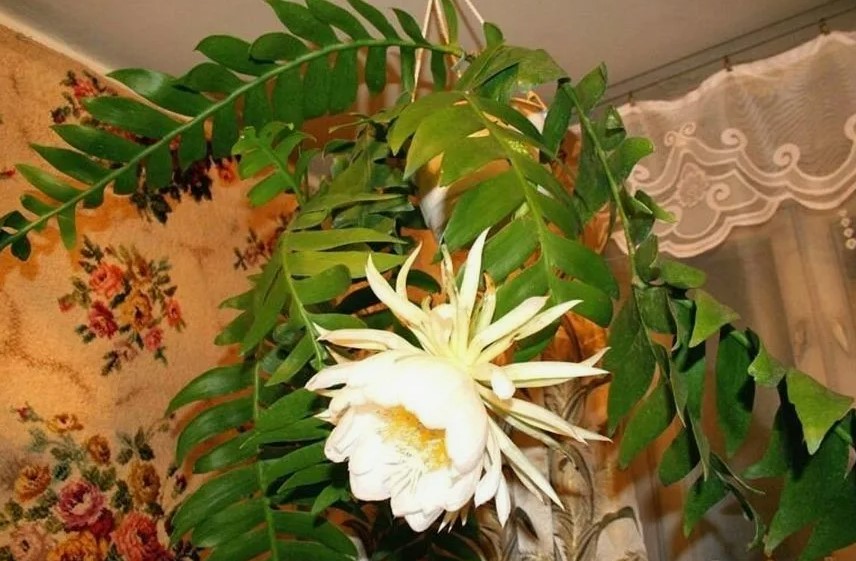
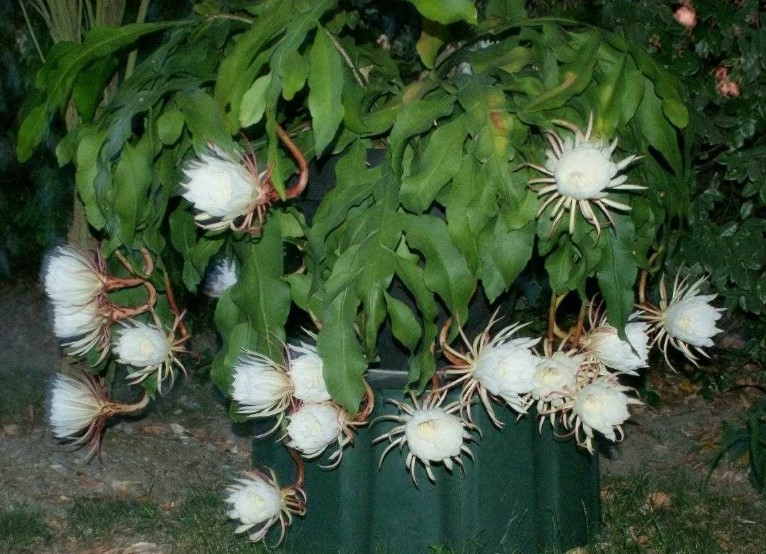
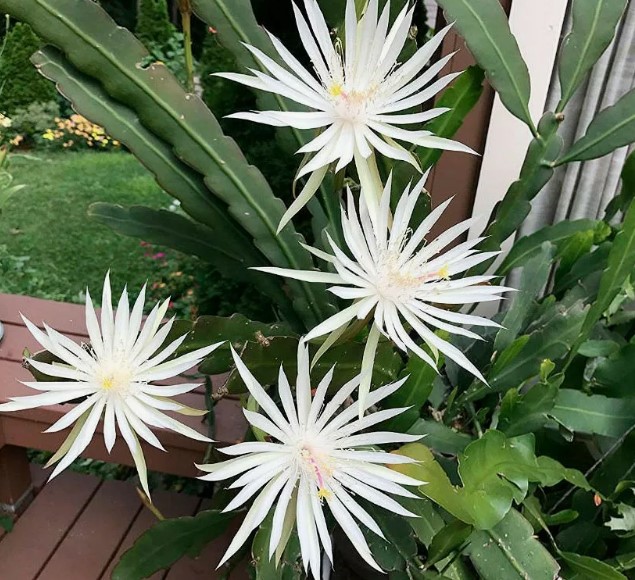
It grows on rocks and in tree crowns. Its fleshy, narrow, wavy stems are up to 6 cm long and 12 cm wide, reaching up to 3 m in height. It's nicknamed "the queen of the night" because of its large, wavy white flowers that bloom at night. They have a pleasant scent and reach a diameter of up to 17 cm. |
| Guatemalan (Epiphyllum guatemalense)
|
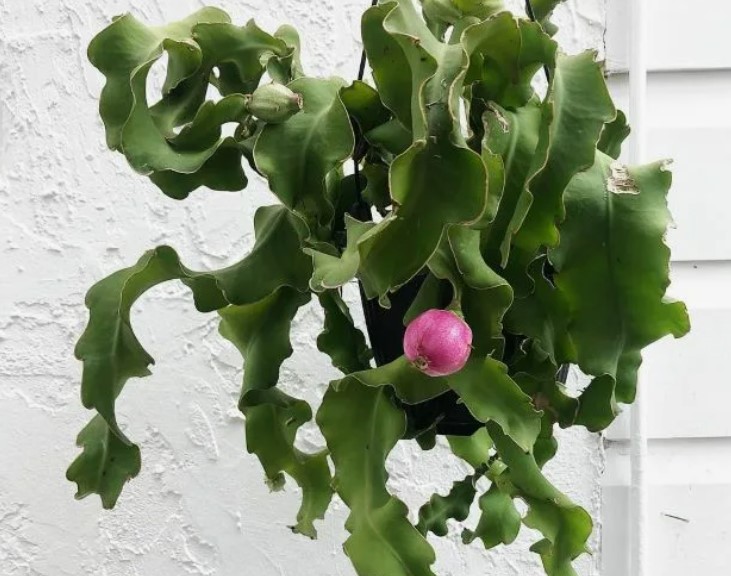
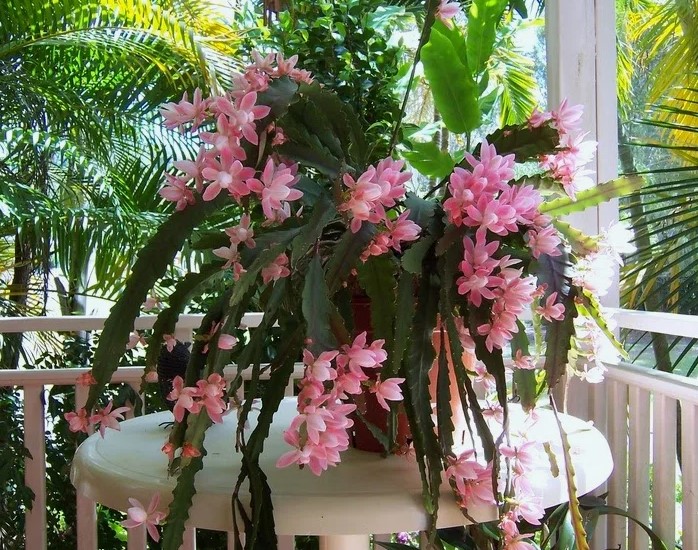
The varieties differ in the appearance of their stems. The first resembles a chain of oak leaves, each link up to 5 cm long. The second, Monstrosa, has darker shoots, undivided and growing in a twisting, random manner, changing shape. The flowers are pink in varying shades. |
| Ackerman's (Epiphyllum ackermanii)
|
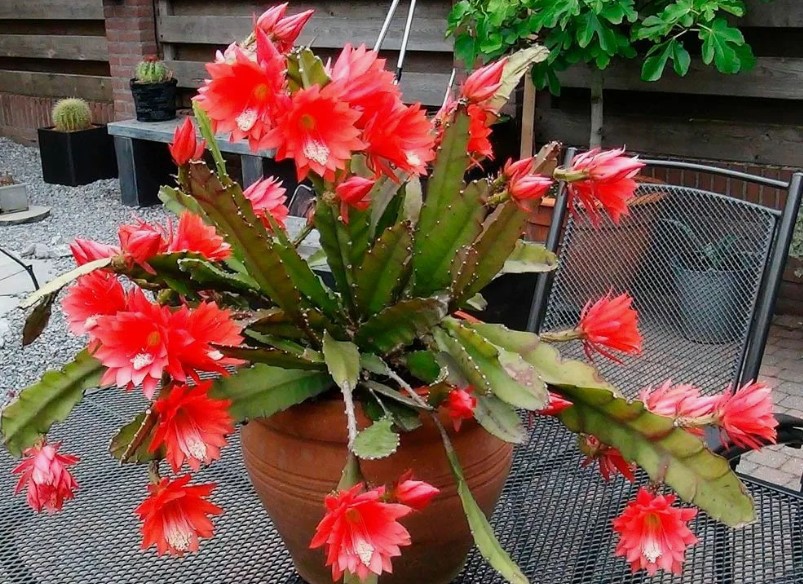
Thin, jagged stems with bright red flowers. Often grown in hanging baskets. Slow growing. |
| White, holly-leaved, Hooker's or Hooker's (Epiphyllum hookeri)
|
Its native land is Venezuela, Mexico, and Cuba. It grows to a large size, with arching, stiff, oval-shaped, pointed stems up to 30 cm tall and 12 cm wide, drooping due to their own weight. The flowers are snow-white, with creamy petals, long and fluffy in the middle, opening at night with a pleasant, lingering scent. |
| Angular or angular (Epiphyllum anguliger)
|
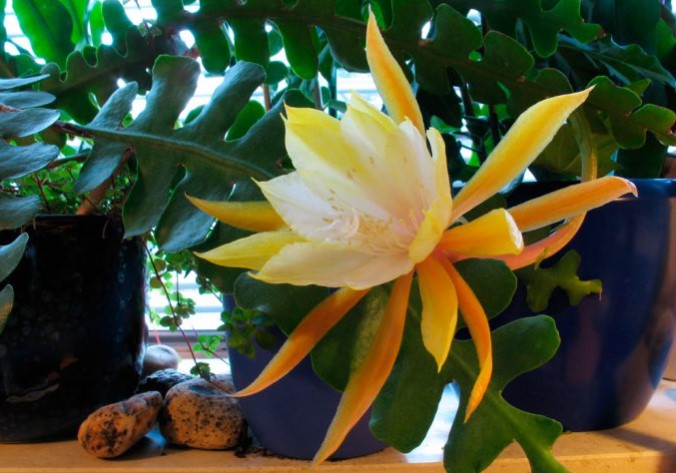
A meter long, it branches heavily in a zigzag pattern. The petals are fragrant, in shades of yellow, white, and pink. |
| Phyllanthus (Epiphyllum phyllanthus)
|
In its natural habitat, it lives in tree crowns. Rich green flowers with soft pink centers, up to 30 cm in size, have a yellow tint. The corolla diameter is up to 18 cm. |
| Serrated, round-toothed (Epiphyllum crenatum)
|
Small, blue-green bushes. Long, erect stems up to a meter tall with narrow, spineless, gray-green, flattened leaf blades. Cylindrical at the base, wavy on the sides, with areoles with bristles. Shades of cream and green with a pleasant aroma are available. Unusually for an epiphyllum, it opens in the daytime to a yellow color, with a corolla 15 cm in diameter. |
Lau (Epiphyllum laui)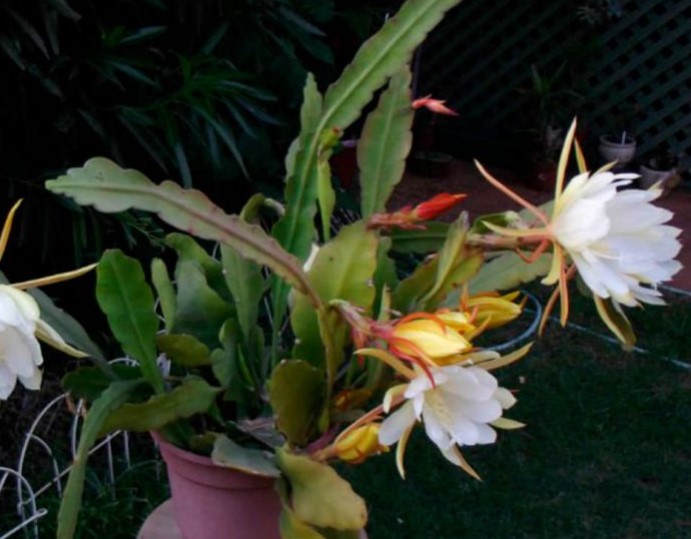 |
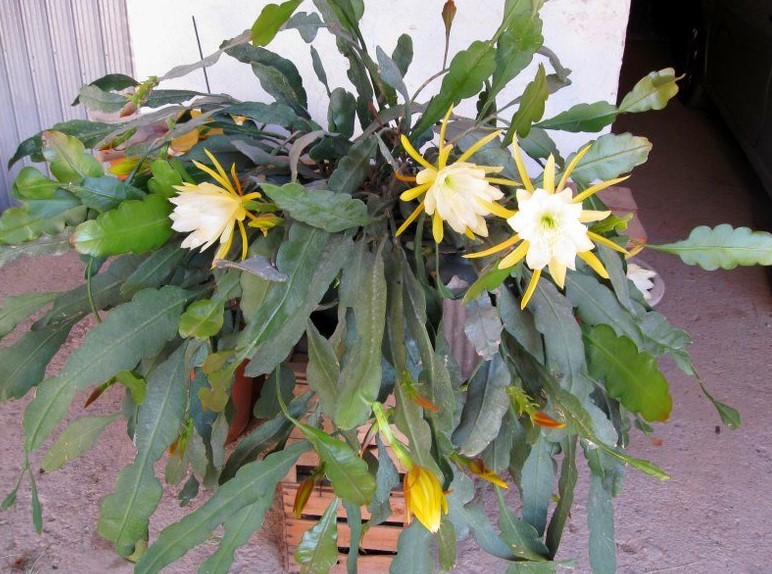
It grows quickly, reaching 3 m in length and 7 cm in width, with yellow-brown needles. Creamy buds open in the evening and last for two days. |
| Just Pru (Epiphyllum Just Pru)
|
This nursery-bred variety is noted for its rapid adaptation to environmental conditions and prefers temperatures of 18°C. Flowering occurs in spring. The color is pink in the center to dark pink at the edges. The corolla diameter is up to 16 cm. |
Dreamland (Epiphyllum Dreamland)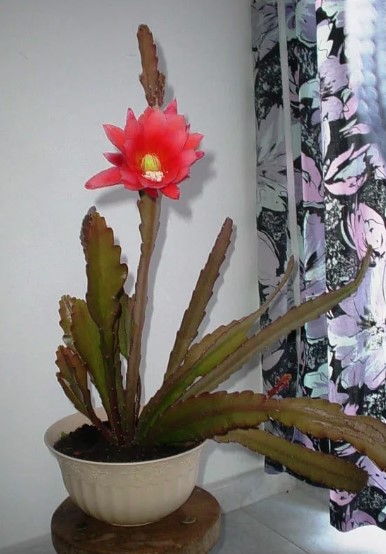 |
Petals are pink, orange, white, and red, appearing in summer. It has medicinal properties. |
Thomas (Epiphyllum thomasianum)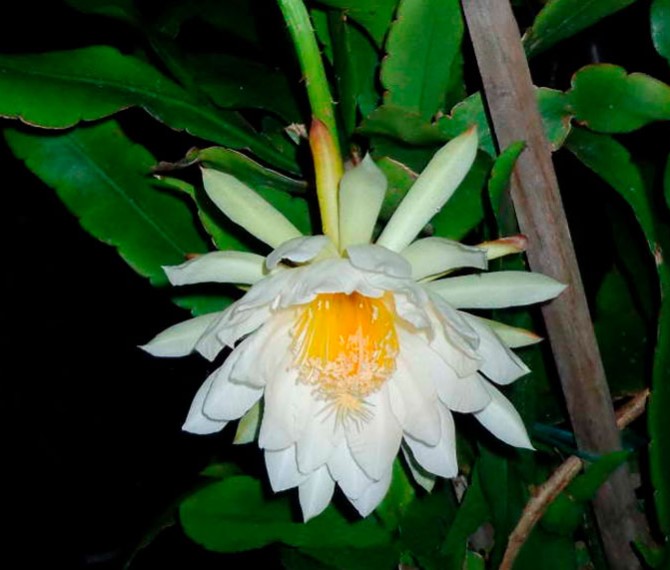 |
In the wild it reaches up to 4 meters, but at home it grows only up to 70 cm. It blooms white, the areoles are pubescent. |
| Paul de Lonpre (Epiphyllum Paul de Lonpre)
|
It is distinguished by long, ground-hugging shoots and large flowers up to 14 cm in diameter. Its color is creamy, with a red edge. It is a hybrid of orbicularis dentata and selenzerius. |
Caring for Epiphyllum at Home
Growing a forest cactus is difficult; proper care is achieved at home by observing all seasonal parameters.
| Parameters | Spring | Summer | Autumn | Winter |
| Location, lighting | Bright, diffused light, western, eastern side. | |||
| Temperature | +20…+25 °С | +22…+25 °С | +15…+20 °С | +10…+13 °С |
| Watering, humidity | Water generously, immediately after the soil dries, plus spray. Let the water settle or filter. | Moderate, 2 times a month. | Minimum. | |
| Top dressing | Mineral fertilizers for forest cacti containing potassium, calcium, phosphorus, without nitrogen. | Complex fertilizers with nitrogen. | If necessary. | Not required. |
If you observe poor flower growth, it means it has insufficient lighting, too much or too little watering, or the wrong substrate.
Lighting
Epiphyllum will delight with its appearance if provided with bright, filtered light. If placed on the north side, it will bloom sparingly; if placed on the south side, it should be protected from direct sunlight. In summer, gardeners place the plant outdoors in a sheltered spot.
Temperature
The flower tolerates the fluctuations of summer outdoors. During the dormant period, the forest cactus doesn't need high temperatures.
Watering
In spring and summer, epiphyllums need to be watered generously. In winter, when temperatures drop, watering is not necessary.
Humidity
In dry air, the plant should be sprayed with settled, not cold water in the morning and evening.
Soil, fertilizer
Choose a fertile, lime-free soil for the plant. The mixture consists of one part agroperlite, one part garden soil, one part bone meal, and three parts coconut fiber. You can buy a ready-made cactus substrate containing peat. During bud formation, water with a 1:4 mullein-water solution once every two weeks, or with nitrogen fertilizer. After flowering, reduce the feeding to twice a month.
Transfer
Every spring, young cacti are repotted before the growing season begins. The container should be wide, shallow, and tightly packed to encourage flowering. It should also have good drainage and retain heat at night.
Clay pots are best.
Mature plants require repotting if roots have already emerged from the drainage holes. Place drainage and soil in the bottom of the container, place the plant, and then place it in the shade, slightly moistening the substrate.
Trimming
To rejuvenate and shape the bush, the plant should be pruned. Once every three years after flowering, remove thin, damaged, old, and overgrown shoots at the base.
Features of flowering
Epiphyllum blooms once a year, while some species bloom twice. During this time, the plant should not be moved or repositioned, otherwise the buds will fall off. Open flowers last from one to seven days. Insufficient light, above-normal temperatures, and excessive watering during the dormant period will prevent the plant from blooming.
Reproduction
Epiphyllum is propagated in different ways:
- by cuttings;
- seeds;
- layering.
Cuttings
In the spring, a healthy stem is cut off at the widest part, 10 cm deep. The cutting is left cut side down. After two days, it is planted at a depth of 1 cm in a moistened mixture of sand and peat. Leave in a dark place for 24 hours, and water after rooting.
Seeds
A store-bought seed is placed in moist soil, covered with plastic wrap, and aired for an hour every day. When the first sprouts appear, the container is uncovered. The shoots emerge with thorns, which then fall off. A plant grown from seed will begin to bloom in five years.
Propagation by layering
When the epiphyllum develops aerial roots, bend the shoot down to the soil and secure it. After rooting, separate it from the mother plant and plant it separately.
Pests and diseases
If not cared for properly, the flower is attacked by pests:
- Spider mites – webbing appears. Treat with colloidal sulfur, green soap, and malathion.
- Aphids – wipe with tobacco infusion or soda solution. Spray with Iskra, Fitoverm, Neoron, or Decis.
- Mealybug - wipe the flower with alcohol or treat with garlic infusion.
- Scale insects - treat with soap solution, use Fitoverm, Aktara, Actellic.
Epiphyllum is prone to fungal and viral diseases due to excessive watering, nutrient deficiency, and low temperatures:
- Rust – visible yellow-brown spots. This is caused by overwatering at low temperatures or sunburn. Treat with a solution of Topaz or Alirin.
- Black rot – black spots on the stems. Remove affected areas and treat with Fundazol. Disinfect cut areas with activated charcoal.
- Anthracnose – light brown spots. Trim off infected stems and treat with Fiotosporin and Trichodermin.
- Fusarium – stems turn red due to root rot. Change the soil, remove infected roots, and treat with Gamair.
- Viral mosaic disease causes small, light-colored spots on the plant, withering tips, and buds falling off. There is no cure, so the infected plant should be discarded.
The flower wilts when overwatered, and bright light causes the buds to fall off.
Signs and superstitions about epiphyllum
According to superstitions, epiphyllum protects the home from misfortune; a blooming epiphyllum promises an addition to the family, and for single people, meeting their future soulmate. However, giving the flower to loved ones is not advised, as it foretells separation. In the home of unmarried women, it signifies the absence of a groom.
Top.tomathouse.com recommends: Epiphyllum – a home remedy
The sap of the forest cactus has healing properties – it's diuretic, cleanses the body, boosts immunity, and restores liver and kidney function. It's used to treat psoriasis, cardiovascular problems, rheumatism, headaches, and colds. The flower can block the harmful effects of electromagnetic radiation, help with hangovers, stop bleeding, and heal wounds.
Reviews of Epiphyllum
Review: Indoor flower "Epiphyllum" - Beautiful, unpretentious.
Advantages: Unpretentious
Disadvantages: Drops of sticky liquid.
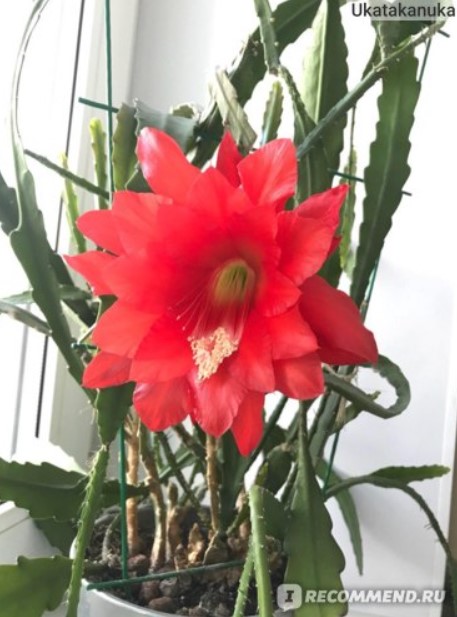
Hello, dear readers of the otzovik website, today I want to share with you my review of a flower. For a long time, I didn't know the name of this flower; my husband called it Mother-in-Law's Tongue, but it's actually an epiphyllum.
This is the second time this spring that my flower has delighted me. It first bloomed two months ago, and there were only two small flowers. Now there are as many as 10 buds (one bud on a different leaf).
This is how it all begins
and how beautifully it blooms was shown in the first photo.
It blooms beautifully. It's scentless, but its flowers drip a lot of sticky liquid (it's good to have screens on the windows, and it's cold, otherwise we'd be chasing the bees away).
But since there are flowers only in the spring, I’m not upset, everything can be washed off.
Usage time: 5 years
Year of manufacture/purchase 2014
Overall impression: Beautiful, unpretentious.
My rating
5
I recommend it to friends YES
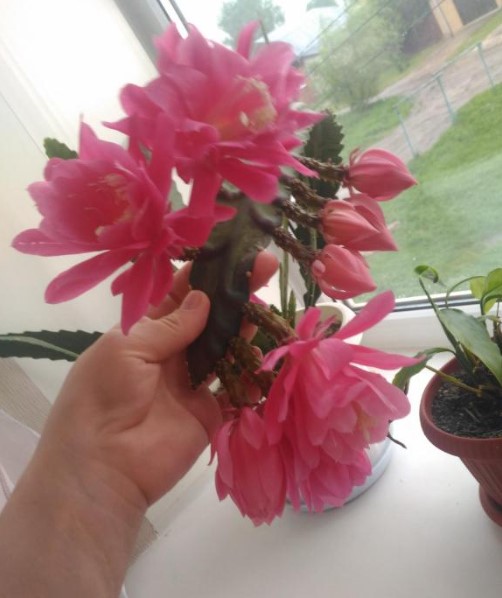
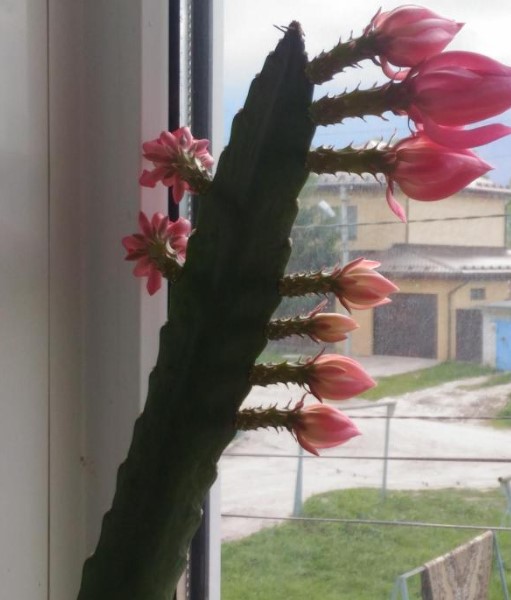
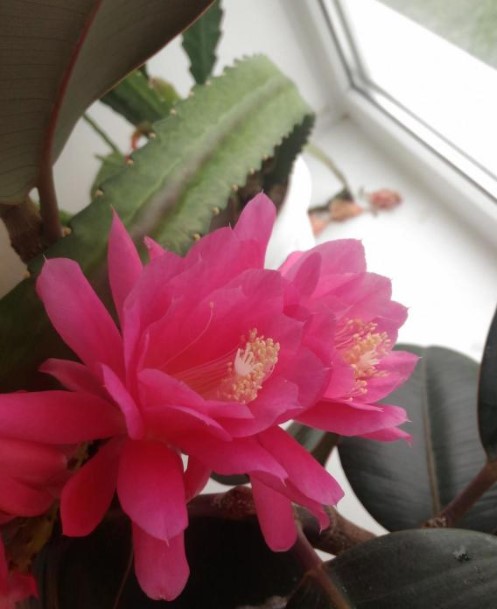
A miracle on the windowsill.
And here... There will be a funny story about how we met. SmileSo, dear fellow gardeners—here's the situation! A green, nondescript, slightly neglected cactus had been growing on my windowsill for twenty years. It had dried out considerably, but stubbornly continued to grow bushy. Then we cleaned it, watered it, fertilized it, gave it some love, and placed it in the sun. As a form of feedback, the plant immediately rushed to send up new shoots with dangerous spines, and to cap off the sketch, God forgive me, it rolled out this idiot the size of my head (which, by the way, is by no means small, and I only got into the frame to make it easier to appreciate its size).
At night, I close the door to the beast’s room just in case, because there is a concern that his next step will be to come out of the potty at night and come and say hello to me.
.
Accordingly, having familiarized myself with and continued to care for the animal, I report the following:
- Unpretentious! It is recommended to keep it in a tight pot for abundant flowering, water it moderately, and feed it in the spring and fall.
-Kolyuch! You should be careful.
-The blooming will be worth all the not so much effort expended; it is impossible to pass by such beauty indifferently.
To all not-so-scrupulous flower growers - I recommend this for cultivation!
Advantages
Generally unpretentious
Long, abundant, lush, bright flowering
Flaws
Inconspicuous appearance during the dormant period
Ukatakanuka
recommends
Review: The indoor flower "Epiphyllum" is a beautiful plant that is not capricious in care.
Pros: Easy care, beautiful large flowers. Large plant, soft spines.
Disadvantages: Difficulty during transplantation.
Description.The Epiphyllum houseplant belongs to the cactus family. It's a fairly large plant, reaching up to a meter in height, and is easy to care for. It's spineless, which is very convenient; you won't get stabbed if you touch it. It grows as a shrub with long, elongated leaves. The earliest shoots in the middle eventually become a "trunk" and turn brown, while the younger ones remain green. It's native to the humid tropical jungles of South America and Mexico.
Care.
The best conditions are: diffused light, but sufficient, and a room temperature of 20-25 degrees Celsius. Humidity should be moderate, but if it gets too hot, mist the leaf surfaces with an additional mist.
Water thoroughly every three to four days in spring and summer. Use cool, filtered water. In winter, water less frequently, once every seven days.
Periodically, once every two weeks, feed with a special composition for cacti.Bloom.
The leaves are serrated, with small spines along the edges. In good soil, it produces large, bright flowers with long stems. Varieties include red, white, cream, pink, and yellow.
The flowering period occurs in April or May, with the flowers lasting five days before falling off. During this time, the cactus needs to be watered, fed, and sprayed periodically. With optimal care, the plant may bloom again in the fall.Preparing the soil.
Mix sand, charcoal, and leaf mold in a 1:1:4 ratio. You can also use a ready-made soil mix for cacti and succulents. It contains peat in varying degrees of decomposition, sapropel, heat-treated river sand, fluorohumate, complex mineral fertilizer, vermiculite, and limestone (dolomite) powder.
This mixture simultaneously increases germination, enhances the growth of the above-ground and root parts, and protects against pathogenic bacteria and fungi.Transfer.
Epiphyllum has weak roots, so it's best to use a wide, ceramic pot (it allows for good oxygenation of the soil). Repotting should be done rarely and after the flowering period has ended.
To propagate, take cuttings, preferably from flat shoots. Cut one side at an angle, let them dry for one or two days, plant them vertically, cut side down, in a new pot at a depth of one centimeter, and leave for two or three days without watering the first day. Avoid exposure to strong sunlight.
Watch for new shoots, also known as "stepchildren," to appear on the epiphyllum. Remove them immediately, as the main plant loses vigor and stops flowering.If you follow all the care instructions, you'll have a wonderful succulent that will delight you with abundant, vibrant blooms. Cacti are long-lived; forty years is nothing to them; they look as young and fresh as ever.
Usable all year round
Cost: 100 ₽
Year of manufacture/purchase 1985
The overall impression is of a beautiful plant that is not demanding in care.
My rating
5
I recommend it to friends YES




"Leave it in a dark place for a day, water it after it takes root." - What, will the roots appear in a day?
At the beginning of the article it is written that abundant watering is required, then as a consequence the fight against fungal diseases, the description of the plant requires a photo, to understand what is being discussed "narrow stems of a wavy shape up to 6 cm long and 12 cm wide, "it's hard to even imagine