The intriguing, unique mesembryanthemum flower is a rare guest in Russian gardens. Its name is difficult to pronounce, and its seeds are not easy to find.
But it deserves the attention of gardeners—this highly ornamental plant is very easy to grow. Planting and caring for it is significantly easier than remembering and pronouncing its botanical name.
Content
- 1 Description and characteristics of mesembryanthemum
- 2 Types and varieties of mesembryanthemum: Harlequin, Sparkle and others
- 3 Growing mesembryanthemum at home
- 4 Propagation and planting of mesembryanthemum in open ground
- 5 Growing Mesembryanthemum from Seed
- 6 Timing of planting mesembryanthemum seeds
- 7 How to plant mesembryanthemum
- 8 How to care for mesembryanthemum in the garden
- 9 Mesembryanthemum in winter
- 10 Pests and diseases of mesembryanthemum
- 11 Mesembryanthemum Reviews
Description and characteristics of mesembryanthemum
The noon flower—that's how its complex name translates—is native to South Africa. It's grown as a biennial or annual. It's a succulent from the Aizoaceae family.
Depending on the species, these can be low shrubs, prostrate or creeping groundcovers, reaching heights of up to 15 cm.
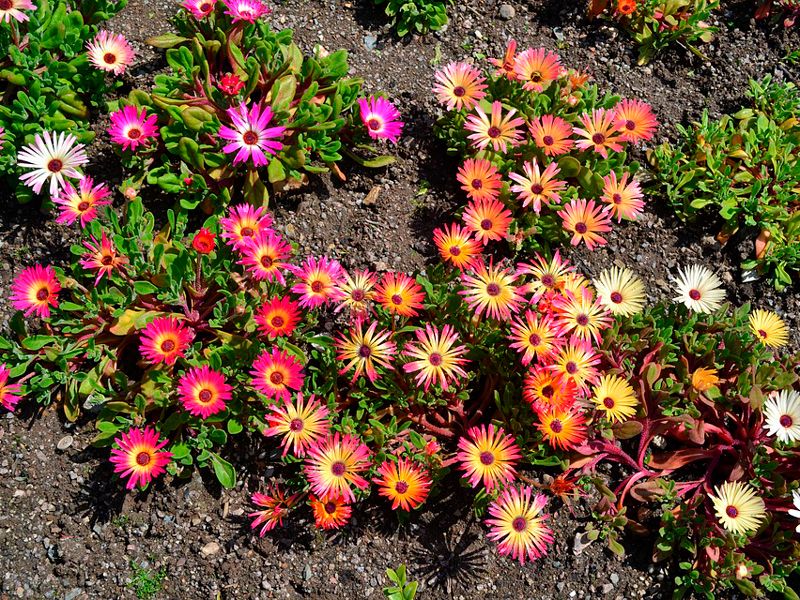
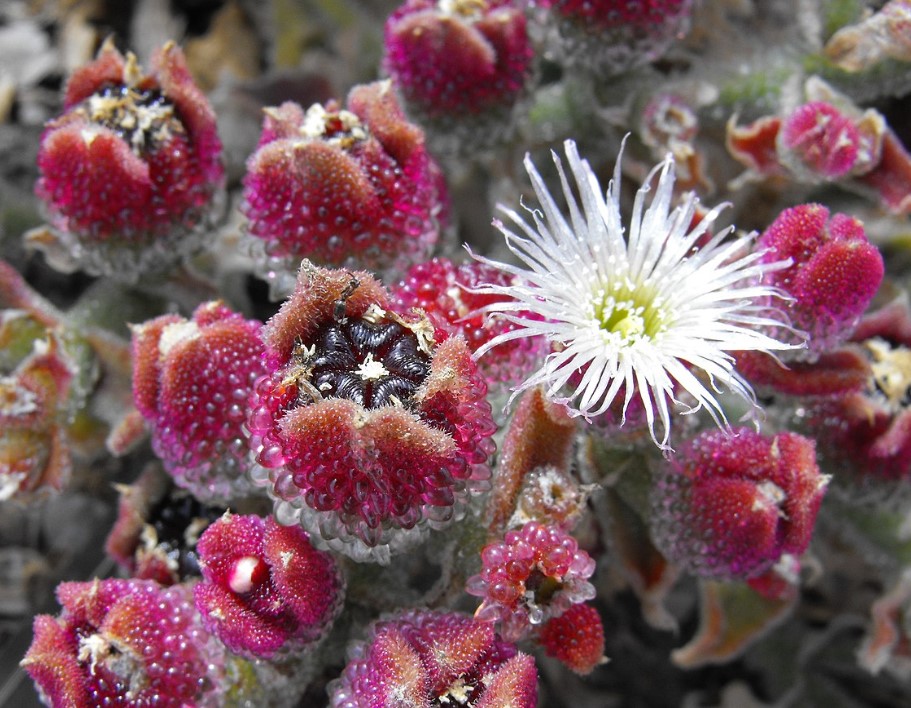
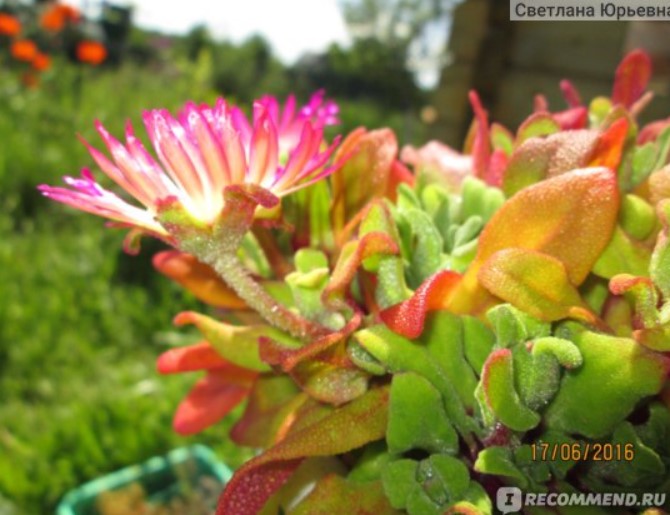
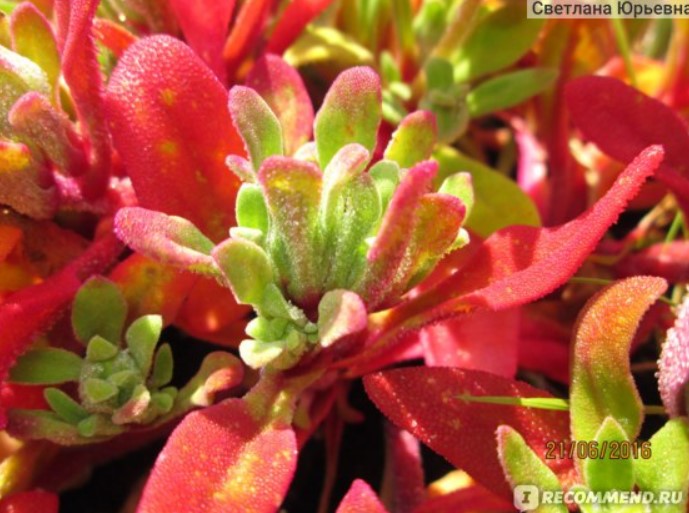
The leaves are usually green, alternate at the top of the stems and opposite at the bottom. They are covered with unusual growths resembling dewdrops, giving rise to the nicknames "glass daisy" and "crystal grass."
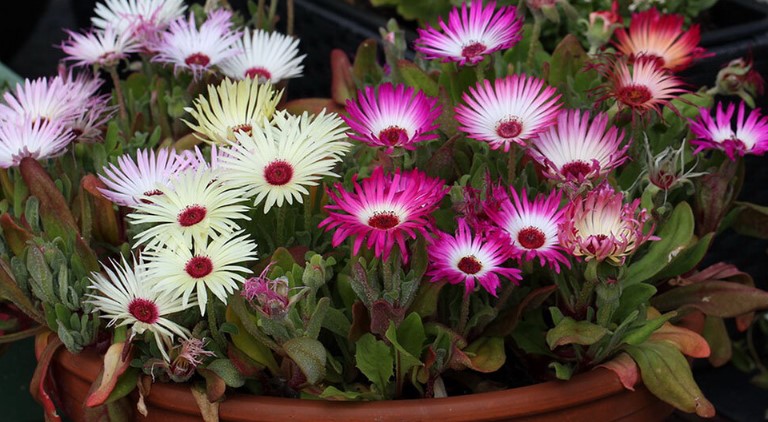
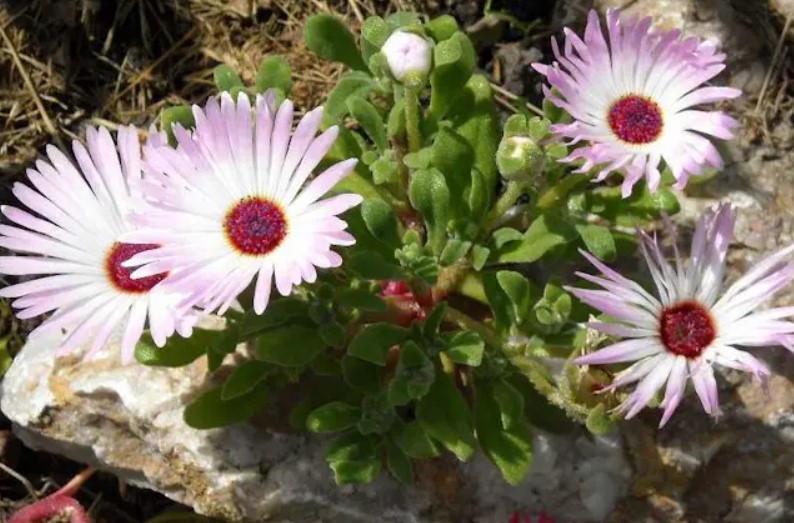
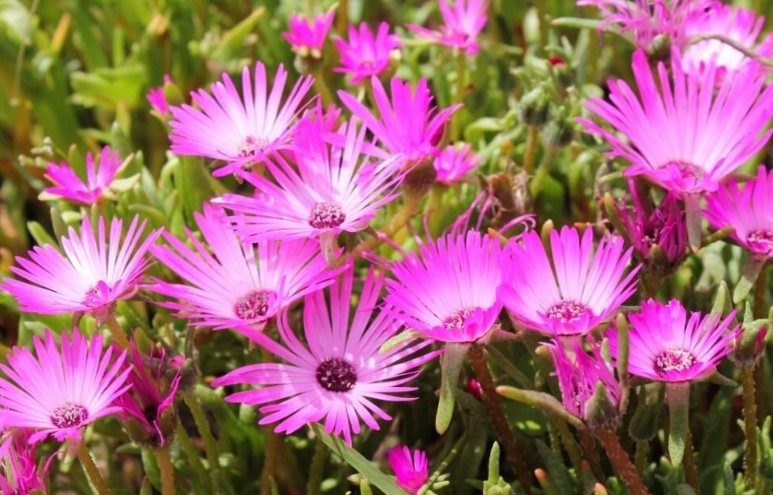
The corollas resemble daisies in shape and size, but offer a striking variety of colors—white, bright yellow, crimson, and bicolor. The inflorescences are arranged singly or in clusters.
Like any succulent, the midday flower easily tolerates heat and lack of moisture. In cloudy or rainy weather, the corollas remain closed—this characteristic is what gives the plant its name. Crystal grass is grown in open ground and in pots as an annual or biennial plant.
Types and varieties of mesembryanthemum: Harlequin, Sparkle and others
Botanists count about 50 species of exotic plants, differing in height, color and shape of inflorescences, and the degree of decorativeness of leaves.
| View | Description
Height, cm |
Leaves. Flowers |
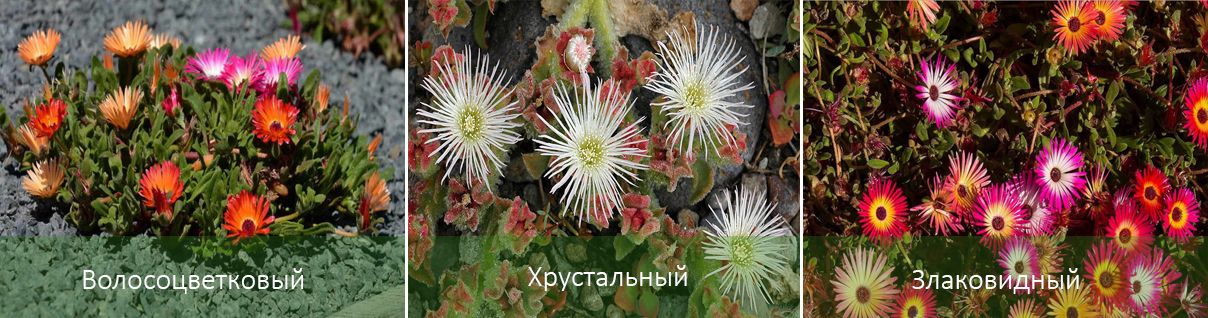
| Dorotheanthus daisy, or hair-flowered dorothenanthus
(Mesembryanthemum crinifolium)
|
Annual.
10. |
Green, fleshy, and covered in growths, the 3-4-centimeter corollas are colored in rich shades of pink or orange. |
| Glazokovy
(Mesembryanthemum occulatus)
|
Biennial.
10. |
Grass-colored, young flowers with a pinkish-bronze tint. Yellow with a bright red center. |
| Crystal
(Mesembryanthemum crystallinum)
|
Perennial. 15. Popular varieties:
|
Fleshy, with wavy edges and hair-like "crystals." The color of the leaves and flowers depends on the variety. |
| Cereal, or tricolor (Mesembryanthemum tricolor)
|
Annual.
12. |
The stems have a reddish hue. The petals range from deep pink in the center to crimson pink at the edges, through a white center. |
| Cloudy (Mesembryanthemum nubigenum) 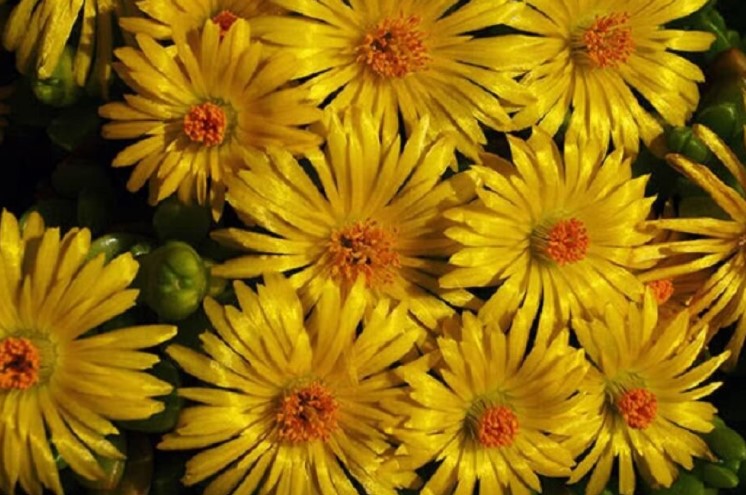 |
Frost-resistant species.
6-10. |
Green, turning bronze in cold weather. Up to 4 cm in diameter, golden, orange, red, or purple. |
Growing mesembryanthemum at home
Most exotic plants thrive indoors. Tiger and white varieties are most often grown as houseplants. Basic care and maintenance guidelines are summarized in the table.
| Factor | Spring-summer | Autumn-Winter |
| Lighting | Bright, it is preferable to place the pots in the southern direction. | As bright as possible. |
| Temperature | Any. | +10…+12 °С. |
| Top dressing | Every 2 weeks with complex fertilizers for indoor flowers. | They don't feed them. |
| Watering | Moderate, after the soil in the container has dried out by 60-70%. | They refuse when at rest. |
| Humidity | It doesn't matter, you can spray it in hot weather. | Doesn't matter. |
Potted cultivars are repotted every spring, replacing as much of the soil mixture as possible.
Propagation and planting of mesembryanthemum in open ground
Crystal grass is propagated by seeds and cuttings. Both methods are easy for novice gardeners.
For cuttings, select the healthiest, strongest bushes in the fall and move them to a darkened room where the temperature is maintained at 10°C for the winter. In March, cuttings are taken from the mother plants and rooted in a light substrate consisting half of sand. The containers are placed in a warm, well-lit area, and the soil is kept moderately moist.
Rooting occurs quickly, and by early May, each cutting forms a small, neat bush. Towards the end of spring, young plants are planted in flower beds, rockeries, and alpine gardens.
Growing Mesembryanthemum from Seed
This is the standard method for growing this midday flower. In the south, it can be sown directly into open ground once the weather has warmed up. The soil in the flowerbed should be light, moderately fertile, preferably sandy loam. Beneath it, add a thick layer of drainage material made of pebbles and broken brick.
The location is chosen so that it is illuminated by the sun for most of the day and is protected from the north-northwest winds.
The seeds are spread along the furrows and covered with soil. When the seedlings grow a little, the strongest ones are left and the rest are removed. Ensure that the distance between seedlings is at least 20 cm. If promising seedlings have formed more densely, they are carefully replanted.
In cool regions, cultivation from seeds is carried out using the seedling method, sowing in early spring:
- The seedling trays are filled with a light substrate. The seeds are scattered over the surface and pressed lightly into place, without covering them.
- The crops are moistened, the box is covered with polyethylene or plexiglass, and placed in a well-lit area with a temperature of +12°C.
- Before the emergence of seedlings, watering is carried out moderately, using a fine-dispersed sprinkler.
- When the seedlings become stronger and form two full leaf blades, they are planted in separate containers and transferred to a cooler room (t +10°).
- Water moderately; seedlings do not need fertilizer.
Young plants are planted in open ground when the threat of nighttime temperature drops to zero has completely passed.
Timing of planting mesembryanthemum seeds
The planting time for glass daisies depends on the climate and actual weather conditions. In warm southern regions, the best time to plant begins in April.
For seedlings, seeds are sown in such a way that by the time of transplanting to flower beds, which happens no earlier than mid-May in a temperate climate, the seedlings are at least 2 months old.
How to plant mesembryanthemum
The grown and strengthened seedlings are planted in open ground when the night temperature does not drop below +10 °C.
The areas for exotic plants are first prepared: they are dug up, and a large amount of sand, peat, expanded clay, or fine-grained pebbles are added to the heavy soil to improve drainage properties.
Immediately before replanting, dig holes proportionate to the root ball in the seedling containers. Space the holes at least 15 cm apart. Carefully remove the young plants and place them in the holes along with the growing medium. Fill the empty spaces with soil, compacting it lightly.
At the end of the process, the flowers are watered and, if necessary, soil is added so that the roots are not exposed.
When planting different varieties of mesembryanthemum in a garden plot, be sure to follow the rule: different species should be isolated from each other.
How to care for mesembryanthemum in the garden
The most important thing for a glass chamomile is a well-chosen location, with consistent sun exposure and good drainage. In this case, the plant requires minimal care:
Water moderately. If there has been heavy rainfall, do not water the flowers until the soil is completely dry.
Feed twice a month with complex fertilizers for flowering plants Agricola, Kemira or similar.
If all conditions are met, crystal grass will actively bloom and grow, almost completely decorating the soil of the area allocated to it with a colorful carpet.
Mesembryanthemum in winter
This African heat-loving plant absolutely cannot stand the cold, dying at temperatures below freezing. Therefore, before the cold weather sets in, the plants are carefully dug up and replanted into pots or containers. Until spring, they are kept at a temperature of at least +5°C in a heated greenhouse, conservatory, or other bright, cool space.
Pests and diseases of mesembryanthemum
The midday flower has a natural immunity to common garden flower diseases. If watering is not properly regulated, specifically if overwatering occurs, root rot may occur.
Among the pests that can threaten crystal grass are spider mites, which thrive in dry air. If they appear, treat the plants with acaricides. Spraying with garlic peel infusion can be used as a preventative measure.
Mesembryanthemum Reviews
Crystal Chamomile
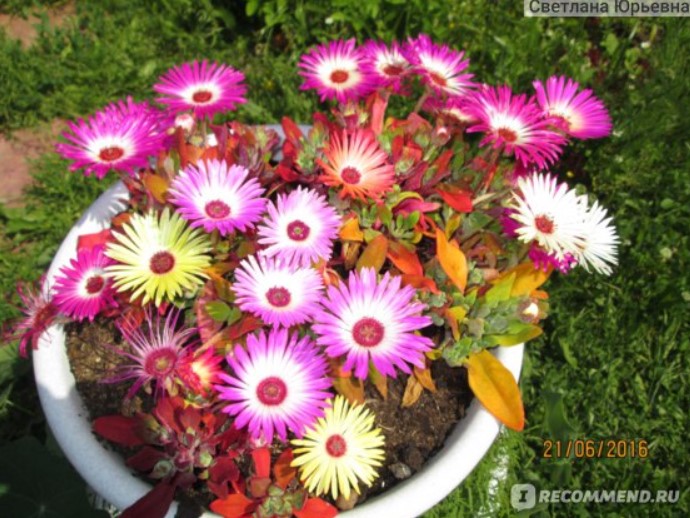
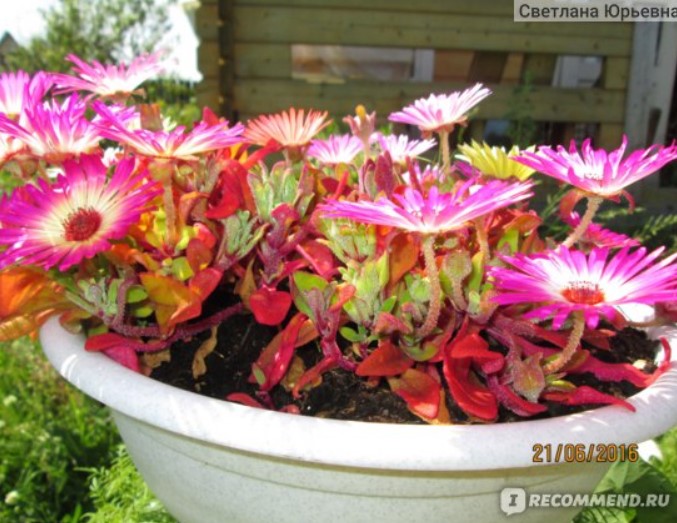
Mesembryanthemum is also called dorotheanthus, and this plant represents an interesting family of aizoaceae, which is very common in African countries.I grew this cute annual succulent with daisy-like flowers from seeds this year. Smile
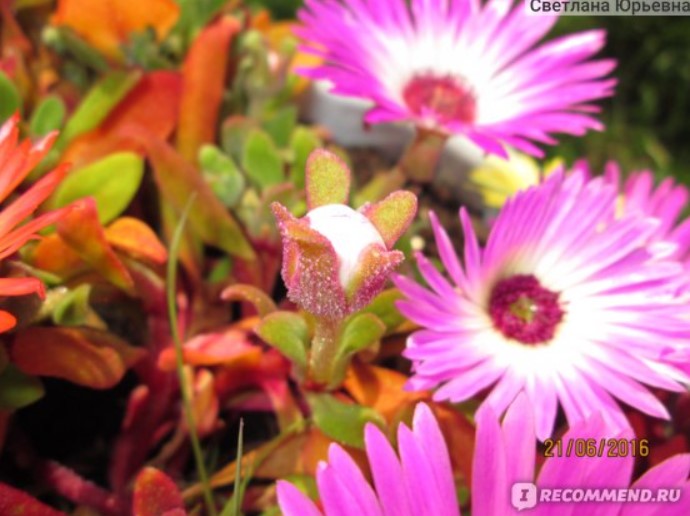
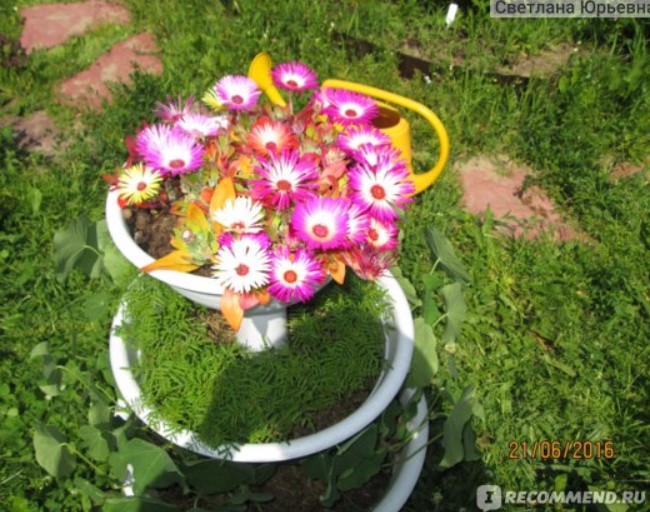
Multicolored flowers, 4-5 cm in diameter, and very interesting fleshy leaves and stems—they are covered with glandular hairs and shimmer in the sun, which is why the plant received the name "crystal chamomile."
Another name, "midday flower," literally matches the plant's official name: the word "Mesembryanthemum" is Greek for "blooming at midday." Indeed, mesembryanthemum flowers open only in clear weather, remaining tightly closed in the evening or on cloudy days.
The plant is not tall, about 7 cm, it spreads and is well suited for an alpine slide.
There are a lot of microscopic seeds - "dust particles" in the package, it says 2000 pieces (I didn't count)
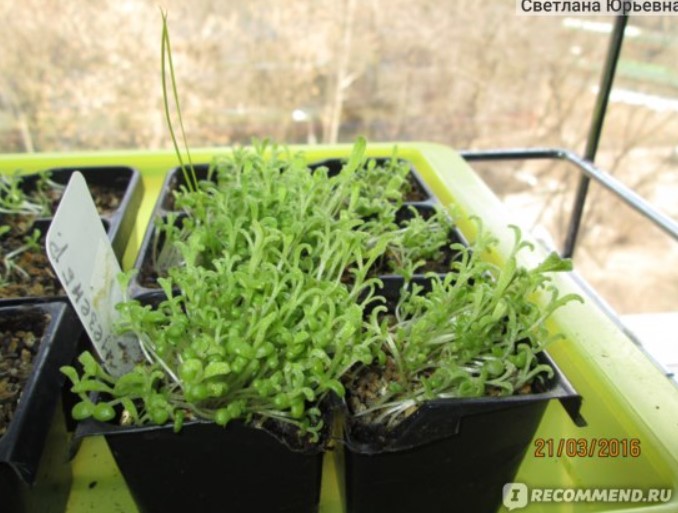
Growing seedlings is not difficult, the main thing is not to overdo it with watering.
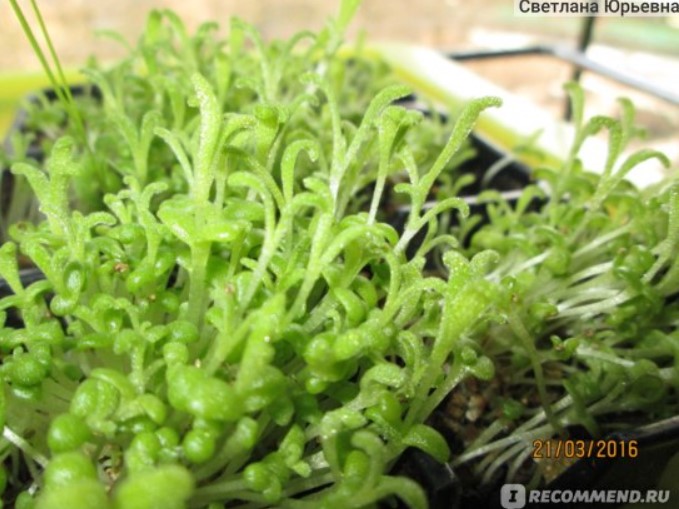
I sowed the seeds in March in a tray, simply scattering them over the soil surface, pressing them into place with a sprayer, and covering them with glass. They sprouted unevenly. I thought all 2,000 seeds sprouted.
I was too lazy to transplant them, so they grew in bunches until I planted them in a pot at the dacha. I gave away most of the seedlings.
I planted the seedlings in the top pot of a three-tiered planter, adding drainage to the bottom, as overwatering is very dangerous for this plant. It's important to place the planter in a very sunny spot.
Flowering began in mid-June and will continue until frost. If you have a sunny window, you can grow mesembryanthemum in a pot.
A lovely flower and very high quality seeds, I recommend paying attention.
Svetlana Yurievna
recommends
I've been sowing it for three years now. The plant is very easy to care for and very beautiful, especially once it's fully grown.
Sow now, superficially. Be sure to steam the soil. Cover the seed dish with glass and place it in a warm, bright spot. When the seeds begin to sprout, sprinkle them with a thin layer of calcined sand. A couple of days after germination, remove the glass completely to keep the humidity low. Important: the substrate under the seedlings should be slightly moist, but not wet, as mesembryantumums are easily damaged by blackleg. Water sparingly, preferably with a syringe with a needle, to avoid water getting on the seedling itself. Water with Previkur and a weak solution of potassium permanganate, alternating between the two.When growing M. seedlings, it is important to maintain a high temperature and bright lighting at all times.
In open ground, water sparingly and plant only in well-drained soil (or simply add more sand) to prevent the plant from becoming waterlogged. Trim off spent flowers.
Unfortunately, there is no photo.