Fatsia is a sparsely branched evergreen shrub of the Araliaceae family. It is native to the Far East, including China and Korea.
Content
Description
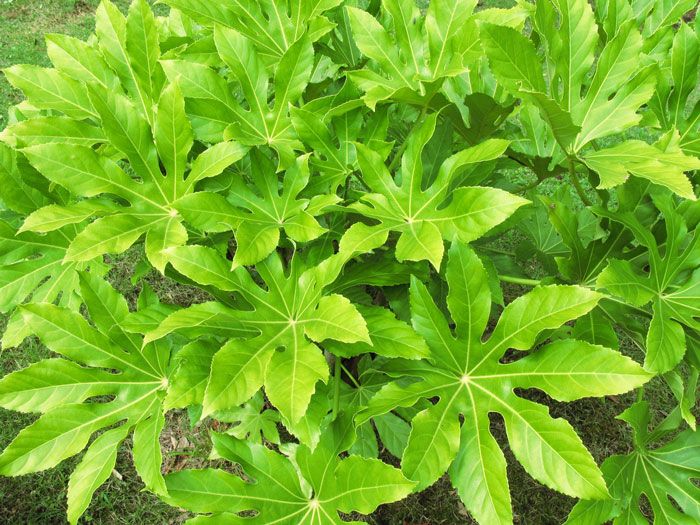
Fatsia is distinguished by large, succulent, bright, and glossy leaves, up to 40 cm wide, which form a dense crown. Their dissection and pointed tips create an exotic and unique appearance. It bears yellow-green flowers, arranged in an umbel-shaped inflorescence. The plant grows to a height of approximately 4 m in its natural habitat.
In nature, it thrives in warm, humid climates with mild summers and cold, but frost-free, dry winters. It tolerates wide temperature fluctuations well.
Fatsia is used for decoration and landscaping in regions with warm tropical climates. In Russia, it grows on the Crimean coast and in the Caucasus, as these are where the climate is most favorable for it. The flower fits into any room's interior, filling empty space and making a beautiful addition.
Types
Of the many varieties of Fatsia, not all are suitable for growing indoors. One of them, Fatsia japonica (Aralia), is a bush that grows up to 150 centimeters even with artificial lighting, and it is also undemanding.

Found in Japan on Nansei Island and off the southern Korean Peninsula. In subtropical climates, it also occurs in New Zealand and Juan Fernandez Island.
Fatsahedra, a hybrid between Fatsia and ivy, is widely grown. It is a herbaceous vine that can reach enormous heights of up to 5 meters. It has large, palm-shaped leaves reminiscent of ivy. It is a hardy and undemanding plant.
Domestic species
| View | Description |
| Face | A climbing shrub with larger, dark emerald leaves than the Japanese variety, consisting of 5 lobes. |
| Samurai or Japanese | Its appearance is no different from Litse, its characteristic features are dark blue berries and pale fragrant flowers. |
| Empire | Its leaves are the largest of those presented—up to 60 cm wide. It flowers extremely rarely. |
Garden views
| View | Description |
| Variegated | A small plant with a pale yellow leaf blade. |
| Mitseri | The smallest species in size with bright green leaves. |
| Aureimarginalis | A rare species, it is distinguished by brown veins on its leaves. |
| Anelis | The most striking of the varieties. Leaves with white veins, covered with gold and yellow flecks. |
Home care
How to buy a plant correctly:
- Choose a young fatsia that has not yet had time to grow.
- Wrap in several layers of plastic bags to maintain air warmth.
- Do not remove the bags for 2-3 hours to get used to the new conditions.
- Check for harmful insects, wash with warm soapy water if necessary.
- After 1.5-2 weeks, transplant into a larger pot.
This shrub requires abundant watering with soft, settled water and moist soil. Watering should be reduced during the fall and winter. Avoid over-watering and excessive soil moisture.
| Time of year | Temperature | Lighting | Humidity | Top dressing |
| Summer | +20…22 °C | Avoid exposure to direct sunlight. | Regular spraying with warm water. | Several times a week. |
| Autumn | +15 °C | Bright light. | Spraying no more than once a week. | Once a week, with organic fertilizers with minerals. |
| Winter | +10°С | Bright light. It is necessary to increase the length of daylight artificially. | Spraying 1-2 times a month. | Stop fertilizing or reduce to once a month. |
| Spring | +18-20 °C | Diffused, dim light. | Regular spraying with water at least +20 °C. Increase humidity to 60-70%. | Once a week, with organic fertilizers with minerals. |
Soil and ground
The plant requires nutrient-rich soil. You can use a ready-made substrate or prepare your own. Mix leaf mold, turf, and sand in a 1:1:1 ratio. Place a drainage layer at the bottom of the container.
Pruning and replanting
Pruning and replanting fatsia to create a denser crown is very easy. Pinch off the top of a young bush. Soon, foliage will appear on the trunk, and new shoots will emerge from the base.
It is advisable to repot the plant only once a year: if the roots have filled most of the pot and grown through the drainage holes.
To do this, choose a container 3-6 cm larger than the previous one, choosing a pot with dark walls, as they reflect less sunlight and will prevent the soil from becoming too cold. Fill the container one-third full with expanded clay drainage media or broken brick. The shrub also thrives in hydroponics.
Reproduction
There are three ways to propagate fatsia. Vegetatively: by cuttings and air layering, and by seeds.
Cuttings
- Held only in June and spring.
- Cut off the apical part of the shoot and several buds.
- Cover the cuttings with plastic wrap or a glass jar.
- As soon as the young plants take root, transplant them into different pots with prepared soil and ground.
Layering
- Use this method only in spring, if the trunk is bare.
- Using a blade, make a thin cut on the stem and cover it with moss soaked in phytohormones or nutrient fertilizers (1 gram per liter of water), then cover with film on top.
- Avoid letting the moss dry out.
- After 2 months, only after the shoots appear, trim the trunk slightly below the place where the root formed.
- Transplant the flower into a separate container.
Seeds
One of the most difficult methods, difficult to achieve success at home, is suitable for experienced breeders:
- Place the seeds in boxes, burying them in the soil to a depth of 15 mm.
- Soil composition: one part each of turf, leaf soil and sand.
- Do not allow temperature conditions to change - no more than +20 degrees.
- Once the seeds have sprouted, transplant them into different pots up to 10 cm in size.
- Change the composition of the soil: two parts of turf soil and one part each of leaf litter and sand.
- Place the sprouts in a lighted place.
Pests and damage
Pests that pose a particular threat include weevils, rose aphids, foamy spittlebugs, sawflies, and leaf rollers. To control them, spray with fungicides several times a week.
Experienced gardeners recommend the following products: Actellin, Vectra, Zircon and Perimor.
A soap solution that can be used at home can be sprayed onto the leaves 2-3 times a day.
| Damage | Cause | Treatment |
| Sunburn | It occurs when the leaves are exposed to direct sunlight for a long time, after which they dry out and wrinkles appear on them. | Increase air humidity, hide the bush in a shady place. |
| Lack of moisture/ Excess moisture |
When there is a lack of water, the leaves are dry and brittle. When there is excess, the crown is drooping, flaccid and softened. |
Water generously when dry, tie drooping leaves to support. Avoid watering for several days if the plant is too wet. |
| Gray mold | This can occur when the flower is growing in a damp and humid room. The stem rots and darkens. | Cut off the affected parts and place in a ventilated area. |
Top.tomathouse.com recommends: Fatsia is a tonic plant.
The beneficial properties of fatsia lie in the large amount of essential oils and chemicals in the leaves.
In medicine, the shrub is used as a tonic and to boost immunity. Medicines made from fatsia roots are used to prevent diabetes.
Harmful properties include toxicity. The sap of the leaves contains toxic substances that can cause irritation, itching, and redness of the skin. Sensitive individuals may experience local allergies; gloves are required when handling the plant.
Fatsia is a hardy and undemanding plant. Even an inexperienced gardener can grow a strong and sturdy plant that will delight the eyes of everyone in the home.