Violets are traditionally considered indoor plants that bring comfort to the home and are a wonderful addition to its interior. However, breeders are constantly developing new varieties that don't always respond ideally to established care methods.
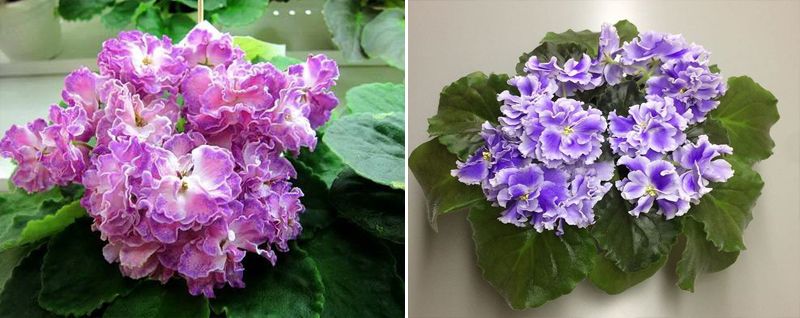
One such variety is the violet Olesya, bred relatively recently by one of the outstanding Russian programmers.
Description of the Olesya variety
Small leaves form a rosette and do not obscure the flowers. The petals are a delicate purple, fading to a brighter hue from the center to the edges. Each petal is edged with a dark cherry border. It blooms long and profusely, exuding a delicate fragrance. Each year, it grows stronger and more beautiful, without changing its color. The Olesya variety can be considered quite young, not even 10 years old.
Features of cultivation
| Factor | Conditions |
| Location | It's important to satisfy this plant's sun requirements without overexposing it. An east-facing location is ideal, though a south-facing location will also work, but shade should be provided during particularly hot weather. |
| Lighting | Additional light is needed during cloudy, short winter days. For this purpose, use a fluorescent lamp, placing it far enough away from the foliage to prevent future sunburn. Without proper lighting, the violet will not stop producing new buds, but they simply won't bloom. |
| Temperature | A young Saintpaulia needs a fairly warm temperature range (+24…+26 °C), and for an older one, +22…+24 °C will be enough. |
| Humidity | A normal indoor climate is quite suitable for violets, but they will feel much more comfortable with 2-3 sprays per week. Young violets should be kept under plastic (in a greenhouse). |
| Capacity | The size directly depends on the root system. A mature Olesya requires a large ceramic pot, but no more than 10 cm in diameter. Otherwise, the plant's entire potential will be spent on root development and foliage growth, significantly reducing flowering or even stopping altogether. However, a regular plastic cup filled with water is sufficient for sprouting a leaf. Once a root appears, transplant it into the ground. |
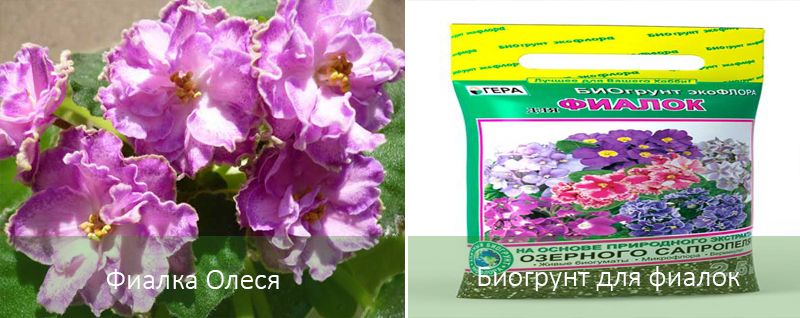
| Priming | Characteristics of poor quality soil:
Moreover, a high-quality, multi-component soil includes:
|
Care instructions
After planting, the steps are limited to two: fertilizing and watering. However, each variety has its own nuances.
Watering
The key to proper violet care is to avoid overwatering the plant, otherwise it will rot.
You should check the soil by squeezing a small piece of soil from the top layer. If this creates dust, the plant needs watering; otherwise, don't rush. Water is crucial; it should be settled or filtered, and always at room temperature. Water the plant only at the roots.
Top dressing
You should not feed the plant more often than once every two weeks and it is recommended to do this only in the following cases:
- Extensive damage was caused by pests.
- It stood in the sun for a while.
Fertilizing should also be done during the first two months after repotting. Organic fertilizers, such as compost or manure diluted with water at a ratio of 1:15, are excellent for this purpose. These instructions are more applicable to mature, disease-free plants; this type of feeding won't harm them. For other plants, a special nutrient mixture (such as "Mr. Color") is suitable. In addition to watering and fertilizing, it's important to carefully trim away dried, damaged, or simply yellowed leaves. This should be done primarily in the spring.
Transfer
It's recommended to repot the plant annually, preferably in the spring. A white coating on the violet may be a sign that it needs repotting; this occurs due to a lack of oxygen in the soil. Another reason to repot is if the roots become densely intertwined, following the shape of the pot. However, if the violet is diseased due to poor soil, it's best to repot it immediately to prevent its death.
This procedure rejuvenates the plant, and if it's young and still growing, it's worth choosing a pot a few centimeters larger than the previous one, which will provide sufficient space for root growth. However, care must be taken to ensure adequate drainage.
The process includes a sequence of several stages:
- Place broken brick or expanded clay on the bottom of the pot; adding charcoal will be a plus; fill the container halfway with the prepared soil.
- Water the plant generously while it is still in the old pot.
- Remove the violet from the old container and place it in the center of the new one, holding it in place.
- Add more substrate around the root.
- Compact and moisten the soil.
- Put it back in its original place and leave it alone for a while.
Top.tomathouse.com warns of potential difficulties when growing the Olesya violet
Young and mature specimens are susceptible to pests and various diseases common to houseplants. The most common are late blight, powdery and downy mildew, root and stem rot, and bacterial blight. In such cases, it is recommended to use fungicides, which are compatible with Topaz. All diseased parts should be removed, and diseased plants should be isolated to prevent contact with healthy ones. The above-mentioned agents are also suitable for preventative measures.
Persistent pests include spider mites, aphids, butterfly larvae, and scale insects. They can be controlled using both natural and chemical methods. Among the latter, consider Apollo, Fitoverm, and similar products. Traditional methods typically involve the use of a soap solution. The foundation of plant health and safety lies in prevention, which should not be neglected, and regular, thorough inspection for unwanted symptoms.