This ancient flower got its name from its ability to induce all sorts of visions. In this article, we'll explore in more detail the secret behind this purple-flowered plant, also known as "datura flower."
Content
- 1 History of the Datura flower + what plant family it belongs to
- 2 Description of the Datura flower
- 3 Types and varieties of datura flowers with photos and descriptions
- 4 Growing Datura flowers from seeds at home
- 5 Planting datura in open ground
- 6 Caring for Datura in the Garden
- 7 The use of datura in landscape design
- 8 Growing and caring for datura at home
- 9 Diseases and pests of datura + methods of control
- 10 Datura cuttings
- 11 How to collect and store datura seeds
- 12 Beneficial and harmful properties (harm) of Datura stramonium
- 13 Real reviews from gardeners about growing datura flowers
- 14 Problem
History of the Datura flower + what plant family it belongs to
The most intriguing question with an unexpected answer is what plant family does datura belong to. It turns out that this mysterious flower belongs to the nightshade family (containing 2,500 species) and is considered a distant relative of the potato and tomato. Incidentally, this family also includes such plants as mandrake, belladonna, henbane, and tobacco.
It's difficult to pinpoint the exact origins of datura. Conflicting information has survived to this day. According to some sources, datura was first discovered by the Roma nomads who roamed along the Caspian Sea. It was through them that it spread to Asian countries.
According to other sources, Datura was brought to the mainland by Columbus's sailors, who brought the exotic plant from the American continent. Native American peoples in the western United States have long used Datura wrightii in traditional medicine and various rituals. For example, the Zuni used Datura root powder as a painkiller and applied compresses of roots and flowers to wounds to speed healing.
Datura was regularly used in the practice of healers, magicians, priests, and sorcerers, who attributed magical properties to the flower. The infusion helped them enter trances and induced hallucinations, which people perceived as a gift of communication with spirits and the highest degree of enlightenment. Knowledge was passed on orally.
The plant was also widely used in medicine. In the 16th century, Europeans used datura extract for medicinal purposes, such as pain relief, and later, vasoconstrictor medications were developed from it. To this day, the datura flower is used in pharmacology and pharmacognosy, and it is grown from seeds in fields.
Description of the Datura flower
The datura flower, also known as datura, belongs to the nightshade family, class dicotyledons (angiosperms). Below is a detailed description of its characteristics.
- Domain: Eukaryotes.
- Kingdom: Plants.
- Department: Angiosperms.
- Class: Dicotyledons.
- Order: Solanaceae.
- Family: Solanaceae.
- Genus: Datura.
It most often grows as an annual. Its shoots are erect and bright green, reaching a height of 90 cm, and the bush itself can spread up to 1.5 m in diameter.
The leaves are large, pointed, up to 15 cm long. On the reverse side of the leaf, the central and lateral veins protrude strongly.
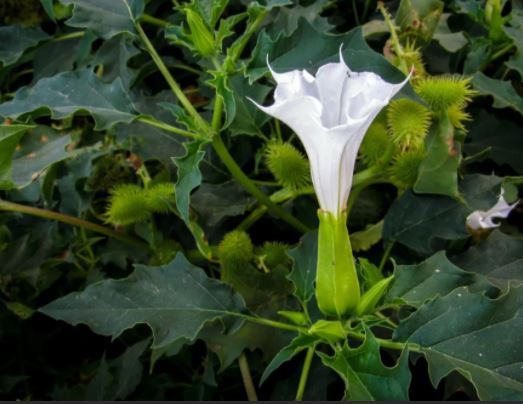
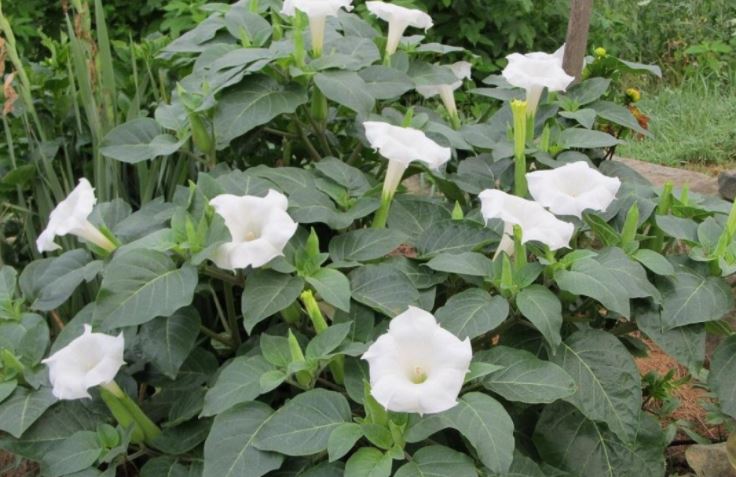
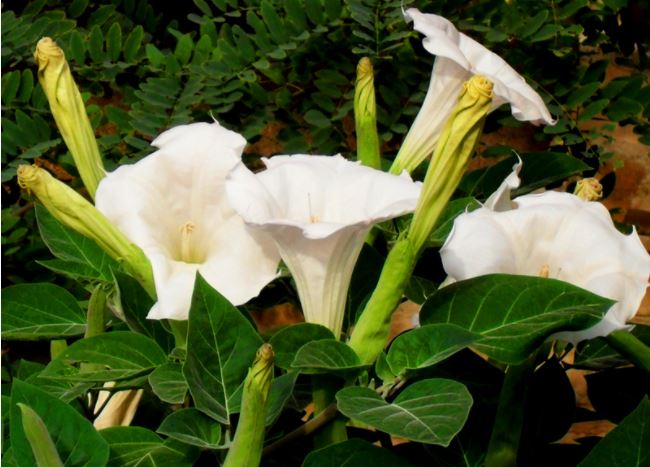
The flowers are large, solitary, bell-shaped, reaching about 20 cm across. Their fused petals are colored red, white, yellow, blue, or pink. They bloom exclusively at night, and the buds emit a pleasant fragrance. After 24 hours, the bud fades, and a new flower emerges on the bush.
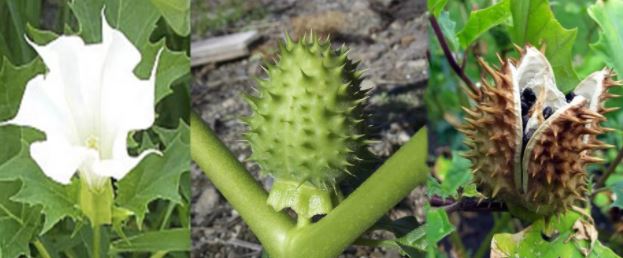
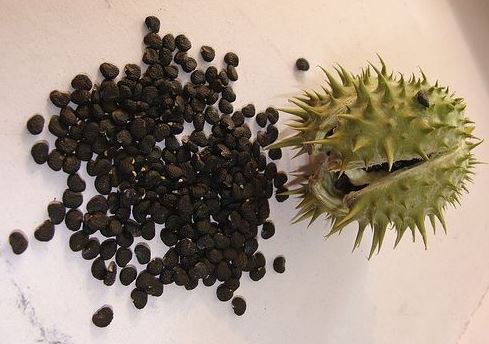
The seed pod is covered in spines. When ripe, it bursts open, spilling the black seeds. If you plan to harvest them, it's important to seize the moment and pick the pod before it opens.
Caution! All parts of the Datura plant are poisonous! Do not handle the plant without gloves, add it to compost, or use it in crafts made from natural materials.
Types and varieties of datura flowers with photos and descriptions
There are 13 varieties of Datura, all of which are considered poisonous. However, in our country, only three are most common: common, Indian, and Indian. Several hybrids have been developed from these varieties, which are widely used as ornamental plants by gardeners.
Datura stramonium
An annual plant with heavily branched, robust shoots. Their height can reach 150 cm. The leaves are large, serrated, and up to 20 cm long. This plant is popularly known as "datura datura." This has nothing to do with the scent of its flowers, which is quite pleasant. However, if the leaves or stem are damaged, an extremely pungent odor emerges.
The inflorescences are large (up to 70 cm) and beautiful, and can be white, purple, or cream. The seed pods are covered with numerous spines and are medium in size, ranging from 3 to 8 cm in diameter.
Hybrids
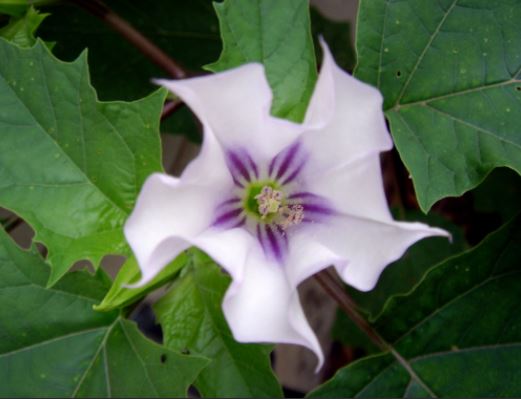
Two hybrid varieties have been developed from the common datura. The first has pointed petals and red stamens, while the second is characterized by a bright blue star within the inflorescence.
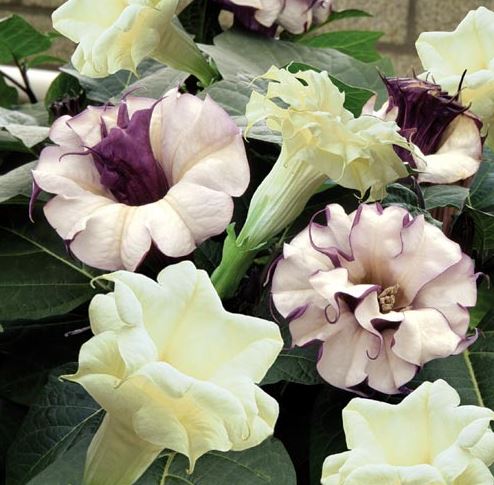
The "Terry Giant" variety is particularly beautiful. Its flowers are very large and fluffy, as if cut from corrugated paper.
"Datura bezrukii" is characterized by luxurious white flowers and a smooth, thornless seed pod. Be especially careful with this variety, as the pods can attract children and are easy to pick.
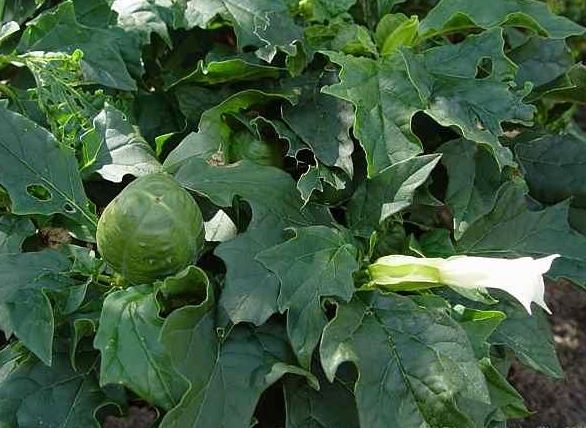
Interesting! You can make beautiful herbariums using datura!
Datura stramonium
In India, it is believed that this flower has a divine origin and grew from the chest of Shiva himself.
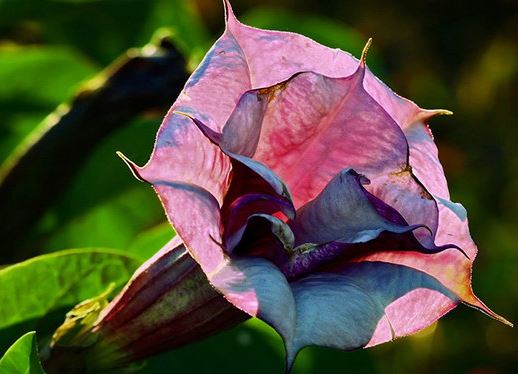
Datura stramonium can be grown as an annual, but in warmer climates it grows for many years. The shoots reach 90 cm in height, and their surface can be covered with a slight fuzz. The leaves are veined, serrated, and up to 15-20 cm long.
The large flowers are usually white and purple and reach 20 cm in diameter. The petals are pubescent on the outside. Like all datura, the Indian datura blooms at night, and the bud wilts in the morning, but a new one quickly forms in its place.
Hybrids
Datura stramonium is the ancestor of the "Knight" variety, which is distinguished by the whimsical shape of its lush inflorescences. They can be yellow or white with lilac edges.
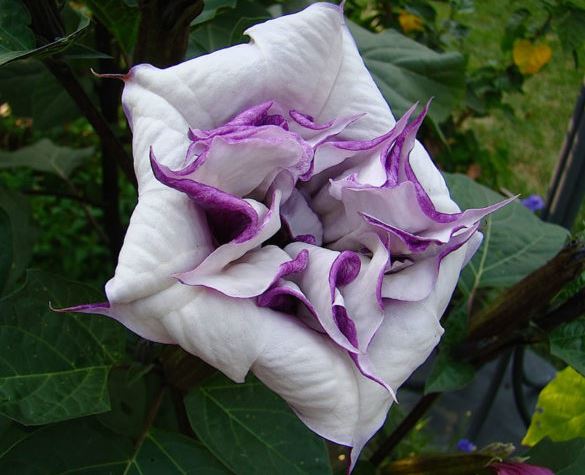
The Ballerina Methyl Violet variety has an unusual petal structure: they are pointed, the inflorescences are curled inwards, and are two-colored (white and purple).
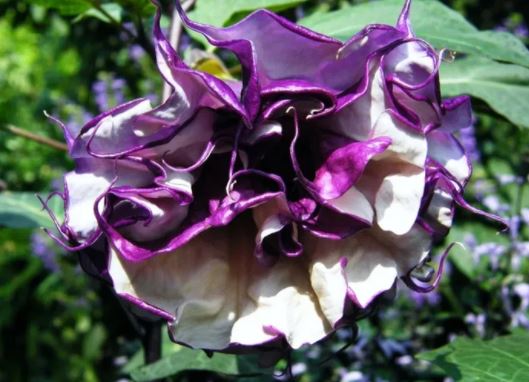
The Medea variety has not very ribbed leaves, white inflorescences, their length reaches 20 cm.
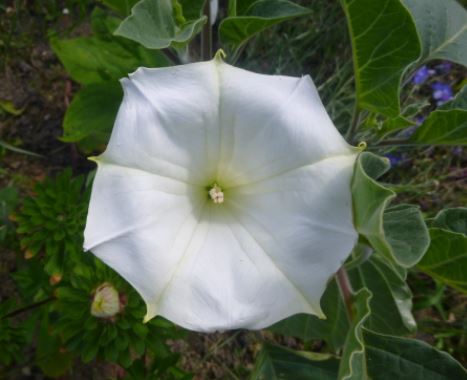
The 'Flore Pleno' variety blooms with double buds of purple or yellow shades with white speckles on the petals.
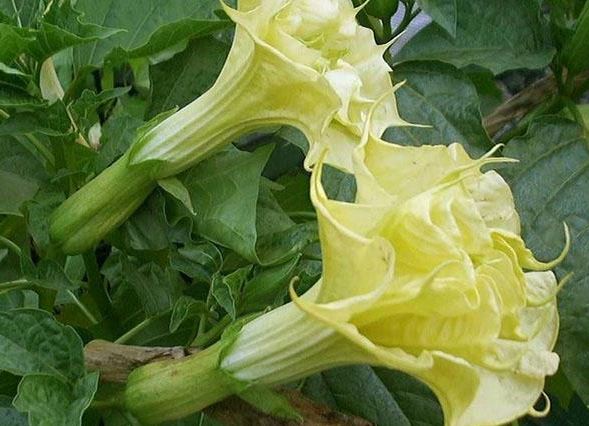
'Troubadour' is a relatively simple Datura variety compared to its luxurious double-flowered counterparts, but it has a compact size and does not grow taller than 70 cm. The flowers are white, sometimes with a purple edge.
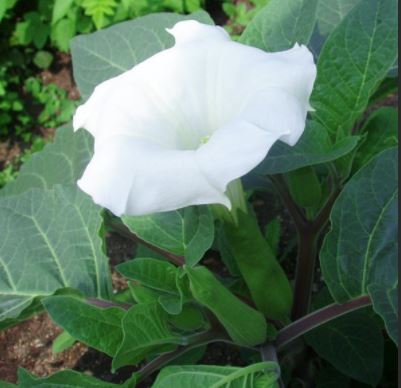
Datura indica
The shoots range from 60 to 150 cm in height, with oval, pointed, and unserrated leaves. All vegetative parts are slightly pubescent. The flowers are snow-white, with an elongated, oblong bell shape. Damage to the vegetative parts can cause a rancid peanut butter odor.
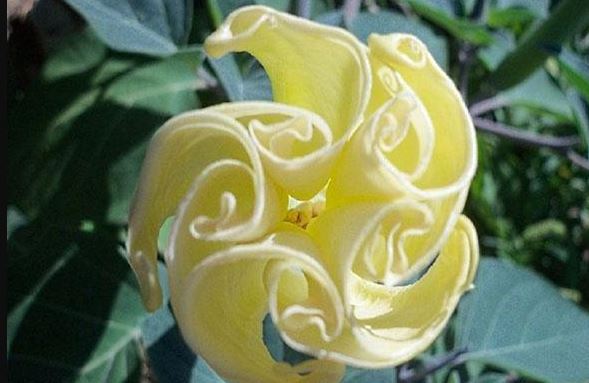
Datura arborescens or Brugmansia
It got its name from its very long shoots, which grow upward like a vine. Brugmansia was previously classified in the genus Datura, but was bred from it. Inexperienced gardeners often confuse datura and brugmansia, but the former is an herb, while the latter is a tree or shrub.
When properly trained, the shrubby form resembles a tree. The flowers hang downwards, like ripe fruit. The bells are large, up to 25 cm long. The petals are often yellowish. During flowering, a persistent citrus aroma lingers, intensifying at night.
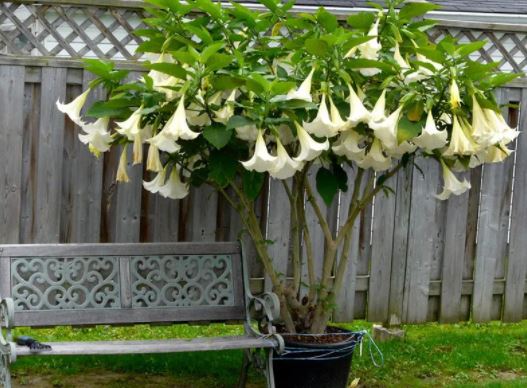
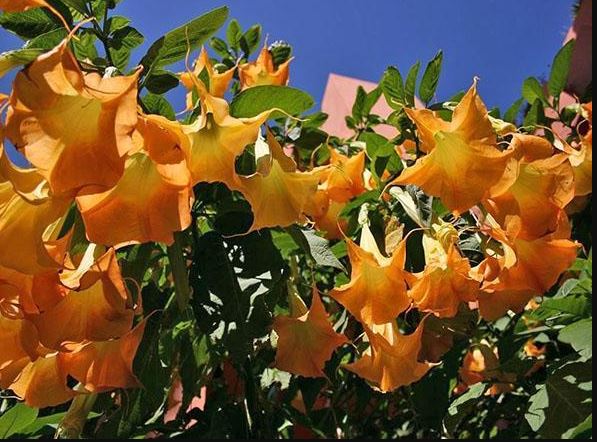
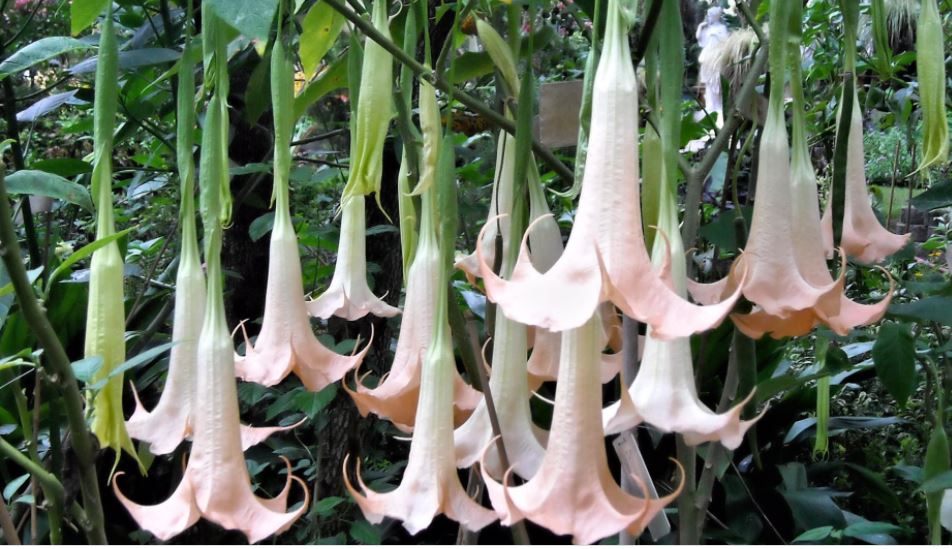
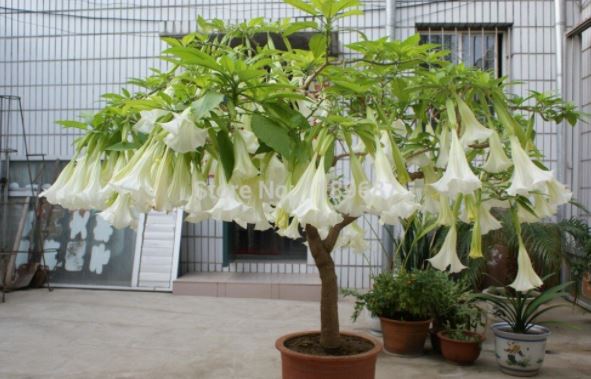
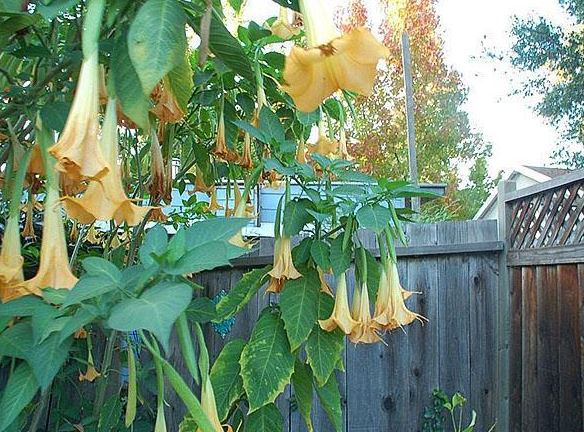
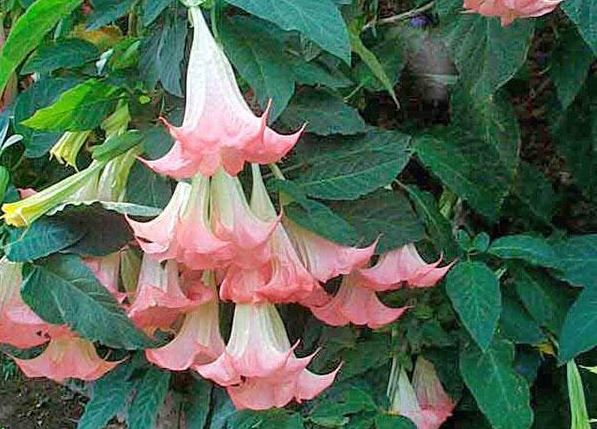
Read more about the flower in the article. Brugmansia at home and in the garden.
Growing Datura flowers from seeds at home
Datura germinates well from seed indoors. However, for best germination, keep the temperature between 23 and 25°C.
All planting work must be done wearing gloves. Seeds can be pre-prepared for planting in several ways:
- Soaking in a weak solution of potassium permanganate for 2 hours.
- Pack the seeds in a damp cloth and place them in a bag. Place the bag in a warm place until the sprouts appear.
- Stratification. Only Datura stramonium requires this procedure. It reproduces by self-seeding, so its seeds harden naturally. This should also be done at home. The seeds are wrapped in a napkin, then in a plastic bag, and then placed on the bottom shelf of the refrigerator for 3-4 days.
For planting, use nutritious soil and sow between February and April. Individual pots can be planted directly, eliminating the need for transplanting later.
Planting datura in open ground
Planting in the garden begins when the soil warms up to 15 degrees Celsius. In temperate climates, this doesn't happen until the second half of May. If winter is late, it's better to plant the flower in early June than to rush and have it freeze before the expected time.
The seedlings should reach a height of 15 cm by the time of planting. The first flowers usually bloom 15 days after transplanting.
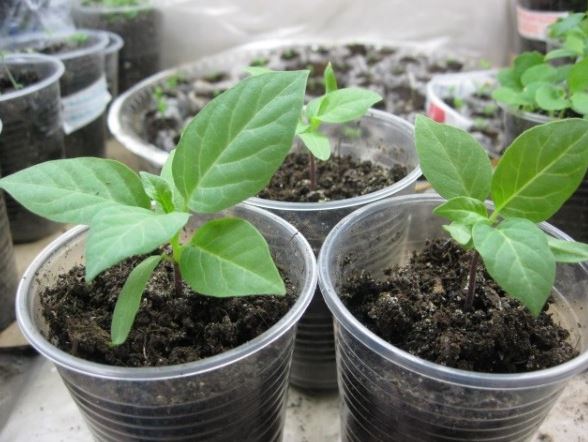
The location chosen is bright, but protected from winds that can break the delicate stems.
A drainage layer of crushed stone, expanded clay or broken brick must be laid in the planting hole to prevent moisture from stagnating at the roots.
Caring for Datura in the Garden
Datura is easy to care for, it grows well in open areas and does not require complex agricultural technology.
Watering
Datura requires plenty of water to thrive, especially during flowering. It's important to keep the soil moist at all times. If the soil is too dry, the buds will fall off without ever opening.
Periodic spraying of plantings is permitted.
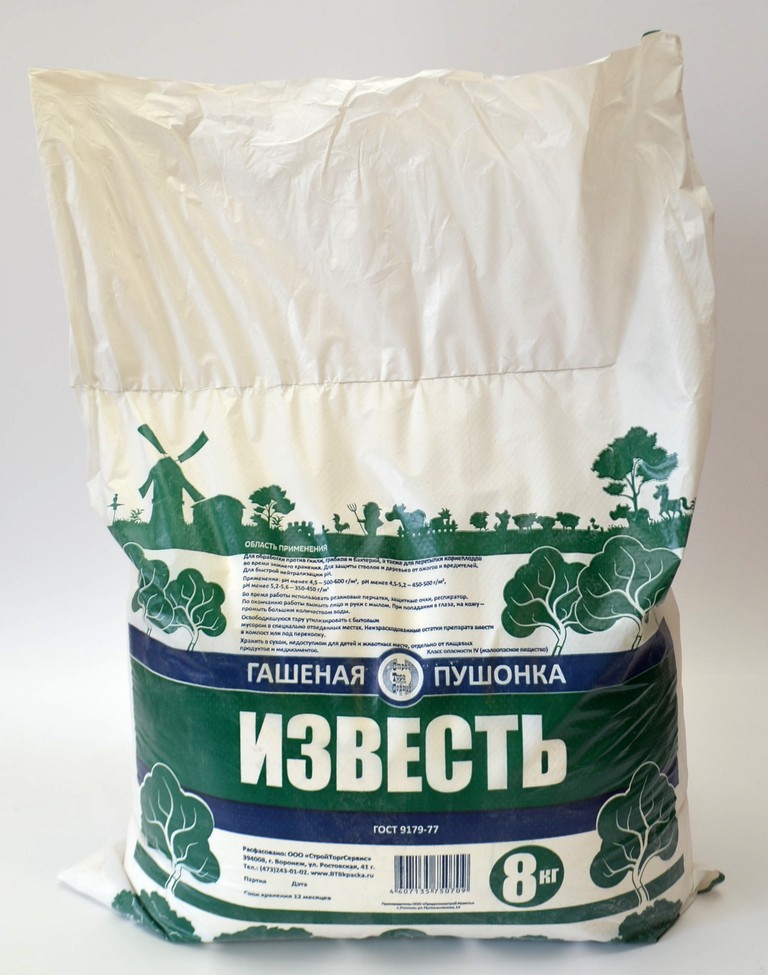
Unlike cultivated plants, datura prefers hard water. If this isn't possible, water the bed once a season with a lime solution at a rate of 10 g of lime per 10 liters of water.
Top dressing
Datura does not require organic fertilizers, as they can trigger the development of fungal diseases, to which the root system is very susceptible.
Fertilize the plantings twice a month using a mineral complex (20 g per 10 l).
Trimming
After the buds have faded, they should be removed to preserve the bush's decorative appeal. This also stimulates the growth of new blooms.
Pruning is only done if the gardener wants to preserve the datura plant until next season and plans to pot it up and place it in a warm location. It's crucial not to cut off the flowering area or damage the young shoots.
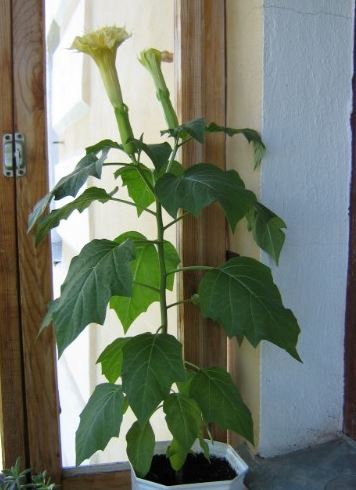
Wintering
Preparation for winter begins in September, when temperatures have not yet dropped below 8 degrees Celsius. The datura is carefully dug up and replanted in a container. It should be stored in a room with a temperature of 15 degrees Celsius.
The use of datura in landscape design
Datura often becomes a design element due to its bright green, large leaves and very beautiful flowers.
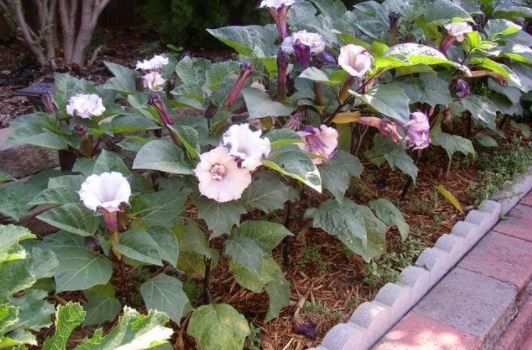
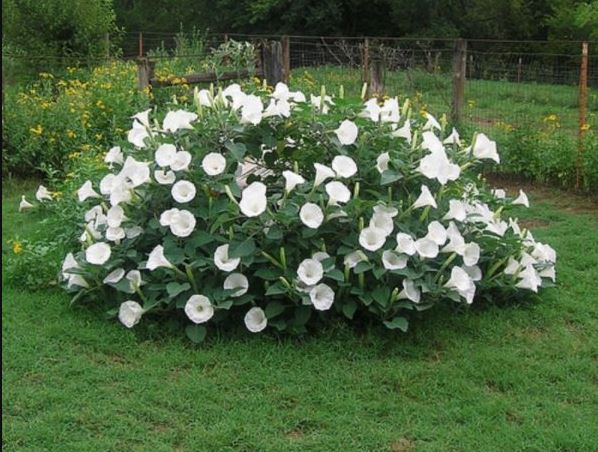
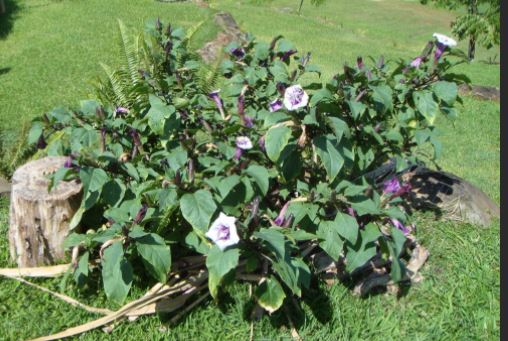
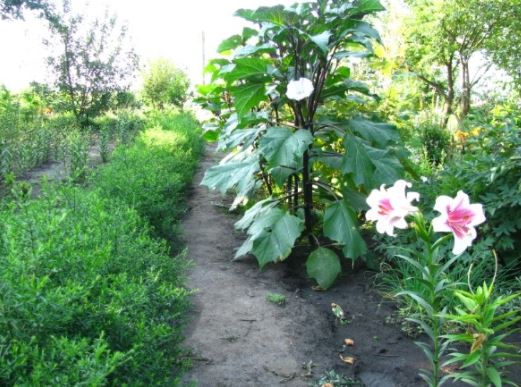
Tall, spreading varieties are suitable for the background of complex flowerbeds. Compact hybrids of Datura sabina can be planted in containers and pots.
Datura can grow on its own in empty areas of the garden, and also become a good neighbor for early flowering perennials, covering their “bare” shoots.
Growing and caring for datura at home
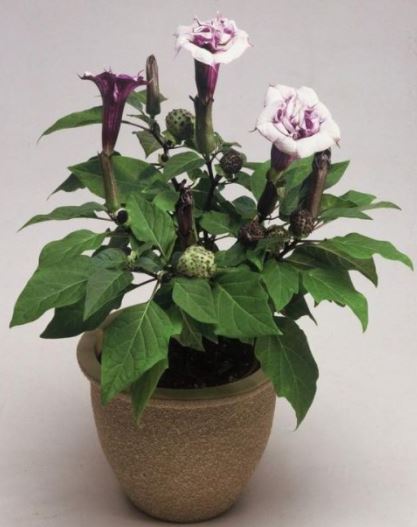
Datura is successfully grown not only in garden plots, but also at home.
To stimulate new shoot growth, which will give the datura plant a fuller appearance, pinching is necessary. After the shoots have finished blooming, they should be trimmed back by two-thirds of their total length.
In winter, most of the leaves may fall off, which is considered normal. However, in healthy datura, they will grow back in the spring.
During the summer, the flower can be taken outside, but the chosen location should be protected from the scorching sun and winds.
When choosing a location for your Datura pot, it's crucial to ensure the vegetative parts of the plant aren't exposed to constant stress. Avoid placing it near doors, in hallways, or other similar locations where the stem or leaves could be damaged. Firstly, any broken stem part will cause an unpleasant odor. Secondly, the sap that forms at the site of injury is toxic to humans and animals.
Diseases and pests of datura + methods of control
Datura is a poisonous flower, so there are no pests in nature that would want to feast on its juice.
If care rules are not followed, for example, with excessive watering combined with cool weather, gray mold may appear.
All other disturbances observed during the growth process are not associated with fungi and bacteria:
- leaves wither, buds fall off due to lack of moisture;
- the stems become bare, the lower leaves become thinner – insufficient pruning is being done;
- the shoots have stretched out, the flowers are loose – the datura does not have enough light,
- Leaves fall when the air temperature drops and when drafts appear.
Datura cuttings
One way to propagate datura is by cuttings. This should be done in spring or summer. The cutting is separated from a semi-ripe shoot. It should be approximately 10 cm long, but most importantly, it should have 2-3 internodes.
For pruning, use a well-sharpened, pre-disinfected tool. The bottom cut should be made at an angle to increase the surface area for moisture and nutrient absorption.
All lower leaves are removed from the cutting to reduce the energy expenditure on growth and to reduce the surface area for liquid evaporation.
Next, the cutting is planted in prepared soil for rooting. To speed up the process, experienced gardeners recommend treating the lower part of the plant with a growth stimulant.
Remember that all work must be carried out with gloves!

How to collect and store datura seeds
The most viable seeds come from the first flowers. However, they are easily lost among the mass of newly emerging buds, so the shoot containing them is marked with a ribbon. It's also important to remember that seed pods open on their own, a process that's difficult to control. To prevent the seeds from scattering, place a loose cloth bag over the pod, allowing light and air to pass through.
Another important rule: any work with datura must be carried out strictly with gloves, as the plant’s juice is poisonous.
The collected seeds are placed in a paper bag, which must be labeled with toxicity warnings and sealed tightly. Datura seeds remain viable for up to 10 years.
Beneficial and harmful properties (harm) of Datura stramonium
Gardeners know that any handling of datura must be done with gloves—the plant is poisonous to living creatures. Since ancient times, datura's properties have been used in folk medicine. Some of these properties have survived to this day.
Medicinal uses of datura
The leaves of Datura herb contain hyoscyamine (up to 0.5%), as well as scopolamine and atropine. The former reduces the secretion of the salivary and sweat glands, reduces bile production, and stimulates the heart muscle. The leaves and stems contain alkaloids used in pharmacology. Alkaloids are individual plant substances: nicotine from tobacco leaves, atropine from belladonna and datura, and reserpine from Rauwolfia serpentina. Datura alkaloids have an antispasmodic effect on smooth muscles, dilate pupils, increase intraocular pressure, cause accommodation paralysis, suppress glandular secretion, and increase heart rate.
Preparations containing datura can be used for medicinal purposes to treat the following diseases:
- Asthma.
- Gastric ulcer.
- Duodenal ulcer.
- Tachycardia.
- Rheumatism.
- Neuralgia.
- Colitis.
- Cholecystitis.
The oil infusion has shown a therapeutic effect as a laxative, and the decoction can be used for gargling, rubbing, or enemas.
When using datura, it's crucial to follow the correct dosage to avoid poisoning instead of benefit. Follow your doctor's instructions and the package insert.
The danger of datura
All vegetative parts of the datura plant are dangerous to humans and animals. When ingested, the plant's sap or seeds are the least likely harm to be expected: food poisoning. Larger ingestion can be fatal.
Important! A contraindication to the medicinal use of datura is the eye disease glaucoma (increased intraocular pressure).
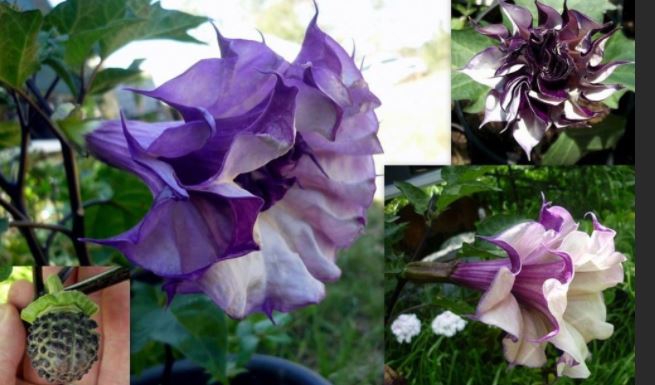
Signs of poisoning include an increased pulse rate, palpitations, a dry throat, and dilated pupils. Headaches develop, and the skin becomes red. Hallucinations may occur, and speech becomes slurred, becoming more like delirium. At the first signs of poisoning, seek medical attention, especially in children. Until the ambulance arrives, a gastric lavage is performed, and a doctor will prescribe primary treatment and recovery.
In cases of poisoning, gastric lavage with weak oxidizing solutions (potassium permanganate) is prescribed, followed by the administration of adsorbents followed by gastric lavage and symptomatic therapy. In severe cases, anticholinesterase and cholinomimetic agents (eserine, neostigmine, pilocarpine) are prescribed.
Real reviews from gardeners about growing datura flowers
Below we have collected reviews from gardeners and vegetable growers about growing this flower, we recommend you read them.
User Alla Timofeevna, Lugansk, September 25, 2013
Datura
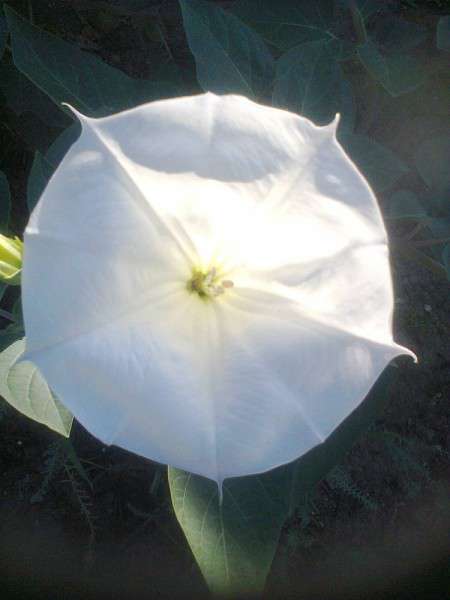
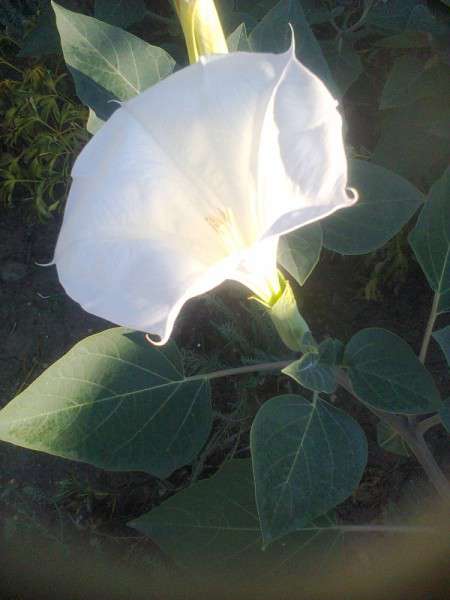
User Masha, Tula, July 8, 2017
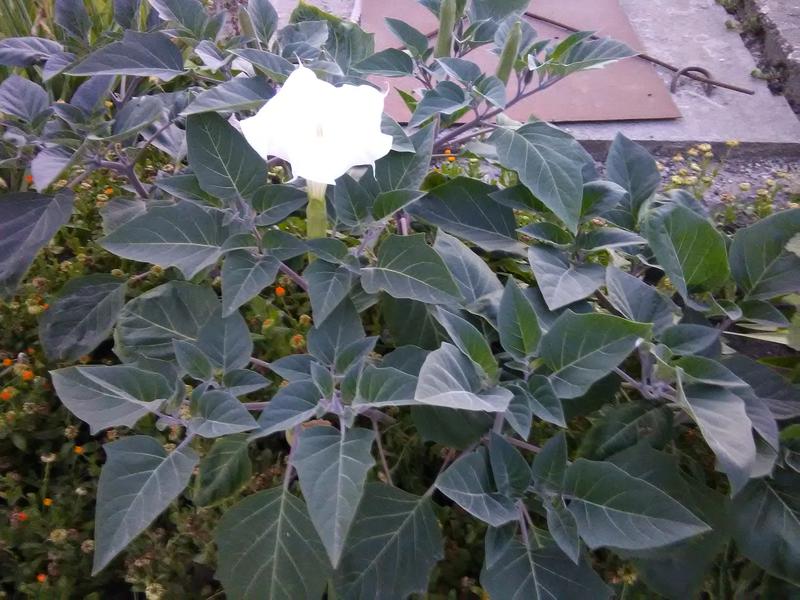
Beautiful, but poisonous. Grows everywhere.
User Lady-Flo, Russia, June 9, 2012
Datura metel (Solanaceae family). Native to Asia.
Variety "Ballerina"
This early flowering variety is recommended for growing as a pot plant and is characterized by a compact bush (height 30-40 cm) with large double flowers up to 10 cm in diameter.
The tubular flowers of the datura in the "Ballerina Tutu" variety come in a variety of colors: white-cream, golden-yellow, lilac-purple. I was so impressed by the beauty of these flowers that when I saw English seeds of this variety in the store, I couldn't resist buying them, despite the fact that the plant is poisonous. Apparently, this contrast (poisonous plant and magnificent, fairytale-like flowers) is captivating and appealing.
I sowed datura seeds at the end of March in loose, standard seed-making soil. Knowing that English seeds have a good germination rate, I didn't plant all of them, but only five. I germinated them at room temperature. The first seedling appeared after three weeks, and the remaining seeds slowly germinated over the next two weeks. Germination rate: 100%.
Now, after being planted in individual cups, the seedlings have started to grow quickly.
User Lyutsina, St. Petersburg and the region, Russia, June 9, 2012
The flowers have a wonderful aroma; my friend grew datura and even successfully propagated it by cuttings.
User Lady-Flo, Russia, June 9, 2012
Yes, the aroma is intoxicating. I grew datura a few years ago, and I had to keep them on the balcony... But the beauty of the flowers is hard to describe: huge, double, upward-facing bell-shaped flowers—yellow and white with purple edges—regal and luxurious. And a big advantage of these flowers is the short period from germination to flowering. It's no wonder that larger varieties are grown outdoors as annuals...
User Fyz, Minsk, January 20, 2014
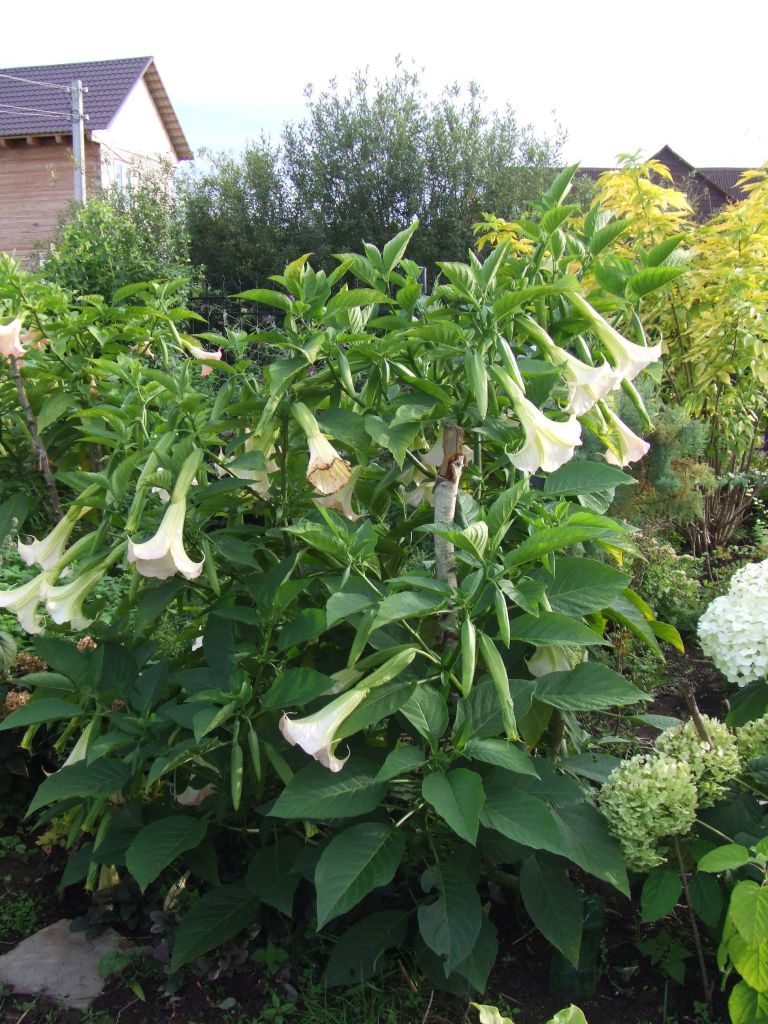
I'll add that it's easy to visually distinguish an orchid by its flower: Brugmansia flowers point downwards, while Datura (datura) flowers point upwards.
I have lilac double flowers on my seed packet. I haven't planted them yet, but for some reason I'm sure there will be white non-double ones.
experience..
I hope they sprout. For store-bought seeds, that's already a result.
User Petunia, Moscow, January 25, 2015
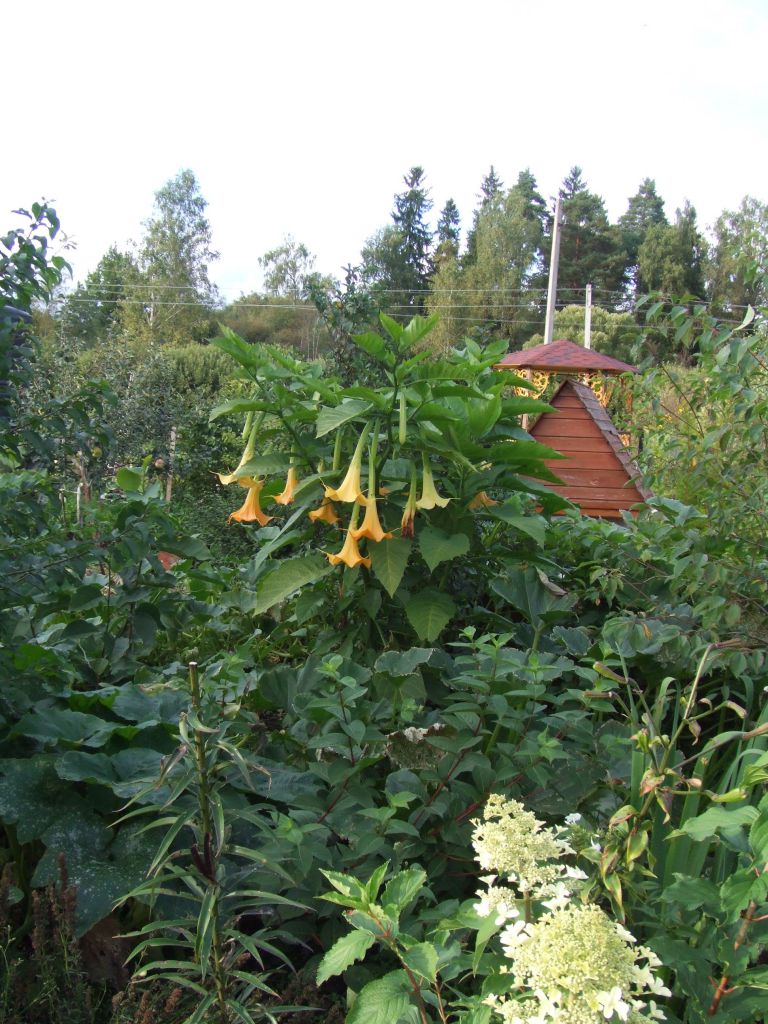
Last year, I planted brugmansia for the first time, three single-flowering varieties: pink, white, and yellow. The first two had flowers that stuck out at a 45-degree angle, while the yellow one had flowers that hung straight down. Their leaves also differed. The yellow one has leaves with distinctly serrated edges, while the first two have smooth edges or smooth, tapered teeth. Here are my brugmansias in summer: the first one has flowers that stick out at an angle, the second one has flowers that hang straight down.
User Gotval, Russia, Kaliningrad, January 29, 2019
Over the many years of gardening, there have been very few flowers that have tormented me as much as the Datura Ballerina, or more precisely, Datura, which is the Latin name for the datura.
Her seeds categorically refused to germinate! And from a wide variety of brands.
And at the same time, the species of datura, having flown in one day as a stray seed, jumped out of the soil like a jack-in-the-box. Having formed its prickly seed pods (much like unopened chestnuts), it treacherously cracked them. And the wind didn't miss a beat! And the following season, seedlings of this datura sprouted everywhere, right down to the flagstone paths. What a daring fellow!
Hello.
I encountered this flower a long time ago in Crimea, in 2008, and fell in love with it. The beautiful white flowers, somewhat reminiscent of large bells, usually open in the evening. Many people write that Datura has a scent or aroma (hence its nickname, Datura), but I honestly didn't detect any.
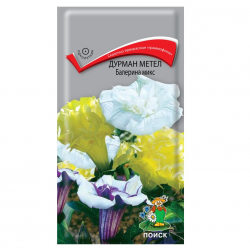
I came across some seeds online, only prettier because they were advertised as double. I wanted to buy and plant every color they had.
And what do you think... Nothing sprouted, not a single seed, and there were only 3 of them in a packet. And the price per seed was 30-50 rubles.
It's a shame that you buy it with the hope that at least something will grow, but the seeds don't germinate.
I planted mine from the regular white ones - they all hatched. But these ones did nothing.
Problem
A cross between a Datura species with purple flowers and smooth seed pods and a Datura species with white flowers and spiny seed pods produced 320 plants with purple flowers and spiny seed pods and 312 plants with purple flowers and smooth seed pods. What will be the phenotypes and genotypes of the offspring obtained from crossing these two F1 types?