Brugmansia is a small, beautiful tree (shrub) belonging to the Solanaceae family. It was formerly included in the Datura genus, but was later classified separately. The plant contains a highly intoxicating substance, which is why the flower is known as the "devil's tree."
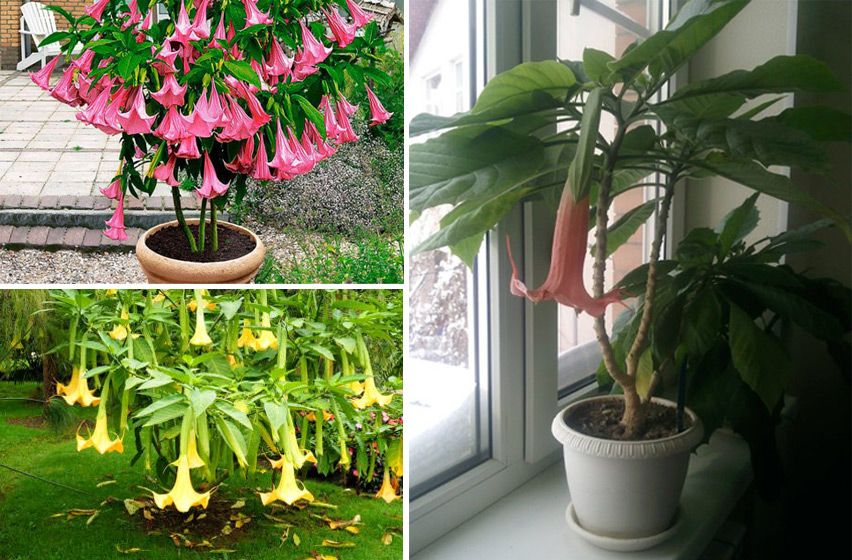
The bright, bell-like flowers, yet incredibly large, have earned it the names "Angel's Trumpets" and "Tropical Beauty." Native to South America.
Content
Description and characteristics of Brugmansia
Indoors, the bush grows up to 2 m. Its shoots grow very quickly, as does its root system. The leaves are oval with smooth edges and a fuzz-like surface.
Tubular flowers (15 cm in diameter, 20-25 cm long) come in white, yellow, and pink. Some bushes display several shades. They have a distinct fragrance. Only mature plants bloom several times a year.
Brugmansia varieties
Quite a few species of brugmansia are suitable for growing in an apartment.
| View | Description | Flowers |
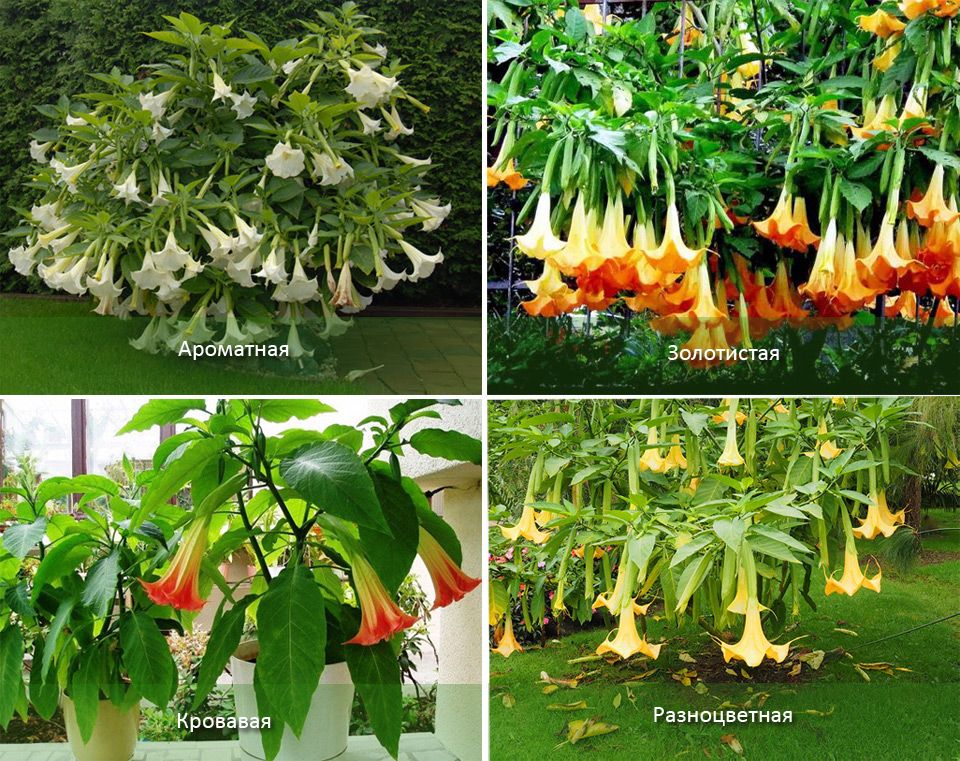
| Fragrant | A large bush (1-2 m). Can be grown indoors or in the garden. | Pure white or with a green tint (30 cm). |
| Golden | Unlike others, it has very large long leaves (50 cm). | Yellow-orange (30 cm). |
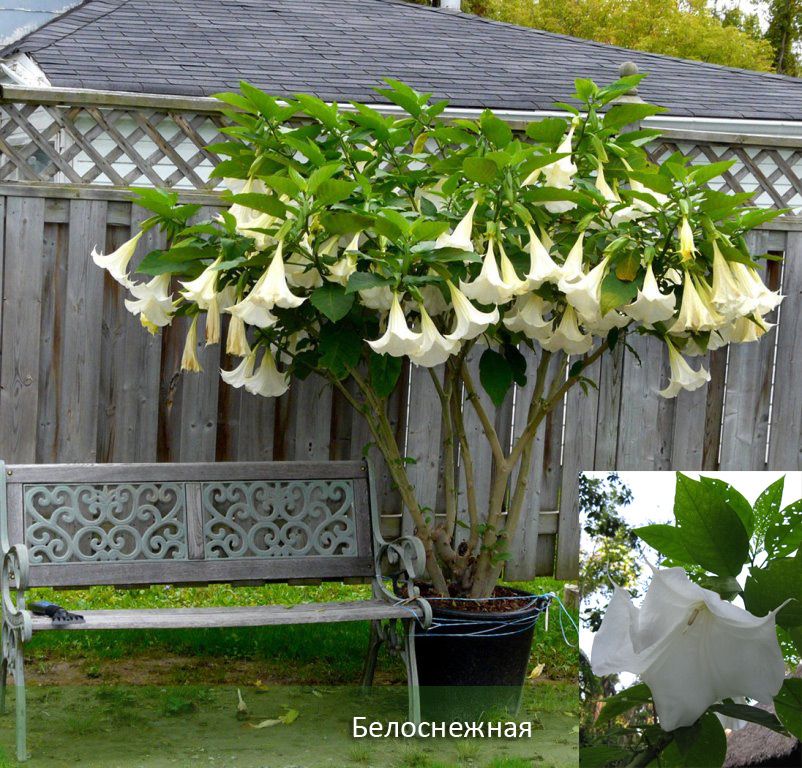
| Snow-white | Tree-like. Small. With velvety leaves. |
Snow-white (25 cm)/ |
| Bloody | Big. Winter-hardy. | Flame-colored (30 cm) Has an interesting smell. |
| Multicolored | The special feature is the longest flowers. | Very large (50 cm). With changing shades. Young ones are white. As they mature, they turn peach and orange. |
Caring for Brugmansia at Home and in the Garden
With indoor care and maintenance of brugmansia, both in tubs and in compliance with the care rules, it is possible to achieve year-round flowering.
| Factor | Spring/summer | Autumn/Winter |
| Location | It can be planted in the garden or transferred to a pot outdoors, but protected from the wind. | Keep away from heating appliances. Can be stored until spring. |
| Lighting | Good, but not in direct sunlight. If there's insufficient light, provide supplemental lighting. | |
| Temperature | +18…+28 °C. Tolerates heat. | +7…+12 °C. At -5 °C, it dies without shelter. |
| Humidity | Spray at elevated temperatures. | Adapts to low humidity. |
| Watering | Abundant and frequent. Reduce during flowering. | In the house - as the top layer of soil dries out. |
| With soft, settled water. Drain excess from the tray. | ||
| Top dressing | Apply mineral fertilizer for flowering plants once every 10 days, with a high potassium and phosphorus content. A solution of 1 part mullein to 10 parts water. | Stop it. |
| Soil | A soil mixture with any acidity. Use palm soil or the following mixture: humus, peat, and sand in a 1:1:1 ratio. | |
When planting and caring for the plant in open ground, you must also follow the rules:
- The soil is loamy, rich and nutritious.
- Water generously daily. In hot weather, mist with watering.
- In rainy, cloudy weather, water only after the top layer of soil has dried out.
- If the brugmansia is in a tub, drain the water from the tray.
- Fertilize like a potted plant.
Bloom
Brugmansia typically blooms from July to December. The flowers don't last long and fade quickly, but their abundance makes the plant appear to bloom continuously. After blooming, remove the flower stalks.
Brugmansia wintering
The end of November marks the beginning of the dormant period. At this time, the plant begins to shed its leaves. But it can be tricked. To do this, provide warmth, maintain the summer watering and fertilizing schedule, and provide lighting. This will allow the brugmansia to continue blooming. However, this disrupts its natural biorhythm. Therefore, it's best to give the plant a rest period before the next season.
In temperate climates, when grown in the garden, the plant is dug up, trimmed, and stored in a basement. If the region has mild winters, the plant can be covered for the winter without digging it out of the ground. One option is to cover the plant with straw, erect a garden frame, cover it with several layers of agrofibre, place plastic film on top and bottom to protect from moisture, and wrap it with rope.
Trimming
With proper care, don't neglect bush formation. Brugmansia is pruned in March. This is done before the growing season begins.
The first pruning is performed only on mature plants, in the second year after flowering. Weak, dry stems that have grown too much by 1/3 are removed. The Y-shaped stems, which will bear flowers, are left alone.
Methods of reproduction
Brungmansia is propagated mainly by cuttings, but sometimes seeds are also used.
cuttings
Propagation by cuttings is used in autumn or spring:
- Young but woody stems with a growth point and 2-3 buds are cut off, and the leaves are removed.
- Take an opaque container, fill it with water and soluble carbon, and place the planting material inside.
- They create illumination and temperature of +20 °C.
- When roots appear (2 weeks), plant them in separate pots.
- The soil is taken loose, breathable, consisting of peat, perlite, sand 2:1:1.
Seeds
Growing from seeds is a difficult and lengthy process, and the properties of the variety may not be preserved.
- Plant in the first months of winter or early spring.
- For better germination, seeds are kept in Kornevin.
- Take a container with light soil, distribute the planting material there, deepening it by 0.5-1 mm, and moisten it.
- Cover with a transparent lid (glass, polyethylene).
- Provides +20…+25 °C, good lighting.
- After the seedlings appear, the film is removed after 2 weeks.
- The crops are sprayed with settled warm water at least 2 times a day, being careful not to flood them.
- When the fifth leaf appears, the seedlings are planted.
Brugmansia care difficulties, diseases and pests
The bush is resistant to diseases and pests, but if you do not follow the rules for caring for this tropical beauty, they may attack it.
| Manifestations | Reasons | Elimination measures |
| Falling leaves. | Interruptions in hydration. | Water correctly, taking into account the temperature regime. |
| Elongation and thinning of shoots. Pale foliage. | Lack of light. | Move to a window with sufficient light. Provide additional lighting with lamps. |
| Slowing growth. | Lack of fertilizers. | Follow the feeding rules. |
| Loss of young buds. | Lack of moisture, sudden temperature changes, little light. | Establish a watering regime. Provide good lighting. |
| Eaten leaves and flowers, their falling off. | Weevil. | Spray weekly with Actlik or Fitoverm until the insects are destroyed. |
| Yellowing, weakening of the plant. | Whitefly. | Use traps, spray with Actellic. |
| The appearance of insect stickiness. | Aphid. | Wash with soap solution. Treat with tobacco dust infusion. |
| Leaf discoloration, web formation. | Spider mite. | Increase humidity (tray with wet expanded clay, humidifier). Spray with Aktara. |
| The appearance of holes. | Slugs, snails (when outdoors). | Treat with insecticides (Actellic, Fitoverm, Iskra). |
Top.tomathouse.com warns: Brugmansia is a datura flower.
Despite the flower's splendor, it is poisonous. Its scent causes headaches in some people. Because of this, brugmansia is even banned from cultivation in some countries (for example, Argentina). The plant's toxic compounds cause hallucinations. Therefore, care should be taken when growing this shrub in households with children.