Ficus benjamina belongs to the Mulberry family and is native to South Asia, the Philippines, and Australia.
Content
Description
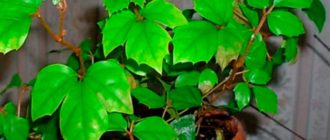
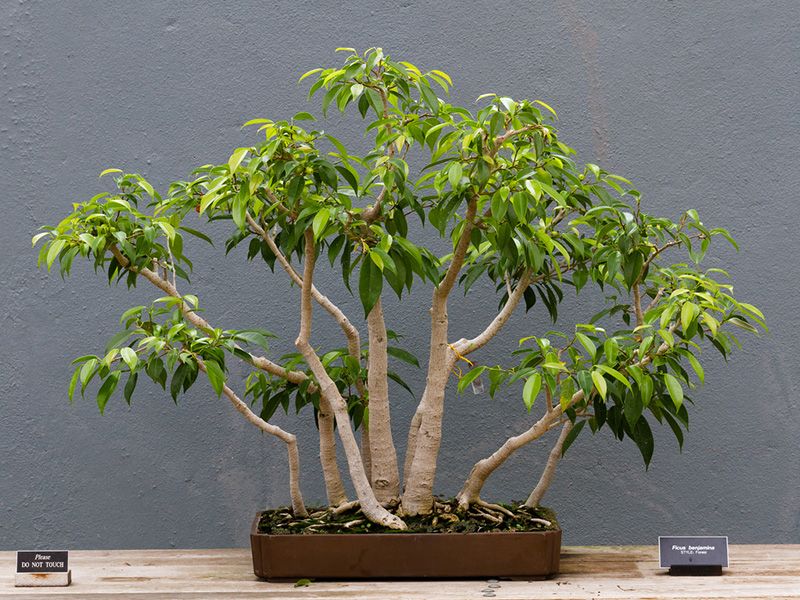
Ficus benjamina grows both in the wild and indoors. In the wild, it reaches a height of 8-10 m, while indoors it reaches 1.5-2 m. The plant has a dark, striped trunk. Its branches droop downward. The leaves are rounded, with elongated margins, 4-8 cm long and 1.5-4 cm wide, thickened, and glossy. Their color ranges from white and light green to dark. Ficus benjamina produces spherical or pear-shaped inflorescences, 2 cm in diameter. They are pollinated by Bastophagi, which prevents the plants from maturing. The inflorescences are used for planting.
Varieties for home growing
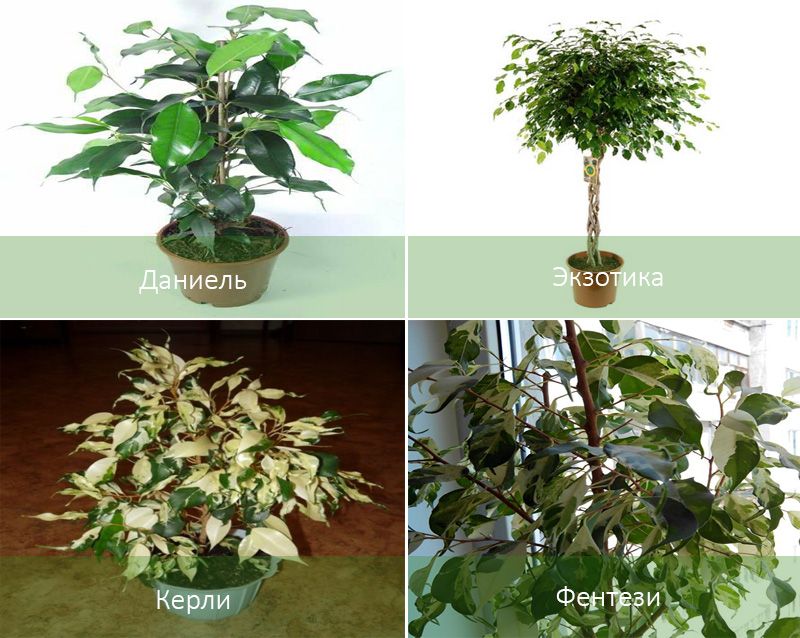
Ficus benjamina comes in a variety of cultivars. They differ in leaf color and care requirements.
| Variety | Foliage | Peculiarities of care |
| Daniel | 6 cm dark green tone. | Unpretentious. |
| Exotica | 6 cm green. | Able to tolerate low light conditions. |
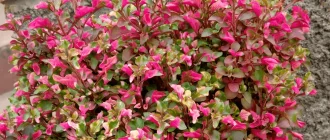
| Curley | 3-5 cm curved. Part or all of the leaf is white. | Grows slowly, prefers brighter locations, and requires protection from the sun. |
| Fantasy | 6 cm green or dark green. | Unpretentious, can tolerate lack of light. |
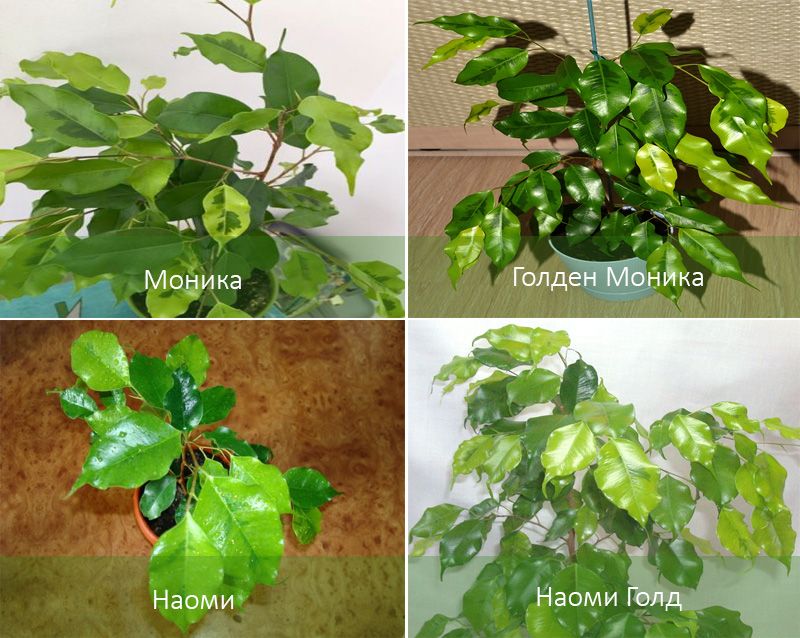
| Monica | 6 cm green, corrugated at the edges. | Unfussy. |
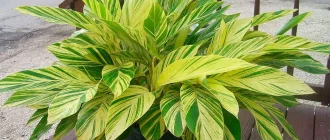
| Golden Monica | 6 cm, corrugated at the edges. Light green-gold color with dark green stripes in the center. | Resistant variety. |
| Naomi | 5-6 cm, round with pointed ends, slightly corrugated at the edges. | An unpretentious variety of fast growth. |
| Naomi Gold | Light green in color, with dark strokes. | Needs protection from sunlight. |
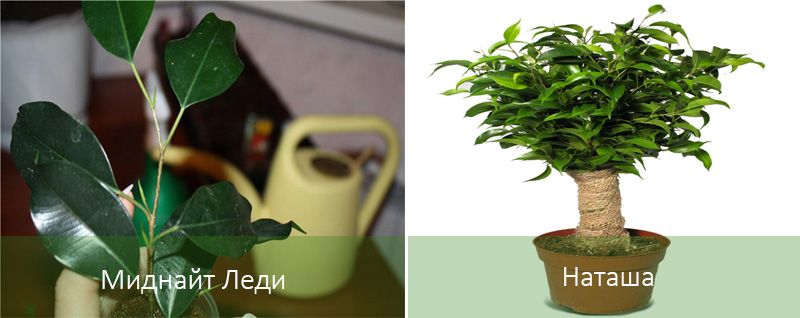
| Midnight Lady | 6 cm, dark green, with corrugated leaves at the edges. | Unpretentious. |
| Natasha | Small-leaved species. | Average growth development. |
Home care
Ficus Benjamin is capricious, but if you follow the care rules, it will grow very well.
Lighting, temperature, watering, fertilizing
| Care parameters | Winter, autumn | Spring, summer |
| Location | Bright, warm locations. When temperatures drop, insulate the roots. | Well-lit, insulated places protected from sunlight. |
| Temperature | Not less than +15°C. If the roots are insulated, it can tolerate temperatures below +10°C. | +20…+25°C. |
| Lighting | The light is bright, additional lighting (if the sun's rays do not reach). | Bright light, but diffused. |
| Humidity | Spraying the leaves, sometimes rinsing under the shower. | Regular spraying with boiled warm water. |
| Watering | Contraction (when temperature drops). | Moderate, after the soil has dried out. |
| Top dressing | It stops in September (late September). It's prohibited in winter. | Once a month. |
Soil, replanting, container
The soil should be slightly acidic, intermediate, and well-drained. You can make your own; you'll need:
- deciduous turf;
- sand;
- peat.
Ratio 1:2:1.
Repotting is done once in early spring (for young seedlings). Each time, the pot should be a few centimeters larger than the previous one. Plastic or ceramic is best.
An adult Ficus Benjamin needs to be repotted once every 3 years, when the roots occupy the entire container.
Reproduction
Ficus Benjamina is propagated by seeds, cuttings, and air layering.
- The seeds are sown in the spring, when the inflorescences have completely changed shape, size, and color. The soil containing the seeds is covered with plastic wrap and stored in a sunny, warm place for one month. The seedlings are then transplanted into separate pots.
- Not all ficus species can be propagated by air layering, but Benjamina is one such example. To do this, select a woody branch or trunk and make a ring-shaped cut in the bark, leaving the wood intact. The exposed portion is wrapped in damp sphagnum (peat moss). This structure is wrapped in plastic film, and the edges are secured with wire or tape. When the roots become visible through the film, it is removed, and the resulting seedling is cut off (be sure to cut below the roots). This plant is replanted as usual, and the cut on the parent tree is treated with garden pitch or ground charcoal.
- Cuttings are taken from a mature plant; the base of the future seedling should be semi-woody (not green, but flexible). The stem should have 4 to 6 leaves. The cuttings are cut to 15-20 cm long, immersed in warm water for 2 hours (to release the white sap), then rinsed and immersed in purified, boiled water. Charcoal is added to prevent rot. Once roots appear, the cutting is replanted under plastic wrap. The plastic wrap is gradually removed to allow the plant to acclimate to room temperature.
Formation of Ficus Benjamin
The tree grows quickly and requires shaping. If the ficus is growing on a windowsill, it should be rotated 90 degrees every two weeks.
Lateral shoots are pruned while the bud is dormant. The cut is moistened and covered with charcoal. The small bush is pinched (i.e., the apical buds and those located at the ends of the shoots are removed).
Diseases and pests
Ficus, like many trees, is susceptible to insect attacks, including scale insects, mealybugs, and thrips. To eliminate scale insects, use Fitoverm, Actelect, and Aktara. Mealybugs are collected by hand.
Mistakes in care and their correction
| Manifestation | Cause | Correction |
| Paleness of foliage. | Not enough light. | Place in a well-lit place. |
| Paleness and wilting of leaves. | Overwatering. | Do not water or transplant to another pot. |
| Shedding of leaves. | This is normal in autumn. If the leaves are falling heavily, the plant is likely in a draft or the temperature is too high. | Remove to another location, adjust the temperature. |
Signs about the Benjamin ficus and its benefits
The Slavs believed that the ficus tree had a negative influence on people. Families where it grew were constantly in chaos, with people arguing and settling their differences for no apparent reason. Women were unable to marry. However, there is also an opposite belief: in Thailand, this sacred tree is considered a benefactor, strengthening family relationships, and bringing good luck and happiness.
In fact, the Benjamin ficus can only be harmful to those allergic to it. It secretes a milky sap called latex, which can trigger asthma if it comes into contact with sensitive skin. However, the plant's benefits are also noticeable: it purifies the air and kills viruses and bacteria.