Gasteria is a close relative of the well-known aloe. This unusual ornamental plant, native to South Africa, is familiar to everyone for the vibrant color palette of its buds and their distinctive shape.
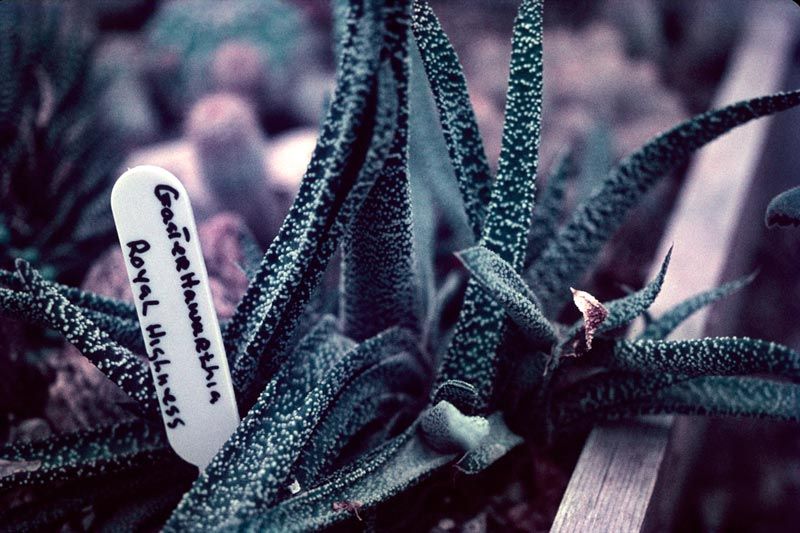
Description and appearance of gasteria
Gasteria is a plant with specialized tissues for water storage. It grows in the subtropical zone of the hot deserts of South Africa. Thanks to its specialized leaves, it is able to store essential water reserves in its tissues, allowing it to withstand the extreme conditions of arid climates.
Belonging to a species of perennial plant, it is distinguished by its thick, tongue-shaped leaves, which has led to its informal name, "lawyer's tongue." The official name, "pot-bellied vessel," refers to the flower bud's distinctive bottle-like shape.
The coloration varies between various shades of green (from light to dark) and depends on the variety. Some gasterias also have small white spots, the pattern of which varies from plant to plant.
The flowers, located on a peduncle, are colored in various shades: white, orange, green, red, pink-cream.
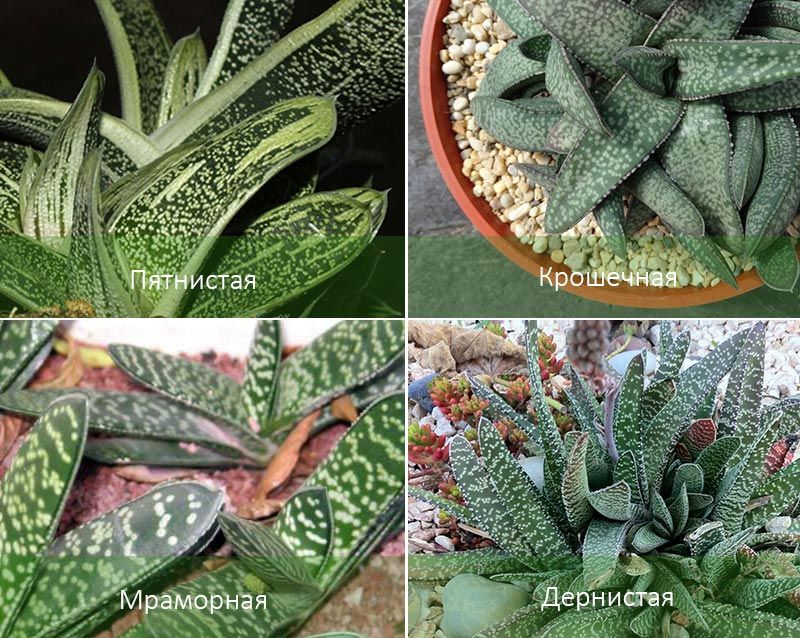
Gasteria verrucosa and other species, photos and names
Due to the specific conditions of the plant's habitat, cultivators have selected only about 10 representatives for home cultivation.
| View | Description |
| Warty | The most common variety. The leaves are fleshy but quite thin. Moderately concave in the middle, they are dark green with a slight blue tint. Small white spots protrude from the surface along their entire length. During flowering, buds appear, resembling half-closed bells. The plant reaches 80 cm in length. |
| Tiny | Small in size (around 30 cm). The rosettes that form with age are about 5 cm long. The leaves are smooth, wide, and tapering at the tip. They are arranged in pairs and grow spirally. They are a rich green near the base, turning pink at the tips. |
| Spotted | It is distinguished by its emerald leaves, which are dotted with small white spots. The plant grows up to 20 cm in length. The leaves grow in pairs, are smooth, and quite wide. Over time, they develop a spiral growth pattern. The flowers are a rich red, edged with a thin green stripe. |
| Armstrong | It differs from its relatives by the presence of prominent, raised white spots on the green leaves, which create a rough surface. The rosettes that form with age reach a height of 5 cm. As the leaves grow longer, they fold back toward the ground. This variety blooms year-round. The buds are vibrant, with shades of pink or coral. |
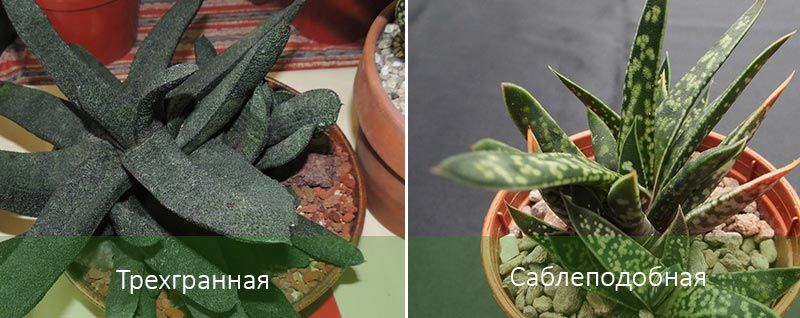
| Saber-like | It is distinguished by the characteristic shape of its leaves, which have a cylindrical base and taper toward the tip. They are dark gray-green in color, with small white spots on their surface. The buds are shades of red. The leaves reach 30 cm in length. |
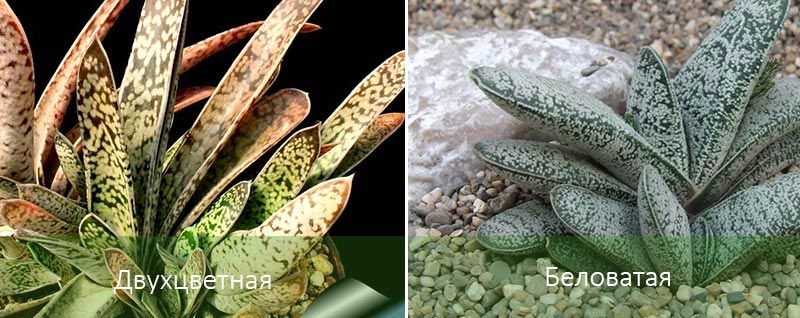
| Two-tone | It has rather thin, concave emerald leaves with small creamy "warts." The buds are red, gradually fading to white. The rosette widens significantly as it grows. |
| Whitish | It has large, sword-shaped, dense, and straight leaves of a rich, dark green with light yellow spots along its entire length. The plant reaches 1 m in height. The buds are pink or red. |
| Soddy | A low plant, no more than 18 cm tall. Rosettes are formed by smooth, green leaves. Small, flush-surfaced spots are visible along the entire length. The flowers are red or pink. |
| Marble | It has many similarities with the previous species. This species has slightly wider leaves, and the spots form a marbled pattern. |
| Triangular | The plant is medium-sized, about 2 cm tall. The leaves are fairly wide and triangular. They are emerald green with transverse white stripes. The buds are pink. |
Caring for gasteria at home
Gasteria is ideal for beginning gardeners. It's relatively low-maintenance. However, there are several key site considerations for successful growth:
- It is important to avoid direct sunlight on the plant, as this increases the risk of losing the pattern on the leaves at best and dying at worst (however, it should receive some amount of heat and sun, so the flower should be placed in the southeast/west);
- A favorable temperature for growing is considered to be +22…+25°C. A cold snap to +12°C will not have a significant negative impact. During periods of low temperatures, it is not recommended to place gasteria near radiators, as the amount of heat generated will negatively impact growth and development.
- It is recommended to regularly ventilate the room, but make sure that the plant is not exposed to drafts.
Due to the ability of gasteria to accumulate sufficient water reserves in tissues, two watering regimes should be followed (it is prohibited to allow the soil to dry out, especially during the period from early spring to mid-autumn, since the plant is actively developing during this period):
- once a month in winter;
- once a week in other seasons.
It is recommended to wash the leaves to remove dust, but care must be taken to ensure that the plant is not exposed to strong sunlight and does not get burned.
Gasteria is also undemanding regarding soil conditions. A special soil for growing cacti is ideal. The optimal composition for maximum benefit is as follows (5:3:2:4, respectively):
- turf;
- leaf soil;
- peat;
- sand.
To prevent significant amounts of water from being retained in the soil, it is recommended to add expanded clay or brick chips.
The use of fertilizers is justified only in the spring-summer period during the active growth and development of gasteria, with a frequency of once every 2-3 weeks.
Cactus fertilizer is optimal for this, but with a slightly lower concentration. Nitrogen should be applied cautiously and in very small quantities to prevent plant death.
Transfer
The plant is repotted on average once a year in the spring. This frequency is due to the slow growth of gasteria.
To carry out the transplant you will need:
- a flower pot of sufficient size;
- drainage material;
- prepared soil.
The transplant process is as follows:
- prepare the pot by adding drainage material (for example, brick chips) to its bottom;
- remove the plant along with the soil and move it to a container;
- transfer the remaining soil into a new pot;
- separate young rosettes to enhance adaptation to new conditions.
Top.tomathouse.com explains: flowering and dormant periods
Most gasterias (except for the spotted one) experience a dormant period in the fall and winter, when characteristic seed pods appear in place of the flowers. Flowering begins in the spring or summer.
Reproduction
Gasteria can be propagated by sowing seeds, young rosettes or individual leaves.
To sow seeds you need:
- buy seeds or collect from a plant;
- pour sand into a container and moisten it, distributing it evenly;
- place seeds on the surface;
- cover the entire container with film, forming a kind of greenhouse;
- maintain a temperature not exceeding +20 °C;
- After the shoots appear, remove the film.
Propagation by young rosettes consists of transplanting the shoots formed near the plant into another pot.
This method is recommended to maintain the purity of the plant variety.
Propagation by leaves:
- Select healthy, whole and strong leaves by cutting them off.
- Dry for 2-3 days.
- Prepare a container with moistened sand.
- Root in prepared soil without watering for 20 days.
Problems with growing, diseases, pests
Improper home care or disease can reduce the decorative value of a succulent. Therefore, it's important to understand the main problems.
- When there is a lack of light, the rosettes stretch out and become thinner.
- If specific care is not followed during dormancy and flowering, spots fade and leaf edges curl.
- When temperatures rise in winter, leaves dry out and die.
- If there is not enough space in the container for the plant, it curls up and stretches out.
- Intensive watering causes leaves to fall, and uncontrolled use of fertilizers causes their color to change.
Gasteria is attacked by a sufficient number of pests:
| Pest | Method of elimination |
| Aphid | For eradication, use a solution of laundry soap or the drug Aktara. |
| Mealybug | |
| Spider mite | Increase humidity parameters, use Neoron or Agravertin and cover the plant with a plastic bag. |
| Scale insect | Use Aktara and remove scale insects manually. |
| Thrips | Spray with Fitoverm. |
Gasterias are virtually free of diseases. The most common is gray mold, which causes rotting and death of the plant during heavy watering in cold temperatures.
Reviews and tips for growing gasteria
Tongue-toothed succulent (+photo) — updated January 21, 2014
Hi all!
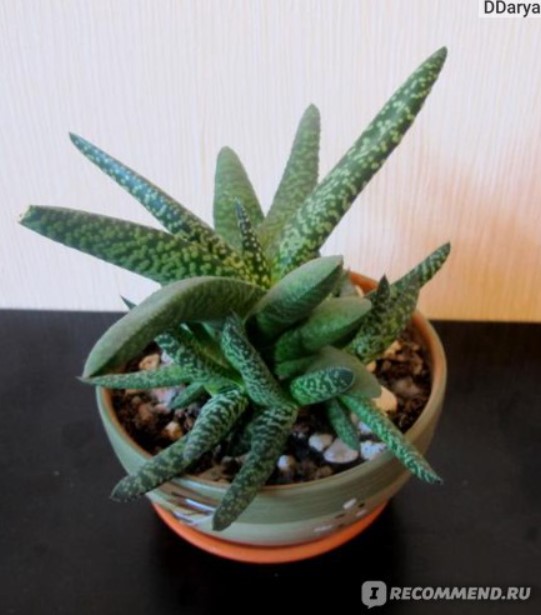
Today I want to show you one of my green favorites - the succulent Gasteria.
I bought this plant three years ago as a small rosette in an Auchan succulent mix. Since then, it's been growing steadily and bringing me nothing but joy.
Gasteria grows wild in South Africa, but is now sold in almost all our stores. It got its name from the shape of its flower, which resembles a stomach. (I had one bloom last year, but I didn't take a photo, so I've included a photo from the internet in the information section.) The fleshy leaves of the gasteria resemble tongues.
Gasteria is considered even more low-maintenance than aloe and haworthia. They're said to tolerate partial shade. But I keep mine on the south-facing windowsill in my bedroom. After all, like many succulents, gasteria absorbs carbon dioxide and releases oxygen at night. So keep that in mind!
P.S. Standard care for succulents: light soil with plenty of coarse sand, infrequent watering, fertilizing with succulent fertilizer every 2 weeks in the summer.
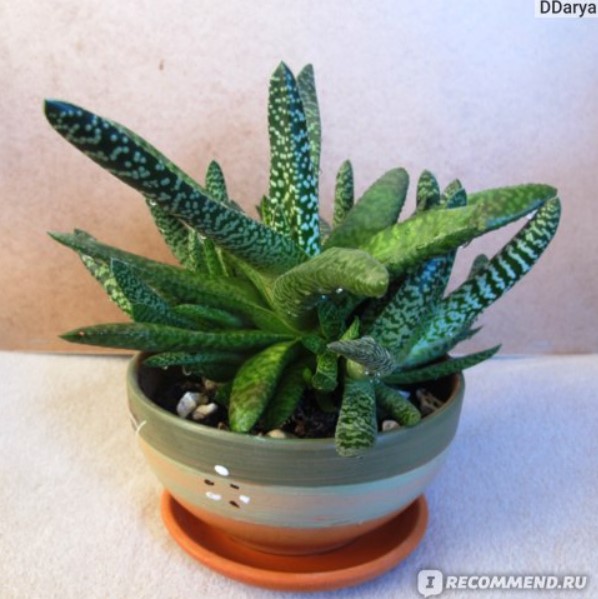
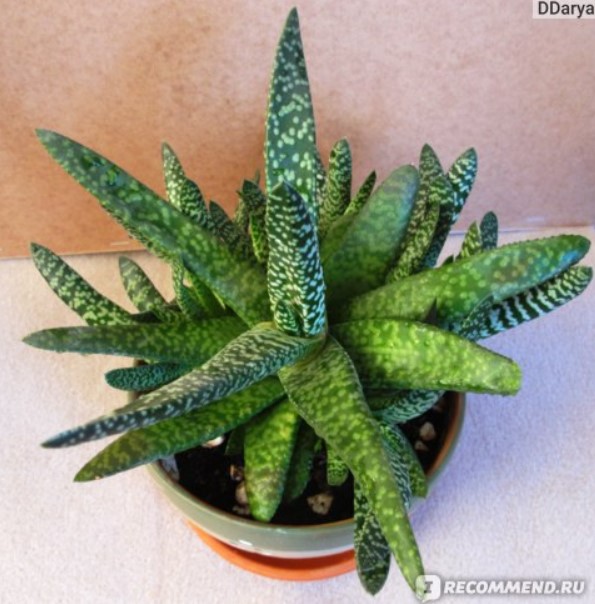
Update 21.01.12
I took a photo of my plant a year and three months after writing this review. You can see that the gasteria has produced several new rosettes. And overall, it's growing like most succulents—slowly but surely. :)
My other succulents, which I have already written reviews about:
Haworthia
Kalanchoe "Antlers"
Adromischus
Stapelia
Advantages
Compact
Unpretentious
DDarya
recommends
·
Hello! My gasteria froze—in the photo, where it's dark, it's completely soft, like jelly. Have you had any experience reviving frozen plants, or is it now just trash?
Thanks in advance for your answers 🌿
Nina Rukavishnikova, December 7, 2021
Now all we have to do is wait. The frozen tissue will quickly die, and it will become clear whether there's anything alive left and whether anything can be done about it.
Apparently the ground was damp and frozen. In dry soil, it would have remained alive, as would the tips of the leaves.Tatyana Galkina · The author responded to Nina
Nina, it's been a while since we've watered, but it's still possible, as they're drying out slower now than in the summer. It was -20°C overnight, and we had a window with micro-ventilation and insulation around the plants, but apparently there was still a draught. The radiators are so hot that if you seal the windows completely, people are starting to die.
Petr Lapshin, December 7, 2021
Gasterias propagate easily from leaves. Cut off any hard, not soggy, leaves, let them dry for a week, and then plant. They take about a month to root, and buds appear in 3-6 months.
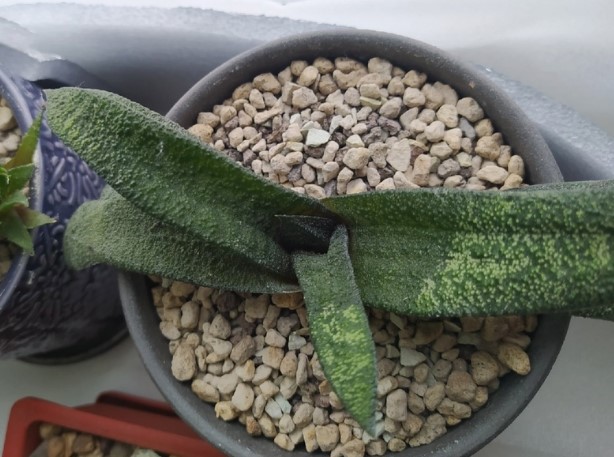
Well, I finally decided to trim the gasteria.
I cut off the top as advised, sprinkled the cut with cinnamon (correct?), and sprinkled a little more rooting agent on the bottom of the crown.
Now I have a question: should I dry it in the light or in the dark for 10 days? Or does it make no difference?
Regarding the remaining plant: where do the gasterias' babies appear? The entire lower part is covered in dried leaf debris (quite hard), and I'm afraid the babies won't emerge. Should I clear the trunk of them?Asio Otus, August 09, 2011, 9:29:54 PM
It does matter that if you dry the cuttings in direct sunlight, they will dry out. Place them in a bright, cool place, away from direct sunlight.
The babies will grow in the leaf axils, where the plant itself will decide and will also depend on the brightness of the light.
elen.cactus, August 10, 2011, 9:03:31 AM
No need to place it by a window or under a lamp. Place it anywhere. Bright, but protected from direct sunlight. It doesn't even have to be bright, but it must be out of direct sunlight.