Guzmania (Guzmania) is a herbaceous evergreen plant, a close relative of the pineapple. It has only recently come into cultivation as an ornamental plant. It is native to the tropical forests of India and South America. It is named after its discoverer, the Spaniard Anastasio Guzman. Its distinctive feature is its long flowering period—up to several months—after which the plant dies, leaving behind its offspring.
Description
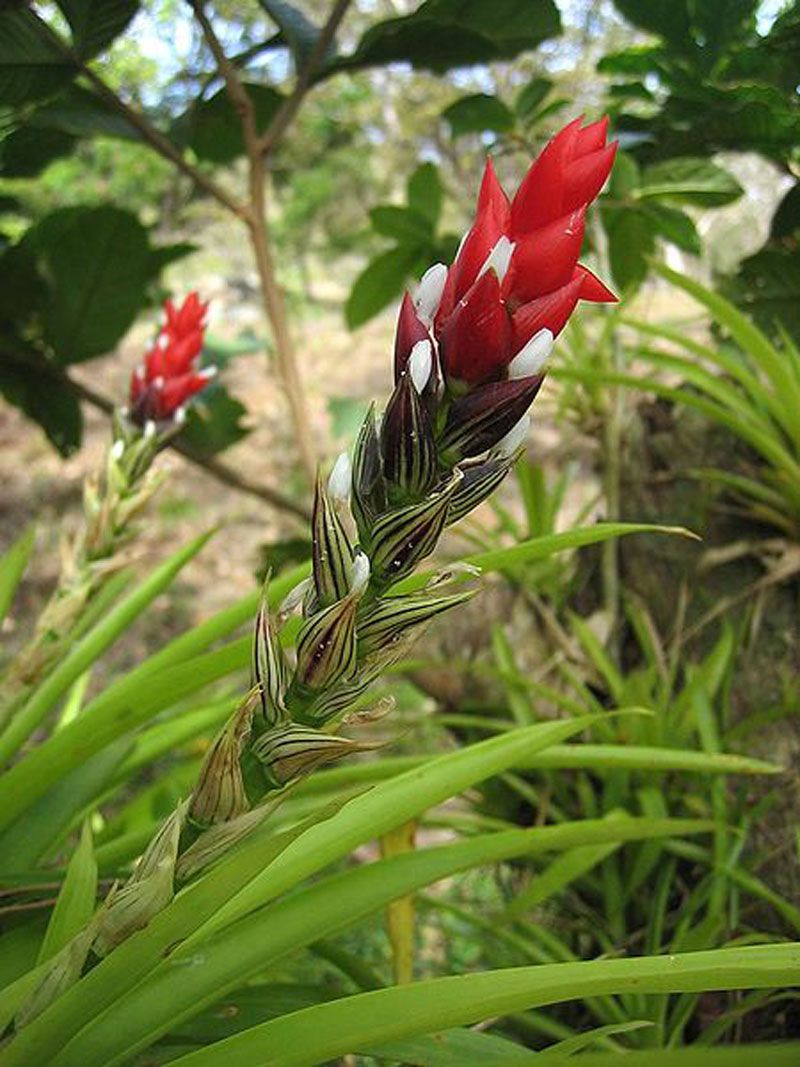
The plant grows up to 80 cm tall, with long leaves forming a rosette 20-25 cm in diameter. The inflorescence is centrally located, upright, and brightly colored.
The distinctive feature of the bloom is the vibrant color of the bracts, which lasts for a very long time. The flowers themselves are unremarkable. This plant is epiphytic and not parasitic.
Important: The plant's sap can cause skin irritation and allergies, so people prone to allergic reactions should not have guzmanias.
Types of Guzmania
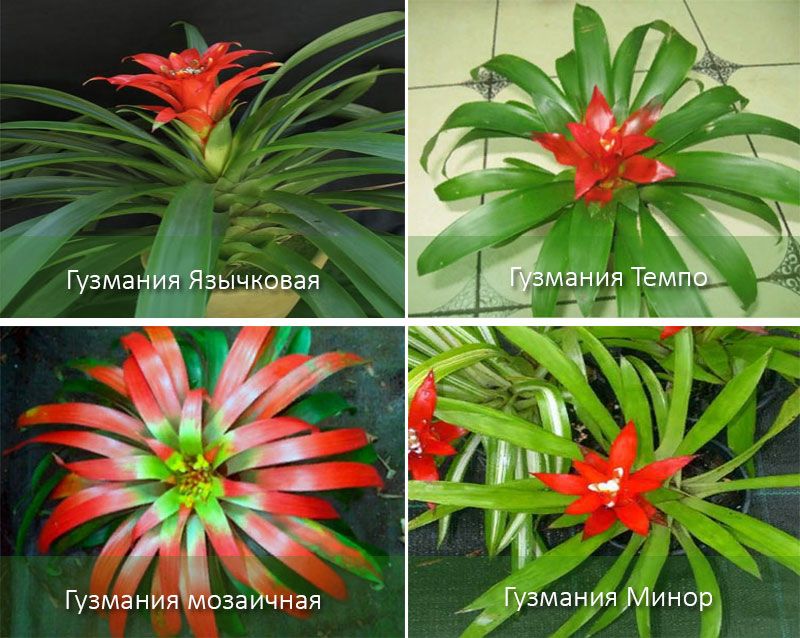
There are approximately 200 species, some of which are grown indoors. More than 10 hybrids have been developed.
| View | Characteristic |
| Donella Smith |
|
| Blood Red (Big) |
|
| Mosaic |
|
| Lingual |
|
| Minor |
|
| Tempo |
|
| Nicaraguan |
|
| Conifer |
|
| Single-eared |
|
| Zana |
|
| Optima |
|
| Hilda |
|
| Ostara |
|
Guzmania Mix is a combination of different varieties in one container.
Content Features
Home care does not require any special skills.
| Parameter | Spring – summer | Autumn – Winter |
| Location/lighting | Diffused light. While the plant is flowering, it can be completely switched to artificial light. | Direct sunlight. |
| Temperature | +23…+27°С | |
| Watering | The soil should not dry out, and should be watered daily. Water the rosette formed by the leaves. Use only distilled or purified water, warmed to 20°C. | |
| Fertilizer | Once a month. | Once every 2-3 months. |
| Air humidity | Spray three times a day. | Spraying daily in the morning. |
After flowering has finished, the flower stalk and old dying leaves must be cut off.
Important: Water getting on the bract will shorten the flowering time.
Fertilizer
Use only specialized fertilizer. When purchasing, be sure to check for boron and copper. Reduce the dosage to half the recommended dose. Fertilize with watering.
Transplantation and propagation: choosing a pot and soil
The plant should be repotted only for propagation and in extremely rare cases (disease, changing the pot).
Transplantation step by step:
- water the soil well;
- leave for a few hours;
- carefully remove the plant from the pot, trying not to destroy the root ball;
- lay a drainage layer (expanded clay is preferred);
- place the guzmania vertically and sprinkle with soil;
- water.
The best time is the end of the flowering period. It's best to buy a ready-made soil mix specifically for bromeliads.
Before planting, the soil must be sterilized.
Since the roots of the guzmania are small, the pot should also be small in size (diameter 10-12 cm), but stable.
Perhaps you should deliberately weigh it down. The pot's diameter should be slightly larger than the root system. Ceramic pots with good drainage holes are best.
Reproduction
After flowering, "baby" shoots emerge from the base. As they grow, the older plant dies. When the young shoots have developed a root system (at least 1 cm), they are separated from the mother plant with a sharp knife and planted in a separate pot. The cut areas are always treated with tar. Cover with plastic to maintain a comfortable humidity level.
Guzmania can also be propagated by seed. Here's how:
- disinfect the seeds by keeping them in a solution of potassium permanganate;
- scatter over the soil surface, press lightly;
- spray with water;
- cover with a plastic bag to create a "greenhouse";
- monitor the humidity level and temperature (not below +25°C);
- After three weeks, when the seedlings grow, remove the film;
- plant out after picking.
Young guzmanias grow very quickly and require the same care as mature plants. They don't need to be separated from the mother plant (just carefully remove the old one), and they'll bloom within a year.
Diseases, pests and care errors
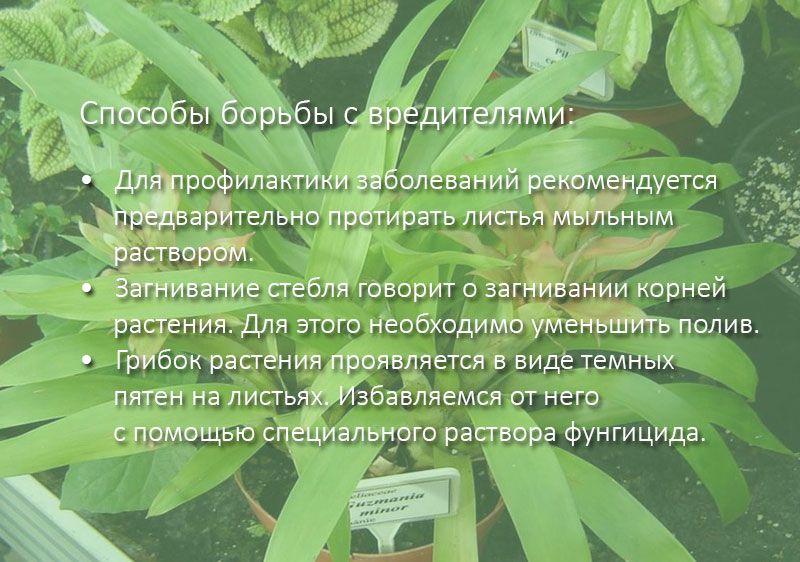
As a rule, all diseases of this flower are the consequences of improper care or the result of pest damage.
| External signs | Cause | Solution |
| Sticky discharge, yellowing of leaves. | Scale insect. | Treat with a soap-alcohol solution. Cut off the damaged part. |
| Cobweb. | Mite. | Increase humidity, ventilate the room, and in case of severe infestation, treat with an insecticide. |
| Whitish coating. | Mealybug. | Remove mechanically, you can also cut off damaged parts. |
| Small round blisters on leaves. | Fungal disease. | The infected plant must be destroyed (there is no cure). |
| Does not bloom. | Not enough light and warmth, possibly too much moisture. | Review care. |
| The tips are brown. | Not enough water. | Increase watering. |
| Darkening of leaves. | Lack of light. | Change location. |
| The leaves have become lighter. | Excess of light. | Change the location or shade the plant. |
| The leaves have withered. | Stagnant water. | Dry it out and stop watering temporarily. |
| It's not growing. | Poor soil or insufficient light. | Feed, change location. |
| The leaves are drying up. | Dry air. | Increase spraying. |
Signs and superstitions
There are several beliefs and superstitions surrounding this plant. Among the indigenous peoples of South America, it is considered a symbol of masculine potency. This has a scientific basis, as guzmania produces a natural aphrodisiac. Locals believe that this flower brings peace and harmony to the home and family. It is also a symbol of prosperity and well-being.