Caladium is a member of the herbaceous family Araceae, native to the tropical forests of Central and South America, where it grows up to five meters in height. It was first described in the early 19th century by a French botanist. It is a tuberous plant.
In its historical homeland, caladium is cultivated for its nutritious tubers, which are used in cooking. Ornamental varieties are grown as houseplants and garden plants. A characteristic feature of caladium is that the depth of the tuber's growth affects the plant's appearance: if the tuber is deeper, the leaves are larger; if it is closer to the surface, the leaves are more numerous.
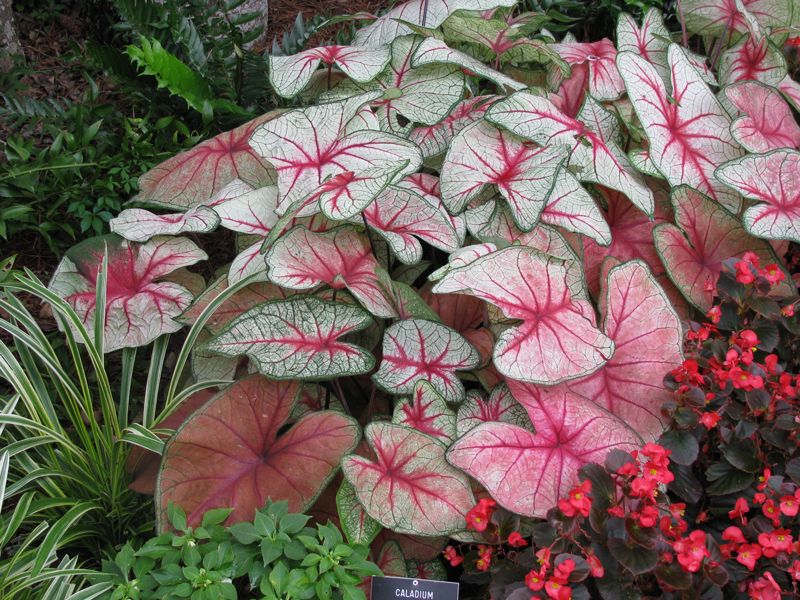
The plant's sap is poisonous. Other names: "angel wings," "elephant ears," and "heart of Jesus."
Description
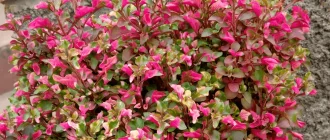
A spreading, stemless shrub with large, decorative leaves. It grows up to 1 m in height. The leaves, up to 30 cm long, are heart-shaped and vibrantly colored. Leaf color varies by species and can be silvery, pink, or crimson.
A perennial with dormant periods. In the fall, all above-ground parts dry up, and new leaves emerge the following spring. Flowering occurs in late spring, with virtually no scent. It blooms very rarely indoors.
The root system is a tuber up to 10 cm in diameter and fibrous roots extending from it.
Types of caladium and their characteristics
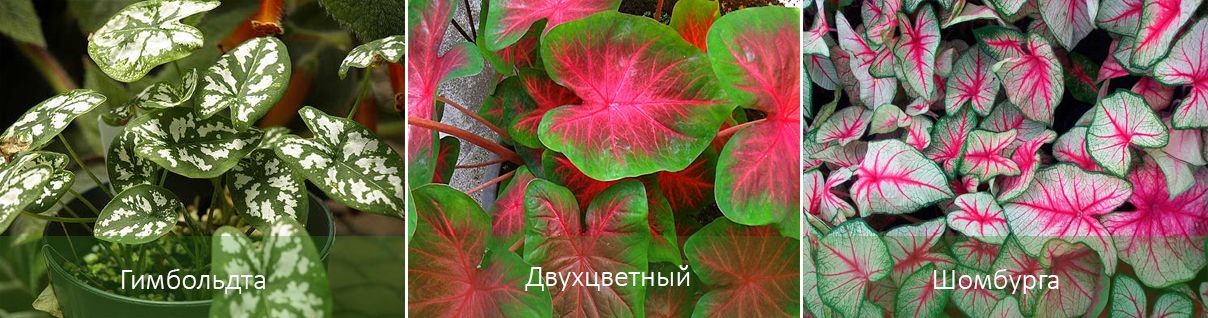
There are 15 known species of caladium grown for ornamental purposes. The most popular are gumboldtii, bicolor, and schomburgii.
| Species name | Description |
| Gimboldt | The leaves are small, up to 10 cm long; they resemble arrowheads, and are variegated with silvery spots on a green background. It blooms in April and is inconspicuous. With supplemental lighting, it does not enter a dormant period, retaining its foliage. |
| Two-color | Many hybrids have been developed from this base variety. The leaves are arrow-shaped, 25-30 cm long, and up to 17 cm wide. Their color varies depending on the variety. It can be variegated, with white and red spots scattered on a green background, or red with a thin green border. The White Christmas variety has silvery leaves with fine green lines and spots. It blooms in late winter to early spring. The flowers form a spadix. |
| Schomburg | The leaves are oval, smaller than those of the bicolor variety. The color is silvery-red, with green veins. Popular hybrid varieties include: veined, red, and silver-veined. |
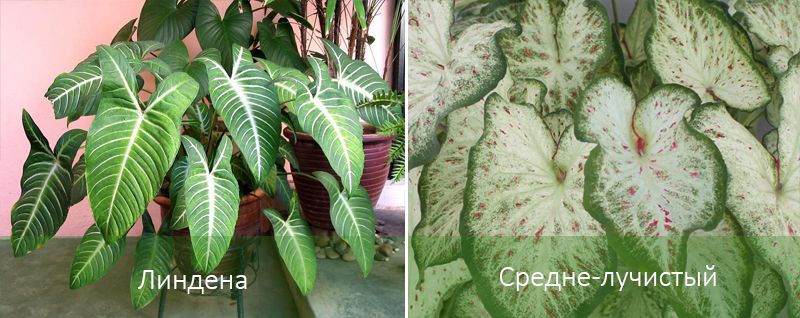
| Linden | Found in the tropical forests of Colombia, it has some of the largest leaves – up to 60 cm long and 20 cm wide. They are dark green with white veins. The petioles are thick, covered with red stripes, and grow up to 60 cm tall. |
| Fluffy | All parts of the plant are hairy. The leaves are heart-shaped, green, and up to 30 cm long. |
| Marble | The leaf length is 15-20 cm. White, gray, and yellow spots are randomly scattered across the surface of the leaf blade. The background color is green. |
| Medium radiant | The leaves are the same size as those of the marbled variety. They are green with a white central vein. A distinctive feature of this species is the wavy edge of the leaf blade. |
| Garden | Not a variety, but a group of hybrids grown in Holland and the USA. |
Home care
The plant is tropical, the most important thing is to provide the necessary temperature and humidity levels.
| Parameters | Spring | Summer | Autumn - winter (rest period) |
| Location/Lighting | Bright but filtered light. Northeast and northwest facing windows are preferred. Does not tolerate direct sunlight. Variegated foliage varieties require more light. | After all the leaves have fallen, move to a dark place. | |
| Watering | Watering is gradually increased as the foliage develops. Excessive moisture will cause the plant to die. | Water generously as the top layer of soil dries out. Use soft, warm water only. | Gradually reduce the frequency of watering. After the plant enters dormancy, moisten the soil occasionally. |
| Temperature | Loves warmth and does not tolerate drafts or temperature fluctuations. Optimal temperatures are +20…+25°C. | Below +20°C. | |
| Humidity | Prefers very humid air (at least 70%). Mist the air around the plant; water droplets on the leaves will cause unsightly brown spots. Mist several times a day during the formation of new foliage. | Not required. | |
| Fertilizer | Once every 2 weeks, with mineral fertilizer. | ||
Reproduction
The plant propagates by daughter tubers, seeds, or by dividing the main tuber. Seeds are available in specialty stores.
When propagating caladium, it is important to choose the right pot and soil.
The pot should be 2-3 times larger than the tuber, with good drainage holes. A drainage layer should be placed at the bottom of the pot.
A soil mixture of 1 part leaf mold, peat, and humus, plus 1/2 part sand, is ideal. Caladiums don't like ready-made soil mixtures sold in stores.
Daughter tubers
In the spring, when repotting, separate the daughter tubers from the main tuber and plant them in a separate container. They require no special care.
By dividing the tuber
The old tuber is cut into several pieces (each piece should retain its buds), and the cut area is treated with charcoal. The tuber pieces are then planted in pots.
Seeds
This method is used extremely rarely. Typically, this method is used when developing a new variety. The seed is planted in a mixture of sand and soil and covered with glass. A constant temperature of around 30°C must be maintained.
The soil should be misted regularly. Under favorable conditions, sprouts will appear in 2-3 weeks. Once the shoots have strengthened, they can be transplanted into a pot.
Important conditions for planting:
- division is best done after the first dormant period;
- divide the tuber along the folds;
- place it in a pot with the bud facing up;
- to obtain “babies” in the fall, plant the tuber at a shallow depth;
- Until the leaves appear, watering should be minimal.
Mistakes in care, diseases and pests
| External symptoms | Cause | Methods of elimination |
| Yellow and dry leaves. | Lack of moisture. | Spray the air around the plant. |
| A wilted plant. | High humidity, draft. | Change the conditions: reduce spraying, move to another place. |
| Foliage rot. | Water getting on the leaves, incorrect spraying. | It is necessary to spray the air around the plant, avoiding contact with it. |
| Leaf curling. | Insufficient watering. | Change the watering schedule. |
| Foliage curling with optimal watering. | Low air temperature. | Change location. |
| Tuber rot. | Overwatering or overcooling. | Remove the damaged part of the tuber, treat it with charcoal, replant and replace the substrate. |
| Smaller leaves that are losing color. | Lack of light. | Change location. |
| Dry leaf edges. | Sunburn, excess fertilizer. | Move to another place, stop feeding for a while. |
| Sticky coating, yellowing. | Aphid. | Treat with insecticides. |
| Whitish coating. | Mealybug. | |
| Web. | Spider mite. |
Caladiums most often suffer from root rot after repotting. Therefore, some gardeners recommend checking the tubers for rot after a month or a month and a half.
Signs and superstitions
There are no signs or superstitions associated with caladium.
The only potential harm is its toxicity. Although no fatalities have been reported, a very serious allergic reaction or poisoning is possible. The plant's sap, when in contact with the skin, causes burns and irritation.
Therefore, it is recommended to keep the plant pot out of the reach of children and pets. Wear rubber gloves when repotting or propagating.