Calathea is a perennial plant in the Marantaceae family. It is native to the Americas. The plant's name comes from the Greek "kalathos," meaning "basket," because the locals wove baskets from its leaves.
Content
Description
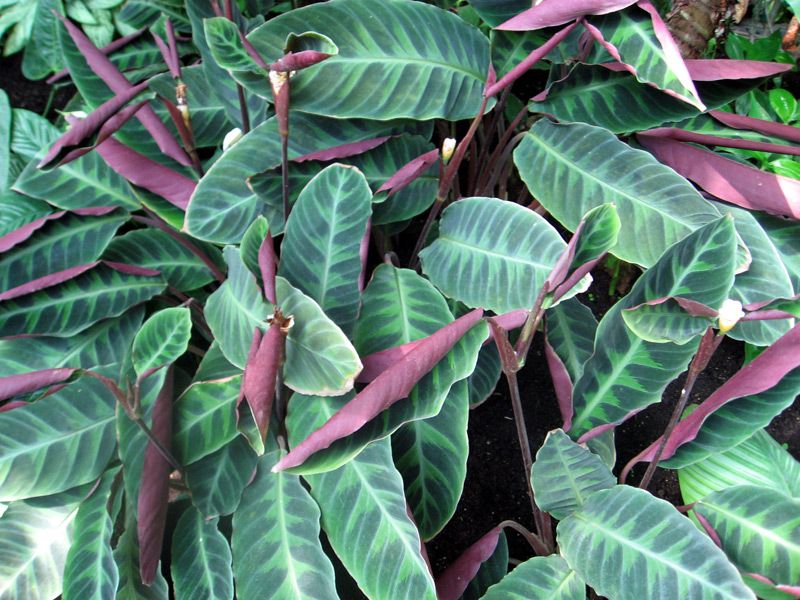
The plant is distinguished by its large, variegated leaves, which have a unique ability to turn toward the light, resulting in a horizontal leaf position in the morning and a raised, folded leaf position in the evening. This is why this flower is also called the prayer plant. The plant's rhizome stores moisture and nutrients.
Top.tomathouse.com recommends a detailed description of the species in the table and a photo gallery
There are over 120 varieties of this plant. In the wild, they can reach 70-80 cm in height. Only a few are grown at home:
| Variety | Description | Leaves | Flowers |
| Rufibarba (red-bearded - there is fluff on the shoots and leaves). | Low-growing, bushy, branched. | Satin, narrow, wavy, emerald green, the back of the leaf and shoots are dark burgundy. | Small, unremarkable white-yellow spike-shaped inflorescence. |
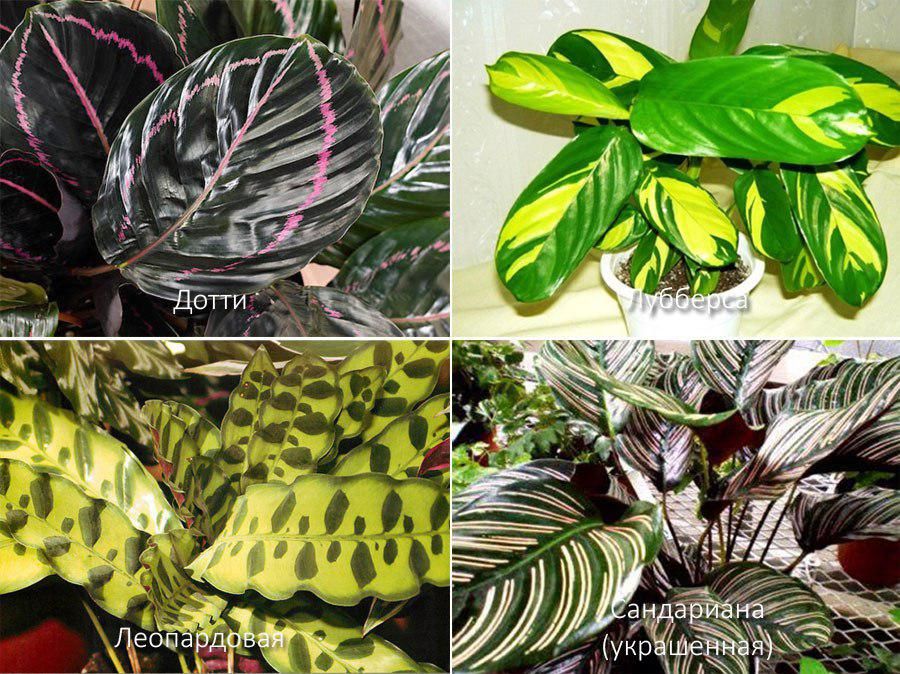
| Dottie | Low stems, large leaves. | Burgundy-brown green, pink veins, reminiscent of a leaf. | The peduncle is light green, the flowers are inconspicuous blue, weak. |
| Crocata (Tasmania, saffron) | Elegant, blooms indoors. | Oval, dark green, reminiscent of malachite, with a burgundy-coffee-colored back and wavy edges. Stems are purple. | Spectacular orange color. |
| Zebrina (striped) | The height reaches 80 cm. | Velvety, convex-rounded, egg-shaped. On the green front side are light green, symmetrical, zebra-like veins; on the underside are purple. | The inflorescences are lilac or white. It rarely blooms indoors. |
| Flame Star | Large leaves. | There is a pattern resembling tongues of flame. | Does not bloom indoors. |
| Majestic White Star | Small, resembles a star. | White with dark olive stripes diverging from the middle. | Does not bloom indoors. |
| Trio star (stromanta) | Looks like a spiky star. | Sharp, narrow, with white spots scattered on a dark green background, the reverse side is crimson. | Does not bloom indoors. |
| Louise | Unremarkable. | Light and dark green stripes. The underside is lilac. | Does not bloom indoors. |
| Bohemian | Attractive | Long, sharp, dense, lanceolate in shape, can reach 50 cm. | Inflorescences in the form of a yellow spike. |
| Lancifolia (remarkable, lanceolate) | Reaches large sizes (80 cm.) | Oblong, narrow, with a wavy edge, similar in color to malachite, dark spots are located along the central vein. | Pinkish or snow-white. |
| Queen of Maui | Compact. | Dull, in the middle in the form of a light green ear | Does not bloom indoors. |
| Roseopicta (medallion) | Small up to 40 cm. | Rounded, the inside, like a malachite medallion, is engraved with a leaf in silvery-pink tones. The reverse side is blueberry-colored. | Flowering is rare. |
| Makoya | A well-known variety. No more than 50 cm. | A light green oval, framed by a dark stripe, with an internal pattern like a carbon copy of rowan leaves. | Does not bloom indoors. |
| Mix | High. | It looks like a zebra, but the difference in pattern is the alternation of pale and slightly greener stripes. | Does not bloom indoors. |
| Varshevich | The most beautiful, reaches 120 cm. | Velvet-like, with a light vein in the center, slightly wavy, and a purple back. | Cream ear. |
| Sandariana (decorated) | Small, from Colombia. | Round, about 20 cm. Light green with pink stripes diverging from the middle. | Spike with white and lilac inflorescences up to 8 cm. |
| Orbifolia | Small. | Fan-shaped, wide, with light and dark green stripes. | Flowering is not significant. |
| Lubbers | High. | They reach 40 cm, an oblong dark green oval with randomly scattered lemon-yellow streaks. | Flowering is not significant. |
| Network (mosaic) | Not high. | Spear-shaped, large, with a pattern consisting of small light rectangles reminiscent of a mosaic. | Flowering is not significant |
| Litze | Unusual leaves. | Wavy, not large. The front side is green with a silvery sheen, with dark olive stripes; the back is burgundy-violet. | Spike-shaped snow-white inflorescence. |
| Picturata (painted) | Unusual leaves. | Oblong, light-colored central vein and edge. Darker center with symmetrical stripes. | Flowering is not significant. |
| Leopard | Unusual leaves. | Lanceolate - 15 cm long, 5 cm wide. Light green with darker stripes. | Spike-shaped inflorescences with yellow flowers. |
| Veicha | Reaches a height of 90 cm. From Peru. | Hard, glossy, large – about 30 cm. Dark and light green stripes radiate from the center. | The inflorescence is a spike of white flowers. |
| Silvery | Compact | Painted in silver color. | Flowering is not significant. |
| Crotalifera | Blooms indoors. | Oblong, dark green. | The ear is yellow or red. |
| Burle Marx (blue ice) | The magnificent Brazilian is named after a landscape architect. | Light green with a bluish tint. | Snow-white. |
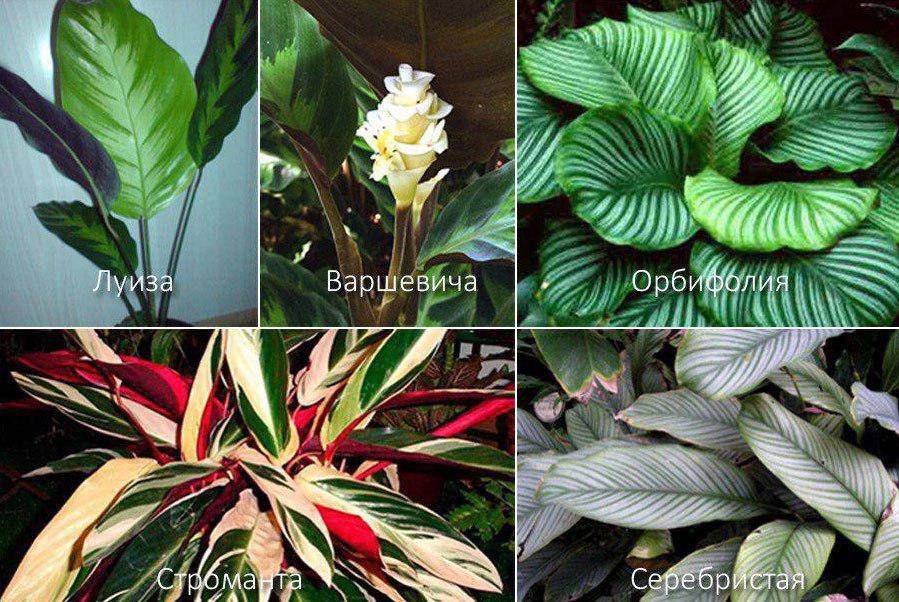
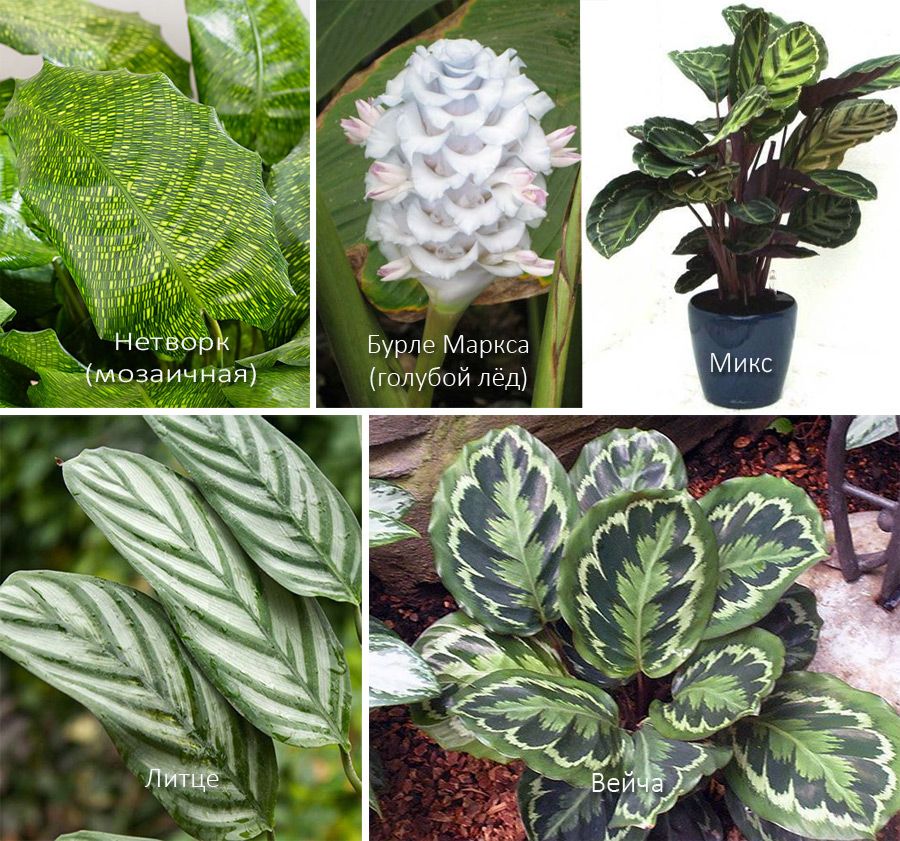
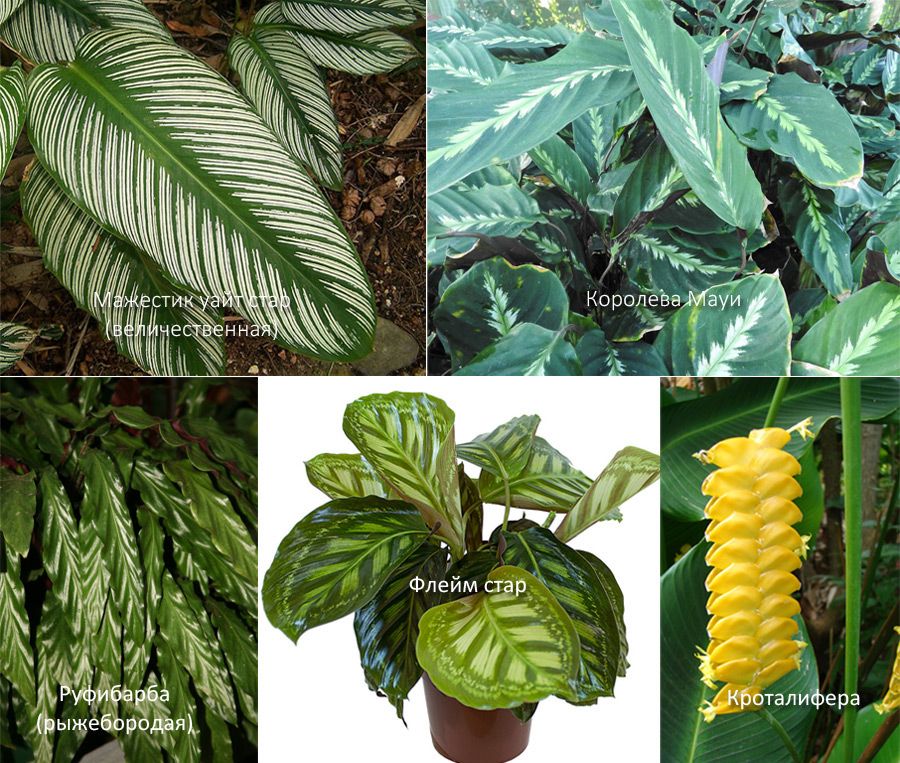
The variety of calathea forms is shown in the photo:
Home care by type
Most calathea varieties require the same indoor care. However, some varieties are more demanding.
| Variety | Care Features |
| Rufibarba | Do not spray. |
| Crocata (saffron) | Very demanding: - does not like direct light and shadow; — 90% humidity is required, but when spraying, moisture should not get on the leaves; — temperature changes and drafts are not allowed. |
| Zebrina | High humidity is required (necessarily 90%), careful spraying with filtered water only. |
| Medallion | Loves shade, humidity 90%. |
| Varshevich | Very demanding, careful spraying. |
| Bohema, Lansifolia, Makoya, Network | Unpretentious. |
Flowering species such as the saffron calathea are very demanding in care, while the most unpretentious is the makoya calathea.
Pot
The container should be shallow but wide. The plant dislikes stagnant water, so it's best to use an unglazed ceramic pot, which will also allow oxygen to reach the roots.
Soil
The soil is used for growing marantas or azaleas and rhododendrons.
You can prepare it yourself:
- soil, humus, peat, river sand, large fractions (2:1:1:1);
- soil, humus, peat (1:1:1).
The most important thing is that the soil should be slightly acidic, with a neutral pH. Wood ash can help reduce the acidity. Before use, the soil mixture must be sterilized (heated in the oven, doused with boiling water, or kept in a perforated container over a double boiler for 15 minutes).
Landing, transplant
These procedures will not cause any difficulties if you take into account the recommendations:
- Water the purchased plant thoroughly.
- Fill the prepared new pot about a quarter full with drainage material (small crushed rock, expanded clay, river pebbles, etc.). Sprinkle it with activated charcoal to prevent root rot.
- Fill the pot with soil to a height of no more than 3 cm.
- Carefully remove the flower from the old container along with the lump of soil.
- Hold it under running water and rinse. If there is root rot, mold, or other damage to the roots, remove it by disinfecting the cut with a weak solution of potassium permanganate and covering it with ash. Remove any dried leaves from the plant.
- Place the plant on the soil, spreading out the roots. The calathea's growing point should be above the soil surface in the center of the container.
- Carefully, in portions, pour the remaining soil into the pot, leaving about 2 cm to the edge. Do not press down too hard.
- Water well and place in a shaded area for three days.
- The next time you water the plant should not be earlier than 10 days later.
Location, lighting
All calathea varieties require sunny, but not scorching, light. The best locations are east, southeast, and west-facing windows.
They also thrive under artificial fluorescent lighting, as long as it shines on them for at least 18 hours a day. In winter, such lamps can extend the plant's daylight hours.
Temperature
Avoid temperature fluctuations and drafts. Calatheas thrive at 20-25 degrees Celsius.
Humidity
All varieties require high humidity (around 90%).
Regardless of the season, mist the plant daily and wipe the leaves with a damp cloth, always using gentle filtered water. This procedure should be done carefully, ensuring as little water as possible gets on the leaves.
For species with velvety leaves, avoid misting. Other methods are used for humidification. An aquarium, glass terrarium, or humidifier should be placed near the plant. You can also place the plant container in a tray filled with moistened rocks or moss.
Watering
Water with soft, settled water (approximately 25°C), avoiding stagnation. To soften the water, place a canvas bag filled with peat moss in the container.
- Summer - every other day;
- Winter - once a week.
Water consumption is approximately half a liter per bush of an adult plant.
Velvety varieties are carefully watered at the edge of the flowerpot.
Top dressing
Water the plant 10-15 minutes before planting. For additional feeding, you can use fertilizer for maranta or ornamental foliage plants.
- Spring/summer: the plant is growing, so regular feeding is necessary – once every two weeks;
- Winter/autumn: dormant period - once every two months is enough or do not fertilize at all.
Be careful with nitrogen and calcium, their excess has a negative effect on the flower.
Reproduction
There are three ways to propagate calatheas:
- division of roots;
- cuttings;
- seeds.
Root division
This is the simplest of the three options. Two- or three-year-old trees are suitable for this. You will need:
- Water the soil in the pot the day before to soften it.
- Remove the plant and carefully free the roots from the soil.
- Divide the bush; each part should have at least three shoots.
- Then they plant (see above).
Cuttings
Cuttings are taken from a healthy, mature plant, carefully cut at the root. The cuttings are placed in a pot with special soil for Marantaceae. They are then placed in a container with wet drainage, with a mini greenhouse created on top (using a bag, plastic bottle, etc.). Once roots appear on the cuttings (2-3 weeks), and the new plant begins to grow, they are removed from the shelter.
Seed propagation
This is the most difficult procedure:
- The container is filled with a mixture of two parts humus and one part sand.
- The seeds are distributed throughout the pot at intervals of 2-3 cm, pressing them into the soil.
- Cover with glass.
- Place in a room with a high temperature of up to +30 degrees.
- After half or a whole month, sprouts should appear.
- The delicate embryos are carefully sprinkled with soil to a depth of one centimeter.
- They are gradually tempered by removing the glass, first for an hour, then longer.
- When they reach about four centimeters, they are placed in separate containers.
Bloom
Flowers of various calathea varieties appear in the spring and summer. The most beautiful are those of the crocata variety.
Difficulties in growing
Growing calathea at home isn't easy, and mistakes often occur, but they can be overcome:
| Problem | Cause | Correction |
| Dry, wilted tips of leaves. | Not enough humidity. | Mist the plant daily. Place the pot in a container filled with wet potting mix. Place a humidifier or aquarium nearby. |
| The leaves are turning brown at the ends. | — Overfeeding the plant. — Drafts. |
— Reduce the supply of fertilizers, especially nitrogen.
— Move the plant to a place where there are no drafts. |
| Curling of leaves, appearance of light spots. | Lack of moisture in the soil. | Increase watering frequency. |
| Rotting of petioles and bases of leaves. | Low temperature and high humidity. | Change the conditions of detention. |
| Deciduous shedding. | — Lack of air humidity.
— Over-watering of the soil. — Highly acidic soil. |
— Humidify the air around the flower.
— Change the substrate. |
| Drying of leaves. | — Perhaps an annual cycle of leaf replacement.
— If growth slows down, there is not enough fertilizer or watering. |
— Keep an eye on the plant and feed it if necessary.
— Observe the watering regime. |
| The appearance of light spots. | Burns from sun rays or after exposure to drops that act as lenses. | Move the plant to a more shaded area. Be careful when spraying; it's best to do this in the morning or evening. |
| Leaf stretching. | Lack of light. | Illuminate the flower with a fluorescent lamp. |
| There are slight enlargements on the back side. | Spider mite or simply frozen cell sap. | Inspect the plant. If there are no webs, there's no need to worry. |
Diseases, pests
Calathea is susceptible to various insects and fungal diseases. However, these can be controlled.
| Problem | Manifestation | Control measures |
| Spider mite | The appearance of a whitish coating and cobwebs. Yellowing and leaf fall. | Increase humidity. Treat with Inta-Vir and Karbofos. |
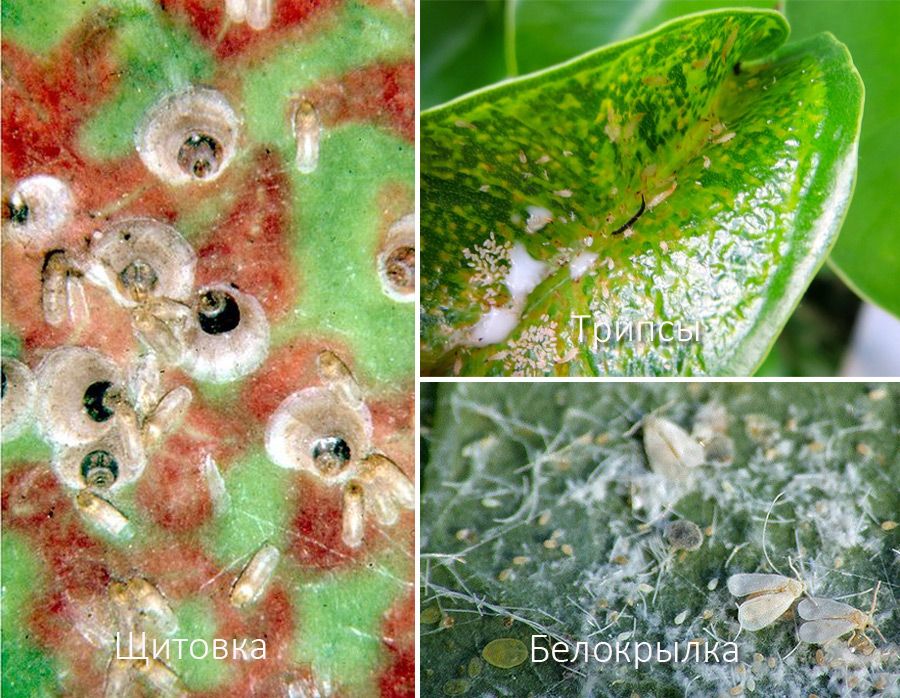
| Scale insect | The leaf becomes covered with sticky dark brown spots. | Take a shower at 45°C (113°F) and wipe with 70% ethyl alcohol. After two hours, treat with a soapy solution, using only laundry soap. Repeat the procedure after a day, then again after four days (at least seven times). Instead of foam, you can use pest control products (Aktara, Bazudin, etc.). |
| Whitefly | Small insects appear on the back of the leaves. | Spray the plant with Fufanon, Mospilan or Confidor. |
| Thrips | Colorless spots that grow into large patches. Insects moving hoppingly are visible on the soil. | Take a shower. Spray twice with Inta-Vir (half a tablet per five liters of water). Water with the same water. |
| Black | Accompanying the appearance of pests, the plant looks as if it has been burned (covered in soot). | A soap solution will help. |
| Fusarium | Blackening, curling, spreading rot. The plant dies. | The plant must be destroyed. |
Top.tomathouse.com recommends: Calathea – the flower of happiness
Chinese scientists claim that calathea possesses a hot, magical energy that can warm a person, protect against colds, prevent the formation of blood clots, and dissolve them.
This plant purifies the surrounding air of harmful impurities. It is recommended for those suffering from insomnia; it has a beneficial effect on the nervous system, brings peace to the home, and helps find a soulful activity.
According to Feng Shui, calathea should be placed in the southeast or east. This will ensure the health and well-being of the family.