Calathea medallion is a decorative houseplant belonging to the Marantaceae family, native to South America. While it can reach several meters in height in the wild, the decorative Calathea medallion is short, reaching approximately 35-40 cm.
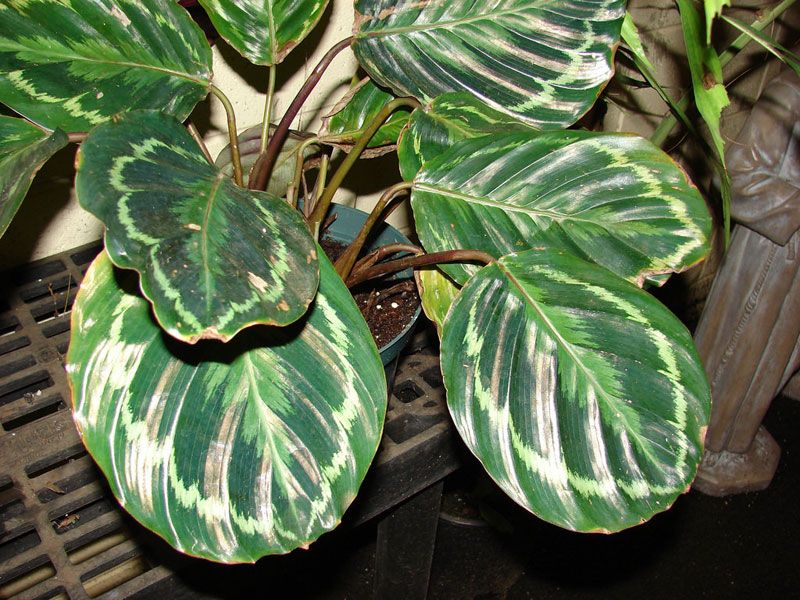
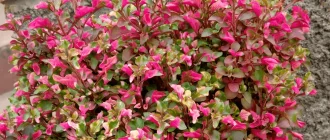
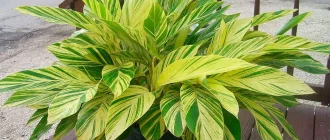
The photo shows that the flower's distinctive feature is its beautiful, patterned leaves, the undersides of which are cherry-colored. The small leaves resemble tubes that unfurl as they grow. Calathea medallion thrives in light and high humidity, and is highly sensitive to light.
The plant is not easy to care for, so it should only be grown by experienced gardeners.
Care
Calathea medallion is a capricious plant that requires gentle conditions and careful care.
Temperature and lighting
This flower thrives best in partial shade. Direct sunlight causes the leaves to wither and turn pale. If the plant is in constant shade, the vibrant patterned coloring fades, and the leaves become uniformly green.
Sudden temperature changes are contraindicated. The plant feels most comfortable at standard room temperatures of 19 to 25 degrees Celsius, and up to 28 degrees Celsius in summer.
Selecting a container and soil for planting, location
The flower has a dense, branched surface rhizome, so a wide container, although not too deep, is preferable. A drainage layer is placed at the bottom.
The soil should consist of equal parts peat and composted soil. A small amount of sand and charcoal should be added to this mixture.
To avoid the hassle of creating the right soil, you can purchase ready-made soil for the Marantaceae family.
Watering, fertilizing
In its natural habitat, the plant grows on the banks of bodies of water, as it thrives in moisture. A comfortable humidity level is 90%. Such humidity is unattainable in a typical apartment, and even if it were created, it would be unpleasant for humans. Therefore, the medallion calathea requires frequent misting.
Water regularly, keeping the top layer of soil constantly moist. Avoid overwatering, as roots will quickly rot if the soil is too wet.
From April to October, the plant grows actively. During this time, it should be given a special fertilizer at least twice a month. Don't overdo it, as it doesn't like excess water.
Top.tomathouse.com explains: Transplanting and propagation
Repotting is done once a year, in the spring. This can also be used to propagate the plant if it is large and healthy.
It does not like dividing the rhizome; it is better to use the cuttings method.
A small branch is cut from the bush, placed in prepared soil, and covered with a plastic bag. Growing a plant from seed is quite difficult, but this method can also be used.
Diseases, pests
Sometimes the leaves of the calathea turn yellow and dry out, which is a sign of overfertilization or the plant is too cold. If the calathea is under-watered, the leaves dry out and curl. Electromagnetic influences, such as those located near household appliances, can also cause the disease.
The most common pests are spider mites, thrips, and scale insects. Treatment is with insecticides.