Clerodendrum (tree of fate) is a perennial plant of the Verbenaceae family. It is native to the tropical climates of Asia, Africa, and South America.
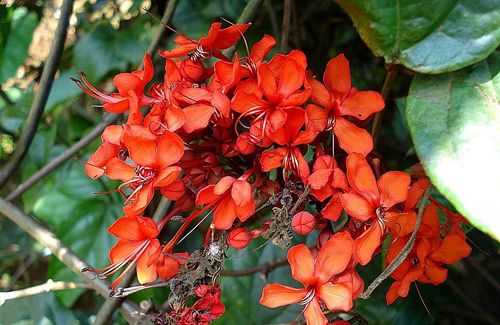
In some sources, clerodendrum is called "volkameria", which translates as "innocent love".
Content
Description
Clerodendron is a deciduous and evergreen plant. Its stems are long, highly branched, and can reach 4 meters in length. Depending on the shrub's variety, the trunk can be either vine-like or tree-like.
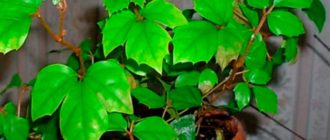
The bark is thin and smooth, light green or reddish-brown. The leaves are opposite, with short petioles of emerald or dark green. The leaves are heart-shaped, ovate, or oval, with serrated edges. They reach a length of up to 20 cm, with distinct grooves running along the veins.
The flowers resemble bells, gathered in corymbs or panicles, and are borne in the axils of leaves or on shoots. The flowers have a complex shape, with two corollas: the first is 25 cm in diameter, the second slightly smaller. Long, slender stamens are located in the center of the corolla.
The tree blooms from mid-spring to late summer, producing a delicate fragrance emitted not only by the flowers but also by the foliage. Each species of Clerodendrum has its own distinct scent. The flower is a pollinated species.
Types for home cultivation
There are several types of clerodendrum that can be grown indoors:
| View | Description |
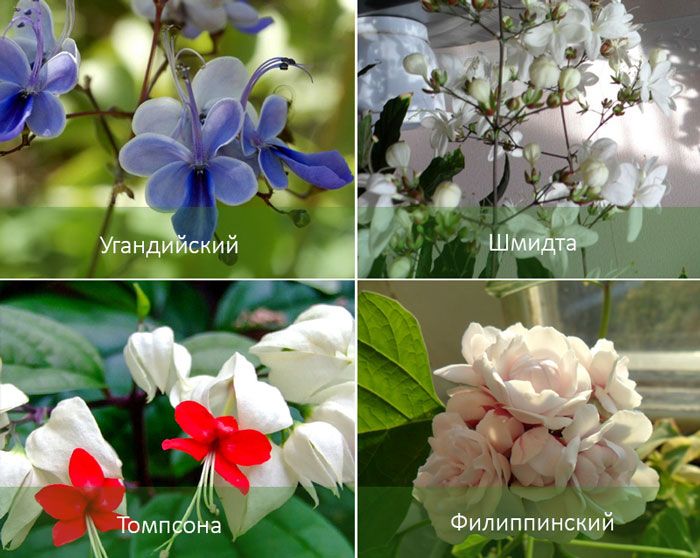
| Ugandan | Native to East Africa, the shoots grow up to 3 meters long. The flowers have five butterfly-like petals and are blue and purple in color. With proper care, they bloom from mid-spring to October. |
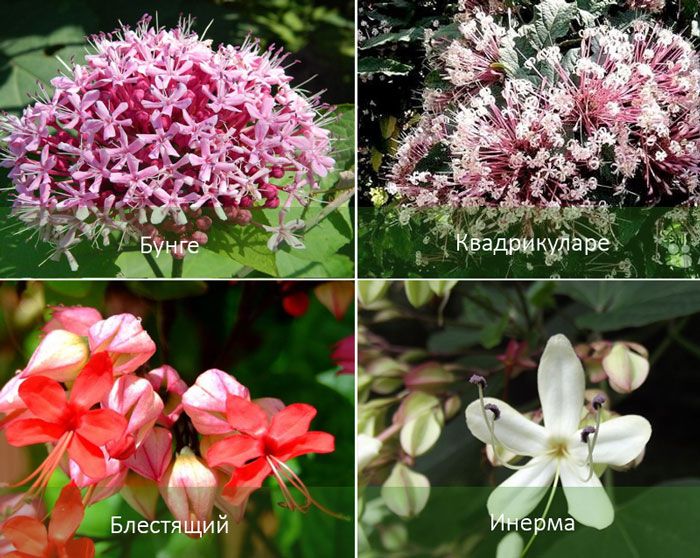
| Quadricular | It has unusual foliage: green above, burgundy below, with pointed edges. The flowers are clustered in elongated stalks and are lilac-white. |
| Bunge (Clerodendrum bungei) | Native to China. A shrub up to 3 meters tall, with upright and branched shoots. The foliage is rough to the touch, with serrated edges. The flowers are spherical, pink in color. |
| Thompson (Mrs. Thompson) | This Clerodendrum cultivar takes its name from an African missionary named Thompson. The plant has flexible, long stems and blooms profusely from March to October. The flowers are cup-shaped bracts, pink and white in color. The foliage is green or yellow-green, up to 12 cm long. |
| Brilliant | The plant has flexible stems and blooms throughout most of the year. The leaves are heart-shaped and have wavy edges. The flowers are 2-3 cm in diameter and red in color. |
| Wallich (Bride's Veil, Nodding Jasmine) | Native to India, this ornamental shrub grows compactly. The branches are drooping. The lanceolate foliage, with wavy edges, is up to 15 cm long. The pendulous racemes contain lush, fragrant white flowers, 2-3 cm in diameter. |
| Inerme (barbless, variegated) | A shrub with upright stems that reach 3 meters without pruning. The glossy foliage is ovate. The umbel-shaped inflorescences are composed of white petals with purple corollas. |
| Philippine | A shrub reaching 2 meters in height, the leaves are large and velvety, with serrated edges. The flowers are large, pink or cream-colored, similar in appearance to roses, and up to 8 cm in diameter. Clerodendrum philippinum produces corymbose inflorescences. It blooms most of the year. |
| Schmidt (Chains of Glory) | An ornamental variety with inflorescences up to 50 cm tall, featuring white flowers with a red cap. With proper care, it blooms in both summer and winter. |
| Wallicia Albomarginata | A shrub, 30-40 cm tall. Flowers are white, collected in racemose inflorescences. Blooms from late spring to early fall. |
| Most Beautiful (Javanese, speciosum) | An evergreen plant that reaches 1 meter in height when grown indoors. It boasts a long flowering period, from early June to November. The heart-shaped leaves are arranged oppositely on the shoots. The flowers are small and bright red. |
| Starshine | A large-leaved tree or shrub up to half a meter tall. The foliage is oval, and the flowers are small and red. |
| Musical notes | It stands out for its unusual flowering, with stamens hanging from white flowers, resembling “strings”. |
| Trichotomum carnival | A shrub with small pink flowers that resemble frozen fireworks. |
| Fragrant or wolfberry | The leaves are pointed, rough to the touch, the petals are fluffy, and have a pleasant aroma. |
| Three-part | A plant with large foliage. It bears small, deep pink flowers with a blue center and pointed petals. |
Home care
Caring for clerodendrum at home varies depending on the time of year:
| Spring-summer | Autumn-Winter | |
| Humidity level | High, more than 70%. | |
| Light | The bright flower needs to be protected from direct sunlight. | |
| Temperature | +20-25 degrees. | +12-14 degrees. |
| Watering | Frequent | Rare |
| Top dressing | Once every 14 days | Dormant period – refrain from applying fertilizers |
Location, lighting, watering
Most Clerodendrum varieties prefer indirect light, as direct sunlight can cause leaf scorch and leaf drop. A west- or east-facing window is considered the optimal location for the plant pot. A south-facing window is also acceptable, but a light-diffusing screen is required.
Watering frequency is directly related to the season and the plant's growth period. During the spring and summer, clerodendrum requires ample watering, but only after the soil surface has dried out. After flowering, watering volumes are reduced. During winter dormancy, watering is minimized, the main thing being to keep the soil moist.
Humidity should also be monitored; it should always be high, as dryness is harmful to the plant. If a humidifier is not available, regular misting with filtered water at room temperature can be performed.
Pot, soil, replanting
The plant thrives in fertile, slightly acidic soil. The easiest option is to purchase a general-purpose potting mix and add a small amount of sand. Alternatively, you can make your own potting mix by mixing the following ingredients in varying proportions:
- peat;
- leaf and clay soil;
- coarse sand.
To prevent diseases and pests, the soil needs to be disinfected. This can be accomplished by warming it up in an oven or microwave.
A ceramic pot is best for the container, as it allows air to pass through and maintains optimal humidity levels. Ceramic is also more stable and heavier, which is crucial when growing large shrubs. When repotting, it's recommended to choose a pot that is approximately 2 cm larger in depth and width than the old container.
Plant transplantation must be done carefully, using the transshipment method.
- Remove the root ball completely from the container; tapping the sides of the pot can help loosen it. However, rinsing the roots under running water is strictly prohibited.
- A 2-3 cm layer of drainage material (expanded clay, brick chips, or small stones) is placed at the bottom of the new pot. A small amount of soil is poured onto this layer, and then the plant being repotted is placed in the center of the container, after which the empty spaces are carefully filled in.
- After filling, the soil is watered, and after it settles, more soil is added.
- After replanting the plant, it is recommended to use phytohormones; this will improve the rooting process.
Top dressing
Clerodendrum typically blooms from March to October, during which time the plant requires nutrient supplementation. It's recommended to alternate between mineral and organic humic fertilizers.
Among mineral fertilizers, Agricola is considered quite effective. FlorHumate is a high-quality humic fertilizer. It can be applied both as root fertilizer and as foliar fertilizer.
Trimming
In spring, the plant's shoots are shortened by approximately a third of their length, and dried and diseased branches are removed. Additionally, the following steps are performed during pruning:
- The growing tops are pinched to give the flower volume.
- To form a clerodendrum into a tree, all branches are removed, leaving only the strongest shoot, which is pruned to a height of approximately 0.6 m. Branches below the crown are removed from the shoot.
- Vines do not require significant pruning, but in the spring it is still necessary to shorten the ends of the branches and pinch the plants.
Rest period
The dormant period begins with the arrival of autumn. During this time, avoid fertilizing. It's recommended to remove all dead branches and leaves and then place the pot in a cool place.
Reproduction
Clerodendrum can be propagated by seeds and cuttings.
Cuttings should be taken in the spring. The following step-by-step instructions will help you propagate the plant correctly:
- Cuttings are prepared. Woody branches are divided into sections with 3-4 internodes. All lower leaves are removed; leaving a few at the top is sufficient; if they are large, they should be trimmed. This will prevent excessive moisture loss.
- The bottoms of the selected cuttings are treated with rooting agent and planted in a pot. A drainage layer of small stones and expanded clay is placed on the bottom of the container beforehand.
- The pots are filled with a mixture of fine sand and peat, taken in equal quantities, and placed in a greenhouse.
- Their condition is checked daily and, if necessary, they are sprayed with substrate.
- After the roots appear, the plant needs to be hardened off, for this purpose the ventilation time should be increased daily.
- Once the clerodendrum can survive without a greenhouse, it can be transplanted to its permanent location. Planting should be done carefully, as the plant has fragile roots.
To propagate by seeds, the following manipulations are performed:
- the seeds are planted in small containers filled with a mixture of coconut substrate and peat, taken in equal quantities;
- greenhouse conditions are created and the pots are placed in a well-lit place, requiring daily ventilation;
- The strengthened plants are planted in a permanent location.
Mistakes in care and their correction
When caring for clerodendrum, certain mistakes may arise that require immediate correction:
| Manifestations | Reasons | Corrections |
| Fall of leaves and flower buds. | Low humidity, poor lighting. | The watering regime is regulated, the clerodendrum is placed closer to the light, and the air humidity is increased. |
| Yellow spot on leaves. | Burns | Prevent the plant from being exposed to direct sunlight. |
| Small foliage. | Being in unsuitable temperature conditions. | Provide peace during the winter. |
| Lack of flowering. | Poor lighting, suboptimal temperature, lack of rest in winter, lack of useful microelements. | The plant is moved closer to the window, the temperature is regulated, and fertilizer is added with the onset of spring. A dormant period is essential. |
Diseases, pests and their control
During the growth process, clerodendrum can be affected by various diseases and insects, which must be identified promptly to save the plant from death:
| Manifestations | Reasons | Solution to the problem |
| Yellowness. | You need to water and spray the plant using only soft water that has been settled beforehand. | |
| Plant wilting. | Root rot. | The clerodendrum is removed from its pot, the root system is rinsed, and any damaged areas are removed. The roots are sprinkled with powdered charcoal. It is then replanted in new soil, and the watering schedule is adjusted. |
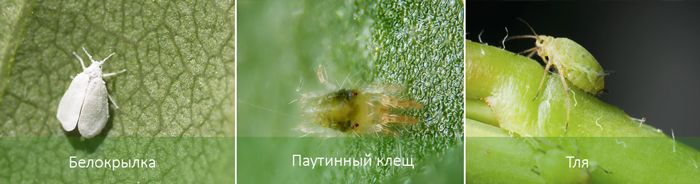
| Deformation of shoots, plaque on foliage. | Spider mite or whitefly. | The plant is rinsed with water and then sprayed with an insecticide (2 ml of Fitoverm diluted in a liter of water). The treatment is repeated after two weeks. |
| Curling of leaves inwards. | Aphid. | The most damaged foliage is removed, and the remaining foliage is washed and sprayed with an insect repellent. The plant is treated again after two weeks. |
Top.tomathouse.com recommends: Clerodendrum – the tree of happiness
Clerodendrum has a positive effect on a person's mood, improves overall health, creates a favorable atmosphere within the walls of the house and gives love.
Legend has it that during Ancient Rome, a special cult dedicated to this plant existed, dedicated to the goddess of love, Venus. Each participant in this cult met their true soulmate.
However, there's also a belief that clerodendrum brings misfortune, reducing success at work and in one's personal life. Feng shui experts strongly disagree with this belief, arguing that any flower brings joy to the home. A price of 150-200 rubles is no reason to avoid it.