Tuberous begonia is a complex hybrid created through selective breeding from various species. It belongs to the Begoniaceae family.
Its origins date back to the mid-19th century. Wild Bolivian varieties were crossed. The resulting hybrid was then combined with begonias from various regions, resulting in many interesting varieties that combined the best qualities of the family: long flowering times and ease of care.
Content
- 1 Description and characteristics of begonia
- 2 The main varieties of begonia
- 3 Planting a begonia tuber in a pot
- 4 Planting begonias in open ground and further care
- 5 Features and differences in wintering indoor and garden begonias
- 6 Reproduction of begonias
- 7 Mistakes in growing begonias, diseases and pests
Description and characteristics of begonia
A large number of tuberous hybrids have now been developed. They have their own differences, but there are five characteristics that are characteristic of this type of begonia:
- The root is an underground tuber (5-6 cm).
- The stem is thick, 25 cm in height, there are 80 cm.
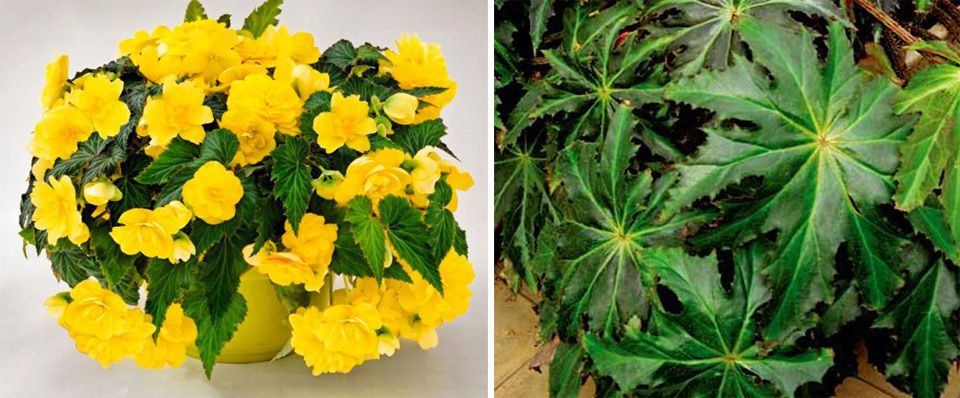
- The leaves are dark or light green, glossy and hairy. They are heart-shaped and arranged alternately and asymmetrically.
- Flowers vary widely, from single to double, in red, white, yellow, and other colors. They can be single, bordered, small or large, solitary or in clusters.
- The fruit with seeds is a 1 cm capsule containing almost 1 thousand small seeds.
Tuberous begonias grow equally well in open ground, at home and on the balcony.
The tuber, which accumulates all the substances necessary for the life of the flower, helps it in any conditions.
The main varieties of begonia
There are many species and varieties of tuberous begonias.
They can be divided according to their features:
| Type | Description | Leaves |
Flowers Bloom |
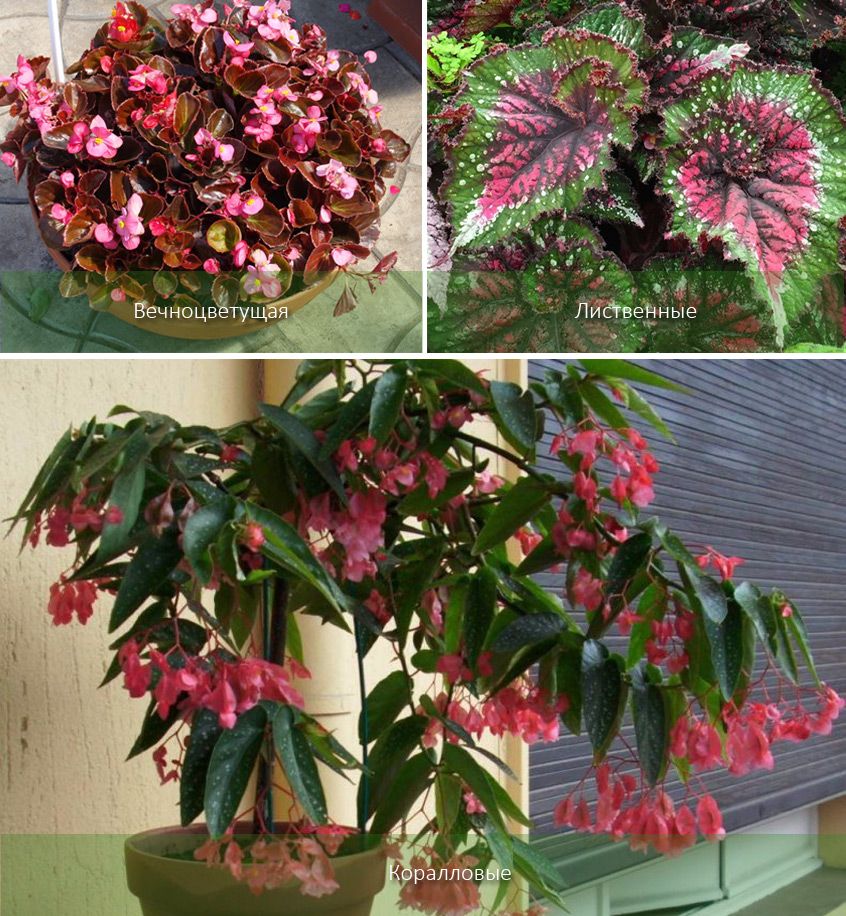
| Everblooming | A herbaceous perennial, growing from 15 to 36 cm tall, depending on the variety. It's planted in the garden in summer and kept indoors in winter. | Round green or burgundy. |
White, yellow, pink, coral. Terry or single. Most of the year. |
| Coral | Height is slightly less than 1 m. Unpretentious in home care. | Elongated, serrated, they are distinguished by their matte finish and light speckles. |
Red hues. Gathered in coral-like inflorescences. Early spring – first frosts. |
| Deciduous | An ornamental houseplant with drooping stems. Very fussy. Not suitable for outdoor cultivation. | Unusual colors: various contrasting patterns, spots, silver and mother-of-pearl highlights. |
Small and inconspicuous. Often absent. |
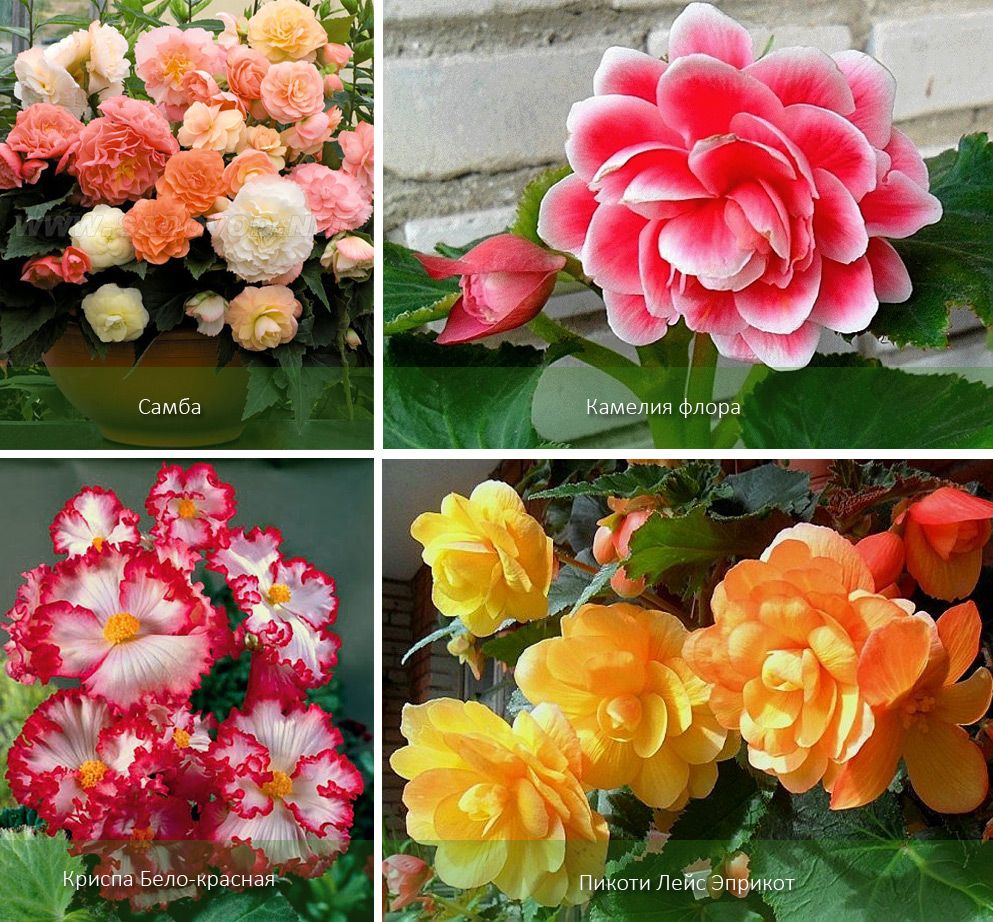
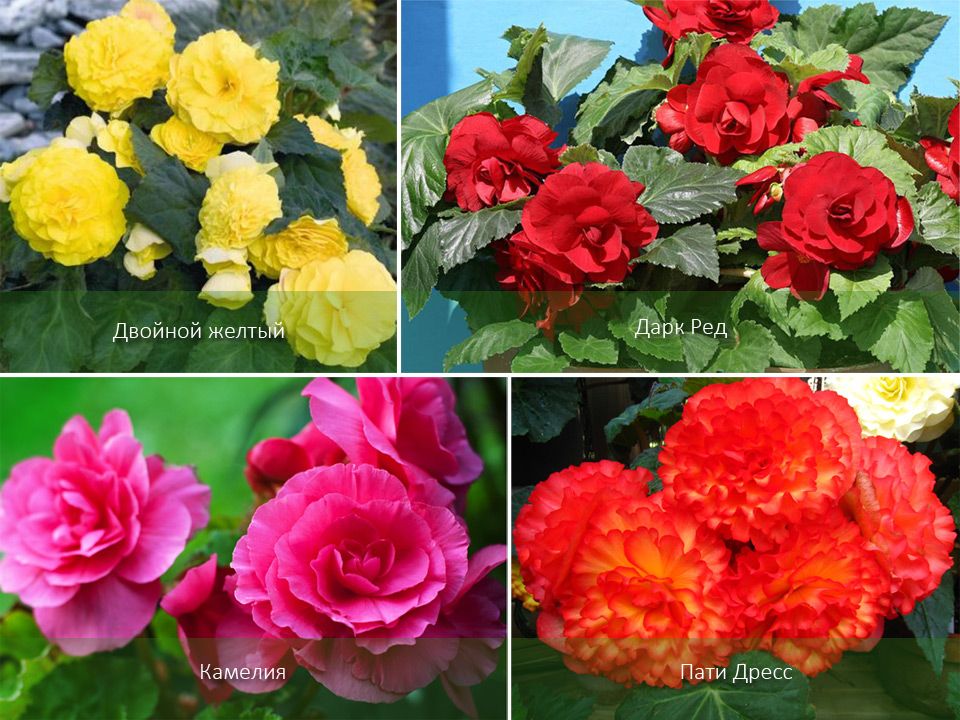
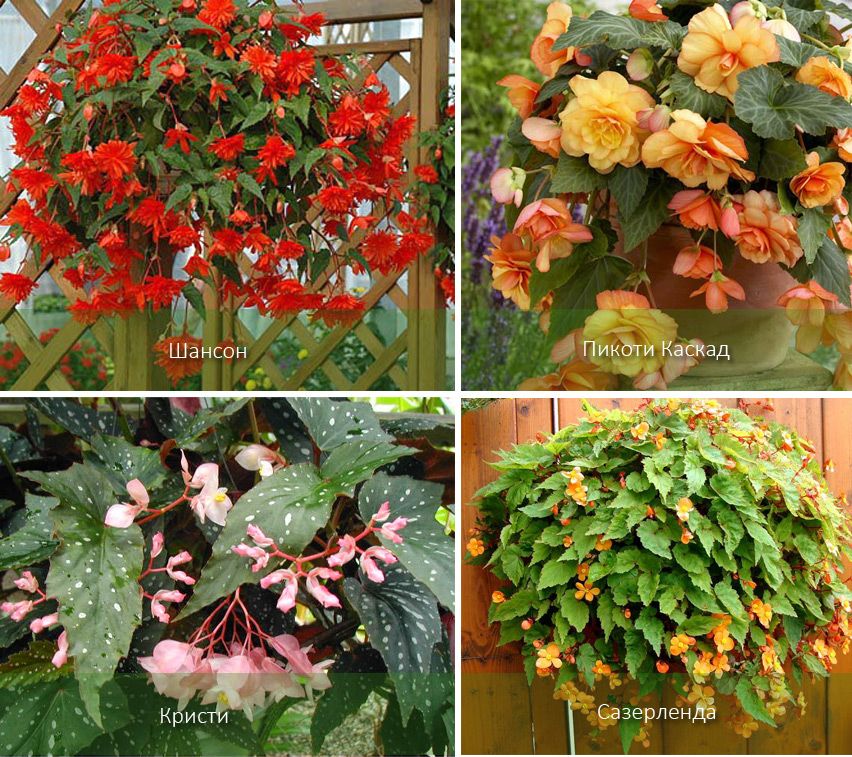
| Type | Varieties | Flowers |
| Erect | Dark Red | Large, dark red, like a rose. |
| Double yellow | Large yellow terry. | |
| Party Dress | Reminiscent of the original huge carnations on a small bush. | |
| Camellia | Camel-shaped. | |
| Camellia Flora | Peony-shaped, waxy, soft pink with a snow-white border. | |
| Crispa White-Red | They look like a large carnation, white with a burgundy or scarlet border. | |
| Picoti Lays Apricot | Terry, corrugated, apricot-colored, very large. | |
| Samba | Pastel colors of various shades, reminiscent of carnations. | |
| Ampelous | Chanson | Medium, semi-double or double, two-colored, similar to camellia, in a variety of colors. |
| Christie | White terry. | |
| Sutherland | Small, simple sunny shades. | |
| Picotee Cascade | Peony-shaped. |
Planting a begonia tuber in a pot
When purchasing tubers, follow these recommendations:
- The best time for this is the end of January - beginning of March.
- Size: not less than 3 cm, color: rich brown, without spots or damage.
- Presence of buds, but not grown.
Plant at the very beginning of spring:
- The container for planting is taken to be of medium size.
- A drainage system of expanded clay and small stones covering 1/3 of the pot is required.
- Soil: peat. When the buds reach 5 cm, transplant into begonia soil or a substrate: sand, leaf mold, peat soil, and humus (1:1:1:1).
- The rounded side of the tuber is immersed in the soil, and the concave side is placed upwards without deepening it, so that the sprouts can breathe.
- When rooting, add soil and remove excess shoots. If the planting material was no more than 5 cm tall, 2-3 shoots are sufficient.
When purchasing an adult plant, it is adapted to home conditions.
Place the plant in the shade for a week or two, do not water or fertilize, and watch for insects.
Caring for tuberous begoniasat home
Although the flower isn't fussy, it does require favorable conditions. In November, if you want to prolong the begonia's blooming, continue feeding and providing light, and follow watering and humidity guidelines, deceiving the plant to prevent it from going dormant. However, to ensure its continued vigor, it needs at least three months of rest.
| Factor | Spring | Summer | Autumn - Winter | ||
| Bloom | Peace | ||||
| Location | North window. | Western, Eastern. | |||
| Lighting | Bright, but without direct sun. | They provide additional lighting. | They provide shade. | ||
| Temperature | +18 °C…+23 °C. | +15 °C…+18 °C, not lower when kept indoors. | Not below +12 °C and not above +18 °C. Cut off. | ||
| Humidity | A tall one is best. Do not spray. Place the plant on a tray with a moist mixture: expanded clay, moss, or sand. | A damp cloth is placed on the radiator next to the flower. | Provides dry air. | ||
| Watering | Abundant. | When the top layer of soil dries out. | Reduced (once a month). | ||
| Top dressing once. Blooming - complex fertilizers for blooming plants. Foliar - for ficuses (1.5 caps per liter of water). |
In 14 days. | In 7 days. | In 14 days. | Per month. | Not used. |
Planting begonias in open ground and further care
Planting takes place when the danger of frost has passed; the best time is early June. Choose a bright location, but protected from direct sun and wind. Acclimate the seedlings to the outdoors gradually.
Humus mixed with ash is added to the bottom of the planting holes. The seedlings are mulched with the same mixture.
Care in open ground includes a number of features:
- Fertilize with humus, ash, potassium-phosphorus fertilizers from mid-spring to mid-autumn, once every 14 days.
- Pinch the stems at a height of 7-8 cm to stimulate the growth of lateral shoots.
- Water generously in hot summers, and in rainy summers, as the soil dries out by 1 cm.
Features and differences in wintering indoor and garden begonias
November marks the beginning of the dormant period, but this is only an approximate date. It all depends on where the plant spent the summer, and whether the goal is to prolong or shorten flowering. In any case, the plant needs at least three months of rest.
Indoor
When storing houseplants over winter, do not remove them from the pot but trim them back, leaving a 1 cm shoot. Keep them in the conditions described in the seasonal table.
Garden
Garden plants are dug up at the end of October, their roots are trimmed, they are treated with a fungicide (Fitosporin), they are dried, and they are placed in a container with peat. They are then placed in a dark, dry place until spring. They can also be stored on the refrigerator door, wrapped in sphagnum moss, or in a cotton bag.
In spring, planting is carried out in a pot, and after germination, in open ground.
Reproduction of begonias
Tuberous begonia is propagated in 3 ways: by seed, cuttings and by dividing the tuber.
Tuber
An effective method, but only possible if there are at least three buds left on the parts.
Step by step:
- The tuber is cut with a disinfected sharp knife.
- The cut is treated with charcoal.
- Plant according to the planting pattern.
cuttings
With this method, in mid-spring, the following activities are carried out:
- Cuttings of about 10 cm are separated from the mother bush.
- Take a container with wet peat and plant the sprouts in it.
- Once they have rooted, they are replanted. When replanting, pinch them to encourage lateral shoots to grow.
Seeds
The method is time-consuming and labor-intensive. It's difficult to obtain seed material when planting at home:
- flowers are artificially pollinated using a brush;
- When the fruits appear, it is not easy to collect the seeds, as they are very small.
The process of planting seeds:
- Scatter seeds mixed with sand into a container with begonia soil. Moisten with a spray bottle.
- Cover with a transparent lid (glass, film).
- After the shoots have grown stronger, they are pricked out.
Mistakes in growing begonias, diseases and pests
|
Symptoms External manifestations on leaves |
Cause | Methods of elimination |
| Yellowing, wilting. |
|
|
| Dryness, browning of the ends. | Lack of moisture, dry air. | Increase watering and humidify the room. |
| Paleness, loss of color. | Not enough light. | They provide good lighting. |
| The appearance of a wet white coating. | Powdery mildew. | Remove damaged parts. Reduce watering. Spray with a 1% colloidal sulfur solution. |
| Brown spots, gray coating. | Gray rot. | Cut off diseased leaves and treat with a fungicide (Fitosporin, Green Soap). |
| Bud drop. | Over-dried air, too wet soil. | Moisten the area around the plant, watering only when the top layer of soil (1 cm) dries out. |
| Twisting of all parts of the plant, deformation and death. | Aphid. | Insects are removed using products containing permethrin. |
| Yellow spots, dots, white web. | Spider mite. | Insecticides are used (Fitoverm, Derris). |