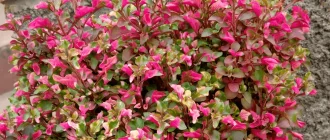
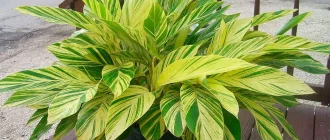
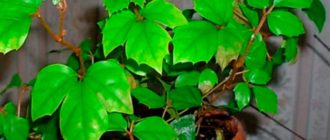
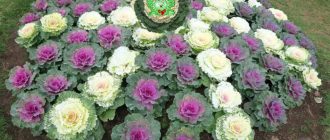
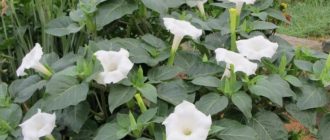
Ornamental plants of the genus Begonia belong to the Begoniaceae family. They are annual and perennial herbaceous subshrubs and shrubs. They are native to South America and India, the Eastern Himalayas, the Malay Archipelago, and Sri Lanka. They are considered native to Africa.
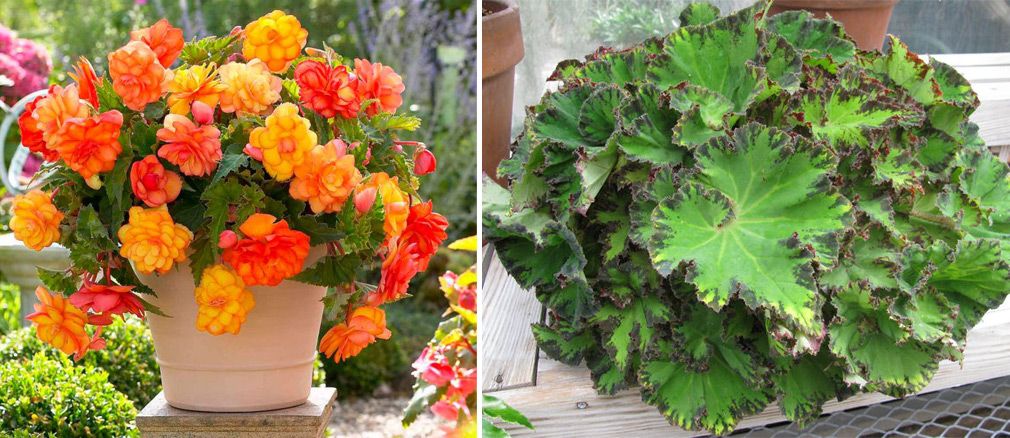
The genus's name was inspired by Haitian Governor Michel Begon, who organized and sponsored exploration of the Caribbean islands in the 17th century. There are 1,600 known begonia species.
Content
Description of begonia
The plants have creeping, fibrous roots and tubers. The leaves are asymmetrical, simple or dissected, with wavy or serrated edges. They are decorative due to their color, ranging from a simple, rich green to burgundy with various geometric patterns. Some varieties are covered with a slight down.
Flowers come in a variety of colors (except blue), can be small or large, unisexual or monoecious. The fruits are small seed capsules. Begonias bloom in summer and fall. Indoor begonias can delight until the New Year.
Types of Begonia
Plants of this genus are divided into types.
Ornamental foliage
This group has no stems, the leaves grow directly from the roots and are decorative due to their unusual appearance.
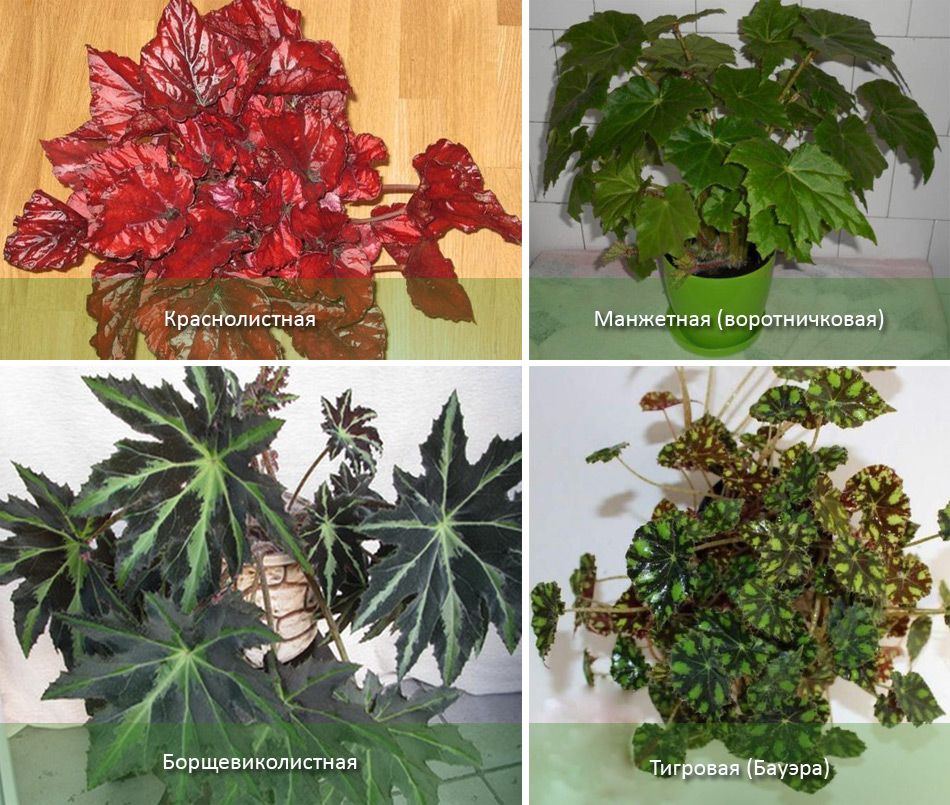
Most popular:
| View | Description
Flowers |
Leaves |
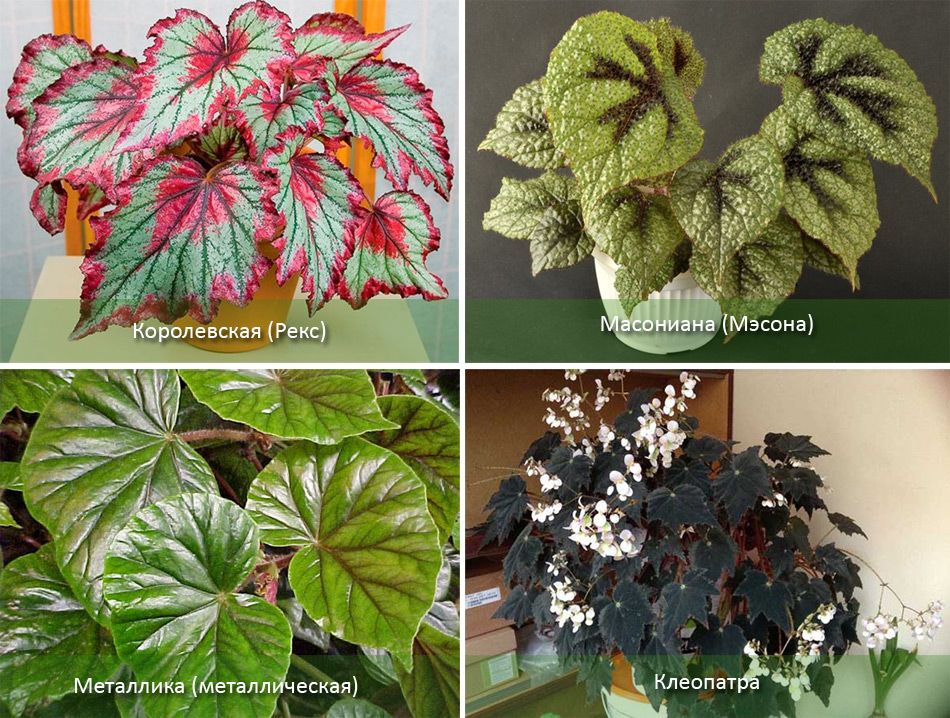
| Royal (Rex) | About 40 cm.
Small, pink ones should be removed to stimulate foliage growth. |
Length up to 30 cm. Red, pink, purple heart shapes with a jagged silver or greenish border. |
| Masoniana (Mason) | No more than 30 cm.
Small, light beige. |
About 20 cm. Light green heart with a dark Maltese cross in the middle, growing on burgundy stems. |
| Metallica (metallic) | Branching, grows up to 1.5 m.
Pink. |
Length 15 cm. Dissected, serrated, reddish veins stand out against a dark green background with a silvery tint. |
| Heracleum spp. | Height - 40 cm.
White, pink. |
Up to 20 cm. Rounded, dissected on a dark green background, lighter veins resemble hogweed. |
| Cuff (collar) | Reaches 1 m. Creeping.
On a high 60 cm peduncle, bright pink. |
Diameter 30 cm. Light green with serrated edges on long petioles with red pubescence. |
| Tiger (Bauer) | Small 25 cm.
Small white ones. |
About 20 cm. Jagged with white fluff at the ends, green-brown with light spots that give them a tiger-like color. |
| Cleopatra | Height - rarely 50 cm.
White and pink, spectacular. |
They look like maple trees, the upper side is olive, the lower side is burgundy, they grow on fleshy long petioles covered with light hairs. |
| Red-leaved | Grows up to 40 cm.
Small pinkish ones. |
They are located on short thick stems, bright green on top and burgundy on the bottom. |
Shrubs
Bushy begonias grow up to 2 m and consist of lateral shoots with branched stems reminiscent of bamboo.
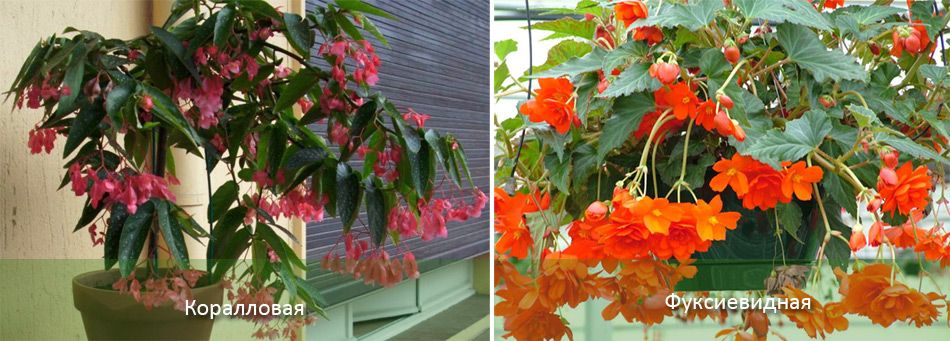
Leaves and flowers come in a variety of shapes and colors. Flowering can continue year-round. The following are most commonly grown indoors.
| View | Description | Leaves | Flowers |
| Coral | Erect, with bare stems, reaches 1 m. | Oblong, egg-shaped, the color of lush grass with small silver spots. | Bright pink, simple, small. |
| Fuchsia | Tall, highly branched branches growing up to 1 m. | Small, oval, deep green, shiny. | Pink-red, drooping. |
Tuberous
Begonias of this species have a tuberous root system, stems of 20-80 cm and a variety of flowers.
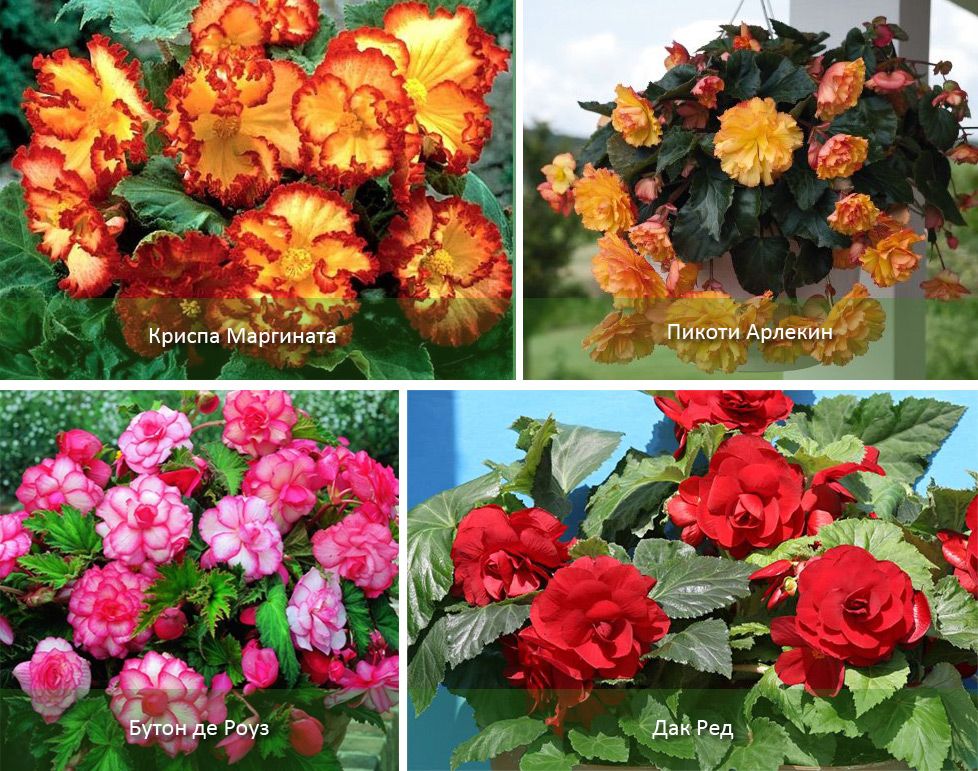
Herbaceous, shrubby, and trailing plants are found. They bloom continuously from late spring to mid-autumn.
| View | Varieties | Description | Leaves | Flowers | |
| Upright | Picotee Harlequin | Small, no more than 25 cm. | Wavy, green. | Terry, 12 cm in diameter, yellow with a bright border. | |
| Bouton de Rose | Miniature, about 25 cm. | Toothed, grassy in color. | Large (18 cm). Delicate pink, reminiscent of a rose. | ||
| Duck Red | Low, 16 cm. | Oval with small teeth, green. | Terry scarlet flowers, 10 cm in diameter, similar to a peony. | ||
| Crispa Marghinata | Small, does not exceed 15 cm. | Emerald with purple trim. | Delicate, wavy, white or yellow with a pink border and a yellow center. | ||
| Ampelous* | Roxana | Long, drooping stems. | Jagged, green. | Orange. | |
| Kristy | White. | ||||
| Girl | Soft pink. | ||||
| Bolivian* | Santa Cruz Sunset F1 | It grows upwards up to 30 cm, then begins to cascade down. | Oblong, small. | Lead-colored. | |
| Copacabana F1 | Bell-shaped scarlet. | ||||
| Bossa Nova F1 | Fuchsia-like, from white to red shades. | ||||
*They are classified as ampelous.
Blooming
The group includes beautifully flowering begonias.
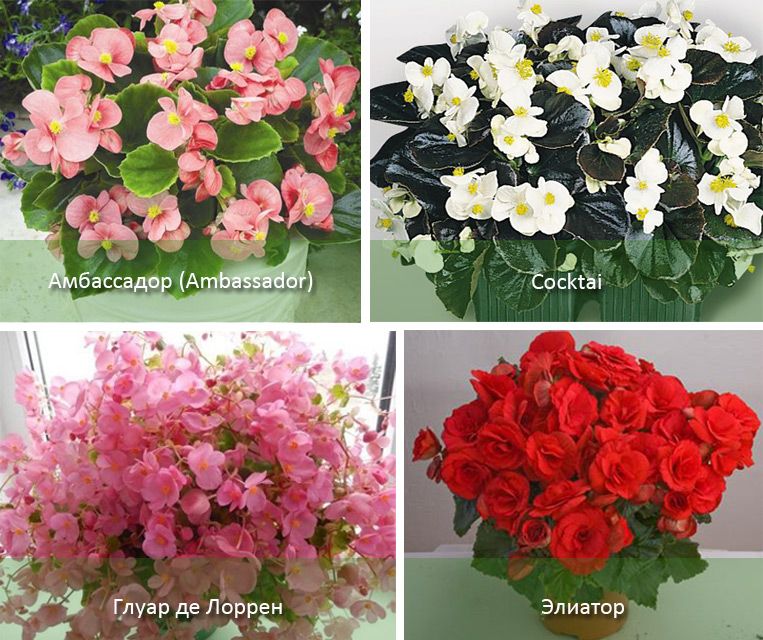
| View | Varieties | Leaves | Flowers |
| Ever-blooming Blooms all summer. |
Baby Wing | Green or bronze. | Solid or variegated in various colors. |
| Ambassador | Original, dark green with a red stripe along the edge. | Different shades, simple. | |
| Cocktail | Brick colored. | Single pink with yellow center. | |
| Eliator Year-round flowering. |
High (Louise, Renaissance) | Small, herbaceous, glossy top, matte and lighter bottom. | Scarlet, pink, orange double. |
| Medium (Annebelle, Kuoto) | |||
| Low (Scharlach, Piccora) | |||
| Gloire de Lorraine. Winter blooming. |
Competitor | Round, shiny light green, with a red spot at the base. | Drooping, pink. |
| Marina | |||
| Rosemary |
Caring for indoor begonias at home
Begonia is an unpretentious plant, but still, when caring for it, certain recommendations must be followed.
| Factor | Spring/summer | Autumn/Winter |
| Location/lighting | Windows facing east, southeast, northwest, or west. Doesn't like drafts or direct sunlight. | |
| Temperature | +22…+25 °C | +15…+18 °C |
| Humidity | Constantly around 60%. Maintain by placing a container of water or a humidifier near the plant. | |
| Watering | Abundant. | Moderate (the tuber is not watered and is put away for storage). |
| Apply when the top 1-2 cm of soil has dried out. Do not allow moisture to stagnate in the tray. Use water at room temperature. | ||
| Soil | Composition: leaf soil, sand, black soil, peat (2:1:1:1). | |
| Top dressing | Twice a month, apply a phosphorus-potassium fertilizer for flowering begonias. For deciduous varieties with a higher nitrogen content, it improves foliage growth and delays flowering. Water beforehand. Organic matter can be added (liquid manure 1:5). | Not needed. |
Features of planting and replanting begonias
Every spring, it is necessary to plant stored begonia tubers in a new container.
For species with a branched and fibrous root system, replanting is necessary as they grow.
- Use a ceramic pot, 3-4 cm larger than the plant's roots. Line the bottom with 1/3 of the drainage material and add a small amount of potting soil.
- When replanting, the plant is removed from the old container and carefully freed from soil (dipped in a light solution of potassium permanganate).
- If there is any damage, it is cut off.
- Place in new soil, cover with soil not to the top, add more when the roots dry out a little.
- Water quite often, but follow the recommendations.
- Do not expose to the sun, adaptation is necessary.
- At this time, they prune to form a new crown.
Features of wintering tuberous begonias
When growing tuberous begonias indoors, winter preparation is more important than for other plant types. This includes the following steps:
- In October, the remaining leaves are cut off from the flower and placed in a dark, cool place.
- After 2 weeks, when the entire above-ground part has died off, the tubers are dug up.
- They are stored in a dark, dry, cool room (not below +10 °C) in boxes or containers with sand.
Methods of propagation of begonias
Begonia is propagated in spring using several methods:
- by cuttings;
- separation of a part of a bush or tuber;
- seedlings grown from seeds.
Cuttings
Prepare a soil mixture of sand and peat (3:1). Use a shoot at least 10 cm long or a large leaf as a cutting. In the former case, the freshly cut planting material is placed in moistened soil and placed in a darkened area. Rooting takes 1-2 months. In the latter case, the leaf is placed in the soil with the petiole, preventing the leaf blade from touching the ground. The container is also stored in a dark area.
Seminal
This process begins as early as December:
- Prepare the soil (sand, peat, leaf soil 1:1:2), pour it into a fairly wide container.
- The seeds are distributed and lightly pressed into the soil.
- After 10 days, when sprouts appear, they are pricked out.
Dividing a bush or tuber
Bush begonias are propagated by dividing overgrown parts of the plant. The roots of the flower, including the bud and shoot, are separated from the mother plant, dried leaves and flowers are removed, and damaged areas are treated with activated charcoal. The plants are repotted in new containers and watered.
In the spring, the tubers are removed and divided into sections, leaving the roots and buds attached. The cut sections are treated with charcoal and planted in a pot filled with peat, leaving a portion of the tuber above the surface. Water and ensure constant moisture.
Diseases and pests of begonias
Failure to follow plant maintenance recommendations may lead to undesirable consequences.
| Manifestation | Cause | Measure of elimination |
| Rotting of leaves and trunk. | Fungal disease - powdery mildew due to over-watering. | Remove diseased leaves. Reduce watering. |
| Lack of flowering. | Insufficient lighting, low humidity, temperature fluctuations, drafts, excess fertilizers. | They do not allow mistakes in care. |
| Buds falling off. | Violation of the watering regime, excess or lack of light, fertilizers. | Follow the recommendations for maintaining begonias. |
| Yellowing of leaves. | Low humidity, soil depletion, pests in the roots. | Change the substrate after soaking the plant in a solution of potassium permanganate. |
| Blackening. | Moisture getting on the leaves and stem. | Be careful when watering, do not spray. |
| Plant elongation, foliage turning pale. | Lack of lighting and nutrition. | They feed it and take it to a brighter place. |
| Leaf curling, drilling and brittleness. | Too high temperature or not enough humidity. | Move to a shaded place and water. |
| The appearance of mold. | Low temperature, high humidity. Gray mold. | Damaged parts are removed and treated with a fungicide (Fitosporin). |
| The tips turn brown. | Lack of hydration. | Follow watering rules and ensure the necessary humidity. |
| The appearance of insects. | Red spider mite. | Treated with insecticides (Aktara). |