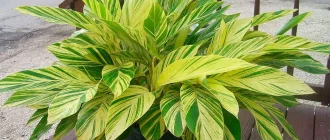
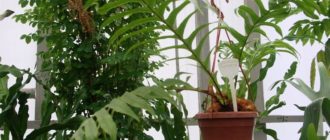
Cordyline is an evergreen plant of the Asparagus family. It is native to the tropics and subtropics of Australia, Africa, and Asia. One species is found in Brazil.
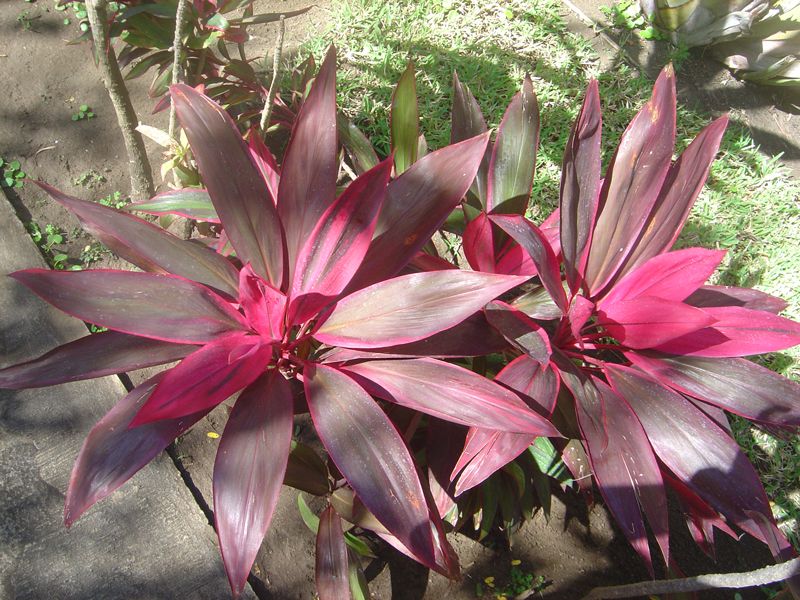
The name of the plant comes from the Greek word kordyle, which translates as a lump or knot.
Content
Description of Cordyline
Cordyline is a tree or shrub with a thick, robust root system. Leaf shape varies depending on the variety and can be linear, lanceolate, or sword-shaped. Flowers are white, red, or purple.
When grown indoors, it grows up to 1.5 meters. As it grows, the lower foliage dies and falls off, giving the plant a pseudopalm appearance.
Species for growing at home
There are several types of cordyline that are suitable for indoor cultivation:
| View | Description |
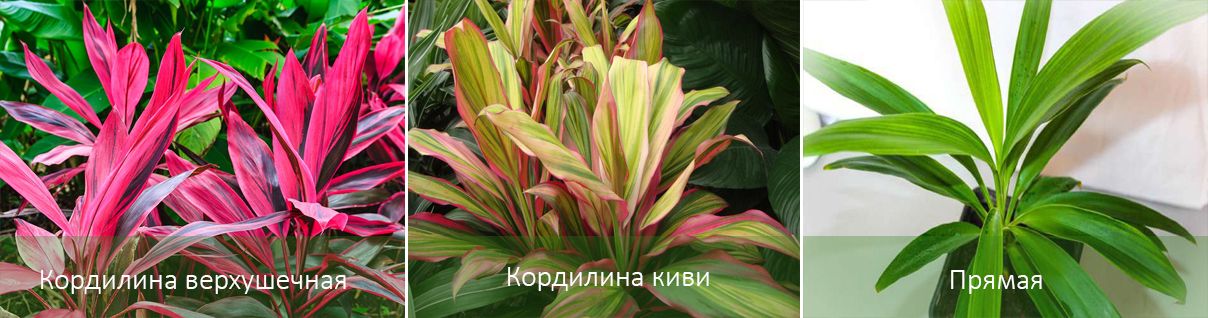
| Cordyline terminalis | A tree-like tree with a straight, pseudostem (sometimes branched) trunk and a height of two meters. Axillary paniculate inflorescences. The flowers are small, white or red. Foliage covers the tree from the ground, so it remains compact for a long time. |
| Cordyline kiwi | A lush shrub. Dark green foliage with yellow stripes and a rich crimson edge. |
| Straight | A shrub with a slender trunk that can grow up to three meters. The foliage is large, green or purple. |
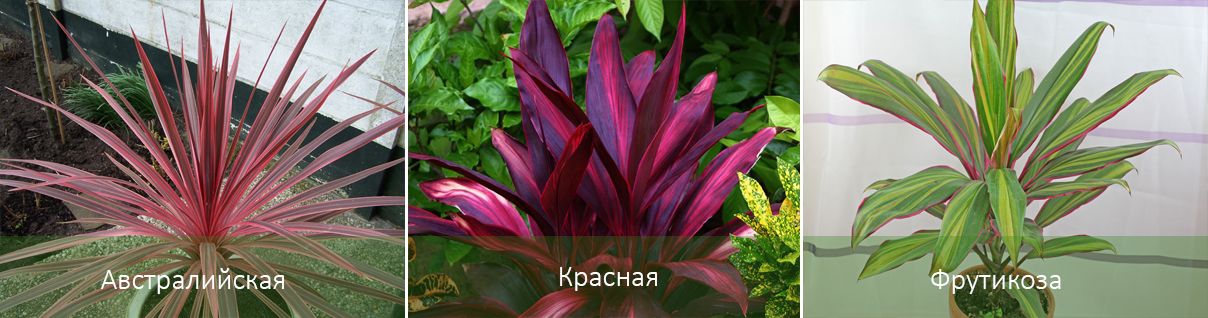
| Australian | The tallest variety of Cordyline, it reaches 12 meters in the wild. It resembles a palm tree in appearance. Its sword-shaped foliage grows up to 90 cm long. Its inflorescences reach up to 1 meter and contain quite fragrant flowers. |
| Red | It has a shrub-like shape and grows up to 3 meters tall in the wild. The foliage is dark green or deep red. The fruits are about 1 cm in diameter and bright red. |
| Mix | This is not a variety, but a collection of different species in one palette. |
| Fruticosa | The foliage can be dark green, crimson, or pink. The inflorescences are formed by loose panicles. |
| Banks | A shrub with a straight trunk, reaching 3 meters in height. The foliage is about 1.5 meters long, forming dense tufts. The outer side of the leaves is green, while the inner side is gray-green. The flowers are white. |
| Undivided | It has a thin, virtually inflexible stem. The leaves are strap-shaped, with a red vein running down the center. |
| Tricolor | Tri-color foliage, a combination of green, pink and cream. |
| Purpul compact | A small shrub with lush purple-green leaves. The trunk is short but strong. |
| Chocolate Queen | The foliage is long and wide, chocolate and green in color. |
| Snow | Green foliage with white stripes and streaks. |
Home care
When caring for cordyline at home, you need to pay attention to the season of the year:
| Season | Temperature | Lighting, placement | Humidity level |
| Spring-summer | As a tropical shrub, it thrives in warmth and tolerates sudden temperature changes. In the spring and summer, comfortable temperatures range from 22°C to 25°C, and with proper care, up to 30°C. Protecting it from wind and sun is recommended. | Cordyline prefers well-lit locations but does not tolerate direct sunlight. The amount of light is directly related to the foliage color; the brighter the foliage, the brighter the pot should be. It is recommended to place the shrub in an east- or west-facing window. | An average humidity of 50-60% is required. During the warmer months, it is recommended to spray the shrub with a spray bottle 1-2 times a week. |
| Autumn-Winter | During this time of year, comfortable temperatures for growing cordyline range from 10°C to 13°C. Some varieties even prefer temperatures of 20°C during this season. | The bush is placed on the windowsill, without additional lighting. | The required humidity level is 50-60%. It is recommended to place the container with the shrub away from heating devices. |
Planting and replanting: choosing soil and pot
Young Cordylines require annual repotting. Once the shrub reaches four years of age, the frequency decreases to once every three years.
The planting pot must have wide edges and be deep, as the shrub has a well-developed root system. The next important step is preparing high-quality soil.
To prepare the soil:
- take slightly acidic soil, sand and peat in a ratio of 3:1:1;
- everything is thoroughly mixed;
- A drainage layer (small pebbles) is poured into the new pot, and prepared soil is placed on top.
If the plant's roots have taken over the entire pot, then repotting will need to be done next spring.
Watering and fertilizing
In spring and summer, Cordyline requires generous watering; the soil should always be slightly moist. The key is to avoid overwatering and avoid stagnant water. A typical watering frequency is three times a week. During the colder months, reduce this frequency to once a week.
Cordyline requires fertilization throughout the year. During the growing season, fertilize three to four times a month. During the fall and winter, reduce fertilization to once a month.
Fertilizers are those intended for ornamental foliage plants. Liquid formulations are preferred.
Reproduction
Reproduction of the shrub is carried out:
- seeds;
- cuttings;
- by dividing the rhizome.
All these methods are relatively simple, but cuttings are more popular.
Cuttings
To propagate using cuttings, take planting material from the middle or top of the Cordyline. If the cuttings are very long, you can divide them into several sections, each with about 3-4 leaves.
Next, you need to follow these step-by-step instructions:
- the pot is filled with soil suitable for growing cordyline;
- rooting is carried out - for this the room temperature must be +28°C;
- For a month, the cuttings are sprayed with a spray bottle, and the soil is carefully watered;
- After the specified period, the rooted plants are transplanted into a permanent pot.
Seeds
If the cordyline has recently flowered and produced seeds, you can use them as planting material.
It's important to remember that this propagation method is only suitable for original species. Hybrids cannot be propagated from seed.
Using seeds is a time-consuming method. The first shoots appear only after 1-2 months. If cuttings are available, it's better to use this method.
Propagation by seeds:
- Sow the seeds in the soil prepared according to the recipe above, spacing them 1-2 cm apart.
- Wait for sprouts to appear within 1-2 months.
- When 2-3 small leaves appear above the ground, plant the seedlings.
Seeds can be purchased at a gardening store. Five seeds cost 50 rubles. Growing begins in early March.
Dividing the root system
To propagate cordyline using rhizomes, follow these steps:
- Divide the rhizome.
- Remove the roots.
- Plant the parts in one pot or tray.
- Root within 1.5 months.
- When the first leaves or trunk appear, plant the rhizomes in separate containers.
The soil composition is the same as for transplantation.
Diseases, pests
Cordyline is a plant resistant to diseases and pests. Its most serious problem is root rot, but this can be avoided by sterilizing the soil before planting.
Pests that are dangerous to Cordyline include aphids, thrips, scale insects, and spider mites. These insects can be controlled with insecticides.
Mistakes in care
When caring for cordyline, you should avoid the following mistakes:
- Exposure to direct sunlight. Short periods of exposure outdoors, especially in the morning and evening, won't harm the plant. However, during midday, it should be protected from ultraviolet rays, as even brief exposure can cause sunburn.
- Lack of fertilizer. The soil must be rich in nitrogen, which requires periodic application of fertilizer.
- Incorrect watering. In winter, reduce watering, while in summer, increase it. Curling leaves indicate over-dried soil, while excessive softness indicates the Cordyline is rotting.
- Keep in a dry room. Leaves should be moistened with a spray bottle. A humidifier is even better.
- Constant temperature fluctuations. Avoid temperature fluctuations of more than 10°C during the day. The optimal temperature is room temperature.
| Error | Cause | Correction |
| Paleness of the leaf blade. | Poor lighting. | Move the cordyline closer to the window. |
| Rotting and falling of leaves. | Excessive moisture and low temperatures. | Reduce humidity and watering frequency. Ensure a comfortable temperature for growth. |
| Darkening and curling of leaves. | Temperature changes. | Place the flower in a room with a stable temperature day and night. |
Top.tomathouse.com recommends: Cordyline – the tree of luck
The plant helps maintain a warm atmosphere in the home and suppresses negative energy. It's recommended to place the shrub in a room where guests are regularly present, as even the most friendly person can unwittingly disrupt the established biofield parameters. The magic of cordyline lies in its ability to preserve a cohesive home atmosphere, eliminating the imprint of strangers. Even those who don't take this superstition seriously report that they no longer feel tired after long gatherings.
The plant purifies the air well and improves concentration, so it is essential if there are school-age children or adults with complex mental work in the house.