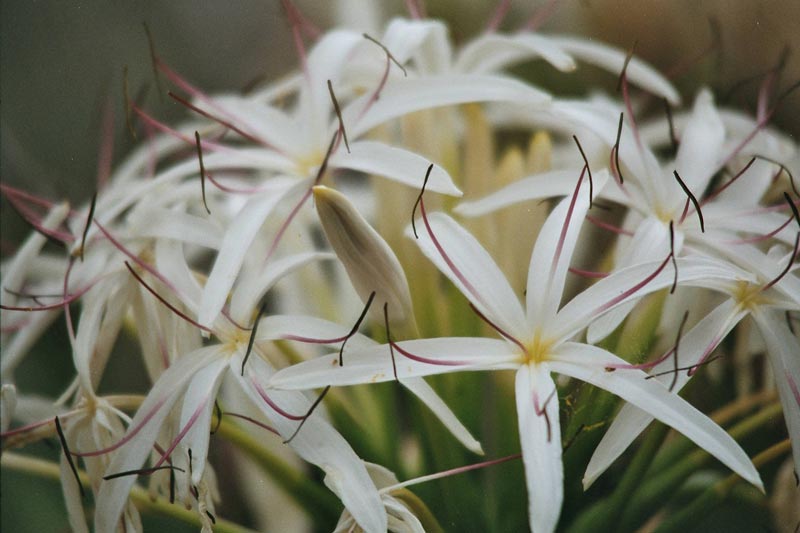
Crinum is a South African plant in the Amaryllidaceae family. It is native to the subtropics and tropics of both hemispheres. In the wild, it grows on the banks of bodies of water. Crinum is grown in gardens, indoors, and in aquariums. It is cultivated in cool or warm greenhouses.
The name comes from Latin, meaning "hair," as the flower resembles hair. The bulbs range from small (up to 5 cm), medium (10-15 cm), and large (20-25 cm). The leaves are thin, ribbon-like, with a rough surface, reaching up to 1.5 m in length.
A distinctive feature is that its fresh leaves curl into a tube, taking on a curved shape with a horizontal throat, and are up to 15 cm in size. The peduncle can sometimes reach 1 m in length. The flowers are located on the inflorescence and are white or pink in color, with a light fragrance. Inside the fruit are seeds containing water for the maturation of the young. Due to its love of moisture, it is called the marsh lily.
Content
Types of Crinum
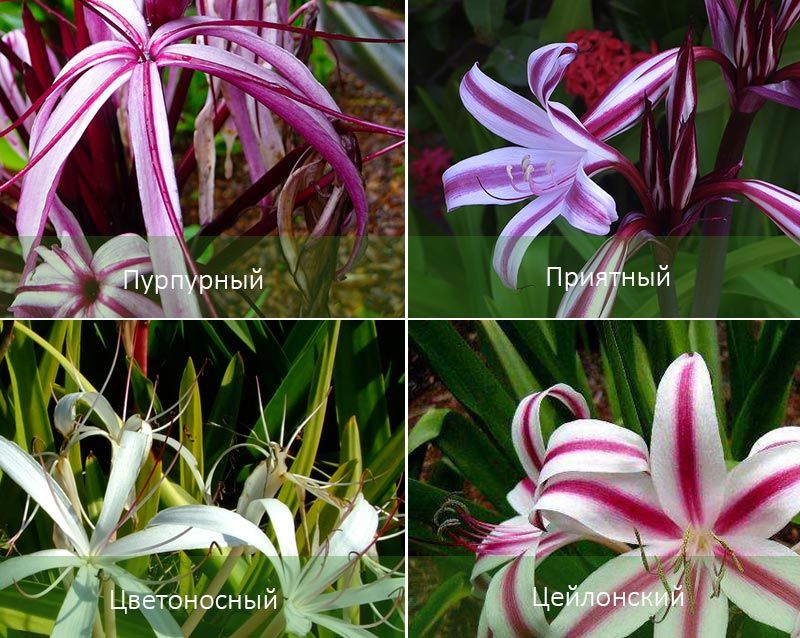
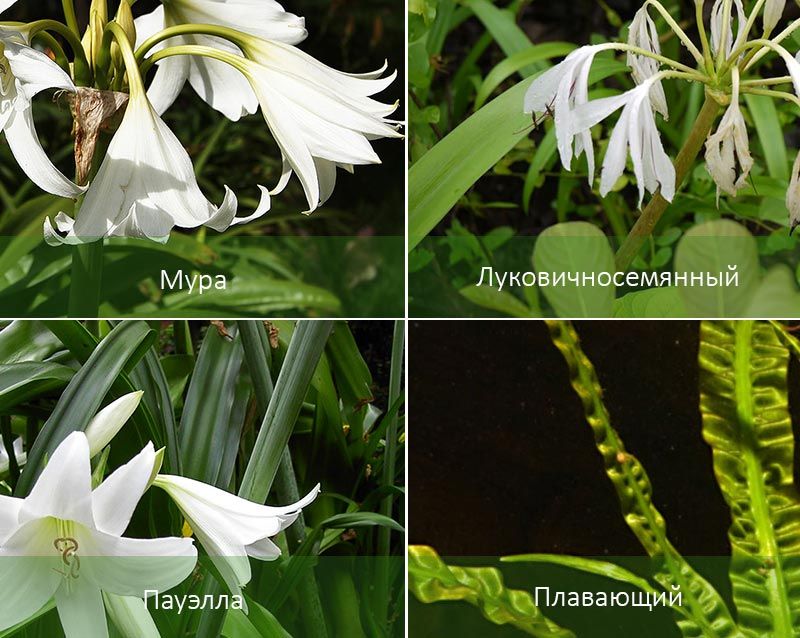
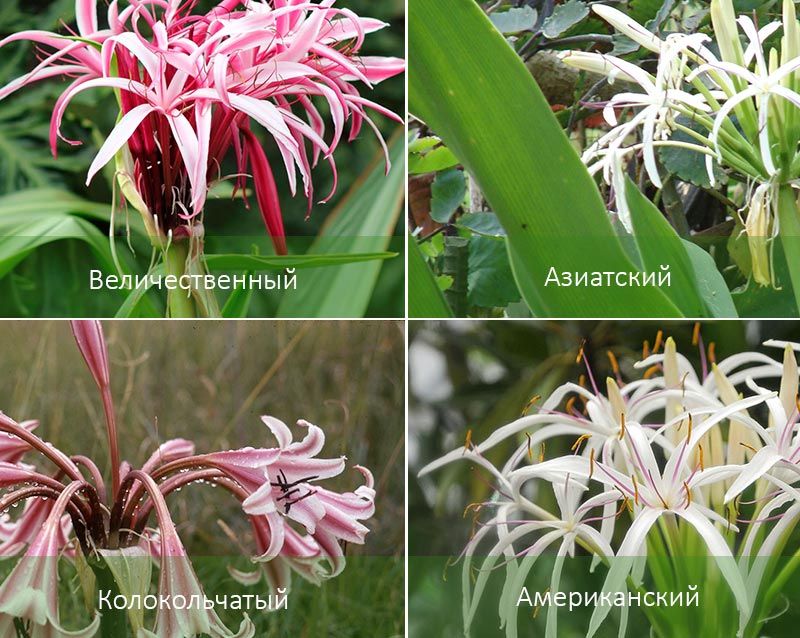
There are over 150 species of crinum worldwide. The table below shows examples of these flower varieties.
| Variety | Distribution area/Description |
| Types of indoor crinum | |
| Asiatic | Asia. The bulb is poisonous. The inflorescence consists of 30 white flowers with red stamens. Flowering period: spring-fall. |
| Nice | Sumatra Island. The inflorescence contains 30 white, pink, and purple flowers. They bloom in early spring. Repeat blooming is possible. |
| Mura | Natal, South Africa. The most popular species among gardeners, it's called the pink lily. The inflorescence holds 6-10 flowers and blooms in summer. |
| Bulbous-seeded (Cape) | Rocky soil, South Africa. The flower stalk holds 8 flowers on a 3-5 cm peduncle. The flowers are white, sometimes tinged with purple. Fragrant. Blooms in summer, July-August. |
| Powell | Natal, South Africa. A hybrid of Moore and Cape Crinum species. The inflorescence bears 8-12 white or bright pink, bell-shaped flowers. |
| Ethiopian (Abyssinian) | Mountains of Ethiopia. The peduncle bears an inflorescence with 5-6 sessile white flowers. |
| Big | Standing water bodies in western tropical Africa. The peduncle is tall, holding 3-12, often up to 6, flowers per umbel. The flowers are sessile, with short, white stamens. The throat resembles a bell. Blooms in summer. |
| Types of garden crinum | |
| Makowana | Natal, South Africa. Nestled next to the mura. The flower stalk holds 10-15 pale pink flowers. Late autumn is the best time to bloom. |
| Floriferous | The species is closely related to Asia. It is native to eastern Australia. The peduncle bears 20-30 flowers on stalks with a pleasant aroma. The color is white and green. It blooms in summer. |
| Majestic | Seychelles, Mauritius. The flat, dark scarlet peduncle holds 20 flowers on peduncles. The petals are straight and crimson. The stamens are red. It exudes a delicate fragrance. |
| Bell-shaped | Water bodies in the Cape region of South Africa. The flower is small, reaching 30 cm in height. The peduncle is narrow and green. It holds an umbel of 4-8 flowers with a 2 cm peduncle. The petals are white-scarlet with hints of green and pink. Blooms in summer. |
| Reddish | American tropics. A peduncle bears 4-6 sessile flowers with a pleasant fragrance. The flowers are white inside and pale scarlet outside. They bloom in summer. |
| Broadleaf | Eastern India. The inflorescence holds 10-20 flowers on a small peduncle, pale scarlet in color. Flowering occurs in August-September. |
| Meadow | Eastern India. An umbel bears 6-12 white flowers on short stalks. The stamens are large and scarlet. Blooms in summer. |
| Purple | Guinean waters. The bulb is small and produces small offshoots. The peduncle is short, holding 5-9 purple flowers. The stamens are wide and red. It can bloom year-round, mostly in summer. |
| Rough | Tropical Africa. The inflorescence holds 4-8 fragrant flowers on short peduncles. The petals are narrow, 3 cm wide. The color is white with a bright scarlet stripe down the middle. Blooms in May-June. |
| Virginian (maiden) | Southern Brazil. The umbel holds six flowers on short stalks. White in color. Blooms in late fall. |
| Ceylonese | Tropical Asia. The peduncle is long, dense, and bright red. It holds 10-20 flowers per umbel. The petals widen toward the top and are white with a distinct red stripe. Blooms in spring. |
| Beautiful | It grows alongside the Crinum amista on the island of Sumatra. The inflorescence bears 30 bright scarlet flowers with white and purple highlights on stalks. It blooms most often in winter and early spring. Repeat blooming is possible. |
| Types of aquarium crinum | |
| Thai | Southeast Asia. The stem is shortened. The leaves are over 2 m long, gathered in a rosette. |
| Floating | West Africa, tropical. The bulb is small, 7 cm. The leaves are 1.5 m long, but no more than 40 cm in aquariums, and 3 cm wide. Light green in color, with wavy edges. The flowers are white. |
| Curly (calamistratum) | West Africa. Considered the smallest representative of the class Crinum, it can nevertheless reach 1.7 m in length. The bulb is large, 10 cm thick, and elongated. The roots are robust. The leaves are strong and fleshy, reaching 0.7 cm in thickness. A vein runs down the center of the leaf. The sides are wavy, giving the flower its name. Crinum forms a rosette of leaves that curl in the water. With proper care, it blooms with fragrant white flowers. |
Garden crinum
The plant doesn't require complex, specialized care and is suitable for growing in garden plots.
Landing
Planting in open ground takes place in May. The following conditions must be met:
- good lighting;
- moisturizing;
- warm;
- absence of gusty wind;
- The temperature should not fall below +10 ºC at night.
A good option would be to plant the bulb indoors in a bowl at the end of March for germination and then plant it in the garden.
To prepare the soil, you will need sapropel mixed with sand and garden soil in a 1:1:1 ratio.
Care
It doesn't require any special care, you just need:
- loosen the soil periodically;
- water daily during drought, and as needed during cloudy rainy weather;
- Plant flowers at a distance of 30 cm.
During flowering, crinum needs additional feeding.
Suitable as fertilizer:
- mulching the soil with humus;
- chicken manure 1:20;
- cow dung 1:10;
- a mixture of superphosphate and potassium salt 5 g/2 l of water;
Transfer
The plant takes root well. It needs to be repotted every three years. During this period, the bulb produces offspring.
To replant, the bush is removed from the ground, the small bulblets are separated, and planted separately. The donor flower is returned to its original location. A dormant period is chosen for this.
Winter period
When planting, decide how the flower will overwinter. If the winter is mild, bury the bulb 6 cm into the soil.
In the fall, when the flowering season ends and the crinum prepares for dormancy, cover the bulbs with a half-meter layer of peat or straw. In the spring, when the weather first warms, remove the layer. This prevents rot and stimulates growth.
If the winter is cold, bury the bulb two-thirds of the way up when planting, leaving the other third above ground. At the end of the season, dig it up, dry it, and store it in a dark room with an air temperature of 5ºC.
If there is a risk of the temperature dropping to 0 ºC, the bulb is covered with a warm material.
Homemade crinum
Crinum is grown not only in the garden. The plant thrives indoors, and doesn't require any special conditions for indoor growing.
Care
The flower itself is hardy, undemanding, and drought-resistant. But remember, it only retains its beauty during the summer. Winter brings a period of rest, leaving the plant looking unkempt.
Lighting
Crinum loves bright sunlight and doesn't mind direct rays. A south-facing windowsill is a good spot indoors.
After winter, the amount of light should be gradually increased to prevent the plant from getting burned.
Temperature conditions
This plant is a heat-loving plant. The minimum air temperature is 14ºC. During flowering, it should be 25ºC; during resting, it should be 15ºC. It tolerates climate change, sudden changes, and drafts. Regular ventilation is essential.
Air humidity and watering
A moisture-loving plant. Water with warm water as needed if the top layer of soil has dried out. The plant is tolerant of humidity. As it prepares for dormancy, reduce watering.
The plant's roots function all year round, so occasional soil moisture is necessary.
Watering can be used to stagger the plant's active and dormant seasons. To do this, allow the soil to dry out without wilting the leaves. As soon as the flower stalk appears, water generously. Then, stop watering for 7-10 days to allow the flower to bloom.
Priming
To plant a crinum in a decorative bowl, you need to prepare the soil. Mix the ingredients in the following proportions:
- clay 2;
- leaf soil 1;
- peat 1;
- humus 1;
- sand 1.
Add charcoal if desired.
Fertilizer
Fertilizers for indoor flowering plants are suitable, using the dosage indicated on the label. To ensure annual blooms, it is recommended not to skip the resting periods.
Transplantation and propagation
Planting indoors isn't much different from planting in the garden. Repot the plant once every three years, during its dormant period. Choose a large decorative pot to comfortably accommodate the roots. Remove any dead or broken roots. Add drainage to the bottom. Leave one-third of the bulb visible. Leave 3 cm from the rim of the pot.
Crinum is most often propagated by cuttings. Small bulblets are separated from the donor plant during its dormant period and planted individually in small 10-cm diameter cups. Water and fertilize regularly to promote good growth. Each year, the cuttings are transplanted into larger cups. In the third or fourth year, choose a spacious 30-cm diameter cup. This promotes the formation of new cuttings and lush flowering.
Pests
The flower is rarely attacked by pests. More common problems indoors include scale insects and stragonosporosis. A fungicide will help combat this.
Spider mites and mealybugs are common in the garden. To kill them, choose potent acaricides or insectoacaricides, such as Fitoverm, Actellic, and Karbofos. There are many methods for controlling mealybugs, including both folk and professional remedies. The former include various infusions, such as garlic, citrus, alcohol, and horsetail tincture. The latter group includes insecticides and insectoacaricides with intestinal and contact action, such as Inta-Vir, Actellic, and Bankol. Everyone chooses what they consider effective.
Care of aquarium crinum species
Plants have long been a decorative addition to aquariums. Besides their beauty, they also purify and oxygenate the water. Crinum is one such plant. It adds a unique look to any aquarium and requires little maintenance.
Submerged crinums are distinguished by their hard roots, ribbon-like leaves and multi-layered bulb scales.
Conditions for keeping crinum:
- water of medium hardness, slightly salty;
- temperature +20º…+28 ºC;
- The lighting is average.
When placing in an aquarium, it should be taken into account that the plant has a rosette shape, due to which it becomes voluminous and feels comfortable at a depth of at least 1 m.
When planting, bury only the beginning of the bulb in the ground; the rest of the bulb should be kept in water. Roots can rot; check and fertilize periodically.
Crinum reproduces in two ways: by cuttings or by seeds. Budding is the preferred method, whereby the small bulblets can produce 2-3 leaves or roots. Up to 20 cuttings can be present on a single mother bulb.
Top.tomathouse.com recommends: Crinum – the flower of Sagittarius
Astrologers believe that each zodiac sign has its own flower. For Sagittarius, it's the Crinum Powellii. The plant purifies surrounding energy, promotes peace, and sets the right mood. On bad days, it creates a protective shield to keep negativity away from its owner. Just as the flowers reach for the sun, Sagittarius is drawn to new travels, discoveries, and knowledge. After all, people born under this sign are philosophers and travelers.
Besides being the flower of Sagittarius, crinum is used in folk remedies. It contains alkaloids valued in Eastern medicine.
A decoction made from the plant's leaves is used to treat various ailments, including radiculitis, colds, and migraines. A decoction made from the bulbs is used to treat hemorrhoids and psoriasis.
For those who prefer traditional medicine, do not try these infusions on your own; consult a doctor first. Crinum contains a toxic substance called crinin. For this reason, gloves should be worn when handling the plant. Wash your hands with soap afterward.
When purchasing a potted crinum, carefully inspect the foliage. Pests often hide in the foliage.
Crinum is an unpretentious plant that, with proper care, will delight its owner for many years.