Codiaeum belongs to the Euphorbiaceae family. It is native to East India, Malaysia, and the Sunda and Maluku Islands. Its distinctive feature is the milky sap that permeates the stems and leaves, helping the plant heal any damage or infection. Florists often use another name: croton.
Content
Description
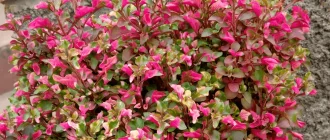
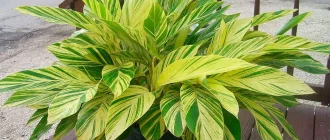
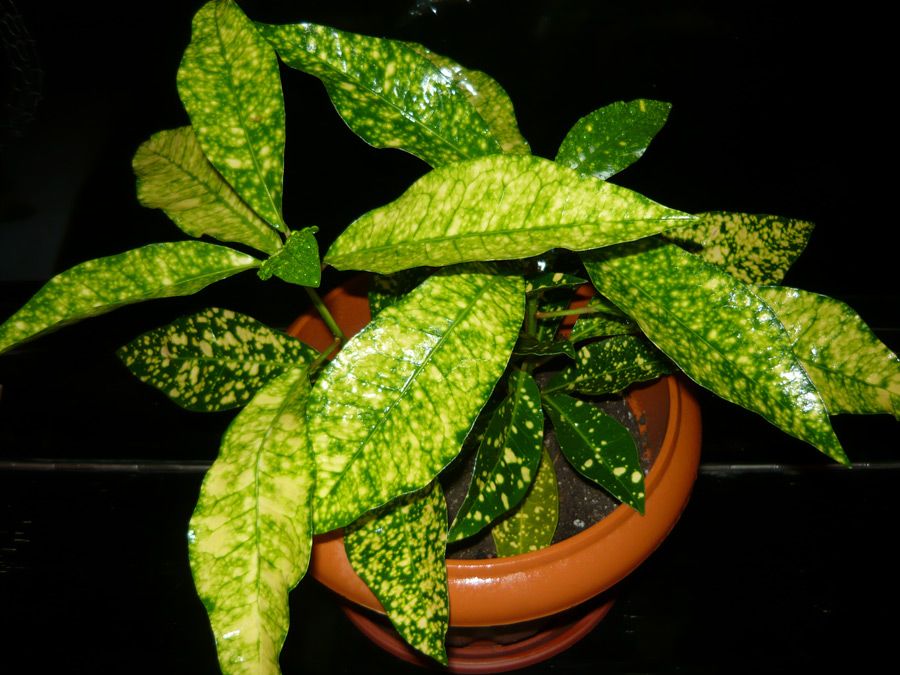
Croton is a shrubby plant. In the wild, it reaches 3-4 meters, and indoors, up to 70 cm. Its leaves are tough, leathery, and come in a variety of vibrant colors and shapes, reminiscent of large laurels. They can be twisted or straight, wide or narrow, pointed or blunt. Their color ranges from light green to reddish-brown, with veins ranging from yellow to red. Young plants are always lighter in color than mature ones. The flowers are small, unsightly, and yellowish-white.
Varieties for indoor cultivation - table
Of all the croton species, only one is grown at home - the verigrade (variegated) variety, but the varieties bred on its basis are no less original in color.
| Varieties | Leaves and other features |
| Variegatum | Large, 30 cm long. Leaf blades come in a variety of shapes and colors, ranging from yellow to green, changing depending on lighting and other factors. The stem is straight, without leaves below. This is the founder of all ornamental hybrids. Indoors, it grows up to 70 cm. |
| Petra | Thick, shiny, light green with yellow edges and veins, shaped like pointed blades.
The stem is branched. |
| Tamara | Elongated oval with jagged edges, the coloring is unusual - pink, purple or yellow spots are scattered on a white-green background.
Hybrid. Reaches a meter in height. A rare variety. |
| Mommy | Twisted, long, curly, variegated. |
| Mrs. Aiston | Long, wide, rounded at the ends, brightly colored - yellow, red, pink and gold. Tall tree-like variety |
| The Black Prince | So dark green they appear black. Red, yellow, and orange spots are scattered across the wide, dark ovals. |
| Excellent | They resemble oak, the front side is yellow-green, the back side is burgundy-red.
A low bush. |
| Disraeli | Lobed green, veins yellow, underside brick-brown. |
| Zanzibar | Very narrow and long, falling in a green, yellow, red waterfall.
Looks spectacular in hanging baskets. |
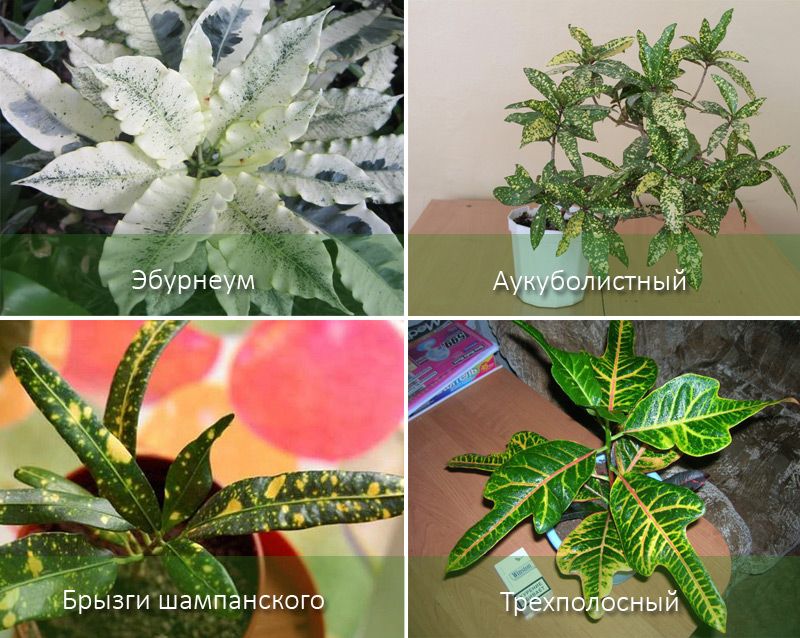
| Aucubifolia | Small, narrow, green in color with uneven yellow spots. |
| Sunny Star | Narrow, dark green, with yellow and lemon hues blooming at the tips. |
| Three-cavity | They consist of three parts with gold veins. |
| Eburnaeum (white chimera) | Creamy in color. With bright, diffused light and regular misting, it can delight with burgundy colors. |
| Champagne splashes | Narrow, oblong, dark with yellow splashes. |
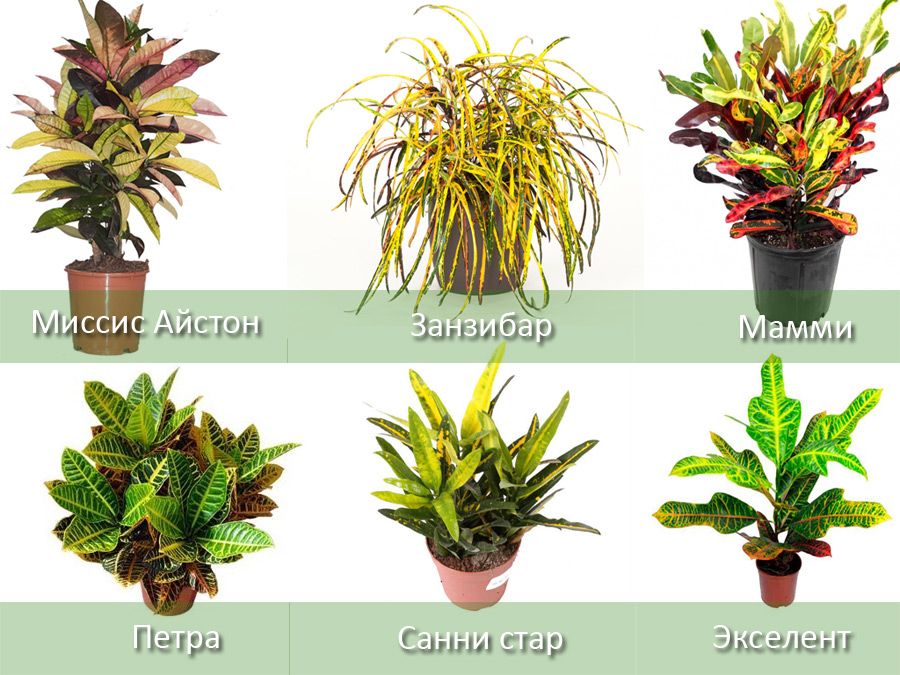
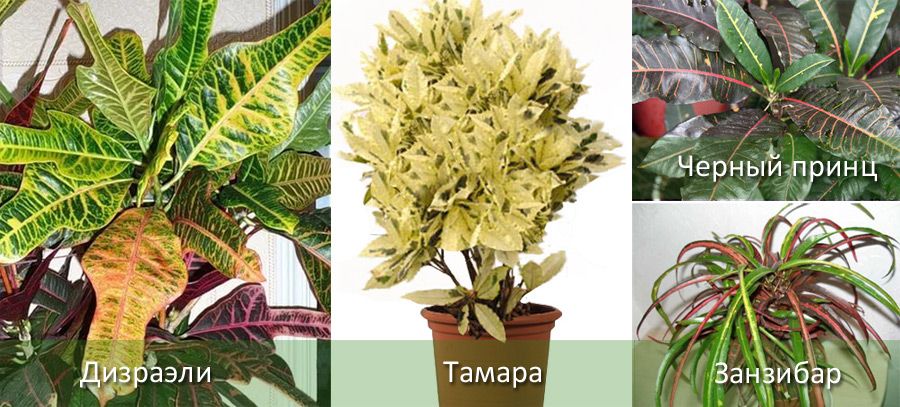
Mix is a variety of croton cultivars.
Home care
The plant is quite demanding, but if you create the right conditions, you can achieve variegation and brightness throughout the year.
Season table
| Parameter | Spring/Summer | Autumn/Winter |
| Location/Lighting | Prefers eastern and western windows with bright but diffused light. | A south-facing window is best. If the plant doesn't get enough light, the leaves will begin to lose their vibrant color, so additional lighting is needed. |
| Temperature | Comfortable temperature: +20…+24℃. At +30℃, shade and increased humidity are necessary. | Avoid temperature fluctuations. Acceptable temperatures are +18…+20℃, not lower than +16℃. |
| Humidity | Increased. In summer, spray regularly with warm, settled water. It's best to place the flower container in a pot filled with moist material (pebbles, expanded clay). | Spraying is reduced. However, during the heating season, it is necessary to ensure the air around the codiaeum is sufficiently moist. |
| Watering | Frequent, good. But the soil should dry out to a third of its capacity. Water should be warm and settled. | They are decreasing. |
| Top dressing | Once a week - alternating complex mineral and organic fertilizers | They cut back once a month. |
Repotting: Pot, Soil, Step-by-Step Description
Crotons are repotted in the spring. Young plants (1-3 years old) are repotted annually, while mature plants (over 3 years old) are repotted every 2-4 years.
The pot should be shallow, slightly wider than the container the plant was in before repotting. This is because its growing roots will interfere with foliage development. Plastic is fine for a young croton, but a clay pot is preferable for a mature plant, allowing the soil inside to breathe.
Drain holes are essential.
The soil should be slightly acidic. Prepared universal soil is diluted with fine-grained drainage, perlite, and charcoal. To prepare it yourself:
- young growth: humus, turf, coarse sand (2:1:1);
- adult croton - (3:1:1).
Transplantation - a step-by-step process:
- The soil is pre-watered.
- The new container is filled with drainage (three centimeters) and a small amount of soil mixture.
- Using the transshipment method, the codiaeum is taken out, placed in the middle and topped up with soil.
- They are watering.
- Place the flower pot in a sunny but indirect light location. Water daily.
It is better to replant a new flower after a month.
To improve the adaptation process, croton is sprayed with a growth stimulator (Epin).
Formation, support
To create a fuller crown, pinch young plants back to 15 cm at first, then 20 cm as they grow. Pruning is done in the spring.
If the codiaeum stops growing after the procedure, this is temporary. It will branch out after some time.
A mature croton with a large amount of foliage and a less-than-sturdy trunk requires support. Bamboo or wooden poles can be used for this initially. You can also purchase special climbing aids or make your own.
Growing methods: terrarium, bonsai
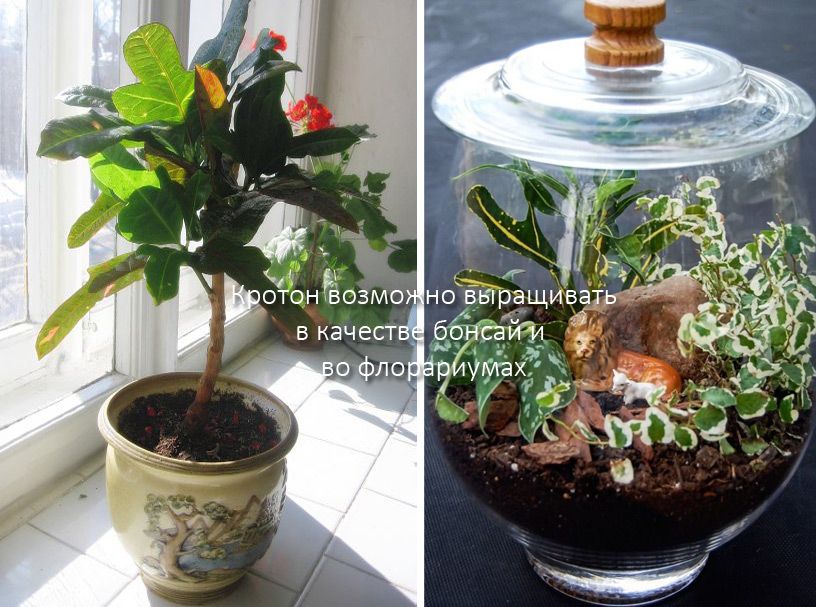
Small varieties of croton can be grown in both indoor and outdoor terrariums, and their leaves will also be bright and variegated. It pairs beautifully with other plants.
If you have patience, you can make a bonsai out of a codiaeum. Proper pruning and hanging of its branches is essential.
Reproduction
The most common method of propagating croton is by cuttings. Rarely, it is propagated by seed or layering.
- After spring pruning, cuttings are taken.
- Remove the leaves at the bottom and trim the top ones.
- They wash it.
- The cuttings are placed deep into the moist substrate.
- Cover with a jar, creating greenhouse conditions.
- After two or three weeks, they are replanted.
Care errors and their elimination - table
Croton's appearance will indicate improper conditions and mistakes in caring for it.
| Type of damage | Reason for appearance | Method of elimination |
| The foliage is turning pale. | Insufficient lighting. | Place closer to light, but protect from bright sunlight. Use artificial lighting in winter. |
| Dry brown inclusions. | Sunburn. | Hide from sunlight. |
| The leaves are curled, the tips are brown but soft. | Temperature changes. | Monitor the temperature during the day and night. It shouldn't vary significantly. |
| Brown and tan leaf edges. | Insufficient watering.
Dry air. Drafts. |
Provide for everything:
|
| Drooping leaves, loss of elasticity. | Insufficient watering. Freezing of roots. |
Water regularly with warm water. Place in a bright and warm room. |
| November. | Croton is getting old.
Excess moisture in winter. Very dry or cold atmosphere, draft. |
Follow the codiaeum:
This is a common occurrence with normal growth of young leaves. If young growth is suffering, eliminate all defects. |
| Redness of leaves. | Nitrogen starvation. | Use fertilizers containing nitrogen. |
| The back side of the leaf becomes white and fluffy, the top side turns brown. | The temperature is too low.
Overwatering. |
In winter, if there is a lack of heat, water with warm water after the soil has dried out to one third of the pot's volume. |
| Yellowing. | Lack of nutrition.
Overwatering. |
Apply fertilizer during growth.
Follow watering rules. |
| Red spots on the back of the leaves. | Excess of sun. | Shade during midday sun. |
Diseases and pests - table
| Manifestation | Disease, pest | Method of struggle |
| Brown spots appear. The codiaeum doesn't grow and dries out over time. | Fungal disease | Remove diseased leaves. Place the codiaeum in a weak solution of potassium permanganate. Replace the soil. Treat the croton with a solution of Fitosporin. For severe infestation, use Skor. |
| Yellowing and falling of leaves, softening of roots. | Root rot | Only at the beginning of the disease is it possible to save croton:
Protected light and infrequent watering are required until new leaves appear. |
| Yellow spots and white webbing appear. Leaves wilt. | Spider mite | Remove diseased leaves. Spray with Fitoverm and Actellic. |
| Raised, dark spots on the back of the leaf. | Scale insect | Remove the pest. Spray with Actellic. Repeat treatments until the insect disappears. |
| Leaves are sticky, a whitish coating appears, growth stops. | Mealybug | Treat with insecticide, repeatedly. |
Top.tomathouse.com recommends: Codiaeum – a flower for communication
Croton leaves combine Mercury and the Sun. This promotes the awakening of communicative energy, allows one to find common ground with others, and reconciles those who have quarreled. Croton prevents the development of diseases and boosts immunity.