Nertera is a flower from the Rubiaceae family, classified as a groundcover. It is native to the tropical and subtropical regions of New Zealand, South America, and Australia.
Content
Description
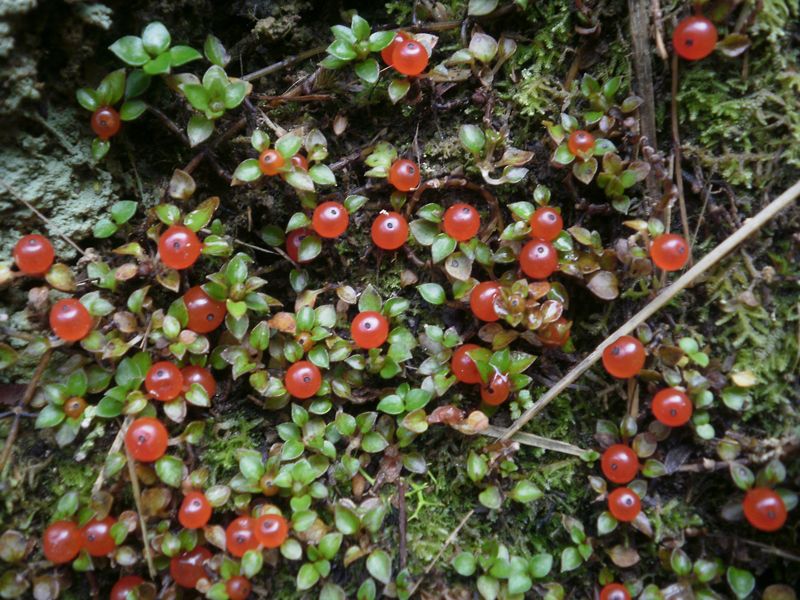
The plant has slender stems, reaching about 2 cm in height, that spread along the ground, forming a "carpet." The leaves are small and rounded, sometimes elongated, and arranged oppositely. Small flowers are green-white or light yellow. The pea-shaped fruits come in red, brown, and orange.
Indoor species
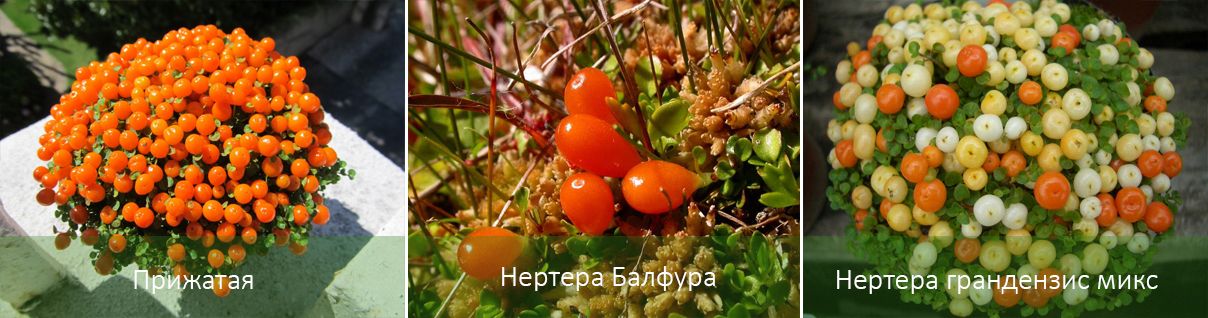
There are several popular types of indoor nertera:
| View | Description |
| Pressed | Native to South America, it produces round, orange fruits. It grows lushly, forming a cushion-like lawn. |
| Nertera Balfour | A low-growing plant with rounded green foliage. The stem is long, reaching 20-25 cm in height. Small star-shaped flowers. Orange, teardrop-shaped fruits. |
| Nertera Grandensis Mix | A low-growing perennial plant with a grass-like stem. The leaves are small, rounded, up to 7 mm long. The flowers are yellow-green, and the berries are orange. |
| Ciliated | The flowers and foliage are covered with small eyelashes. The foliage is green and lanceolate. The flowers are small, white and green. The fruits are round and orange. |
| Nerter Cunningham | The stem is green and herbaceous. The fruits are round and red. |
Proper home care
When caring for Nertera at home, you need to take into account the season of the year:
| Season | Location and lighting | Temperature | Humidity |
| Spring – summer | Requires indirect light and does not tolerate direct sunlight. It should be placed in partial shade. | +20…+22°C. | High 70-80%. Wet pebbles and expanded clay are placed under the pot. |
| Autumn – Winter | Autumn-winter +10…+12°C. | Average – 55-60%. Spraying is carried out once a week. |
Watering
In summer and spring, the plant requires ample watering, ensuring the soil does not dry out. In the fall and winter, wait until the soil is completely dry before watering.
Container, soil, transplant
When replanting an adult flower, you can use the same container in which the Nertera was previously growing.
To avoid damaging the plant, carefully remove it from the pot along with the soil ball. It's best to slide a blade between the sides of the container and the soil ball.
Then, holding the flower, turn the pot over and tap the bottom lightly. The contents will separate from the sides. Carefully remove the plant from the pot, then:
- Place a drainage layer (a mixture of expanded clay and pieces of foam) on the bottom of the container;
- pour out the substrate (a mixture of leaf and turf soil, peat, sand and humus);
- plant a plant;
- water moderately.
Top dressing
Fertilizer selection requirements for top dressing are strict. The plant reacts negatively to excess nitrogen, so only mineral and complex nutrients are permitted. Fertilizing should be done strictly from March to September.
Reproduction
Reproduction is carried out in three ways.
Seeds
Sow seeds at the end of winter. Use a wide pot and prepare a soil mixture of sand, leaf mold, and peat (one part each). Add drainage to the bottom of the container. Place the seeds spaced apart, compact them, spray with water, and then cover with glass. Store the pot at 22°C. All the seeds won't germinate together; some will germinate in a month, while others may take three. Once this happens, place the pot on a well-lit windowsill, away from direct sunlight. In low-light conditions, it's best to use special lamps. When the soil dries, water the seedlings.
cuttings
Nertera can also be rooted using green cuttings. Place the cuttings in a glass of water, submerging them two-thirds of the way. For better rooting, use special preparations, such as Kornevin. Roots will appear on the stem in about two weeks. When they reach 1 cm, the plant should be repotted in a separate pot.
Rhizome division
This method is used to propagate Nertera after the berries have fallen. Prepare a substrate of turf, leaf mold, peat soil, and coarse sand (one part each). Then, fill the new pot with the prepared soil mixture, making sure to provide drainage (expanded clay and broken bricks), and transplant a portion of the plant into it.
Mistakes in care
When caring for Nertera, novice gardeners make mistakes.
| Manifestation | Cause |
| Lack of flowers or their falling off. | High temperature, excessive amount of nitrogen in the soil. |
| Stem rot. | Over-watering of the soil. |
| Drying of leaf tips. | Lack of moisture, exposure to direct sunlight. |
| Leaves change color to brown. | High temperature and excess light. |
| Fruit shrinkage. | Too high temperature in winter. |
Diseases, pests
During the cultivation of Nertera, it can be affected by various diseases and suffer from the effects of harmful insects:
| Disease/Pest | Cause | Methods of control |
| Gray rot. | Frequent spraying of foliage. | Reduce the frequency of spraying, remove all affected branches. |
| Root rot. | Over-watering of the soil. | Regulating the plant's watering regime. |
| Spider mite. | Insufficient air humidity. | Treating the flower with any insecticide. |
Top.tomathouse.com warns: poisonous nertera
Nertera berries are non-toxic and cannot cause death after consumption, but they do cause problems with the gastrointestinal tract.
If there are small children in the home, it is recommended to place the plant at a height where the child cannot reach it.
The plant can be used to decorate patios and courtyards. It is recommended to place it indoors or in a well-lit area of the yard where winter temperatures do not drop below 10°C.