Peperomia is a genus of perennial herbs belonging to the pepper family. The name itself suggests a family connection: pepero means pepper, and omos means similar.
Content
Description
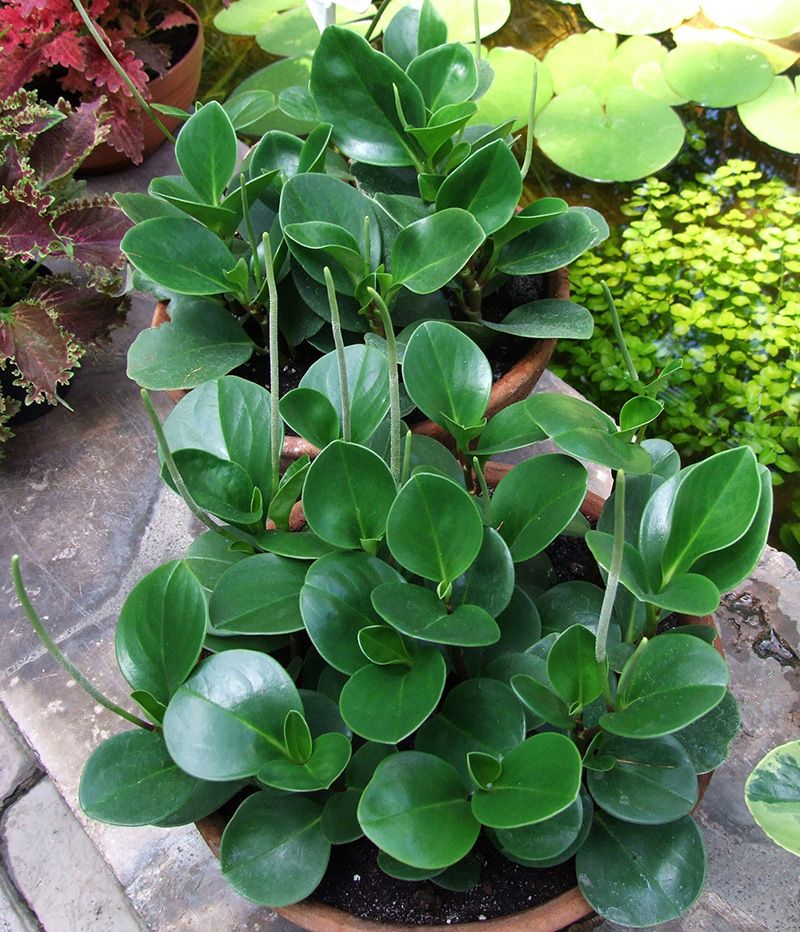
Peperomia is a herbaceous plant growing from 15 cm to half a meter tall with fleshy leaves. The foliage can come in a wide range of shades, with or without stripes or spots. Peperomia blooms in spring and early summer, and after flowering, small, dry fruits form.
The genus is very large: according to some estimates, it contains approximately 1,500 species. Wild representatives grow in the shade of tropical forests in the Americas and Asia.
Types of Peperomia
Peperomia is a trailing plant, so it's often used to create complex arrangements and is highly prized by decorators. There are many decorative species and varieties.
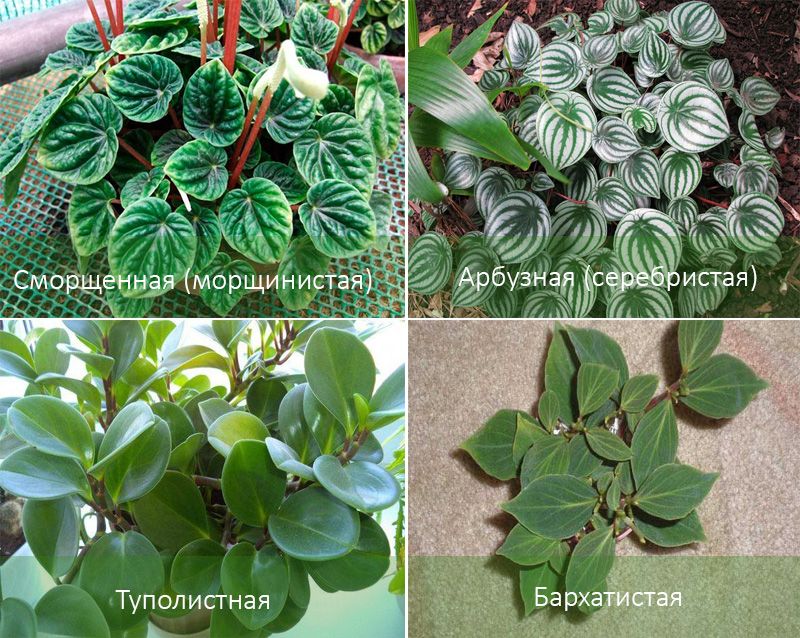
The most popular of them are:
| View | Description |
| Wrinkled (wrinkled) | A small, compact plant (growing up to 10 cm) with velvety, heart-shaped leaves. They are wrinkled, with brown veins on both sides. There are varieties with red foliage. One of the most popular is the caperata lilian. |
| Watermelon (silver) | The plant is virtually stemless. Fleshy, glossy leaves are attached to long petioles (10-12 cm). Its green color with light stripes resembles that of watermelons, hence its second name. |
| Obtuse-leaved | The plant grows up to 30 cm tall, with wide, dark green leaves that are fleshy, smooth, and very dense. It does not flower. The most popular varieties are variegata and alba. They differ in leaf color. |
| Velvety | It grows up to 50 cm. The dark brown trunk is pubescent, as are the leaves. The leaf shape is elongated, oval, with lighter veins. |
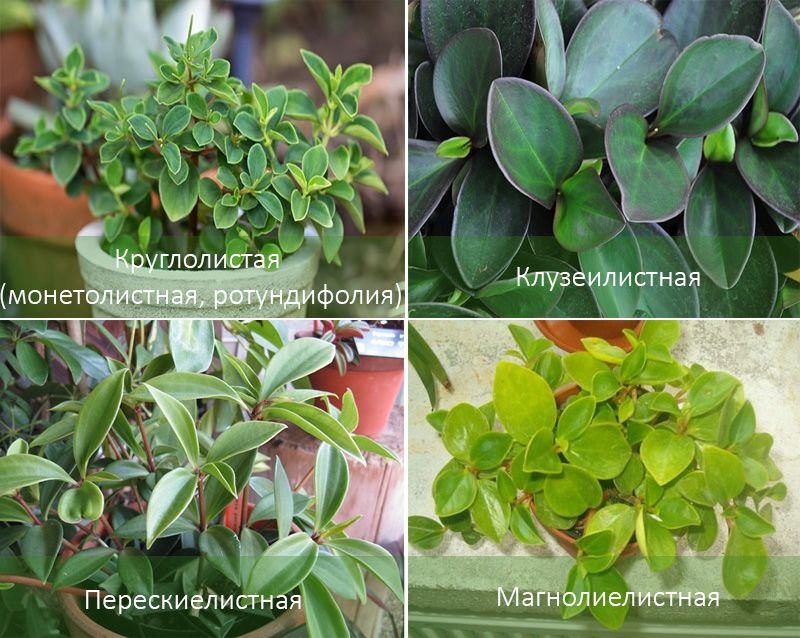
| Round-leaved (coin-leaved, rotundifolia) | A trailing, small-leaved species. Creeping, light-brown shoots are covered with small, round, bright-green leaves. This species has no resting period in its cycle. |
| Cluseilifolia | A tall, upright bush. Distinguishing features: vibrantly colored leaves. They are dark green in the center, with red, pink, yellow, or purple hues toward the edges. |
| Pereskilistnaya | A trailing plant with stiff, elongated leaves. The leaves are leathery and dark green. |
| Magnolifolia | Named for its leaves' resemblance to magnolia, the thick, pinkish stems reach heights of up to 40 cm. Variegated forms have leaves with bright yellow edges. |
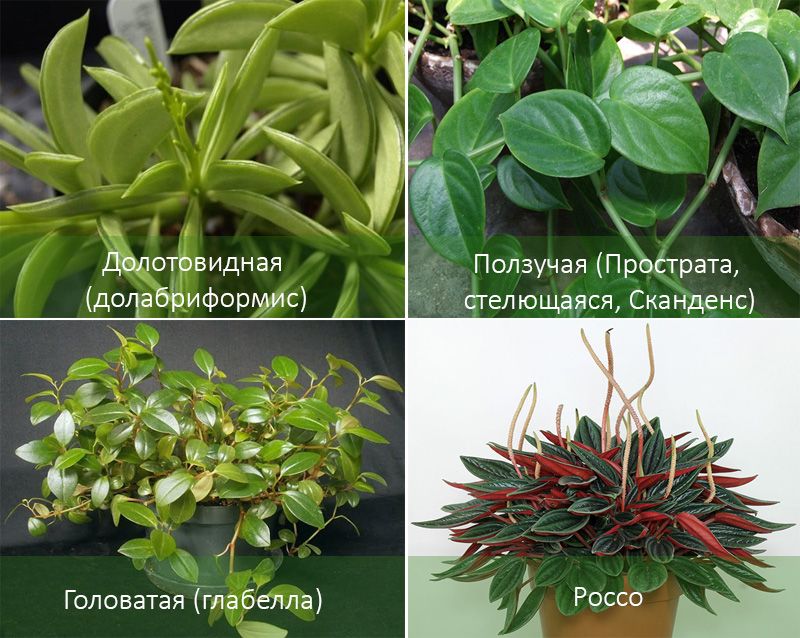
| Chisel-shaped (dolabriformis) | A low plant (up to half a meter) with unusual fleshy leaves reminiscent of pea pods. The trunk and foliage are bright green. The most popular varieties are Happy Bean, Ferreira, and Nivalis. |
| Creeping (Prostrate, creeping, Scandens) | Epiphyte. The leaves are small, rounded, and borne on short petioles. They are dark green with a lighter edge. |
| Headed (glabella) | Trailing variety. Drooping or creeping shoots up to 20 cm long, covered with fleshy, round, bright green leaves. |
| Rosso | A low, compact shrub. It does not flower. The leaves vary in color: green on the upper surface and burgundy on the lower surface. |
| Whorled | A trailing succulent. Drooping shoots with large, gray-green leaves. The leaves are attached in whorls. |
| Gray-haired | In the wild, it grows on rocky slopes in Brazil. Its succulent leaves are covered with fine, silvery hairs. |
| Graveolens | A low-growing plant with fleshy, brightly colored leaves. The underside is burgundy, the top is green. A succulent. |
| Polybotrya (Raindrop) | A rare species with leaves resembling water lilies. The bush grows from 20 to 50 cm tall. |
Recently, Peperomia Mix has appeared in flower shops. This isn't a cultivar per se, but a collection of miniature varieties planted in a single container.
What you need to know about caring for peperomia at home
Peperomia is unpretentious, but it is worth keeping in mind:
- Variegated varieties prefer light; their uniform green color is more comfortable in partial shade or under artificial lighting. The darker the leaf color, the more shade-loving the peperomia is.
- All species (except for the fleecy ones) like high air humidity of about 50%.
- They do not tolerate drafts well.
- Grows well in the kitchen.
- Due to the tendency of the roots to rot, you cannot water through the tray.

Seasonal care: table
| Parameters | Spring-summer | Autumn-Winter |
| Location | A west- or east-facing window. Requires protection from scorching sunlight. In winter, variegated varieties can be moved to south-facing windows; otherwise, they will become diseased due to lack of light. | |
| Temperature | +20…+24 °C | +18…+20 °C |
| Lighting | Depending on the plant variety. | |
| Watering | Moderate, focus on when the soil dries out. | |
| Fertilizer | 2 times a month | Once a month |
The plant doesn't tolerate temperature fluctuations well. If the pot is located near a windowsill, it's best to place insulation underneath it in winter.
Despite its tropical origins, peperomia doesn't require much misting. Often, it's only necessary in hot weather. Varieties with fleshy, shiny leaves appreciate being wiped with a damp cloth.
Soil and fertilizing requirements
The difficulty of indoor care lies in choosing the right soil. Different types of Peperomia typically require different soil compositions. Each variety should have a clay-based substrate. The soil composition should be neutral, similar in quality to mixtures for ficus or palm trees. It should be low or neutral in acidity.
Peperomia requires a well-drained and loose soil mixture. Some varieties are best grown hydroponically.
Fertilizing every two weeks in spring and summer and once a month during the cold season is sufficient. Any mineral fertilizer is suitable, but the dosage should be reduced by half. Peperomia roots are very sensitive, so fertilizing should only be done after watering.
Watering
This plant is adapted to low soil moisture, so watering should be moderate. Based on the soil condition, water only when the top layer (at least 3 cm) is dry. In summer, this is approximately once every 10 days; in winter, once every 2-3 weeks. The water should be soft and warmer than the room temperature. After a while, be sure to drain any excess water from the tray.
Transfer
The frequency of repotting depends on the age and species. Only young plants up to three years old should be repotted annually. Large-leaved plants should be repotted no more than once every two years, while small-leaved plants should be repotted once a year. Spring is the best time.
It's easy to tell when it's time to repot your Peperomia: the plant stops growing and roots begin to emerge through the drainage holes.
This plant has a small root system, so it's best to choose a small pot. The new container should be approximately 1.5 times the diameter of the old one. Since Peperomia roots grow slowly, an overly large pot is undesirable. Tall ceramic pots are suitable. When repotting, it's crucial to ensure good drainage. Leave at least a 6 cm layer of soil. Then, keep the container in partial shade for two weeks. Once the plant has recovered, return it to its original location.
Reproduction
Propagation of this plant is carried out in the following ways:
- generative (by seeds);
- by cuttings;
- dividing the bush during transplantation.
Generative method
Suitable for flowering species. Ripe seeds are stored in a cool, dark place until spring. Procedure:
- soil preparation (a mixture of coarse sand and universal substrate);
- place the soil in a shallow container and water it;
- spread the seeds over the surface and sprinkle with a small layer of soil;
- Cover with glass or film and place in a bright, warm place. If possible, provide heating;
- ventilate for 5 minutes daily;
- spray when the soil dries out;
- When 2 adult leaves have formed, replant.
Cuttings
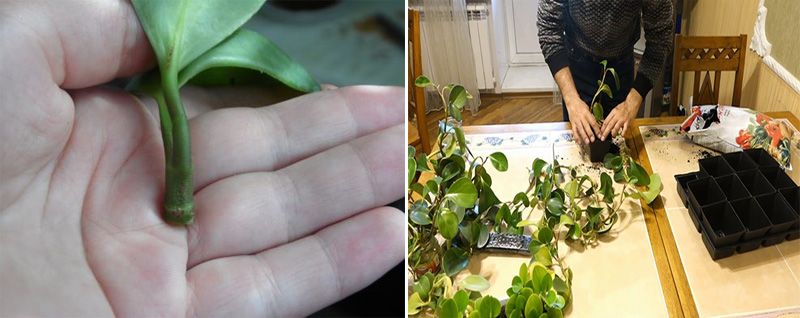
Cuttings can be taken from leaves or stems. The advantage of this method is that the plant can take root at any time of year. When choosing a cutting, pay attention to the presence of growth points; the more there are, the higher the chance of rooting.
Important: Even a leaf from an adult plant is suitable for propagation.
Place the cutting in warm water or damp sand. If using water, immerse the cutting no more than 3-5 mm deep, otherwise rot will occur. To speed up the process, cover the container with glass or plastic. On average, rooting takes about a month.
Dividing the bush
Divide the bush only during planned repotting. The procedure is the same as for regular repotting, except that the root system must be divided. This is best done with a sharp knife, and the cuts treated with charcoal.
Pests and mistakes when growing peperomia
| External signs on leaves | Cause | Treatment methods |
| The appearance of brown spots, yellowing. | Excess fertilizer. | Replant with complete replacement of soil. |
| Darkened edges. | Low temperature or draft. | Move to a more suitable location. |
| Lethargic. | Too much lighting. | Shade or move to another location. |
| Growths at the bottom. | Overflow. | Replant with a complete soil change. |
| A wilted plant under normal lighting. | Root rot. | Transplant into new soil after pre-treating the roots (rinse, remove damaged areas, treat with charcoal). |
| Curvature, lack of growth in a recently purchased plant. | Dwarfism virus. | The disease is not curable. |
| Cobweb. | Mite. | Treat with insecticide, increase humidity. |
| White coating. | Mealybug. | Wipe the damaged areas with a cotton pad soaked in alcohol. Replace the soil. |
| Falling off. | Skipping watering. | Change the watering schedule. |
| Falling in winter. | Low temperature. | Move the flower to a warmer place and insulate the pot. |
| The appearance of dead areas and swelling on the roots. | Nematodes. | 30-minute bath with hot water (+40 °C); treat with insecticide. |
| Flat growths (and on the stem). | Scale insect. | Treat with a soap-alcohol solution or insecticides. |
Top.tomathouse.com explains: the benefits and harms of peperomia
This flower is not only beautiful but also beneficial. Its leaves produce a special substance that kills streptococci and staphylococci. Scientists have proven that its presence in a room reduces airborne bacteria by 50-70%, making it especially beneficial in children's rooms. According to popular superstition, peperomia is the "flower of love," inspiring a desire to care for and protect loved ones. There's a surefire sign: if a peperomia appears in your home, expect good changes in your life.