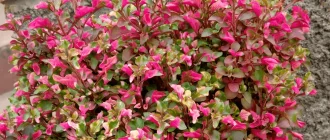
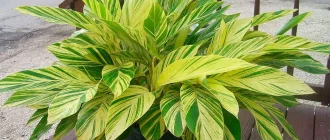
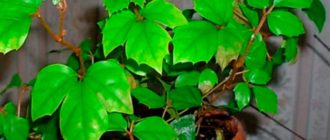
Plectranthus, Swedish ivy, spur plant, house mint, or moth tree—these are the names of this humble native of South Africa. It also refers to a genus of plants in the Lamiaceae family, which, according to various sources, comprises between 250 and 320 species: shrubs, subshrubs, and trailing plants.
Description
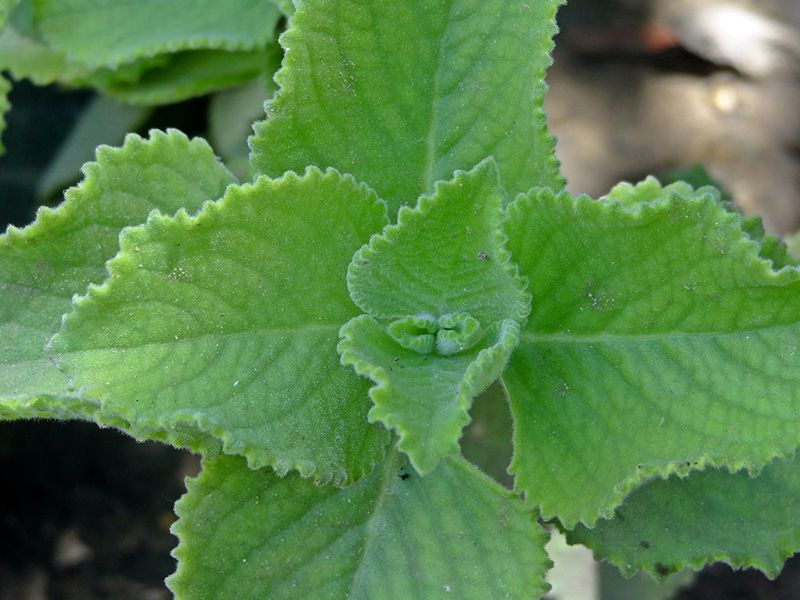
Plectranthus is a plant grown not for its flowers, but for its beautiful foliage. Trailing plectranthus looks especially beautiful in hanging pots.
The plant is characterized by long, flexible stems and beautifully carved leaves. Compact, it grows up to 80 cm. The serrated-edged leaves are arranged in pairs on a short petiole. They are uniform in shape and size, and their color is a soft green, sometimes patterned. They have a pleasant minty scent due to the oils they produce. This aroma repels moths.
It blooms in summer. The flowers are small, gathered in whorls. Their color ranges from white to various shades of blue.
Types of Plecranthus and their characteristics
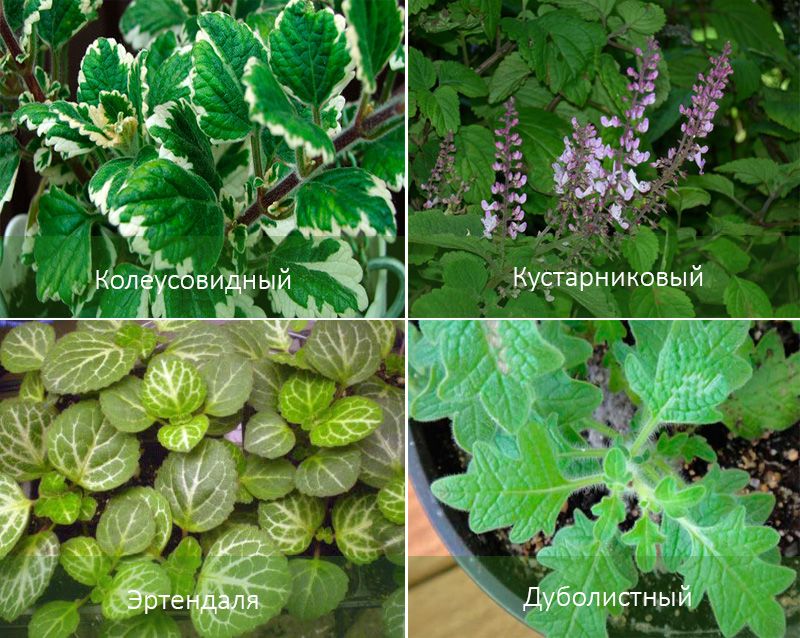
Plectranthus species and varieties differ not only in their external features, but also in their aroma.
| View | Characteristic |
| Coleus-like |
The most common varieties:
|
| Shrub |
|
| Ertendal |
Popular varieties:
|
| Oakleaf |
|
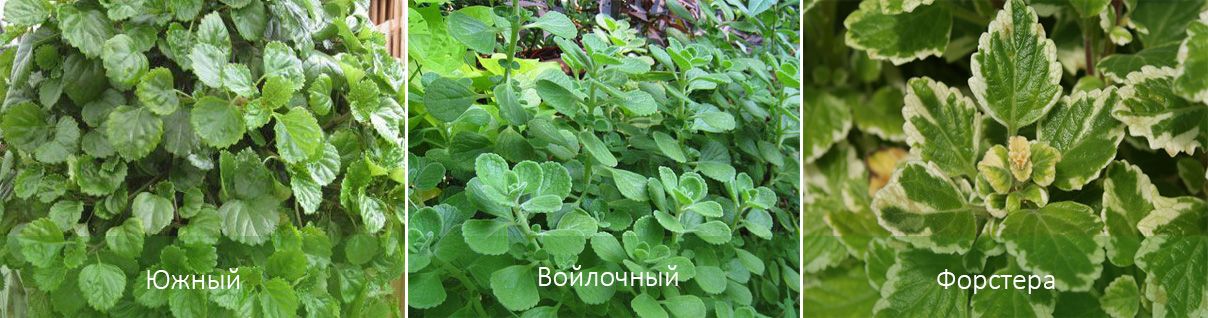
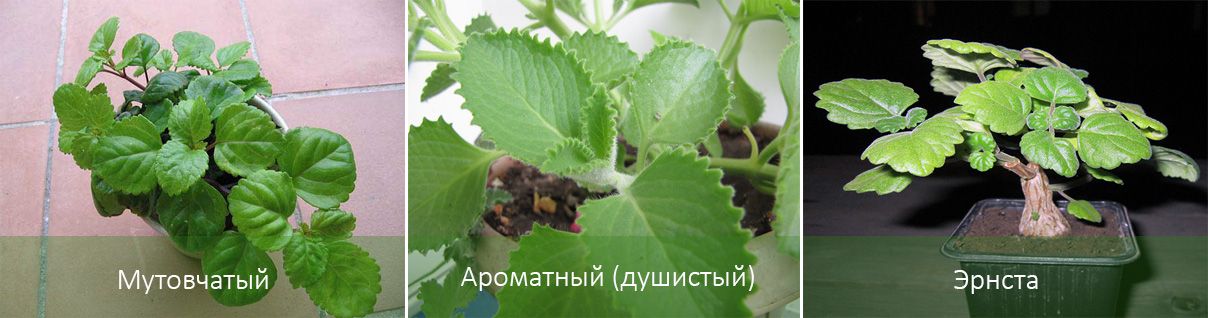
| Southern (Scandinavian, Swedish ivy; whorled, nummular) |
|
| Felt (Hadiensis, Indian borage) |
|
| Forster |
|
| Whorled |
|
| Fragrant (aromatic) |
|
| Ernst |
|
Home care
Caring for a plectranthus at home doesn't require much time. The plant is easy to maintain.
| Parameters | Spring-summer | Autumn-Winter |
| Temperature | +20…+22 °C | +15 °C |
| Location/Lighting | Bright but filtered light. South- and west-facing windows are ideal. Direct sunlight can be harmful to the plant. | |
| Humidity/Spraying | It doesn't require much humidity. Misting is necessary if the pot is located near heating appliances. | |
| Watering | Moderate. Only when the top 1-2 cm of the substrate has dried out. The water must be soft, settled, and warm. | |
| Fertilizer (mineral and organic, alternately). | Once every 2 weeks. | One feeding per month (if not dormant). |
Repotting: choosing a pot and soil
For indoor mint plectranthus to thrive, proper soil composition is essential. It should be highly fertile and slightly acidic. A good option is a mixture of equal parts soil, turf, sand, and humus. Annual repotting is required for the first three years of its life. After that, repot as needed, approximately every three years.
Repot in the spring. The pot needs to be spacious, as the rhizome is large and very developed (the diameter of the new container is 2-3 times larger than the previous one). Drainage should be one-third the height of the pot.
When replanting, do not compact the soil mixture; it should remain loose. Water thoroughly afterwards.
Reproduction
Propagation is by cuttings. To do this, they are placed in water or soil. It's important that the cuttings have several growth nodes. Some of the leaves at the bottom should be trimmed off.
Roots appear as early as the second week. When they reach 3-4 cm in length, they can be transplanted into individual pots.
Trimming
Plectranthus is characterized by rapid shoot growth, often leaving bare. To maintain its decorative appearance, the plant requires regular pruning. This is best done during repotting in the spring. During this period, branches are cut back to half their length. Throughout the year, shoot tips should be pinched. This promotes abundant branching.
Mistakes in caring for plecranthus, diseases and pests
| External signs on leaves | Cause | Methods of elimination |
| Yellowing, falling off. | Root rot due to excess moisture. | Reduce watering. |
| Wilted, drooping stems. | Insufficient watering. | Increase the frequency of watering. |
| Smaller size, color change. | Excessive lighting. | Shade or rearrange. |
| Yellowing and shedding with moderate watering. | Low temperatures. | Rearrange |
| Twisted. | Aphid. | Treat with insecticides. |
| Sticky coating, wilting. | Mealybug. | |
| Cobweb. | Spider mite. | |
| Gray spots. | Powdery mildew as a result of overwatering. | Reduce watering, treat with a special preparation. |
Top.tomathouse.com recommends: healthy plectranthus
In addition to pleasantly scenting a room, plectranthus has many other beneficial properties:
- repels moths;
- its aroma calms the nervous system;
- used for medicinal purposes (relieves itching from insect bites, inflammation, has diuretic properties, treats coughs, helps with headaches);
- tea brewed from plectranthus helps with infections and colds;
- According to popular superstition, mint solves money problems.