At the end of the 18th century, the Dutch scientist Jacob Cornelius Matthäus Radermacher described a plant he discovered in Southeast Asia, on the island of Java.
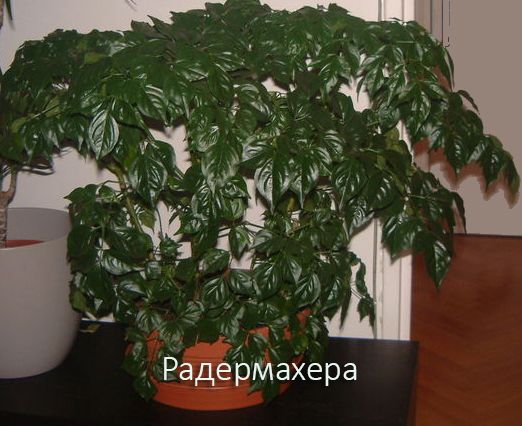
Description
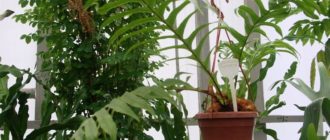
Radermachera belongs to the Bignoniaceae family. It is an easy-to-grow deciduous plant that can reach a height of 1.5 m with proper care (in the wild, it grows up to 40 m). Florists especially appreciate its rich crown. An evergreen, radermachera has beautiful, richly green, glossy foliage that reaches 30 cm in length. It rarely blooms indoors. However, in the wild, it produces large yellow bell-shaped flowers. This shrub with its twining stems is easy to shape, making it a popular choice for ornamental landscaping.
Species for breeding (growing) at home
Growing the Chinese chrysalis (one of the many names for the radermachera) is a fairly simple process. However, of all its species, only one is adapted to indoor conditions: the radermachera sinensis. The radermachera, also known as the sinica, is an evergreen shrub. Indoors, it is recommended to artificially restrain its growth (pruning) to prevent the bush from becoming bald. Its uniform, emerald, lanceolate leaves make it a favorite among many gardeners.
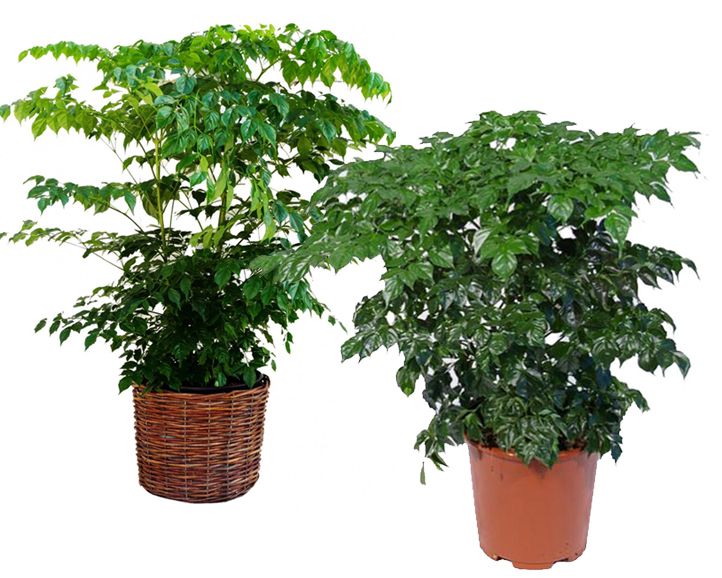
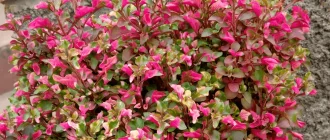
Currently, there are active attempts to “cultivate” another species, the fiery red radermachera, which is just as beautiful as its relative.

Necessary conditions for indoor care
Radermachera is unpretentious, and at home, care does not require much effort.
| Conditions |
Winter |
Spring/Autumn |
Summer |
| Location and lighting | A warm room with no drafts. Artificial lighting (fluorescent lamps, phytolamps) is required. | Keep the room warm, avoiding sudden temperature changes. Artificial lighting should be provided as needed (at least 12 hours of daylight). | You can keep it on a balcony or veranda; if the climate permits, it can be planted outdoors. Avoid direct sunlight (this will cause leaf burns). |
| Temperature | Not below +15 degrees Celsius. | Optimally +20-+25 degrees, but not below +15 (at +14 degrees the plant may die). | Optimally +20-25 degrees. |
| Humidity and watering | Water moderately and mist (leaves don't like being rubbed). Water should be soft (if using tap water, let it sit at room temperature for 24 hours first). | Water once every 2-3 days, spray, do not wipe the leaves. | Don't allow the soil to dry out. Radermachera dislikes overwatering and doesn't tolerate drought. Therefore, water as needed, at least 2-3 times a week. The water should be soft. Mist. In extreme heat, a warm shower can be used. |
| Top dressing | Once or twice a month, unless the plant is dormant. | Once or twice a month. Fertilize with nitrogen-rich fertilizers in the spring and potassium and phosphorus-rich fertilizers in the fall. | Once or twice a month. |
Tips for planting and replanting
The optimal time for repotting is the first half of March. Young plants are recommended to be repotted annually, while mature plants (over 5 years old) should be repotted every two to three years. Roots emerging from the drainage hole are a signal to repot.
When choosing a pot, it's recommended to use the diameter of the previous one as a guide (the new pot should be at least 2-3 cm larger). Avoid giving the plant too much space. The Chinese doll will not grow until the roots have filled the new space. This is a natural characteristic of the plant. Also, pay attention to the size of the drainage holes; they should be large enough to prevent the next repotting from causing significant damage to the root system.
Soil is crucial for Radermachera. Therefore, it's important to choose the right soil carefully. General-purpose soil or citrus palm soil are good choices.
The transplant process is as follows:
- at the bottom of the pot - drainage (3 cm will be enough);
- fill with soil about a third of the way;
- we moisten the soil;
- we take a plant with a lump of earth;
- we trim dry roots and tops;
- sprinkle the cuts with chalk (you can use activated carbon);
- don't touch for several hours;
- place in a new pot;
- we add soil;
- compact carefully;
- moisturize.
Reproduction
There are three ways to propagate the emerald tree:
- Cuttings – you can take flowers that are at least three years old. Cuttings are the upper portions of shoots, approximately 8-12 cm long, with the nodes of emerging leaves. It's important that they show no signs of disease. Cuttings are either placed in water or rooted in soil.
- Air layering: Take a mature plant with strong, woody branches. Make a shallow cut along the branch's ring. Wrap the cut in a layer of damp moss and cover tightly with plastic. The trunk is separated when the newly formed roots reach at least 5 cm in length.
- Seeds are not very popular. Some specialty stores sell indoor ash seeds (another common name). The seed is placed in a mixture of peat and sand (equal parts) to a depth of 1 cm and covered with a jar to create a greenhouse effect. Periodic ventilation and watering are necessary. Germination will take approximately two weeks.
Pruning, crown shaping
The plant can be trained in two ways: as a bush or as a small tree. However, this is essential because the radermachera grows very quickly. The plant tolerates pinching well, so shaping it is quite simple.
Don't break off branches; you'll need pruning shears or scissors. It's best to remove no more than 1/5 of the crown at a time.
To shape the tree, remove excess side shoots throughout the plant's life, leaving the central trunk. To achieve a bonsai style, the branches can be twisted, bent, and weighted down with various tools until they become woody. Rotate the pot periodically to ensure the crown develops evenly.
Errors and their elimination
If you carefully observe the tree, it will itself tell you what it lacks.
|
Symptom |
Cause |
Method of elimination |
| The shoots stretch out. | Insufficient lighting. | Compensate for the lack of light. |
| The tips of the leaves dry out and their tone decreases. | Insufficient watering. | Do not allow the top layer of soil to dry out and do not forget to spray the plant. |
| The leaves become smaller and duller. | Lack of nutrients. | Make some fertilizer. |
| The leaves turn yellow and the plant begins to shed them. | Lack of light. | Find a more suitable location with sufficient lighting. |
Top.tomathouse.com warns of diseases and pests
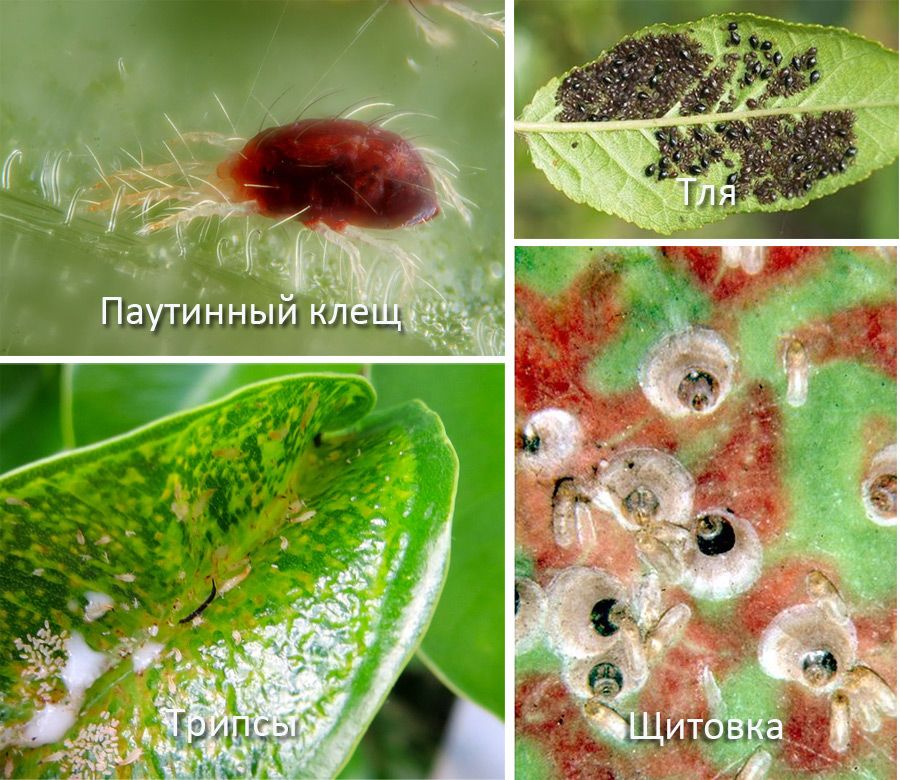
- Aphids. Small insects appear on the underside of the leaf. Spots of dead leaf tissue form on the upper surface. The leaf becomes unpleasant to the touch, sticky, as if secreting a specific resin.
- Mealybug. Whitish "cotton-like" pellets form at the junction of the leaf and shoot. The soil surface also takes on a whitish tint.
- Spider mite. Leaves are covered in webbing. Dark spots (puncture marks) are visible.
- Whitefly. The leaves develop a silvery tint that is unusual for the plant.
- Scale insect. The underside of the leaf becomes covered with oval plaques, with a yellowish or reddish tint developing around them.
Any disease is curable. If a plant has been damaged by a pest, it's important to take action promptly. Specialty stores offer affordable treatments for every situation.
Folk beliefs about the plant
Want to achieve harmony? Get a radermachera. According to folk belief, it not only brings harmony to the home it inhabits, but also peace to the souls of those living there. This plant can protect its owners from curses or the evil eye, and even absorb attacks. Perhaps it's just superstition.,or maybe not.