Selaginella is a spore-bearing plant of the Selaginellaceae family, an ancient group of club mosses. Native to the Americas, Mexico, and Africa, there are over 300 species, each distinguished by its leaf appearance. The plant grows rapidly in a humid, warm climate, tolerates heavy rains, can survive without sun, and can be immersed in water without rotting.
Content
- 1 Description of Selaginella
- 2 Types of Selaginella for the home
- 3 Basic rules for caring for selaginella at home
- 4 Propagation, pruning
- 5 Mistakes in caring for selaginella, diseases, pests and their elimination
- 6 Methods of growing Selaginella
- 7 Top.tomathouse.com explains: the beneficial properties of selaginella
Description of Selaginella
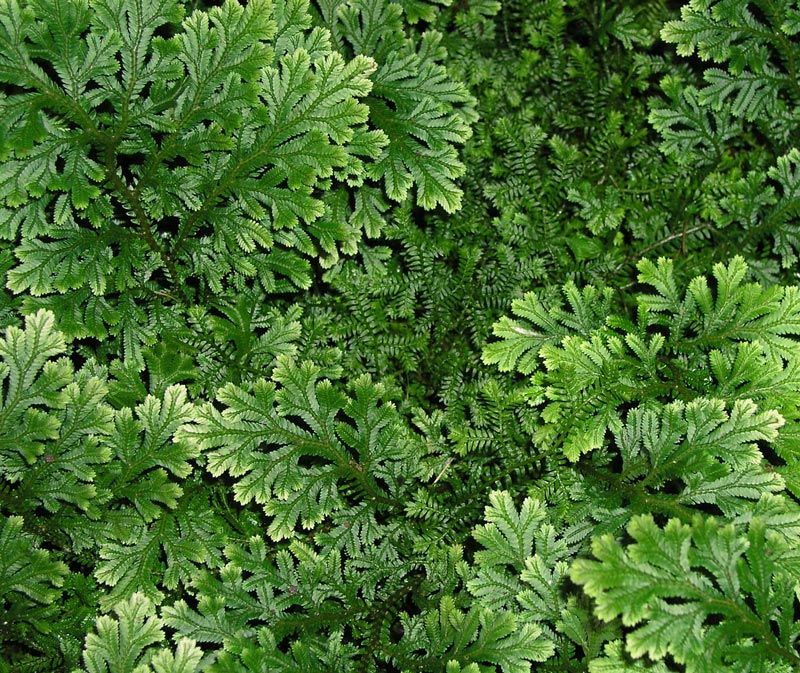
Selaginella is a branching groundcover plant. Epiphytes and lithophytes—climbing, moss-like, and climbing—are also found. They grow on cliffs, tree crowns, swamps, and rocks. Club mosses grow up to three meters tall in the hot tropics, with shoots that are either ascending or prostrate. Selaginella, resembling vines, can reach lengths of up to 20 meters. The leaves (about 5 mm) resemble pine needles, but are very soft, growing tightly in rows, partially overlapping each other like tiles. They vary in shape, pattern, and shades of green.
Types of Selaginella for the home
Gardeners cultivate over 20 species of indoor club mosses. These plants don't bloom, but they do delight with their unusual foliage. The most common are:
- Selaginella Lepidophylla (Jericho Rose) is drought-adapted. This lepidophylla is native to the American deserts. This "resurrection plant," a round, dried lump, revives in water within a day – scale-like leaves unfurl, and feather-like shoots up to 5 cm tall straighten. This is called cryptobiosis, when the plant survives without rain, even in drought. The upper surface of the leaves has a ligule for collecting water.
- Vildenova is a branched bush with flat green shoots 10 cm long and thin oval leaves of a blue hue.
- Jori (Yori) is a tropical plant characterized by a straight stem up to 20 cm tall and a spherical crown. Its shoots are light green with a foam-like edge.
- Apoda is a creeping plant with moss-like cushions. The stems are short, no more than 20 cm, and the shoots are smooth and flat. The leaves are emerald green with a yellowish tint, serrated at the base, and have adventitious roots. Native to North America and Canada, it can overwinter under snow. Indoors, it grows as a trailing plant in hanging pots.
- Martensii is an ornamental flower with unusual, lacy, fern-like leaves. It grows up to 30 cm and has aerial roots. The stems are straight and droop as they grow. The leaves come in various shades of green, glossy or matte. Some species have yellow or silvery tips.
- Kraussii – long shoots up to 30 cm long can quickly root and create a beautiful carpet. The leaves are small and yellow, although variegated varieties are also available.
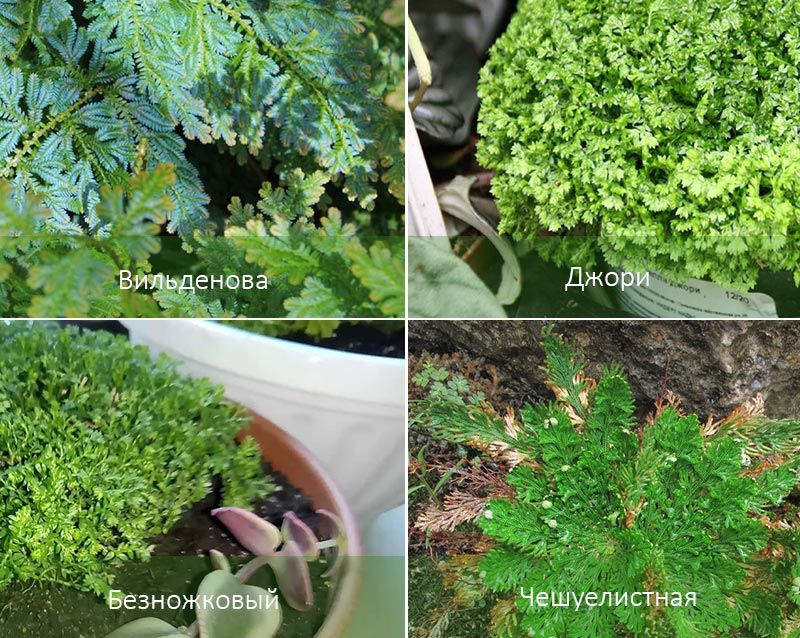
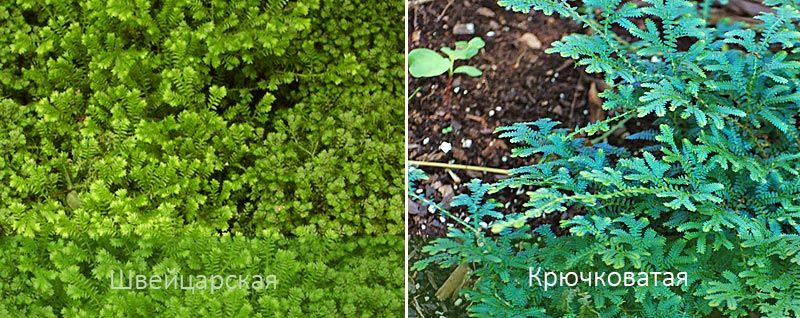
The following are distinguished:
- Hooked - blue leaves, very tightly adjacent to each other, reminiscent of pine needles.
- Swiss rhododendron is found in the Caucasus and the Far East. It is distinguished by its light-colored leaves, which are arranged perpendicular to the shoots. It prefers partial shade and moist, water-draining soil.
Basic rules for caring for selaginella at home
Caring for selaginella is difficult due to the lack of moisture in home conditions. It requires careful attention to location, temperature, humidity, watering, fertilizing, planting in suitable soil, and replanting according to the rules.
| Parameters | Recommendations |
| Location and lighting | Diffused light is not necessary; it grows in shade and tolerates artificial lighting. Place near west- or north-facing windows. |
| Temperature | +12…+22 °C depending on the season. |
| Humidity and watering | Water frequently with soft water, immediately after the soil dries out. Water regularly under the bush and into the tray where the plant will absorb the moisture. Maintain high humidity and mist frequently. Use humidifiers. |
| Soil | A mixture of peat, leaf soil, and sand, one part each. |
| Top dressing | From March to September, fertilize once every two weeks with a special liquid fertilizer for foliage plants. Use half the dosage recommended in the instructions. |
| Transfer | Using the transshipment method (the integrity of the root ball is not disturbed), transplant in the spring once every two years into a wide, shallow container with a drainage system. |
Temperature, humidity
| Parameters | Summer | Spring, autumn | Winter |
| Temperature | +20…+24 °С. | +18…+21 °С. | +15…+21 °С. |
| Humidity, spraying per day | High – 60-70%. 2-3 times. | From 50-60%. 2 times. | From 50-60%. 1 time. |
| Watering | Once every two days. | Two or three times a week. | Twice in seven days. |
Propagation, pruning
Representatives of the club moss family reproduce in nature by spores, and at home vegetatively – by dividing the bush and rooting cuttings.
Division
Cut rhizomes up to 5 cm long with shoots from the plant. Plant three rhizomes at a time in moist peat moss, covering the lower ends with soil. Cover with transparent film or glass, and maintain high humidity at 20°C for a week. Seedlings appear after a month.
Rooting
Select shoots at least 4 cm long with adventitious roots, plant them deep in the soil, and cover with plastic wrap. Spray with warm water for two weeks. Prepare the container for continued growth.
The planting substrate is prepared from equal parts peat, leaf mold, and sand. Commercial potting soil for Saintpaulias and begonias is also suitable. Choose a ceramic or clay container. Cover the plant with soil, but not too deeply.
Prune in the spring, carefully trimming overgrown foliage, not cutting it short. Dry, damaged leaves are cut off.
Mistakes in caring for selaginella, diseases, pests and their elimination
The plant is not susceptible to viral diseases and pests, you just need to follow the care parameters.
| Pest / Disease / Bugs | Signs on leaves and other plant parts | Method of elimination |
| Spider mite | They turn yellow and a thin web appears. | Occurs due to low humidity. Treat with laundry soap or Actellic. |
| High temperature | They darken and dry out. | Move to a cool place. |
| Poor lighting | They turn pale and the stems stretch out. | Place in a bright place, away from direct sunlight. |
| Lack of oxygen in the soil | They wither and become soft. | Transplant into light soil, add drainage. |
| Nutritional deficiencies | The flower does not grow. | Feed. |
| Dry air | The ends of the stems dry out. | Spray more often, install a humidifier. |
| Draft or hot air | They are folding up. | Move away from drafts and ventilate the room. |
| Bright light | They become discolored. | Shade or rearrange. |
| Stagnant water | Mold on the soil, pale stems. | Do not water for several days, remove dry leaves, replace the soil with lighter one. |
Methods of growing Selaginella
Selaginella is grown as a groundcover plant in greenhouses, warm winter gardens, paludariums, and in aquariums where high humidity is created.
A flower terrarium is an ecosystem with regulated temperature and humidity. An old aquarium or other container made of clear, thin glass or plastic is used. Selanginella and other plants (fittonia, fern, calathea) are planted, creating a floral mix. The terrarium is covered with a lid and watered infrequently.
Top.tomathouse.com explains: the beneficial properties of selaginella
Selaginella is not poisonous and does not pose a danger to others.
In dry form it is stored in cabinets to repel moths.
It is used as a medicinal remedy in China and India for liver diseases, genitourinary disorders, gynecological ailments, jaundice, and malignant tumors. The plant also improves symptoms after sunstroke.