Soleirolia (Gloxinia, Helxina) is a low-growing perennial plant of the Urtice family. It is native to the Mediterranean region and the humid forests of Sardinia and Corsica.
It was first discovered in the 19th century by Captain Soleilol, and the flower received its name thanks to its discoverer.
Content
Description
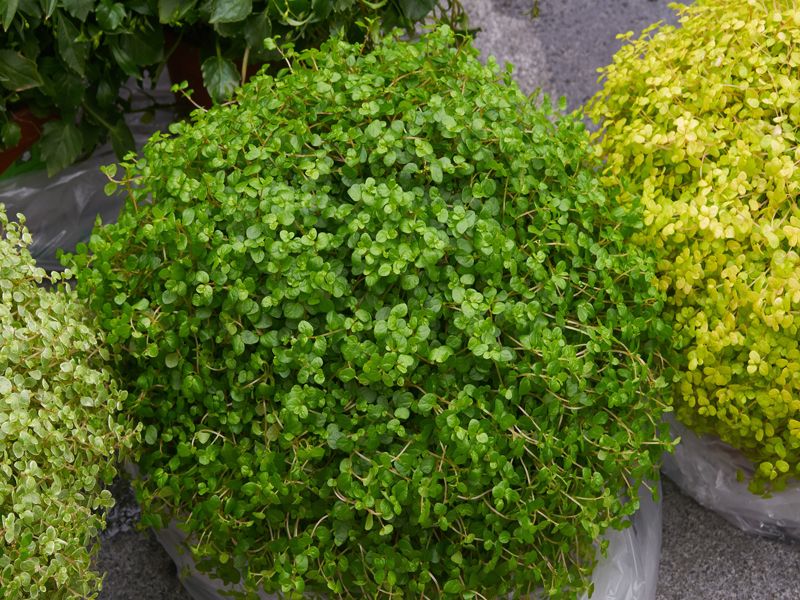
The plant has creeping, branching shoots that form a dense green carpet. The root system is threadlike and thin.
The leaves are numerous, up to 0.6 mm in diameter, and heart-shaped, kidney-shaped. Because of their leaves, the plant is commonly known as "house duckweed."
The flowers are small, solitary, reaching 1 mm in size. They are cream or white in color and odorless.
Varieties
The genus contains one species, Soleirolia soleirola, which includes a number of varieties:
| Variety | Description |
| Green | Light green foliage, up to 2 cm in diameter. Considered a miniature variety, it responds well to pruning. |
| Argentia | It has silvery foliage. |
| Aurea | Golden leaves are present. |
| Variegata | The leaves are green with a thin white border along the edge. |

Caring for Soleirolia at Home
Depending on the season, home care for gloxinia varies significantly:
| Time of year | Temperature | Air humidity | Lighting |
| Spring-summer | +20…+25°C | From 60% to 80%. To maintain this level on warm days, the plant needs to be sprayed three times a day. | It's best to place it in partial shade. An east, north, or west-facing window is ideal. |
| Autumn-Winter | +15°C | Spray two to three times a week to maintain humidity. | Additional lighting will be required; if there is a lack of light, the shoots will stretch out and become thinner. |
Watering
During the warmer months, the plant requires regular and abundant watering; when cold weather sets in, it should be watered more sparingly. Avoid allowing the plant's roots to dry out.
Water with soft, purified water at temperatures between 24°C and 27°C. Cold water will kill the Soleirolia.
Young plants are watered every 2-3 days, adults – once every 5 days.
Top dressing
Fertilizer should be applied twice a month during the warmer months. Liquid nutrient solutions are recommended. A universal fertilizer for ornamental foliage plants, such as Kemira-Lux, is ideal. The concentration should be several times lower than that indicated on the packaging.
Planting, container selection, soil, transplanting methods, support
Gloxinia is a fast-growing plant, so it needs to be repotted annually. Early spring is considered the best time.
It's recommended to choose loose, lump-free soil. You can opt for commercial soil for ornamental foliage plants. When preparing your own mix, use equal parts of soil, fine sand, peat moss, and humus.
The pot should be wide but not deep, as Soleirolia has a shallow root system. To prevent waterlogging, place a 3-cm layer of stones at the bottom of the container.
The transplant is carried out using the transshipment method, following the step-by-step instructions:
- nutrient soil is being prepared;
- a drainage layer is placed at the bottom of the flowerpot, which is sprinkled with soil on top;
- the root ball is removed from the old pot and placed in a new container, the voids are filled with soil;
- After transplanting the plant to a new location, you need to wait until it takes root without watering.
A newly purchased plant also needs to be repotted:
- the leaves are washed with warm water;
- the root system is completely cleared of soil, damaged areas are removed, and the cuts are sprinkled with ash;
- Soleirolia is planted in new soil mixture.
When growing as a trailing plant, you should prepare a flowerpot, as well as wooden trellises and stands to act as a support.
Trimming
Gloxinia pruning is done annually. In early spring, thinning out dense plantings is recommended. This involves cutting certain shoots back to the ground, leaving only the strongest ones. This promotes growth, and the resulting stems grow stronger and more leafy.
Gloxinias can be pruned into virtually any shape, including a ball. They can be pruned at any time of year, reducing the shoots by approximately 1/3.
Reproduction
It is produced in three ways: cuttings, seeds and shoots.
Step-by-step instructions for cuttings:
- young shoots are cut off and then placed in water until roots form (they can be immediately placed in a damp mixture of sand and peat);
- the plant is placed in a greenhouse where the temperature is maintained at +25°C and it is periodically ventilated;
- the cutting takes root in 2-3 weeks;
- After this, the flower is planted in the ground.
Various indoor growing options
When grown indoors, gloxinia can be grown in not only pots of various sizes but also in aquariums. The plant grows quite quickly in this environment, so careful selection of plant companions is essential.
Errors and their elimination
| Error | Cause | Correction |
| The leaves wither, dry up and die. | Lack of moisture, insufficient air humidity. | Spray daily. Keep away from heating devices. |
| Elongation of stems, pale foliage, slow growth. | Insufficient amount of useful elements in the soil, not enough light. | Feed the plant with a complete fertilizer. Move it to a sunny location and provide additional lighting with a grow light. |
| Drying of leaves, appearance of grey-brown spots. | Exposure to direct sunlight. | Move to partial shade. |
| Yellowing and falling of leaves. | Excess moisture. | Reduce the number of waterings. |
Pests, diseases
| Disease/pest | Manifestations | Methods of getting rid of |
| Gray mold | A grey coating forms on the leaves, the shoots rot and die. | Remove affected areas of the flower, reduce watering, and ventilate the room more often. |
| Brown rot | The stems become thinner and turn brown. | Spray with fungicides, thin out occasionally. |
| Spider mite | A thin web forms on the leaves, the leaf blades become deformed, they turn yellow and dry out. | Rinse the plant in the shower and treat it with any insecticide. Repeat the treatment 2-3 times. |
| Whitefly | The leaves curl, turn yellow and fall off. | Treat with Aktara. |
Top.tomathouse.com recommends: Soleirolia – harmony in the nursery
Among the mystical properties of Soleirolia are its ability to bring joy into the home, improve mood, and facilitate communication. The flower can relieve depression and has a calming effect on children. Gloxinia guarantees peace and good dreams for the baby.
However, it is best to avoid placing the plant in the parents' bedroom (it increases Yang energy, which negatively impacts relationships between family members) and the living room.