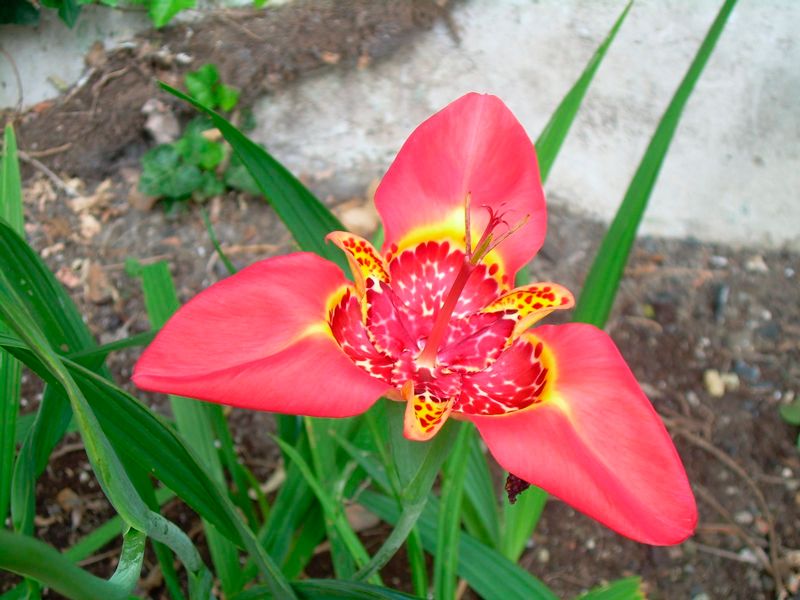
Tigridia is a perennial flower native to Central and South America. The bud consists of three large and three small petals, which have a "tiger" pattern at the base, hence the plant's name. The indigenous peoples of Mexico once used the flower's corms as food, roasting them in fires like potatoes. It wasn't until the 16th century that the plant was brought to Europe as an ornamental, but it never became widespread on the mainland.
Content
Description and characteristics of Tigridia
This perennial flowering plant grows up to 0.7 m in height, with the first leaves appearing not far from the ground level.
The tigridia root is notable for its density, resembling a bulb in shape. Buds appear in early summer, but can also bloom in the fall. The flower opens for no more than 10 hours, then fades. A seed pod remains in its place, the contents of which can be used for future planting.
Types and varieties of Tigridia
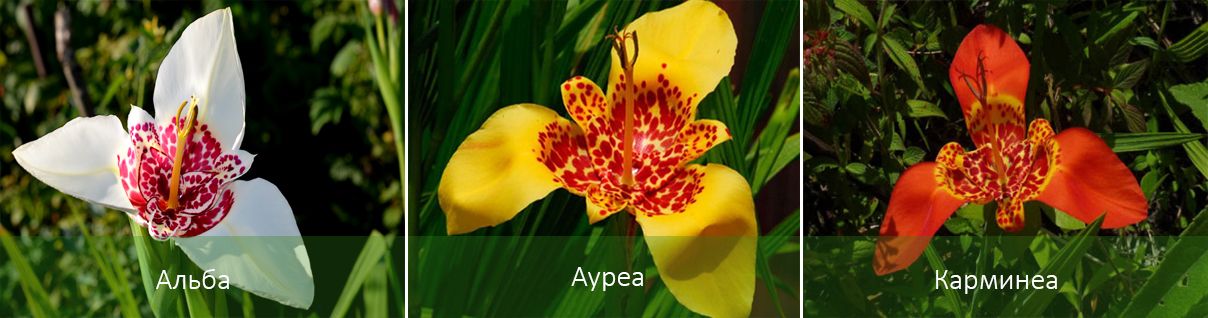
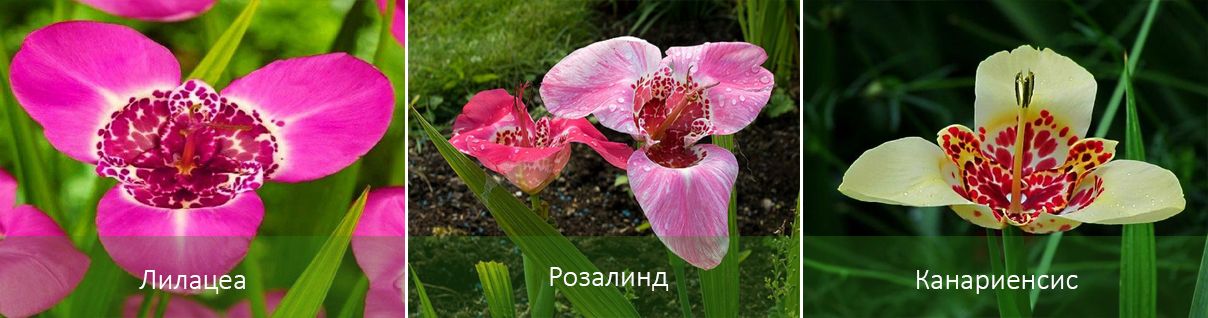
Of all the Tigridia species, only the Peacock Tigridia, native to Mexico, is cultivated. The corms are covered with membranous scales and grow up to 6 cm in length. Their diameter is usually no more than 4 cm. Gardeners and breeders have developed several varieties of Peacock Tigridia, but the following are widely used:
| Variety | Flowers |
| Alba | The petals are white and covered with red spots. |
| Aurea | The bud is rich yellow and has carmine variegation. |
| Carminea | Spotted orange-yellow representative. |
| Lilacea | The petals are red-purple in color and decorated with carmine spots. |
| Rosalind | The bud is pink in color. |
| Canariensis | Yellow petals frame a bright red center. |
| Speciosa | The red flower is covered with golden spots. |
| Vanhoutte | The outer petals are spotted, yellow-burgundy in color. |
| Chess | The coloring resembles a chessboard. |
| Multi-flowered | Golden patterns decorate the burgundy background of the petal. |
Planting Tigridia in open ground
When planting an exotic plant, it's important to consider a number of factors and conditions that directly affect the flower's growth and development. Failure to do so can result in the plant failing to bloom at all, becoming frail, and regularly susceptible to disease or insect attacks.
Planting dates
This perennial doesn't tolerate frost well, so it's best to plant it outdoors once warm weather has set in. In our climate, this typically occurs in late spring or early summer.
Landing site
The most important factor when planting a tigridia is its location. Since the plant loves the sun, a well-lit spot is best. Partial shade is also an option; it won't adversely affect the size of the buds or their color saturation, but it will affect the stems and flower stalks. They will need support, as they will grow very thin. To prevent wind and drafts from damaging the tigridia, choose a sheltered location.
It grows well with the following annuals: gypsophila and lobularia.
Priming
The flower requires loose, moist, and well-drained soil. If the soil is too compact, add sawdust and sand. Before planting, dig the soil and add fertilizer, such as mineral fertilizers, manure, or compost. Lime should be added to neutralize soil acidity.
Landing rules
To prevent diseases such as fusarium and others, it is necessary to soak the tubers in a fungicide solution diluted in the ratio indicated on the package.
The depth of planting depends on the bulb's size. For example, larger bulbs should be planted 10 cm into the soil, while smaller bulbs should be planted 5 cm deep. It's important to maintain a distance of 15 cm between bulbs and 20 cm between rows. The first shoots will appear in 4-6 weeks, blooming in late summer. They won't have time to fully bloom before frost, so it's best to grow the tigirdias indoors before planting them outdoors.
Caring for Tigridia in the Garden
Growing this perennial involves a comprehensive care regimen, including watering, fertilizing, mulching, and pruning. The plant responds well to cultivation if properly managed.
Watering
The plant requires abundant and regular watering, while avoiding stagnant soil moisture. If there's no rain, moisten the soil daily and mist the plant in the evenings. Overwatering will quickly rot the roots, so it's important to water carefully, ensuring all water is fully absorbed and doesn't remain on the soil surface.
Top dressing
Fertile soil doesn't require additional fertilization, but poor soil does. The first mineral fertilizers should be applied no earlier than 3-4 weeks after planting the tigridia. Once buds begin to form, the plant can be fertilized again, not only by applying fertilizer but also by spraying the foliage with a suitable solution.
Additional work (loosening, mulching, pruning)
The area where tigridias grow should be cleared of weeds promptly, as they not only disrupt the aesthetics of the flowers but also invite the appearance of various insect pests.
To prevent moisture from stagnating and allow it to penetrate the soil more quickly, loosen the soil around the tigridia after each watering. Mulching with organic matter will slow water evaporation and prevent weed growth.
Trimming
Pruning is performed only after the tigridia has finished flowering and all the buds have faded. This helps preserve the bulbs' health and vigor before winter.
Transplanting Tigridia
If you start the bulbs indoors in early spring, the young plants will bloom somewhat earlier in the open ground. To achieve this, plant them in a container with a special potting mix during the fifth week of spring.
One small pot will accommodate about 4 bulbs, which should be planted 3 cm deep in the soil. Then, provide them with regular watering. As the plant germinates, increase the amount of watering, ensuring the soil is moist throughout the bulbs' depth.
Pots with large drainage holes and a tall base for bottom watering are ideal for repotting. Once the plant sprouts, place it on a well-lit windowsill. Tigridia should be planted outdoors in early summer.
Reproduction of Tigridia
Tigridia can be propagated using two methods:
- Seed;
- Vegetative.
For the first method, you need to save the dried flowers that form the seed pods. These are usually flat and dark in color. They should be collected before the first frost and sown in winter. Then, place them in pots and keep them in a bright, warm place. A comfortable temperature for seed germination is around 20°C. Once the seedlings have 2-3 leaves, they can be transplanted into individual containers. The first buds will appear six months after planting.
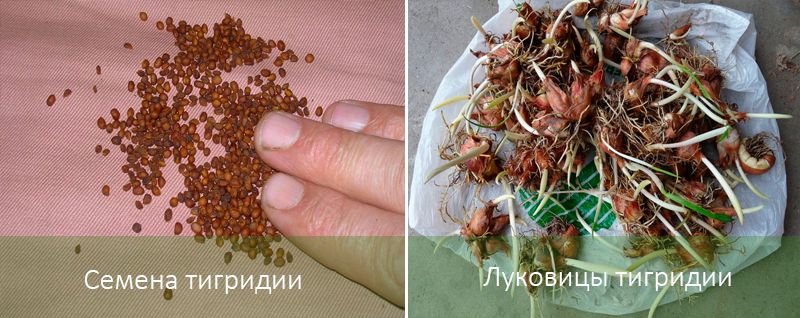
The second method involves planting offspring. A mature specimen can produce several small bulblets over the course of a single season. These must be separated from the parent tuber before planting in the spring.
Cut wounds should be treated with activated charcoal. Small bulbs, unlike mature tubers, are planted almost entirely without depth.
Diseases and pests
This exotic plant is often attacked by insect pests and is also susceptible to a number of dangerous diseases. These can be controlled with various treatments and preventative measures.
| Problem | Measure of elimination |
| Rotting caused by insufficient ripening of the bulb. | If you harvest for storage after the above-ground portion of the plant has died off spontaneously, this problem will not arise. As a preventative measure, the bulbs should be soaked in fungicide solutions such as Fundazol or Benlat. |
| Rust, scab | Timely treatment with fungicides or herbal infusions. |
| Mosaic | The virus is untreatable, so saving an infected plant is impossible. Proper care will significantly reduce the risk of contracting this disease. |
| Noctuids, caterpillars, thrips | Treatment with insecticidal preparations. |
| Slugs | Manual collection only. This can be simplified by using various materials to create shade for insect pests to hide in. |
| Mole crickets | Manual extermination: their burrows can be filled with a mixture of soap and water. This will either kill the burrow inhabitants or force them to crawl out. |
Tigridia in winter
Tigridia isn't frost-hardy enough to survive the winter in temperate climates, so it should be dug up in the fall. The storage temperature shouldn't drop below freezing, but it shouldn't be too warm (above 10°C). It's important that the bulbs are already mature. If there's a chance the above-ground portion of the tigridia won't fully wither before frost, the following measures should be taken:
- Remove the corms from the soil without damaging the roots, preserving the root ball;
- Keep in a cool, bright room until the foliage has completely withered.
Then you need to prepare the bulbs for storage, to do this you should:
- Peel the tubers;
- Wash;
- Soak in a fungicide solution;
- Dry completely.
During this time, small bulbs should not be separated from the parent tubers; it is better to do this in the spring, immediately before planting.
Top.tomathouse.com recommends: How to store tigridia bulbs
The bulbs should be covered with sand or peat and then left in a place with standard humidity and cool temperatures. A paper bag makes an excellent storage container. Periodically inspect the bulbs for signs of rot or other defects. Discard any diseased or dried-out bulbs.