Tillandsia is an evergreen plant in the Bromeliad family, originally introduced to Russia from Latin America. It thrives in a variety of climates, from dry continental to humid equatorial, giving rise to its diverse species. There are over 400 varieties, 200 of which can be grown indoors.
Content
Two types of plants
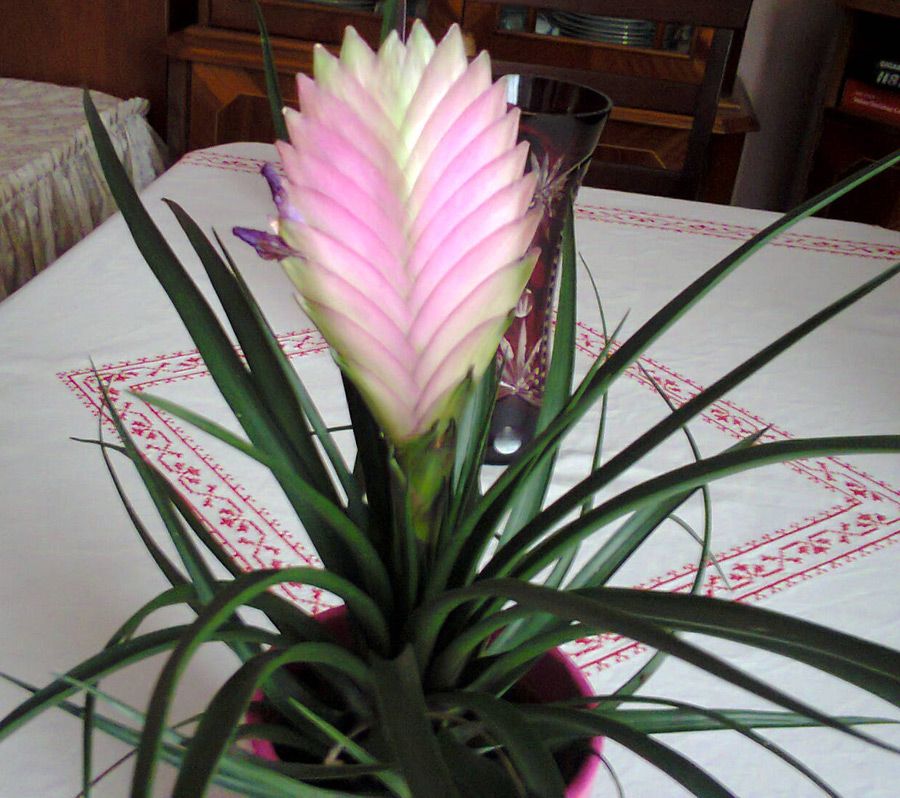
Tillandsia is divided into two types: airborne and potted. The former have fewer roots and typically grow on poles or driftwood. The leaves are a variety of colors, from grayish to green, oblong, 25 cm long and 1 cm wide. Potted varieties thrive in the ground. The leaves are flat, covered with narrow green scales, and some are smooth and up to 40 cm long. The inflorescence is a bright pink spike.
Popular indoor species and their differences
| View | Type | Characteristics, care advice |
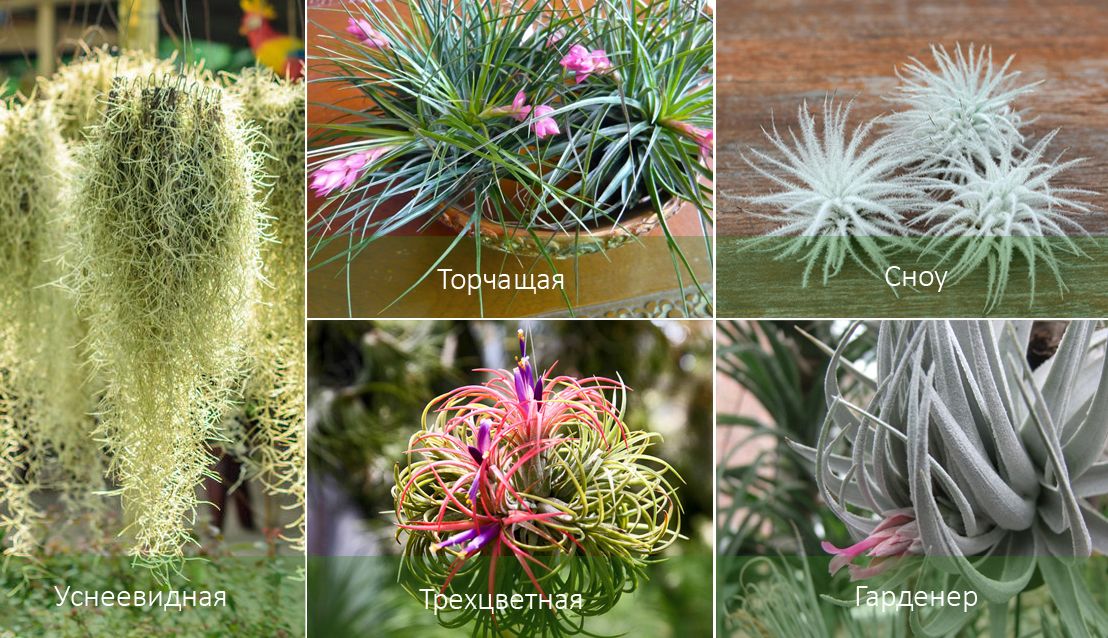
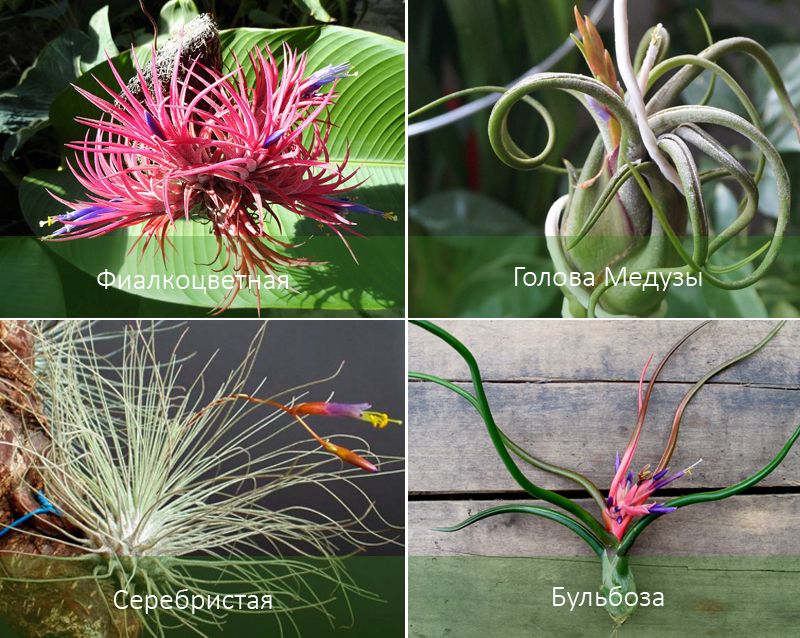
| Usneoid (Louisiana moss) |
Atmospheric | A long stem up to three meters. Narrow leaves with scales up to 5 cm long, giving them a gray appearance. There are no roots, so no support is needed. Small yellow-green flowers appear in summer. |
| Bulboza | The leaves are stiff, thickened, but narrow, gathered into a bulb. During flowering, they turn from green to scarlet and burgundy. | |
| Snow | It has pointed, narrow, covered hairs. These participate in the plant's nutritional process from the environment. Its development begins with flowering and pollination, then it blooms and forms several rosettes in the leaf axils. These rosettes grow, reach flowering age, and the cycle repeats. | |
| Violet-flowered | The bush is 5 cm tall. The silvery leaves, due to the small scales that collect moisture, are cone-shaped and stiff, ending in a rosette. The flowers are purple. During flowering, the leaves turn red. Grows without a pot. If several plants are planted close together, they will soon cover the entire surface. | |
| Silvery (hair-like) |
The thread-like leaves are covered with scales, giving them a silvery sheen in the sun. They have a thickening near the rosette where nutrients and water are stored. Small red-blue flowers appear in summer. | |
| Head of Medusa (Gorgon) | It has a thickened bulb with twisting leaves. It's important to ensure it dries thoroughly after spraying to allow new leaves and roots to develop. | |
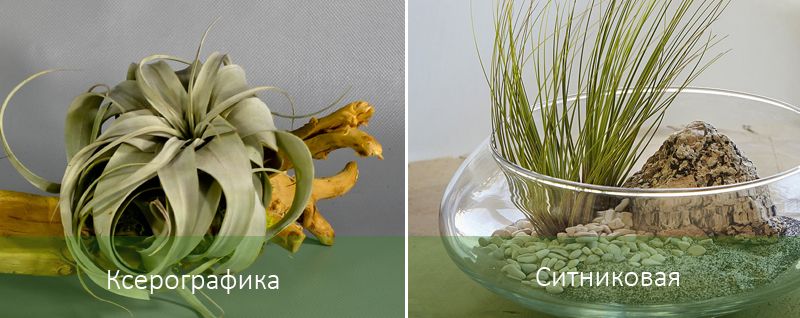
| Sitnikovaya | The leaves, about 50 cm long and reminiscent of reeds, are gathered into panicles. The rosette is divided into several panicles. The red bract bears purple flowers that open successively. | |
| Sticking out | Narrowed triangular leaves - 20:1 cm. Flower spike-shaped. Peduncle not long. | |
| Tricolor | The leaves are gray-green, linear, and borne in a large rosette. The peduncle is straight and long, with inflorescences in green, yellow, and red. The petals are purple and diamond-shaped. | |
| Gardener | The leaves are thick, narrow, and widen toward the bottom. They form a rosette. They collect moisture and supply it to the flower. | |
| Xerographics (xero - dry) |
The leaves are curved, and the flower stalk is pink. No soil is needed; the main thing is to place it so that nothing interferes with the roots, and mist it regularly (especially if the leaves are curled at the ends). It has excellent moisture retention, making it easy to grow even for a novice gardener. With proper care, it grows up to one meter tall, making it the largest variety. It blooms for about a month. | |
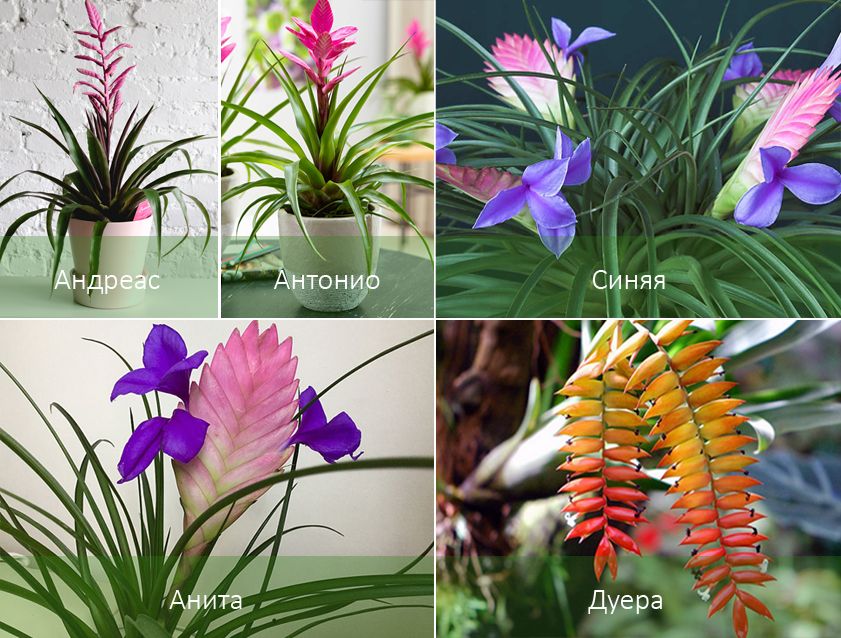
| Blue | Potted | Green, herbaceous leaves. A distinctive feature is the bright pink or lilac inflorescence. The flowers are purple or blue. Easy to grow indoors as a potted plant. |
| Anita | This variety was created using the atmospheric type, Sinyaya. It has gray-green basal leaves. Its distinguishing feature is the bright pink spike-shaped inflorescence. The flowers are blue. It is easy to care for. | |
| Linden | Often confused with Blue, the spike-shaped inflorescence is rounder and pink or red. The flowers are blue. The leaves are thin. | |
| Antonio | It has vibrant flowers and protruding, thin leaves that intertwine within the flowers. It's a highly ornamental plant and completely unpretentious in care and cultivation. | |
| Duera | Long, dense, tongue-shaped leaves form a rosette. A spike-shaped inflorescence, reminiscent of yellow acacia leaves. Blooms from the top to the bottom. The bract is red. | |
| Andreas | It has bright flowers and thin, protruding leaves. It's a highly ornamental plant and absolutely easy to care for and grow. |
Home care: location, lighting, temperature, humidity, watering, and fertilizing
Tillandsia should be placed near a window away from the sun. In summer, it can bloom and grow if placed on a balcony. If necessary, provide a light cover. In winter, install artificial lighting inside the house.
Normal temperature: +24°C in summer, +20°C in winter. The room should be frequently ventilated.
Tillandsias should be watered with warm water. In winter, it's best to plant them in a container with clay and pebbles at the bottom. In summer, the soil should be kept moist, but in winter, the soil should be allowed to dry out to prevent root decomposition.
Rules
- Provide fresh air.
- In spring and summer, water the plant by completely immersing it in clean distilled water at a temperature of at least 20°C. In autumn and winter, limit spraying to every 4-5 days.
- Provide the epiphytic variety with protection from the sun's rays.
- You shouldn't keep the plant at low temperatures, below +10°C, it won't survive.
Care chart by season
| Type | Season | Temperature | Humidity |
| Atmospheric | Spring-summer | +18⁰C-+21⁰C | 65%-85% |
| Autumn-Winter | +14⁰C-+18⁰C | ||
| Potted | Spring-summer | Up to +25⁰C | |
| Autumn-Winter | Not below +18⁰C |
| Type | Watering | Light | Top dressing |
| Atmospheric | 2-3 times a week the pot is placed in a tray with water for 20-30 minutes. | Sunlight in the morning and evening. | Once or twice a month. |
| Not required. | |||
| Potted | Water after the soil dries out. | Light shadow. | Once or twice a month. |
| Maintain soil moisture. | Not necessarily. |
Methods of planting and transplanting
Tips for planting and replanting tillandsia vary depending on the type of plant, namely potted or outdoor.
Potted
Once 2-3 years have passed since the main planting, the plant is replanted into a container one size larger to ensure normal growth of the flower, otherwise it will stop developing.
There's no point in repotting a blooming tillandsia, as it dies afterward, leaving behind offspring. Once these have grown, they can be repotted. It's best to repot the seedling in the spring to allow the roots to develop properly.
Soil: coarse grains, approximately 2 cm in size. Free of soil, peat, and rotted leaves. Approximate composition:
- river stones;
- bark.
It is good to use bonsai soil with the addition of coconut chips and seramis.
The pot is small but sturdy. Charcoal provides drainage.
Remove the plant from its old pot and place it in a new container at the same distance from the original. Spray the center of the rosette or place it in water for 20-30 minutes.
Atmospheric
The unique feature of this type is that it doesn't require soil to grow. Natural fragments of branches, roots, pieces of wood, felt, etc. are used for planting. It's important that the plant, attached to the stand, can be easily submerged in water, allowing moisture to penetrate freely.
To help the tillandsia secure itself, use sphagnum moss and coconut pads. After securing, the plant is sprayed and hung.
Important: Do not change the placement and lighting of the atmospheric tillandsia frequently.
Watering, fertilizing
In summer, it's best to provide a moist environment with damp soil, water the rosettes, and mist the entire plant regularly. In winter, water when the soil dries out and mist with warm water.
Fertilize every two weeks with mineral fertilizer (for orchids or flowering plants). For potted plants, the dosage is half the instructions, and for outdoor plants, it's four times the amount.
All types of tillandsias prefer foliar feeding.
Reproduction
The plant reproduces by: babies, seeds.
Kids
They appear when the plant begins to fade. Planting takes place in the morning, but can also be done early in the day.
The seedlings are carefully separated and planted in pots no more than 10 cm deep. They are then kept at 25°C, with constant watering and aeration. Flowering occurs in 1.5-2 years. Video of potted planting:
Atmospheric plants are propagated by cutting a shoot from the mother plant. Simply secure it to a support. Video for an atmospheric plant:
Seeds
Painstaking and unpopular reproduction.
Sow the seeds on top of a moist peat-sand substrate. Place glass or film on top. Place the containers in a warm, bright room at room temperature. Seedlings should appear within a month or two.
Preventive measures against tillandsia infection
With proper care, tillandsias are less susceptible to pests and diseases. Simple preventative measures will reduce the risk of infection:
- Quarantine purchased plants for 20-25 days.
- Weekly check-up for signs of infection.
- Free placement of pots on the windowsill.
- Cleaning the plant and airing the room.
- Balanced watering.
- Top dressing and fertilizers.
- Preventive and disinfectant treatment of soil, pots and tools.
Pests, mistakes in care and methods of their elimination
Often, gardeners make common and unintentional mistakes that lead to tragic consequences for tillandsia, especially at low, humid air temperatures.
| Problem | Error | Elimination |
| It rots and dies. | Planting in normal soil. | Change the soil. If there are offspring, replant them in separate pots. Do not use fungicides to prevent rot. This may harm the plant. Discard or burn any supports infected with mold or mildew. |
| Excess moisture. | ||
| Excess fertilizer. | ||
| Does not bloom. | Lack of heat. | Provide the plant with normal conditions and light. In summer, at +18 put it on the balcony. |
| There is not enough light. | ||
| Temperature changes. | ||
| The end of the leaf is brown. | There is not enough water. | Water with warm filtered water. |
| The leaves curled up. | ||
| Softening of leaves. | The air temperature is too low. | Create a favorable temperature regime. |
| There are no daughter sockets. | Lack of minerals and vitamins. | Fertilize. It's best to add a small amount of fertilizer to a spray bottle and spray it onto the plant. |
| Gray spots appear on the leaves. | Mushrooms. | Remove diseased leaves. Follow the care instructions from now on. |
| Gray foliage at the tips. | Use of heavy water for irrigation. | Water only with warm filtered water. |
| Spider mite | Neighborhood with roses and unbalanced cultivation. | Treat with a soapy solution. After a short time, remove the insect and all damaged leaves. |
| Mealyworm | Infection from other plants. | Spray with an alcohol-based soap solution. After two hours, shower and remove any visible insect infestation (brown pellets). Place in an airtight container with garlic and onions. If that doesn't work, treat repeatedly with Tanrek or Rogor (but only as a last resort). |
Beneficial properties
Gardeners believe the benefits of tillandsias lie in their ability to filter air. The plant's energy radiates widely, from the roots to the flowers.
Prices for different types and grades vary greatly. Here are some approximate prices:
- Usneoid - 900 rubles.
- Bulboza - 350.
- Medusa's head - 400.
- Ionanta - 1200-1500.
- Three-color - 400-500.
- Xerographics - 1200.