Yucca, also known as the "palm lily," belongs to the Agavaceae family, of which there are approximately 40 species. It resembles a small palm tree.
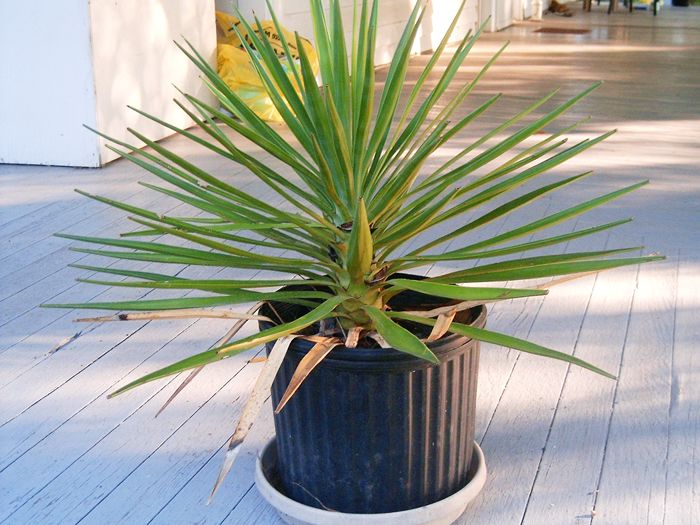
Yucca is native to the deserts of North America, with several varieties found in the central part of the continent, as well as on the Caribbean islands and in Asia. It prefers rocky soils and areas with abundant sunlight. Garden plants can reach heights of up to 10 meters and resemble a tree. Indoors, yucca does not grow taller than 1 meter.
Content
Description
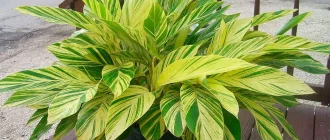
It has a thickened trunk, making it a woody plant. The leaves are quite stiff, sword-shaped, and can be green with a bluish tint, sometimes with spines at the tips. The edges can be wavy, serrated, or hairy. The leaves are gathered in a tuft at the top of the plant, either on branched stems or growing from a rosette directly from the soil.
The crown comprises one or more rosettes. The palm's flowers are white, bell-shaped, and up to 9 cm long. The inflorescence is a simple panicle.

Other colors are also found in nature: cream, yellow, canary yellow, and soft green. A single palm tree can bear up to 200 flowers. Yucca rarely blooms indoors. The fruit is a juicy capsule; edible varieties also exist.
Types of indoor yucca
| View | Description |
| Aloe leaf marginata | It blooms in summer, producing a cluster of numerous bell-shaped flowers. The leaves have serrated edges, and the flowers are creamy with a purple tint. |
| Whipple | A slow-growing variety of yucca. The stem is short, and the leaves are greenish with a grayish tint, gathered in a rosette. The edges are serrated and tipped with a spine. It blooms in summer with numerous bell-shaped flowers that emit a subtle fragrance. The coloring is the same as the previous variety. Price: around 4,000 rubles. |
| Filamentous or Guard | Stemless, frost-hardy, and spreading, it can withstand temperatures down to -20°C. The leaves, up to 65 cm long, are green with a bluish tint, pointed at the tip, and tipped with white threadlike fibers. It blooms with yellow flowers. |
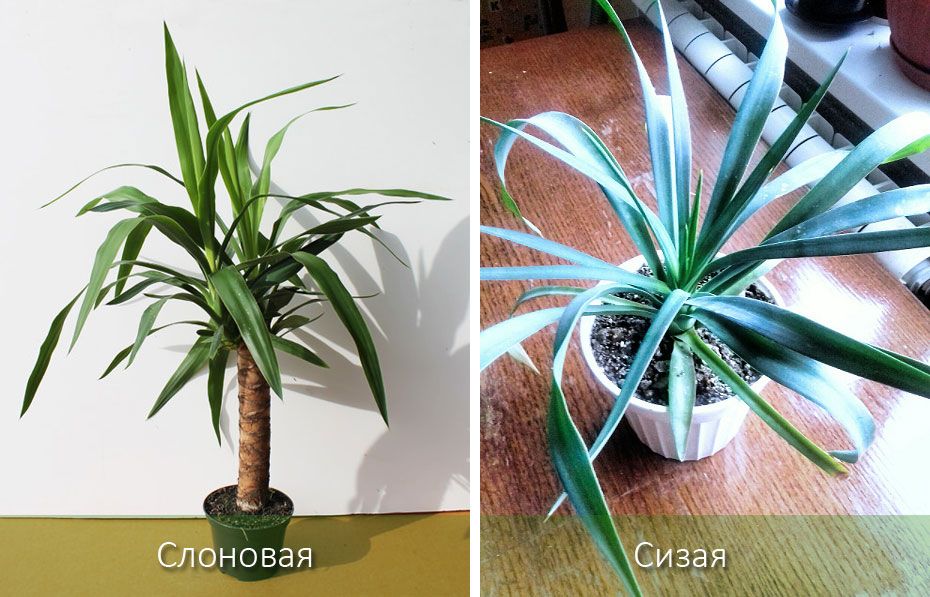
| Elephant or Elephantis | It grows slowly, eventually becoming a lush bush. The trunk is thick, and the stem is woody. At the top is a rosette of stiff, light-green leaves. It blooms in summer, producing a flower stalk up to one meter long. |
| Blue or Lord's Candle | An evergreen species growing up to 2 meters tall. The leaves are arranged in a large rosette, stiff, and bluish-green. The tips are tipped with gray fibers. Flowering occurs in summer. |
| Glorious or Joanna | A small tree, up to 5 meters tall. When young, the plant has no trunk; the shrub is spherical. It has dark green leaves with a waxy coating. It blooms in summer with white flowers with burgundy tips. Once the flower stalk falls off, a capsule containing black seeds forms in its place. |
Yucca can be planted alongside bonsai or fuchsia. It also looks great alongside ficus and peace lilies.
Home care
When growing indoor yucca, you need to pay attention to the following conditions:
| Parameter | Winter | Summer |
| Location/Lighting | Provide additional artificial lighting, as it is desirable for yucca to be under light for 16 hours a day. | Yucca palms will thrive on the south and southeast sides of the room. Young palms will need more light than mature ones. During hot weather, they should still be placed in the shade. Insufficient sun can cause the plant to become ill. |
| Temperature | It's best to provide the shrub with a slightly cool temperature of up to 10°C. You can place it on a balcony if it's heated. Otherwise, open the window more often and place the pot closer to the glass. | A comfortable temperature of up to +23°C is recommended. If it's higher, additional humidification will be required. |
| Humidity | There is no need for high humidity. | When the temperature rises to +25°C, create additional humidity: spray daily or add expanded clay to the pot and constantly moisten it. |
| Watering | Do not overwater the plant; make sure the soil dries out and reduce the frequency of watering. | Watering should be frequent, but excess water from the tray must be drained promptly, otherwise the roots will rot. |
| Top dressing | No fertilizers are needed. | Feed with mineral fertilizer once a week. Suitable fertilizers are suitable for cacti and palms. |
Trimming
It promotes the growth of new shoots, which form beautiful, lush bushes. Pruning is done in March, with pruning shears cutting off the top 60 cm from the rosette. Do not break the trunk, as this will lead to prolonged disease or even death of the bush. The stem must be carefully and sharply pruned.
The fresh cut should be sprinkled with charcoal or covered with paraffin to help the yucca retain moisture. Afterward, place the bush in a dark place. New shoots will appear at the cut site within three months.
Only plants with a trunk diameter greater than 5 centimeters can be pruned. Otherwise, the stem should not be trimmed.
Choosing a pot, soil, replanting
The first repotting should be done immediately after purchasing the plant, and the next in March. While the bush is young, it can be repotted annually, then every three years.
It's best to plant the plant directly with the root ball still attached. Be sure to add drainage to the bottom of the pot to prevent root rot after watering.
Step-by-step transfer:
- Buy a clay pot with holes in the bottom for water drainage, 2 sizes larger than the previous one.
- Pour drainage material 4 cm high into the bottom and cover with soil on top.
- Transfer the plant to a new pot with a lump of soil on the roots.
- Fill the remaining empty spaces with soil and compact it carefully.
Remove any black, dry roots in advance, and sprinkle the cut surfaces with activated charcoal. After repotting, the yucca plant will not grow for six weeks.
The plant thrives in slightly acidic soil. It should drain water and nutrients well to the roots. It's best to add river sand or compost to the soil mixture. There are ready-made potting mixes for palms, cacti, and dracaenas that are suitable for planting yucca.
Reproduction
Gardeners propagate yucca in four ways.
Seeds
The key here is choosing the right seeds for planting. They can only be collected at home after pollination. Steps:
- File the seeds with sandpaper to damage the hard shell, this will help them germinate faster.
- Soak them in water for 24 hours.
- Plant in a small container with a special soil mixture.
- Cover with film and place in a warm place in the house with good lighting, constantly moisten the soil.
- Wipe the film every day to remove condensation.
- As soon as shoots and leaves appear (in about a month), transplant the plants into different containers and feed them with fertilizer on the 10th day.
- After 5 leaves have sprouted, the plant is considered mature.
Cuttings
- Make a smooth cut from the cuttings of an adult plant.
- Dry and treat with growth product.
- For the soil, use a mixture of peat and river sand.
- Transfer the cutting into the soil and bury it in the soil by 3-4 cm.
- Water the soil well and spray the shoot daily.
Parts of the trunk
This is how you can propagate an adult plant, but only in the spring. The process:
- Carefully cut off the top of the bush and dry.
- Place the cutting in water until it produces its first roots, then in soil.
- As soon as the buds produce young shoots, plant them.
adventitious roots
This method is used for stemless yucca species. In summer or spring, root suckers are cut off with a knife, and the seedlings are transplanted into a pot with wet sand.
Mistakes in care
| Symptom | Error | Elimination |
| The trunk softens and brown spots appear. | The soil is excessively moist. | Maintain regular watering. |
| Dry and light spots are formed. | Excess of light | Maintain the temperature regime. |
| Leaves curl and brown spots appear. | Insufficient humidity and watering. | Watering according to a schedule and daily spraying. |
| The leaves turn pale and become thinner. | Poor lighting and high temperature. | Observe the light and temperature regime. |
Diseases, pests
| Symptom (what's happening to the leaves) | Disease/Pest | Treatment |
| They are drying up. |
|
Regular watering, spraying the plant and humidifying the air in the room. |
| They turn yellow. | This is a natural process. The leaves live for a couple of years, then turn yellow and die. | No treatment is required. |
| They are falling off. |
|
Maintain a watering regime, provide warmth and close the windows. |
| Light spots appear on them. | Too much light. | Observe the lighting regime. |
| They are rolled into a tube. | The reason is hypothermia. | Adjust the room temperature. |
| Dark spots appear on them. |
|
Remove damaged leaves and spray the plant with a fungicide. Reduce watering. |
| They become pale and elongated. |
|
Observe the thermal and light conditions. |
| Pests are visible on them: spider mites, aphids and caterpillars. | Overwatering. | Spray with insecticides. |
Top.tomathouse.com recommends: Yucca – the tree of life
This palm tree is beneficial for air purification and noise reduction. The leaves have medicinal properties and contain selenium, antioxidants, zinc, chlorophyll, and steroid sapogenins. The rhizome contains magnesium, iron, and calcium.
Yucca is used for cosmetic purposes and in folk medicine. It's used in shampoos and is used to treat prostate conditions, diabetes, and stomach ulcers. It also lowers cholesterol and is used in cooking (it tastes like beans).
The plant has virtually no contraindications, but it's still best to consult a doctor. Yucca is contraindicated in people with kidney stones, pregnancy, and breastfeeding. It's not used in pharmaceuticals, only in traditional medicine.
There is a belief that having a yucca plant in the house strengthens family ties.
The harm of Yucca is that it:
- In its pure form, it causes digestive upset in the stomach.
- Causes allergies and, in rare cases, tremors.
- It has spikes and children can easily get hurt.
- It is considered a vampire plant; you should not place a pot of it in a bedroom or children's room.
The Indians called yucca "the tree of life."