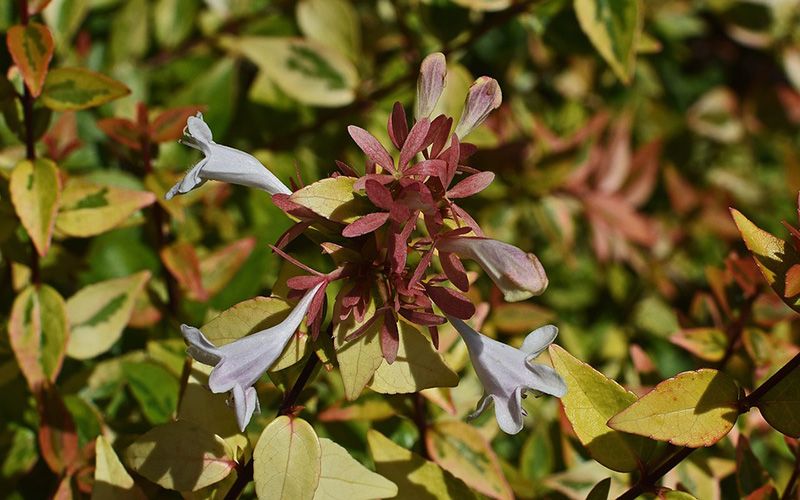
Abelia is a slow-growing shrub in the Capsicum family (subfamily Linnaeus). It is common in East and Southeast Asia. It is rarely found in Mexico (two species) and in the southern regions of Russia's Primorsky Krai (Korean). The height and diameter of the bush usually does not exceed 1.5-2.5 meters. Paired, glossy, pointed, oval-shaped leaves are usually dark green. Small flowers, with rare exceptions, adorn the bush from June until the first frost, which explains Abelia's popularity among gardeners. Another advantage of this shrub is its tolerance to pruning, making it ideal for creating a hedge or growing as an indoor tree with an easily shaped crown.
Popular types of Abelia
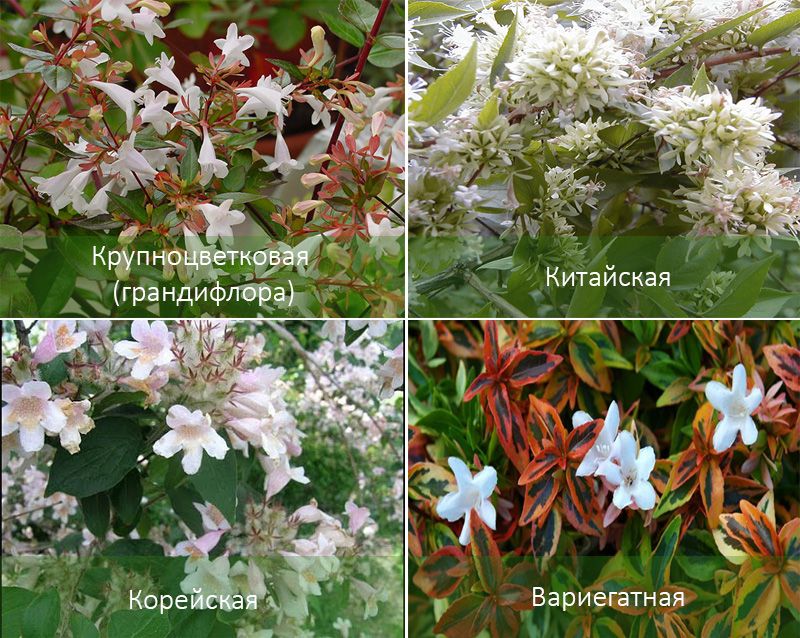
There are approximately 30 varieties of this flower worldwide, but only four are widely cultivated.
| View | Description | Bloom |
| Large-flowered (grandiflora) | A hybrid growing up to 6 m in height. Most of the funnel-shaped flowers are concentrated at the ends of the shoots, although inflorescences are found throughout the entire shoot. |
White, pink or lilac. Fragrant. From June to September. |
| Chinese | A medium-sized (up to 2 m) semi-evergreen ornamental shrub that changes the colour of its leaves to bronze after the flowers fall. |
Snow-white with red veins, similar to bells. May-June and until the beginning of October. |
| Korean | A winter-hardy semi-evergreen shrub that turns red-orange in foliage after flowering. |
White or white-pink, strongly scented. From May to October. |
| Variegated | An unpretentious shrub that changes color in autumn to variegated yellow and red. |
White bells with a honey scent. From June to September. |
Caring for Abelia at Home
It is most often grown as a houseplant. Basic care guidelines for indoor use:
| Factor | Spring/Summer | Autumn/Winter |
| Location/lighting | Partial shade in a place protected from the wind. | Good lighting without direct sunlight. |
| Temperature | +20… +25 °C, but if the watering regime is observed, it can also tolerate summer heat. | Optimally +10…+15 °C, when temperatures drop it sheds its leaves. |
| Humidity | Responds well to periodic spraying with cold water. | In greenhouses and indoor conditions, spraying is carried out in the same manner as before. |
| Watering | Moderate, after the top layer of soil has dried out. | Sparse, not allowing the soil to dry out completely. |
| Top dressing | 2 times a month with mineral compounds for shrubs. | No. |
Transplantation, pruning
The root system dislikes cramped conditions, so young plants are repotted into larger pots each spring. The soil mixture consists of sand, humus, soil, and peat in a 1:2:2:2 ratio. Good drainage is provided to prevent root rot.
Pruning is done in the fall, when the plant has finished flowering and sap flow has ceased, or at the end of winter. Abelia tends to form a lush crown, which can be pruned according to taste. The shorter the stems are left, the more branched the bush will become.
Reproduction
There are several ways to increase the number of Abelia seedlings:
- Cuttings are rarely used due to their poor survival rate. The upper portions of shoots remaining after pruning are best. They are rooted in a sand-peat mixture at 18 to 20°C. After the root system has formed, the shoots are placed in individual pots.
- The seeds have a low germination rate. To propagate them this way, they are planted in January. The young plants are transplanted in early spring.
- Root suckers are the easiest method. To do this, they are separated along with a portion of the parent root and replanted in a separate pot. This is not done before wintering.
Diseases and pests of Abelia
The most common reason for a flower to wilt is the rotting of its root system due to overwatering or insufficient drainage.
| Manifestation | Cause | Elimination measures |
| Curling and wilting. Sugary discharge. Blackness. | Aphid. | Careful mechanical removal of pests is recommended, followed by spraying the foliage with a soapy solution (avoid contact with the soil). Then, apply two insecticide treatments, spaced 1-2 weeks apart. |
| Deformation of flowers and shoots. Loss of inflorescences. Yellow or discolored spots on leaves, holes, silvery areas. Mass wilting and leaf drop. | Thrips. | Shower, then at least 2 insecticide treatments with an interval of 1.5-2 weeks. |
| Colourless or pale yellow spots, which are covered with a fine web on the reverse side. | Spider mite. | A shower followed by a thorough spraying of the plant with insecticides and acaricides. Repeat treatment is recommended after 7 days. |
When the first symptoms of the disease are detected, it is important to completely isolate the plant.