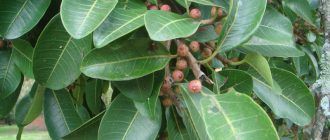
Abutilon (rope vine) belongs to the Malvaceae family. It grows in tropical and subtropical forests of South America, Australia, the African tropics, as well as in China and India.
Content
Description
The genus includes perennial evergreen and deciduous varieties, shrubs, and trees. They have woody or herbaceous shoots. They reach a height of 4 m in the wild.
- The long stems are covered with stiff hairs or soft felt. The shoots are usually highly branched.
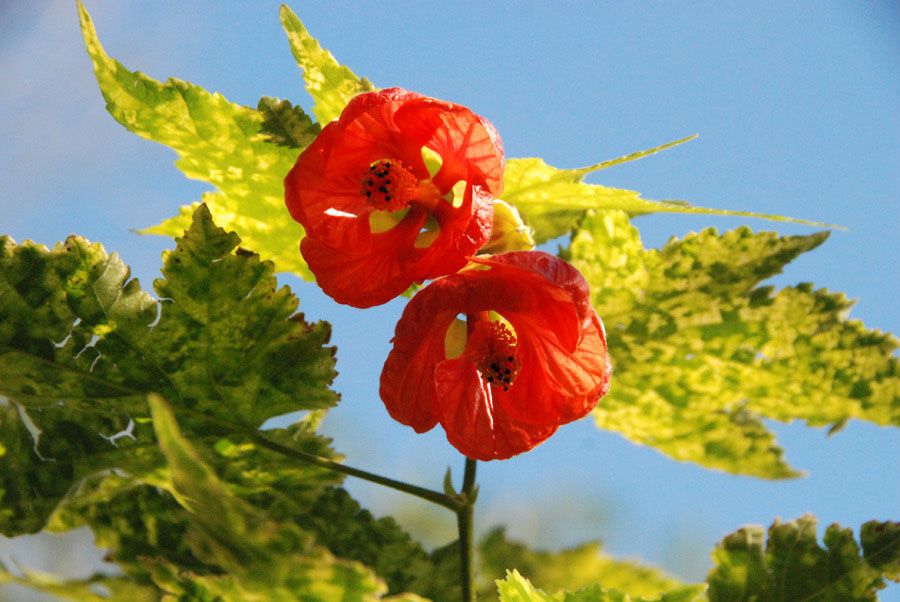
- The leaves are dissected into several lobes. They resemble maple leaves: dark greenish or gray with a blue tint and pointed tips. This is why the Abutilion is commonly known as the indoor maple.
- Some varieties have striped or speckled foliage. The leaves are no more than ten centimeters long. Not all of them are maple-shaped; variegated varieties have heart-shaped foliage.
During flowering, bell-shaped buds form. Their diameter reaches eleven centimeters. There are varieties of double abutilon with large corolla petals. The flower color varies depending on the subspecies. Most often, the flowers are solitary, forming in the axils of the foliage.
Varieties of Abutilon
The most suitable types for home:
| View | Peculiarity |
| Bella | When it begins to bloom, lush pinkish or golden buds up to 8 cm in size appear. It is characterized by strong branching, and pruning or pinching is not necessary. It grows up to 0.4 m in height. |
| Organza | A shrub up to 1 m tall, it has smooth, green leaves and large, single flowers. It requires pruning. |
| Bellevue | A hybrid with flowers in every shade of the rainbow. This lush shrub reaches a height of a couple of meters with proper care and regular pruning. |
| Bella mix | A hybrid with large flowers in shades of yellow, peach and pink. |
| Sello | It has peach-colored inflorescences with pink veins. It blooms from July to December. |
| Tiger's eye | A large bush with orange-hued flowers with reddish veins. If you look at its photo, it resembles a lantern. |
| Juliet | This variety grows up to 0.5 m in just 12 months. Flowering is year-round, beginning six months after sowing. The buds are large and vibrant, reaching 6 cm in diameter. |
| Amazonian | With proper care, it blooms all year round. Its buds resemble weeping Chinese lanterns. It's bicolor: the tip is yellowish, and the corolla is red. |
| Terry | It has lush pink buds and is a medium-sized shrub. |
| Grape-leaved | Several flowers form in clusters and cascade down like threads on long stems. They are lilac or blue in color and appear in May. The leaves resemble grapevines, hence the name. |
| American (hybrid) | It grows up to 0.5 m. It has brown bark. The flowers come in a variety of colors, from white to burgundy. |
| Arabesque | Blooms year-round. Large, pinkish buds. Typically, they don't exceed 40 cm in size. |
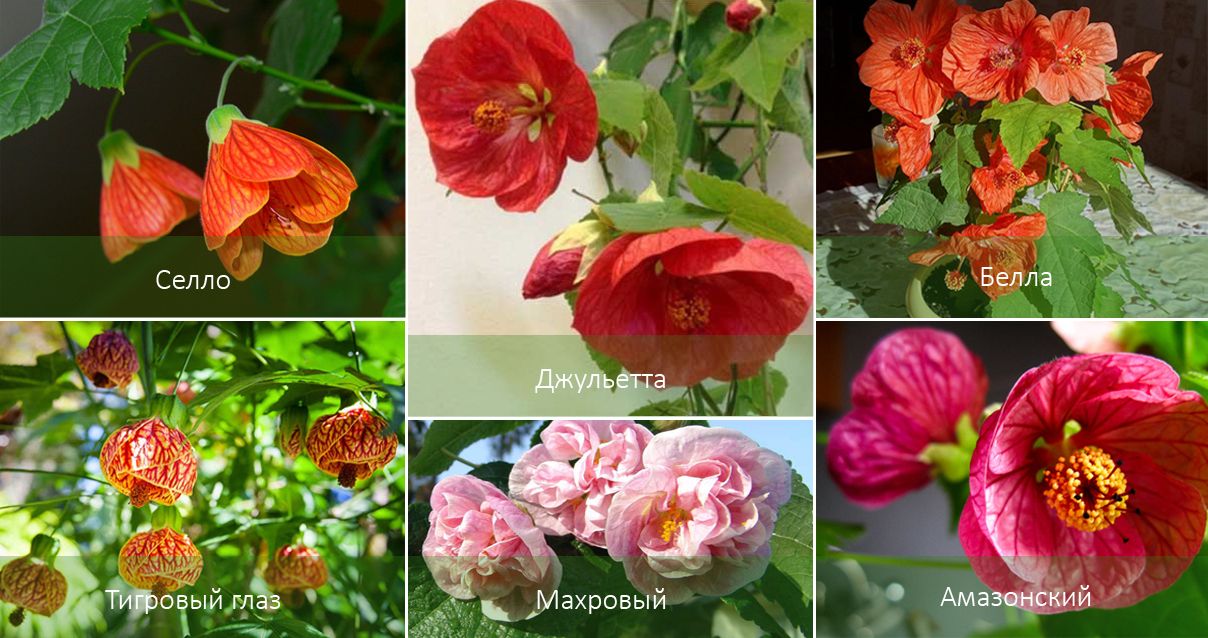
In total, there are more than 100 subspecies (Macrame, Lobelia Maranta, Neon Pink, Ornella, Variegata or variegated, Chardonnay, Isabella and others).
Home care
Caring for an abutilon at home isn't particularly difficult. In favorable conditions, the tree grows to the ceiling. It grows and develops quickly. Simply follow these simple guidelines.
Selecting pots and soil
At first, the cordatum is grown in a liter pot.
The tree has a peculiarity: until its roots have covered the entire ground, it will not begin to bloom.
The container should have drainage holes at the bottom. If roots emerge, it's time to repot.
There are two ways to prepare the soil:
- coarse sand, peat, leaf soil in equal proportions;
- coarse sand, humus, leaf, sod soil - 0.5:1:1:2.
You can purchase a ready-made mixture in a specialty store.
Lighting, temperature
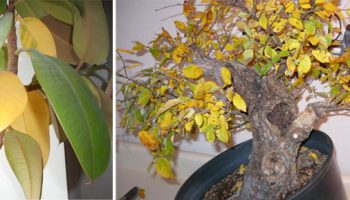
If you don't maintain the right temperature in your apartment, your abutilon will become diseased, dry out, and may even turn yellow. The optimal temperature in summer is 25°C, and in winter, 12-15°C.
At sub-zero temperatures the bush dies.
Abutilon does not tolerate sudden temperature changes or extreme heat. At 30°C or higher, it sheds its petals and foliage. The plant should also be kept away from drafts.
The shrub doesn't like direct sunlight. It's best to place it on east, west, southwest, or southeast-facing windowsills. Avoid placing it near a south-facing window, as bright sunlight will damage the plant.
Watering and humidity
Indoor maple loves water. It requires regular watering. However, don't overdo it. Excess moisture will kill the plant, just as too little will.
In summer, water frequently and thoroughly. The soil in the pot is always slightly moist. In winter, if the bush is not blooming, the soil can dry out slightly.
Irrigation is not necessary. However, if it is done, it will grow healthy and strong. Misting is recommended in winter during intense heating. If the bush is exposed to ultraviolet rays, water in the evening. Otherwise, sun-heated droplets will burn the foliage.
Top dressing
Complex mineral mixtures are used for fertilization. Feeding is done weekly in spring and summer.
During the flowering period, it is recommended to use fertilizers with a high concentration of potassium and phosphorus.
Formation and transplantation
To keep the bush looking its best, its shoots need to be pruned regularly; they grow quickly. Otherwise, the plant will develop an "antennae-like" appearance or the shoots will begin to curl. Buds form only on young lateral shoots. Good branching and flowering can be achieved by regularly pinching the top. After winter, the tree needs to be refreshed: cut off half of the spine (stem).
Repotting abutilon is recommended only when necessary. This should be done in the spring, before buds appear. Repot once a year into a larger pot if the shrub's roots completely envelop the root ball. Mature plants are moved to a new pot no more than once every 2-3 years. This is done by transshipping to avoid damaging the roots.
Reproduction: step-by-step instructions
Propagated by seeds, step-by-step instructions:
- The soil is sifted to ensure looseness and better moisture retention. Low-acid soil is disinfected with a potassium permanganate solution.
- The seed is soaked in lukewarm water for 12 hours.
- The seeds are planted in a pot at a depth of 5 mm. The pot is covered with plastic and placed in a warm, sunny spot. The sprouted seeds will begin to sprout in about three weeks.
- When the greenery is formed, the sprouts are transplanted into separate containers with a diameter of 7 cm.
Vegetative propagation is best used in August:
- Take a 12 cm root with a flexible stem. Remove the lower buds and greenery.
- The cuttings are planted in small containers and covered with jars (creating favorable greenhouse conditions). After about a month, the shoots will begin to sprout creeping roots. Watering, irrigation, and ventilation are essential.
- The planting of the strengthened seedlings is carried out in pots with a diameter of no more than 7 cm.
Diseases and pests
Pest infestation can lead to the death of the shrub. To prevent this, inspect it periodically under a magnifying glass for insects and diseases. Humidify the air around the abutilon. If pests do occur, pest control products can be purchased from specialized stores.
Indoor maples become ill due to improper care. Root rot is the most common cause.
Application, benefits, harm
Abutilon is used for decorative applications (for example, the ampere varieties look great against suspended ceilings). It also has technical applications after processing. It is used to produce:
- rope burlap;
- ropes;
- ropes of high tex and high-quality weaving.
That's why it has another name—rope. It's not harmful, but it can be an allergen for some people. There's a belief that rope brings bad luck to a home, but this is just superstition.