Adonis, or adonis, is a plant in the buttercup family. There are several theories about the origin of its name. According to one theory, the flower (according to Greek legend) is the tears of the goddess Aphrodite mourning the dying Adonis.
Content
- 1 Description and characteristics of Adonis
- 2 Types and varieties of Adonis
- 3 Growing Adonis from Seeds
- 4 Transplanting Adonis seedlings into open ground
- 5 Caring for Adonis in the Garden
- 6 Adonis or adonis after flowering
- 7 Reproduction of Adonis
- 8 Diseases and pests
- 9 Top.tomathouse.com recommends: the medicinal properties of Adonis vernalis
Description and characteristics of Adonis
Adonis grows in the steppes of Europe with a rich grass cover, and is occasionally found in Germany and Switzerland (very rarely, almost extinct). It prefers black soil, open areas, and small elevations. In some areas, it can grow on cliffs (Crimea), and occasionally on the edges or in clearings of birch groves or oak forests. It is found in Western Siberia, the Altai, and the Caucasus, where its flowering period lasts only until mid-June.
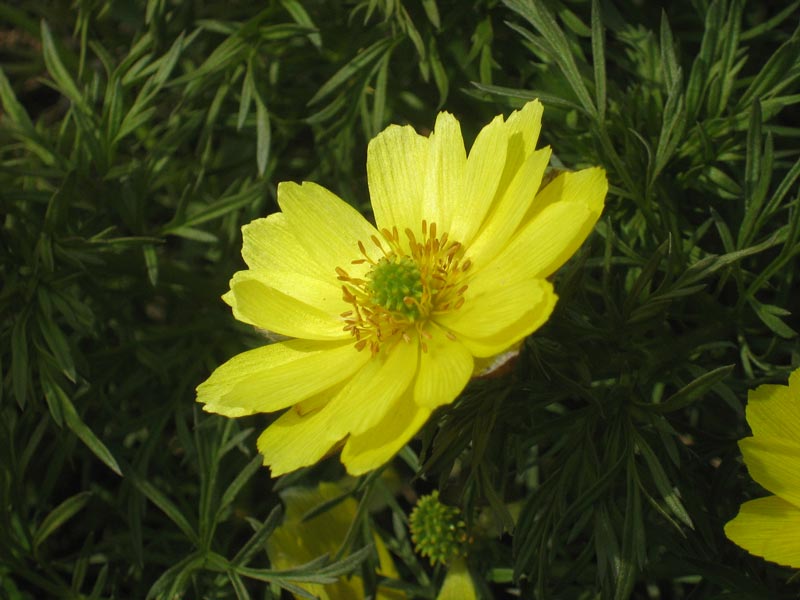
Poets compare this plant to the sun and spring. A botanical description would be less beautiful. Its single lemon-colored flower (4-8 cm) is located at the top of the stem. In summer, spherical fruits (20 mm) ripen, forming nuts (30-40 pieces) with a hooked beak. The leaves are brown. The lower ones resemble scales, while the others are sessile, divided into narrow lobes. The straight shoot (15-30 cm) is smooth and rounded. The vertical root is small, with branches, brownish in color.
The plant and its parts are considered poisonous. Adonis vernalis is listed in the Red Data Book of Russia for its protection.
It is grown industrially for use in pharmaceutical formulations or for making medicines. When harvesting wild plants, do so carefully and selectively (leave at least three stems per square meter undisturbed).
Types and varieties of Adonis
Adonis is divided into species: annual and perennial.
Annuals
The growing season of such a plant lasts one season.
Summer (aestivalis)
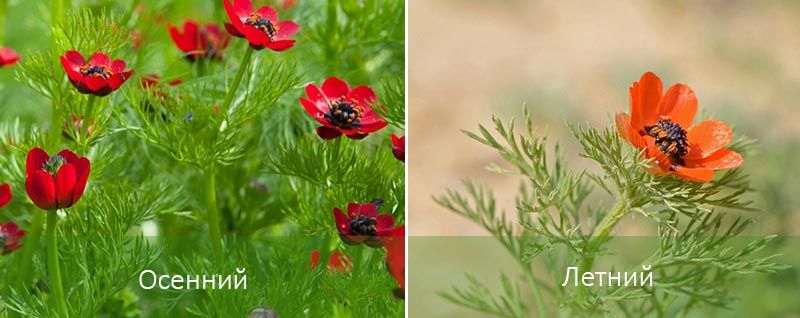
Other common names include "fire ember" and "pheasant's eye." Its straight, grooved stems (10-50 cm) come in various forms: branched, straight, or simple. The leaves, consisting of two or three lobes, come in the following types: sessile at the top, petiolate at the bottom. The flower is 2-3 cm in size. The red perianth has a dark central spot. It blooms throughout the summer.
Autumn (annua)
Sometimes called Adonis annuus, it grows up to 30 cm. The leaves are thin, cut in an alternate arrangement. The flowers are light yellow or deep red (1.5 cm), closed at the top. Their central part is dark. It has been cultivated artificially since 1596.
Perennials
They grow in the same place for several years without changing their properties. They have periods of development and rest.
Volzhsky (volgensis)
The inflorescence is lemon-colored, and the sepals are purple. Few shoots emerge from the thick rootstock. The height is 30 cm. Branching begins halfway up the stem. Before the first inflorescence appears, the leaves and stems are densely pubescent, but this later thins out. The dissected leaf curls toward the ground.
Amur (amurensis)
It grows in the Far East. Large, yellowish-golden flowers (5 cm) appear first, followed by pinnate, petiolate leaves. At the blooming stage, the plant reaches 12 cm, later reaching 35 cm. It is a forest species, with flowering lasting almost 20 days. Many cultivars with varying shades have been developed from it.
|
Variety |
Flowers |
| Benten | Velvet whites. |
| Sandanzaki | Yellow, protective-colored petals in the middle, semi-fluffy. |
| Hinomoto | The front part is protective bronze, the lower part is coral. |
| Pleniflora | Straw-colored with greenery, shaggy. |
| Ramosa | Red-chestnut, fluffy. |
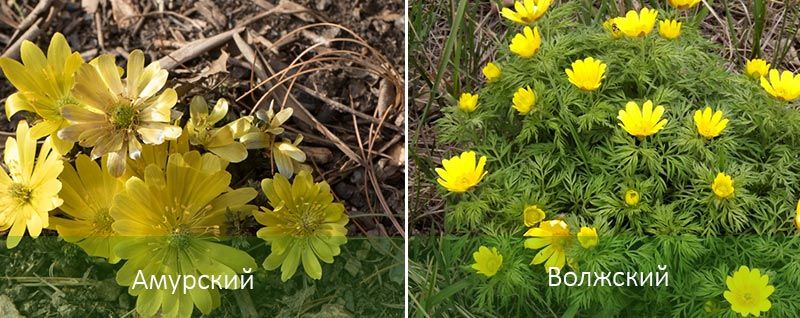
Siberian (sibirica)
A rich golden (6 cm) flower. Grows up to 60 cm, with pinnately divided leaves. Blooms in late spring or June.
Fluffy (villosa)
It thrives on the edges of birch groves or flat steppe. It has single, densely pubescent stems (15 cm). Lemon-colored flowers appear first, followed by triangular or oval-shaped leaves. During this period, the pubescence diminishes, and the height reaches 30 cm.
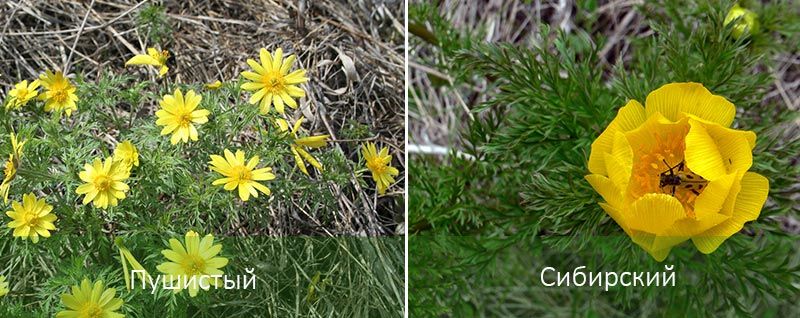
Golden (chrysocyathus)
An extremely rare flower, listed on the IUCN Red List. It's beneficial for health and highly prized for its use in design.
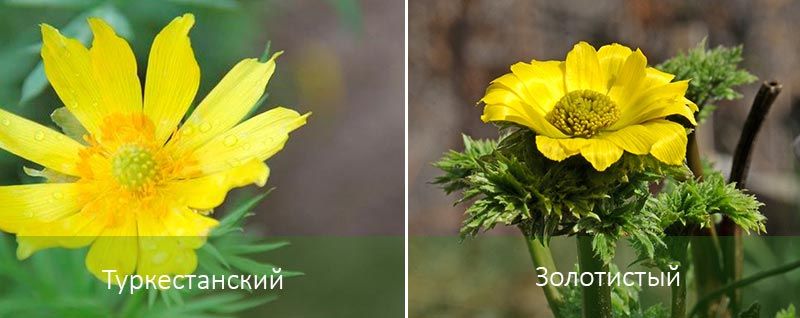
Turkestan (turkestanicus)
A single bush simultaneously produces ovaries, buds, and flowers (4-6 cm). The petals of the inflorescence are two-toned: the outer part is light blue, the inner part is orange-yellow. The above-ground parts of this medicinal plant are covered with curly hairs.
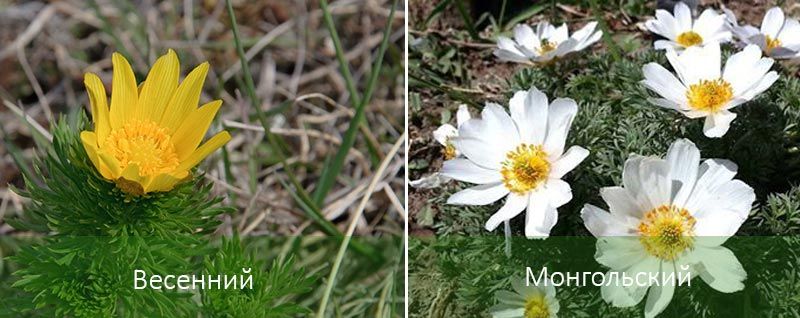
Mongolian (mongolica)
Typically grows in unused pastures. The bush consists of 30 shoots. The white flower (5 cm) opens first. The sepals are salad-colored with a lilac tint. The leaves are sessile in the middle, the lower ones are reduced.
Spring (vernalis)
Cultivation of this species began in the 16th century for ornamental and medicinal purposes. A thick, small rhizome produces numerous branched brown shoots. During flowering, the height is 5-20 cm, and afterward, 40-60 cm. The leaves are finger-shaped, cut into narrow lobes. Yellow flowers (7 cm) consist of 12-20 glossy petals, which appear in April, 4-6 years after planting.
Growing Adonis from Seeds
Sowing seeds differs slightly for annuals and perennials. Annuals are planted in the garden in the fall (November) at a depth of 1-2 cm. Germination may take a short time, so it's best to use recently harvested seeds. Store-bought seeds are sown in the greenhouse in the spring.
Perennials are planted in containers in the fall and then placed in a cool spot. In winter, if there's snow, they are placed in a snowdrift.
The best seeds can be obtained from plants that are 6-7 years old.
It's best to prepare the soil for sowing by mixing sand, turf, and manure in a 2:1:1 ratio. The first shoots usually appear after the air warms up to 20°C. However, some seeds may require a full year to germinate.
Seedlings require bright, diffused light and protection from direct sunlight. Watering and gentle loosening of the soil are performed daily. Seedlings are thinned to 15-20 cm apart.
If there is little time left before the transplant, it is better not to do this.
Transplanting Adonis seedlings into open ground
Caring for and planting the plant outdoors is a simple procedure. Typically, strong, mature seedlings are planted. The time for replanting depends on when the seeds germinate. It's important to remember that for the plant to survive the winter, it needs to establish itself well, which takes four months.
A wonderful location in the garden for Adonis is one with plenty of morning sun and afternoon shade. For abundant flowering, the soil should be rich in fertilizer and lime, with a pH of 7.0-7.5. Space the seedlings 25-30 cm apart. The prepared hole should be deep enough for the roots to avoid bending. After planting, water and cover. It usually doesn't bloom in the first year due to its slow development.
Caring for Adonis in the Garden
Adonis is an easy-to-grow plant, so it doesn't require much care. The following steps are necessary:
- regular watering, preventing both drying out and stagnant moisture;
- periodic loosening to ensure access of air and water to the roots;
- regular application of fertilizers (complex, manure) before flowering and at the end of summer;
- blossoming inflorescences are not picked during the first 2 years so as not to damage the renewal buds;
- shelter for the winter period.
Adonis or adonis after flowering
The adonis has finished blooming and fruit has appeared, so it's time to begin collecting seeds. For this, take unripe seeds and plant them immediately, as they don't store well. Young shoots should be covered with peat and spruce branches for winter protection. Mature plants (2 years old) don't need this because they are cold-hardy.
Reproduction of Adonis
The plant is propagated in two ways: by seedlings and by dividing the bush. The first method involves growing from seeds. The second method can be used on bushes that are five years old or older. This is usually done in early fall. Carefully dig up the bush and break it into several pieces, ensuring each contains a root and at least two buds. It's best to leave the pieces larger to facilitate rooting. Disinfect the cut area and plant immediately.
Care for them is the same as for young seedlings. If flowers appear on such a bush, they must be carefully removed. The plant should be well established in its new location before the onset of cold weather.
Diseases and pests
Due to its toxicity, Adonis is not susceptible to rodents and various insects. It is susceptible to two main diseases:
- Rot. It occurs with overwatering or when there is no drainage. The affected part of the plant is removed with a sharp tool, and the cut area is dusted with sulfur or ash.
- Fusarium. Wilting and degeneration caused by a fungus. Disinfection with Benomyl, a special preparation, is necessary.
Top.tomathouse.com recommends: the medicinal properties of Adonis vernalis
Of all the Adonis species, the spring Adonis is especially renowned for its medicinal properties. It contains cardiac glycosides, vitamin C, magnesium, potassium, calcium, magnesium, and iron salts, and tannins. These properties determine the plant's use in both traditional and official medicine:
- Circulatory problems, nervous system disorders, epilepsy, hypertension, etc. Improves heart function, normalizes blood pressure, reduces shortness of breath and leg swelling.
- Kidney disease. As a diuretic for urolithiasis.
- Whooping cough, chronic bronchitis. Depresses the cough center.
- Joint pain, rheumatism.
- Glaucoma, hepatitis.
Decoctions, infusions, teas, and alcoholic tinctures are prepared from it. Adonis is also well-known for its use in combination with other medicinal plants. Medicinal infusions are prepared for kidney diseases, hypertension, and as part of the complex treatment of hepatitis. In medicine, Adonis is an ingredient in certain tablets (Adonis-brom) and mixtures (Bekhterev's), as well as homeopathic preparations.