Adromischus is a species of succulent in the Crassulaceae family. It is native to southern and southwestern Africa. The plant is low-growing, reaching 10-15 cm in height.
Description of Adromischus
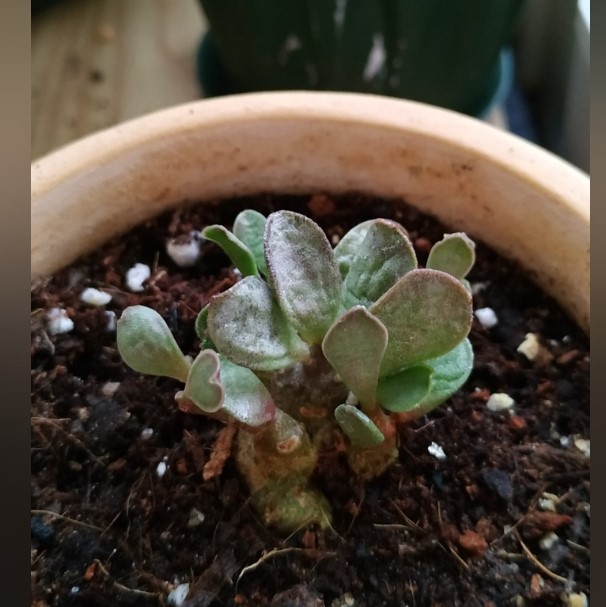
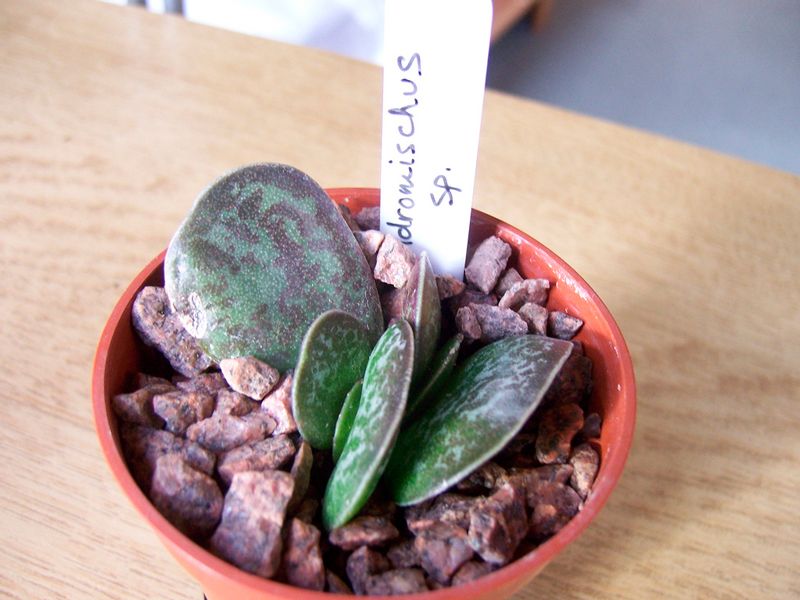
A short stem bears a lush crown of thick, rough-surfaced leaves. Their color varies depending on the species, but most commonly includes numerous shades of green with touches of gray or purple.
The flowers are tubular and pink or white, with some species being purple. They are borne on small, up to 25 cm, peduncles.
A fairly developed root system. Some species eventually develop reddish-brown aerial roots above the soil surface.
Varieties of Adromischus
There are about 70 species of Adromischus worldwide. Only a few are grown as houseplants.
| Types | Description | Leaves | Flowers |
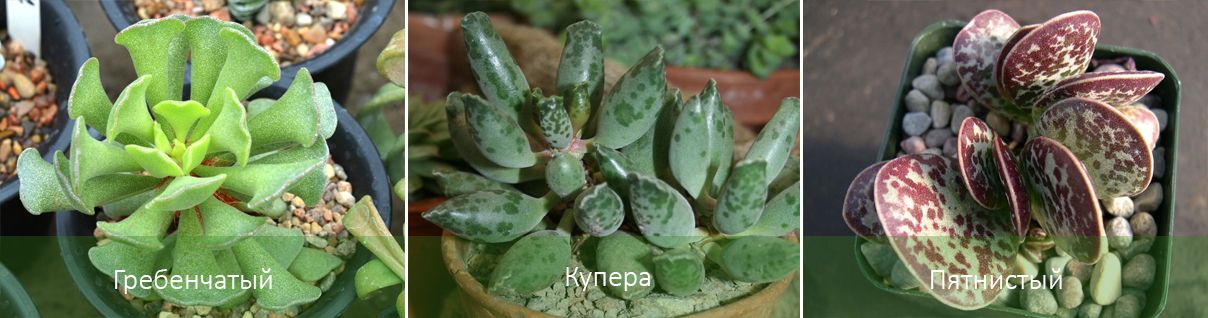
| Comb (cristatus) | Height no more than 15 cm. With age, the branches begin to sag, and the plant becomes creeping. The stem is completely covered with aerial roots. | Small, fluffy, collected in rosettes, wavy and comb-like at the edges. | The buds are dark green, wavy, with a pink edge. They are tubular in shape and have grayish-white petals. |
| Cooper | Short and thick stem, many thread-like aerial roots. | Oblong, tapering toward the base. Green in color with a slight bluish tint. | Small, up to 2 cm, gathered in a rosette. Purple or pink. |
| Spotted | Woody short stem no more than 15 cm. | Unique in its coloring—green with small red spots, merging into a single continuous border toward the edge. Oval or round in shape, no larger than 5 cm in size. | Tubular, red-brown in color, collected in a spike-shaped peduncle. |
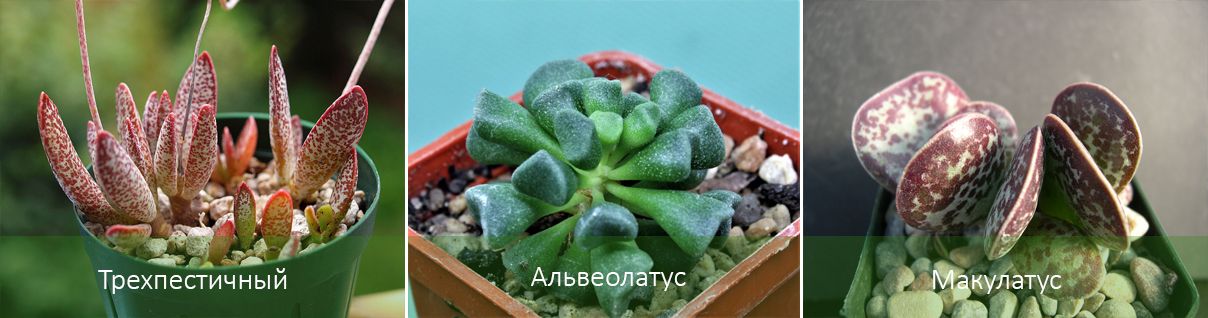
| Three-pistil | It does not grow more than 10 cm, has short stems, and practically does not branch. | Round, slightly elongated, grow up to 5 cm. Pale green and red blotches are collected in the form of spots along the upper edge. | Reddish with a whitish tube from the base. |
| Alveolatus (grooved) | Slow-growing, low-growing. With age, it develops aerial roots; when these turn brown, they die off. | Elongated, crystal-like, with a small groove along the edge. Green. | The flower stalk grows up to 25 cm. The buds consist of 5 pale pink petals gathered together. |
| Maculatus (spotted) | It has an erect stem up to 10 cm tall. At its base, it is surrounded by a row of small oval leaves. | Green ones with red spots reach 5 cm in length. If the lighting is insufficient, the spots disappear. | Red-brown flowers are collected on a spike-shaped peduncle. |
Growing Adromischus at home
Adromischus, like all succulents, is not fussy, but it does require attention. It's important to carry out all necessary care in a timely manner, respecting the season.
| Indicator | Spring/summer | Autumn/Winter |
| Lighting | Not afraid of direct sunlight. | Additional lighting is required. |
| Temperature | From +25 °C to +30 °C. | From +10 °C to +15 °C. The dormant period begins. |
| Watering, moistening | Often, but in small portions. | In autumn they slow down, in winter they stop. |
| Top dressing | Once a month. | Not needed. |
Propagation and transplantation
Repot the plant in late spring, but only if absolutely necessary. Choose small pots. Use a special soil for succulents, making sure to include expanded clay drainage. You can mix the following ingredients yourself in a 2:1:1:1 ratio:
- leaf soil;
- peat;
- turf;
- sand.
Select whole, mature, undamaged leaves. Dropped leaves are also suitable. Lay them out on paper and let them dry slightly, for no more than 24 hours. Then, place them upright in the soil, ensuring they are stable and upright. After a while, side shoots will appear, and the mother leaf will dry out.
Problems with growing adromischus
Andromischus rarely causes problems for its owners, as it is quite disease-resistant. However, regular inspection is necessary. Potential diseases and problems:
| Reasons | Manifestations | Measures to eliminate |
| Aphid | The leaves completely lose moisture, dry out, and curl up. They then fall off, which can lead to the death of the plant. | Spray both the flower and the soil with a tobacco decoction mixed with a soap solution or an aerosol insecticide such as Fitoverm or Fufan. |
| mealybug | It appears on the roots, and occasionally on the above-ground parts. The plant becomes covered with white, cotton-like lumps. | Treatment is carried out with Akthar and Confidor. Repeat at least three times, every 5-7 days. |
| Spider mite | The leaves become entangled in a fine web. Affected areas turn yellow, merge with other parts of the plant, dry out, and die. | Apply Intavir, Karbofos, and Actellic generously. |
In some cases, a plant dies for no apparent reason. This is usually due to improper watering, water getting into the flower rosette, or, conversely, the soil drying out completely. If the leaves have faded and the stem is stretched, it indicates insufficient light.
Reviews and tips for growing Adromischus
Sturdy, prolific, and just a cutie ♥️
Experience of use: six months or more
Hi all!I, too, was suddenly craving something exotic—succulents, a trendy plant these days. Among other things, I found an andromyschus, along with a leaf from its friend as a gift.
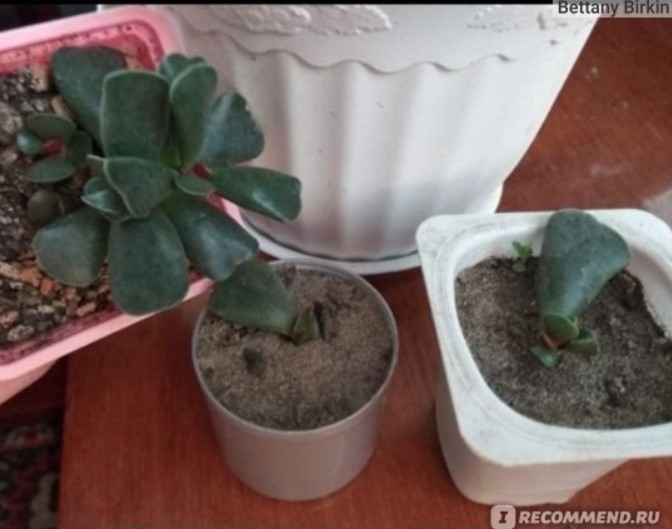
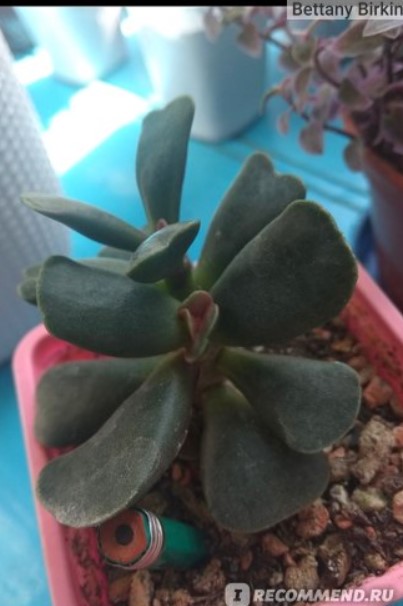
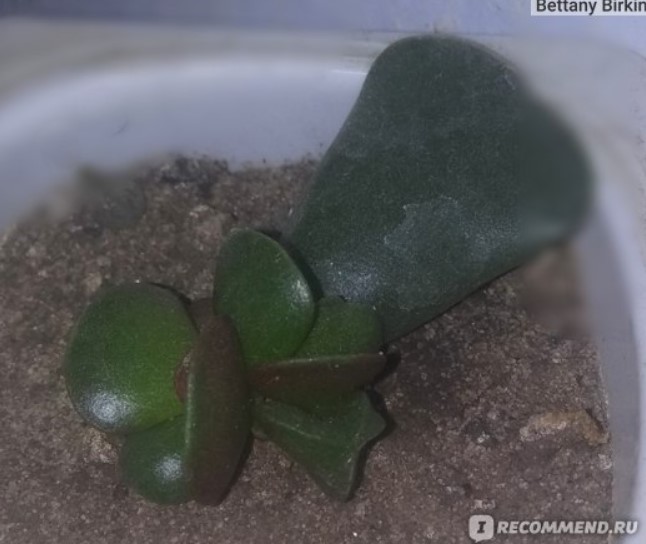
Andromischus and its leaves with babies
I'll say right away that I'm a huge fan of watering plants generously and frequently, so I wasn't sure he'd stick around for long. Succulents aren't my thing yet; they're still learning how to grow me. Plus, I don't like slow-growing plants that sit around for years without my "efforts" showing. I love examining and discovering new branches and leaves.
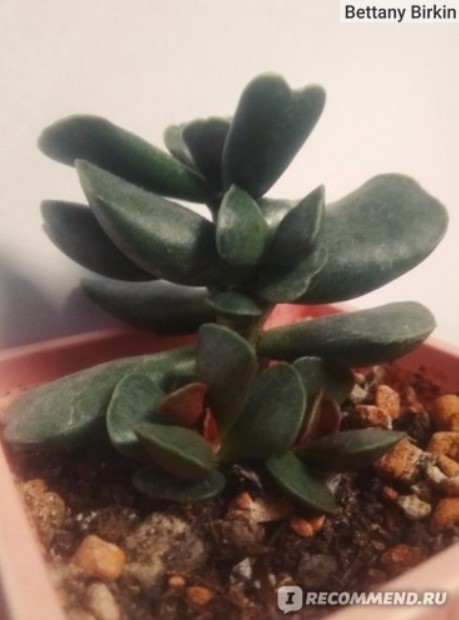
The andromyschus foresaw this and immediately took off. I never expected it to grow so quickly! I placed the bush by a south-facing window, but it only got about 1-2 hours of sun. I wasn't sure if it was right or not, but it grew beautifully and turned crimson, much to my delight. The young leaves turned reddish while the bush itself was dark green. Very interesting and pretty. I already have haworthias that also turn brown in the sun, but I didn't know this about andromyschus. Almost immediately, the bush produced two offspring and began actively growing them. It also started sending out side shoots. One leaf broke, but I was so sorry to break it off that I simply propped it up with a pencil 🤦😁. After a while, I saw roots hanging from it and decided to plant it separately. I didn't take a photo of the roots or couldn't find one.
Kids
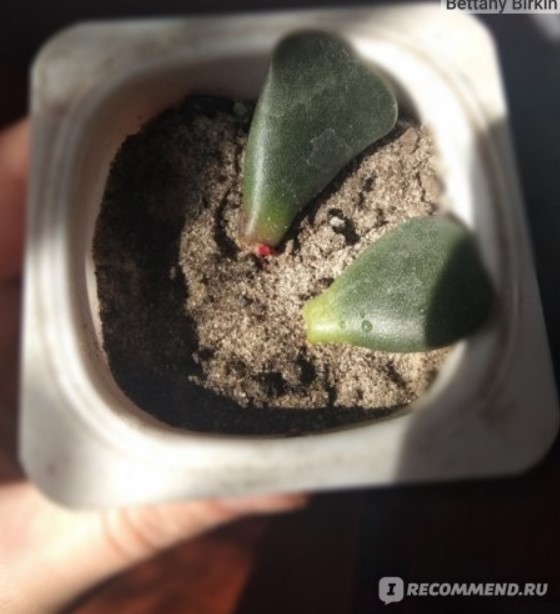
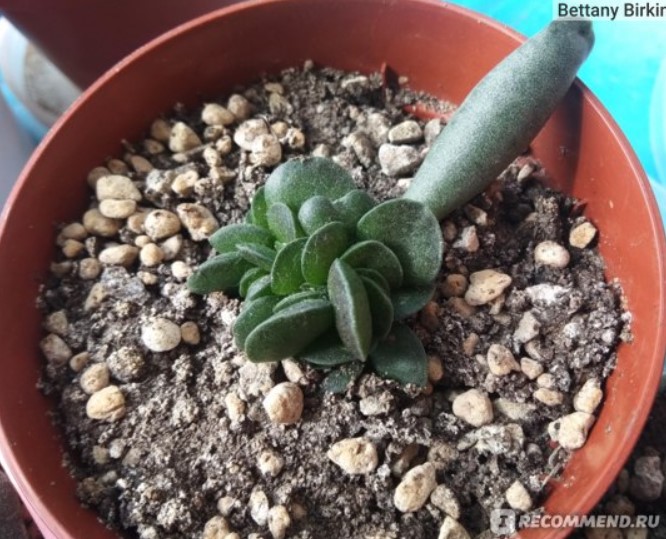
The gift leaf sat for a long time. I root everything in sand, just like my Haworthias. It was a slightly different shape, oblong and narrow. I don't know if it's a different species or the result of different conditions. The seller herself wasn't sure which was which, but she said it was supposed to be variegated, which isn't at all evident from the leaf. So for now, I'm growing it and waiting for a miracle, but I'm very skeptical. It's growing slower than the leaves from my andromyschus, so I don't know anything yet, even about the shape of the leaves. Eventually, I decided to break off another leaf above the babies and placed it in the sand, too. Now I have three separate cuties, I don't know what to do with them, and I can't bring myself to throw the leaves away.
A little more detail about rooting. Simply place the leaves on damp sand.
Rooting, I've already sprinkled the roots
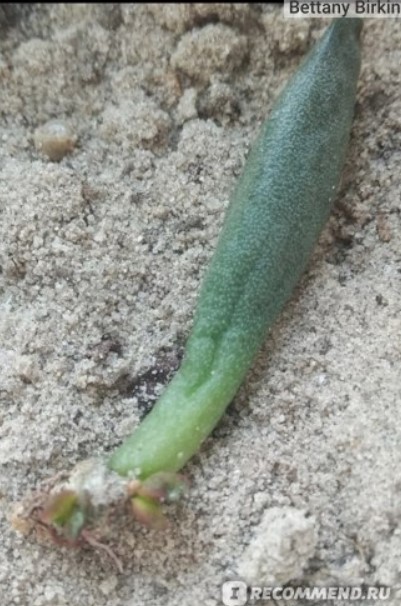
There's no need to bury or poke anything. As the sand dries, moisten it, but avoid making it muddy or stagnant. Even if the leaves wrinkle a little, it's okay. Just don't let the sand dry out so the leaf feels moist. Roots will appear over time, and when they grow a little, you can sprinkle them with sand, but don't bury the leaf too deep. The babies will grow very quickly. Incidentally, the babies appeared first on the gift leaf, and then the roots.
A leaf as a gift
Gift leaflet
The soil is still the same as before, according to the seller: lechuza + succulent soil. The babies are still growing in the sand and haven't complained.
My andromyschus has been growing for about six months or a little more, so it's too early to talk about flowering. Mine don't even bloom, and a cactus or succulent is a dream come true. But you can expect anything from this nimble little plant.Regarding watering, I'll say this: the most reliable way is to watch the leaves. When I see they're starting to lose a little density, I water. I try to soak the entire soil, but without stagnant water. I don't have a specific watering schedule. I water the offspring of the leaves the same way: whenever I see the mother leaf is wrinkling. Sometimes I water them little by little and out of turn.
It's winter now, and they're still standing on the same south-facing window. I don't notice any stretching or any lack of light. Their growth rate has slowed down a bit, of course. The new leaves have also paled a bit, but they're still reddish. The redness on the new leaves almost completely disappears without sun.
As you can see, this plant is very friendly and quite active. It's suitable even for those new to succulents. And despite its simplicity, it's incredibly cute! Those ear-shaped pads immediately won me over 😍. There's something cheerful about them. Now I really want to get other types of andromyschus, because mine is the simplest and it brings me joy, and there are also variegated ones and those with frills! 😇
Now
A small addition.
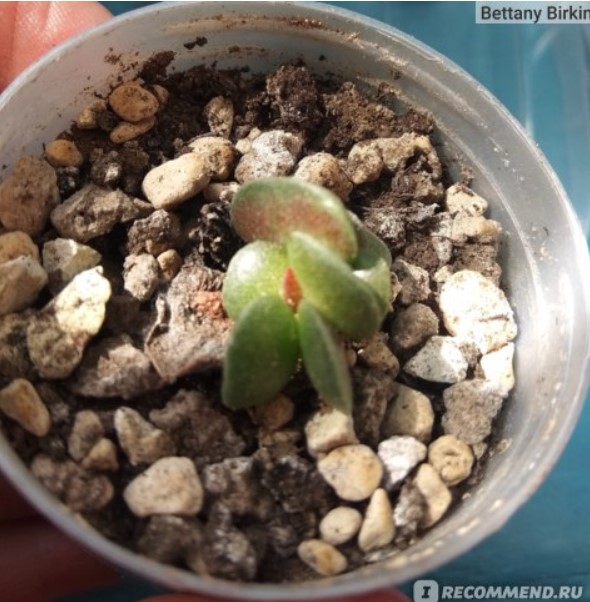
The babies from the gift leaf have grown a bit, and oh yeah, I see variegation! But it's weak for some reason. Either the bush is genetically like this; you can tell from the mother plant's leaves. Or maybe it'll grow and the lighting will change things. I'll keep an eye on it. But I see it, so it's definitely a different variety.
Variegation of the baby from the gift sheet
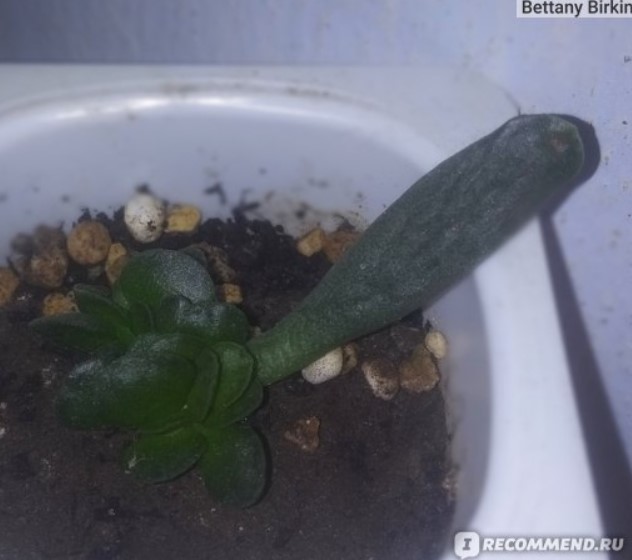
They bought one of the larger offspring from my bush. The smaller one is still growing, but also very slowly, or so it seems to me. Now, with the arrival of spring, it should start growing more actively. Perhaps it's also because the mother leaf, as you can see, has dried out. And the offspring is only getting nourishment from its small roots. But it's not withering, and that's good. Its leaves are already a little tanned in the sun.
Advantages
Easy to care for
Nimble
Bettany Birkin
recommends
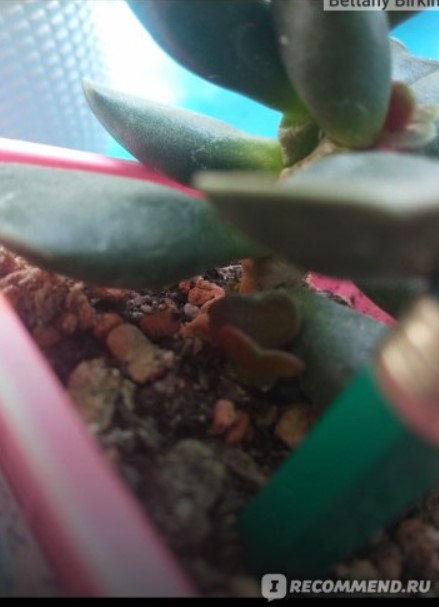
Care for adromischus is the same as for all succulents: very moderate watering, fertilizing in the summer once every 2 weeks with fertilizer for succulents, the soil must contain loosening agents (perlite, zeolite, coarse sand).
I wouldn't pinch back the adromischus; damage takes a long time to heal. Mine has had a severed flower stalk sticking out unsightly for a year now... If yours is growing like a crassula, then cut back on watering; it shouldn't be stretching like that.
Propagated by dividing the bush, as well as by leaf cuttings.
Help! My adromischus is drying out.
I can't find a way to treat it. What could be wrong? I'm not drying it out, and I'm not overwatering it. I've tried all sorts of soil. I've had it for about two years now (it's slowly dying).
Olga Lukina
I would do it this way: Take it out. Shake all the soil off the roots. Let it dry without spraying or other water for a week. Then plant it in the soil you have (it looks fine, although you could use half as much peat), water it, and cover it with a plastic cup with holes. Place it in the shade. Water it as the soil dries out completely. Leave the cup in place for about 3 weeks, but air it out once a day.
Lyubov Ertuganova
It seems to me that the pot is too big and there is a lot of peat in the soil.
Daria Starodubova
I had the same adromischus. When I got an additional phytolamp at home, it immediately came to life.
Lyudmila Rezanova
Take a look through a magnifying glass: there might be a small number of spider mites living there. It looks like typical damage to the leaves.
·
Evgeniya AbikhI bought and repotted an Adromischus festivus and it shriveled up just like that and didn't respond to watering. I started wrapping it in a clear plastic bag—I wrap it at night, keep it in the bag overnight and the next day until 6 o'clock, where it sweats. At 6 o'clock, I take the bag off to air it out, and then put it back in the bag at night. After 2-3 weeks of this packaging, it's swollen—not growing yet, but it's no longer a mummy, so there's hope.