Aphelandra (Aphelandra) belongs to the genus Acanthaceae. It is native to tropical regions of the Americas. The family includes approximately 170-200 species, according to various sources, some of which are cultivated indoors.
Description of Aphelandra
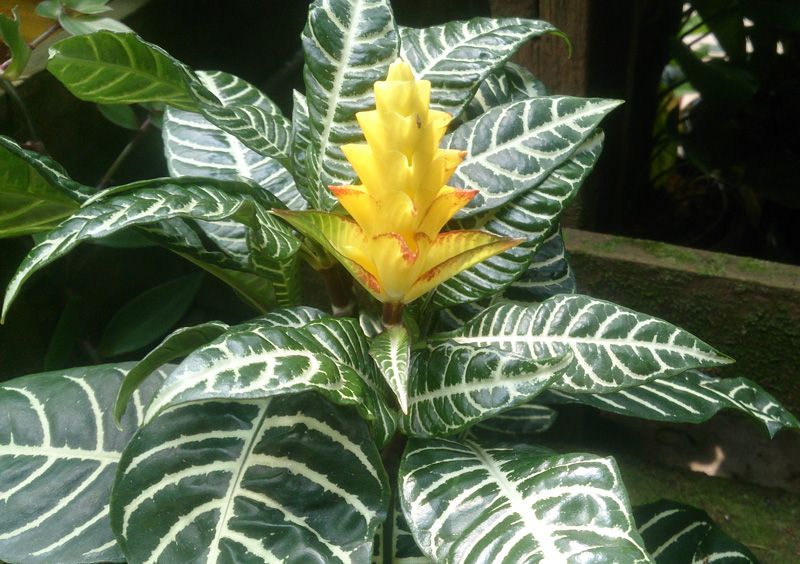
Aphelandra is a long-lived herbaceous plant or low shrub. In the wild, it grows up to 2 m tall, but in captivity, it grows significantly shorter, no more than 0.7 m.
Large, dark, glossy leaves are spiny or smooth, with wide central and lateral veins in beige, silver, or snow-white tones, creating a unique pattern. Flowers with stiff, richly colored bracts are located on terminal cone-shaped or spike-shaped petals. They have a two-lipped corolla in shades of reddish, rufous, yellow, or lilac. The upper labellum is two-toothed, the lower three-lobed.
Species and varieties suitable for indoor gardening
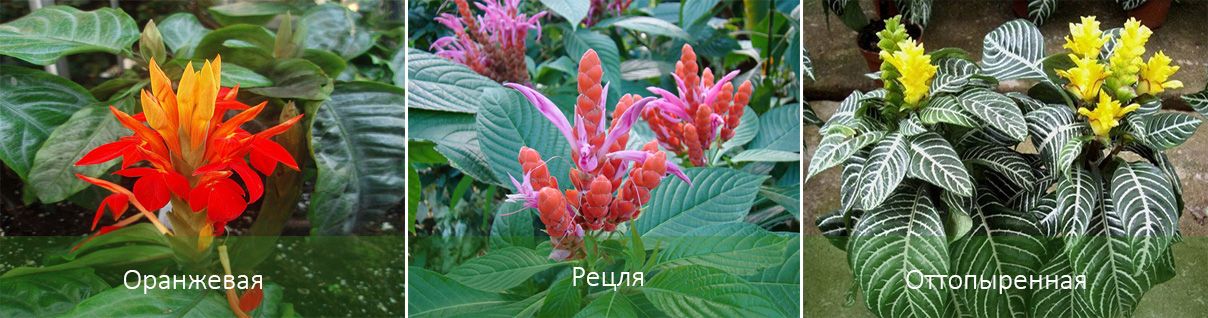
Aphelandra is used to enhance residential and office spaces, exhibitions, etc. Popular varieties of Aphelandra:
| Types/varieties | Distinctive features | Leaves | Flowers |
| Orange | A low-growing shrub with a thick, succulent stem of a reddish hue, which becomes woody with age. | Oval-oblong, diametrically positioned. Silvery-green in color, with entire edges and a pointed tip. | Bright red with greenish bracts on tetrahedral spike-shaped inflorescences. |
| Retzl | The most popular for keeping at home. | Silvery-snow-white. | Fiery red. |
Protruding, varieties:
|
With fleshy, bare stems. | Large, petiole-less, elliptical. Glossy green on the outside, with silvery-white stripes. Lighter on the inside. | Delicate yellow with rufous bracts. They are collected in inflorescences with four sides. The corolla is formed by a pistil and four stamens. |
Optimal environment for growing aphelandra
Caring for this plant at home isn't easy. Furthermore, the sap of the Aphelandra is poisonous, so handle it with gloves and keep it away from children and pets. For optimal growth, it's essential to provide an environment as close to natural as possible:
| Parameter | Conditions | |
| Location/lighting | Spring/summer | Autumn/Winter |
| Rooms with good ventilation. | ||
| When the temperature is appropriate, move the plant outdoors to a terrace or balcony. Protect from strong winds and precipitation. Bright, diffused. If the pot is on a south-facing windowsill, it should be shaded in the hot sun. |
Remove from cold windowsills away from drafts.
Extend daylight to 10-12 hours using fluorescent lamps. Hang them 0.5-1 m above the flower. |
|
| Temperature conditions | +23…+25 °С | +15 °C (except for Aphelandra Procumbens, which requires +10…+12 °C). |
| Humidity/watering | High, not less than 90-95%. Spray several times a day. Place damp moss or peat in the tray. Install a humidifier in the room. | Average 60-65% |
| Moderate, as the soil dries out (2 times a week). | Rarely, once every 1-2 months. | |
| Use room-temperature water that has been standing for at least one day. Melt or rainwater is best. Avoid spilling liquid on the greenery. Be careful not to allow water to stagnate in the tray, as this will cause rhizome rot. | ||
| Soil | Light, loose, and well-drained soil. A suitable soil mixture consists of:
It is advisable to add wood ash and processed cattle bone products to the soil (3 g per 3 l of mixture). |
|
| Top dressing | Every 2-3 weeks. Alternate between store-bought fertilizer for ornamental flowering plants and organic fertilizer (bird droppings, nettles, cow manure). It's best to prepare the latter outdoors, as it will have a distinctive odor.
Use mixtures from stores strictly according to the instructions. |
No need. |
Landing, transplant
Professional gardeners grow aphelandra in an artificial medium without soil. The shrub obtains its nutrients from the nutrient mixture surrounding the rhizome. In this case, the plant does not need to be repotted.
Without repotting, it loses its decorative appeal: it grows strongly upward, sheds its lower leaves, and exposes its stem. Young specimens (up to 5 years old) need to be repotted every spring. Mature bushes should be repotted as needed, approximately every 3-4 years.
If the root system has not yet had time to entangle the root ball and is not affected by diseases, it is sufficient to replace the top layer of soil (3-4 cm) with fresh substrate annually.
Choose a pot a few centimeters larger than the diameter of the root system. It should have drainage holes. It's best to choose an unglazed ceramic pot, which helps aerate the soil.
Transplantation step by step:
- Water the bush, wait 5-10 minutes for the soil to be completely saturated.
- Remove the plant, clean the roots from soil, and rinse with running water.
- Inspect them: cut off any rotting, dry, or broken shoots with a knife dipped in a solution of potassium permanganate. Treat damaged areas with crushed charcoal.
- Fill the new pot with drainage made of expanded clay, shards, and pebbles, 3-5 cm in size.
- Fill the plant pot 1/3 full with soil.
- Place the bush on the ground and straighten the roots.
- Holding the plant vertically, add soil, lightly compacting it (leave 1-2 cm from the surface of the substrate to the top of the pot).
- Water generously and place in a permanent location.
Reproduction
Aphelandra is propagated by cuttings and seeds. The former method is considered the preferred and easiest.
Propagation by cuttings:
- In spring, select a one-year-old, healthy shoot up to 15 cm.
- Leave 2 large, healthy leaves on it.
- Place the planting material in a growth stimulator (for example, Kornevin, Heteroauxin, Zircon).
- Root the shoots.
- Cover with plastic to create greenhouse conditions.
- Keep at a temperature of +22…+24 °C in a room with diffused light, without drafts.
- Remove the cover daily for 10 minutes to ventilate and remove condensation.
- After 4-8 weeks, rooting will occur, the bushes can be transplanted into separate pots and placed in a permanent location.
Propagation by seeds:
- Select fully ripened seed material.
- Spread evenly over the surface of the substrate.
- Cover with a glass jar or plastic bag.
- Keep at a temperature of at least +25 °C.
- Remove the shelter every day for 20 minutes for ventilation.
- After the first sprouts appear, transplant into small pots.
If you don't intend to use the seeds for propagation, it's best not to wait for them to ripen, as ripening depletes the plant of nutrients and energy. It's recommended to cut the inflorescences immediately after the petals fall.
Common problems when growing Aphelandra
If there are mistakes in care, the aphelandra will start to get sick and will be eaten by insect pests.
| Manifestation | Reasons | Elimination measures |
| Brown growths, sticky drops on the plates. Leaf fall. | Scale insect. |
|
| A snow-white coating on the greenery, resembling pieces of cotton wool. Growth stops. | Mealybug. |
|
| The leaves are dried out and their tips are deformed. Green insects are visible on the plant. | Aphid. |
|
| Darkening and softening of the rhizome. | Root rot. |
|
| Fall of leaves. |
|
|
| Withering. |
|
Move the pot. |
| Brown stains around the perimeter of the leaf. |
|
|
| Brown spots. |
|
|
| The leaves are getting smaller. |
|
|
| Delayed or absent flowering. |
|
|
| Verticillium wilt: yellowing and falling of lower leaves, curling of upper leaves, gradual death of the bush. | Fungal infection of soil. | It's impossible to cure. To prevent the disease, the substrate should be sterilized before planting. For example, place it in an oven for 1 hour or keep it in a water bath at 80°C. This will kill the infection. |