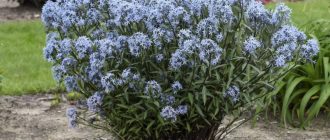
Agapanthus is a perennial plant with a graceful blue flower with six petals. Also known as the "Lily of the Nile," it originally grew in southern Africa, on mountain slopes and along the coast.
Nowadays, due to its decorative qualities, it is grown both indoors and for landscaping garden plots, parks, and lawns.
The plant shares characteristics with the onion, amaryllis, and lily families. The flower's classification, while a subject of scholarly debate, has led to its classification as a separate species—Agapanthaceae. It is considered a symbol of success and prosperity in many countries. The flower became popular in Europe in the 17th century.
Description and characteristics of agapanthus
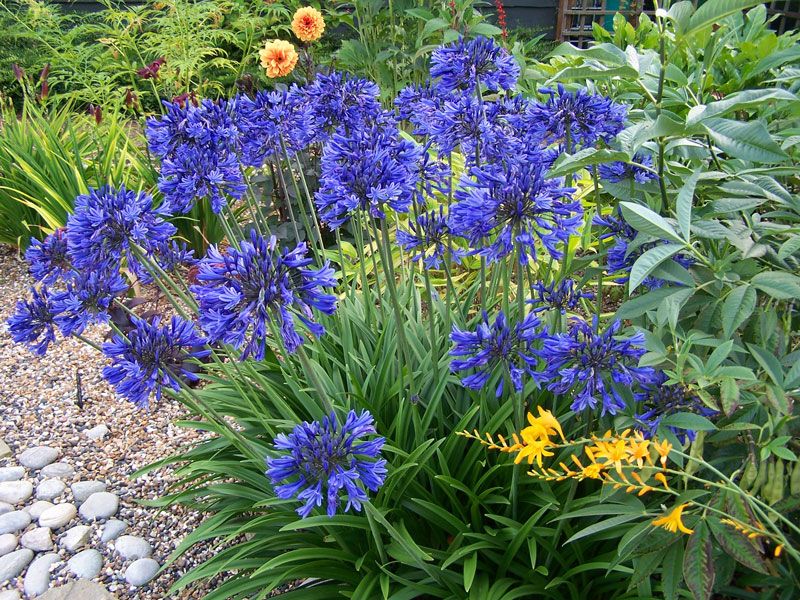
Agapanthus has a fairly long lifespan; most varieties are evergreen, with an elongated flower stalk and exotically shaped leaves that are somewhat reminiscent of the yellow daylily, which has long been widely used for decorative purposes.
The plant has a distinctive, rather fleshy, short root and a thick stem (the flower reaches a height of one and a half meters). The flowering period is long, lasting up to two months.
Approximately 30 funnel-shaped flowers are collected in umbel-shaped inflorescences (30-45 mm in diameter) in delicate colors ranging from blue-purple to milky white. They have six petals and brown-pollen stamens. Flowering peaks in July and ends in late August.
The leaves form a rosette near the root of the flower, spread along the ground, strap-shaped and hard.
Agapanthus grow in large groups, and being native to Africa, they tolerate hot climates well, but cold below (+10 °C) is fatal for them.
Types and varieties of agapanthus
The plant has many hybrid varieties, partly due to the work of breeders who, by cross-pollinating different varieties, obtain new colors.
The most common, Agapanthus umbellatus, is the progenitor of all other varieties. The original color is blue. The blue Agapanthus (Agapanthus Blue) of this species, thanks to its bright, sky-blue flowers, is most sought after for ornamental purposes. It's not very tall (up to a meter), but it has long, firm leaves and two-centimeter bell-shaped inflorescences. It's excellent for both lawns and compact indoor growing.
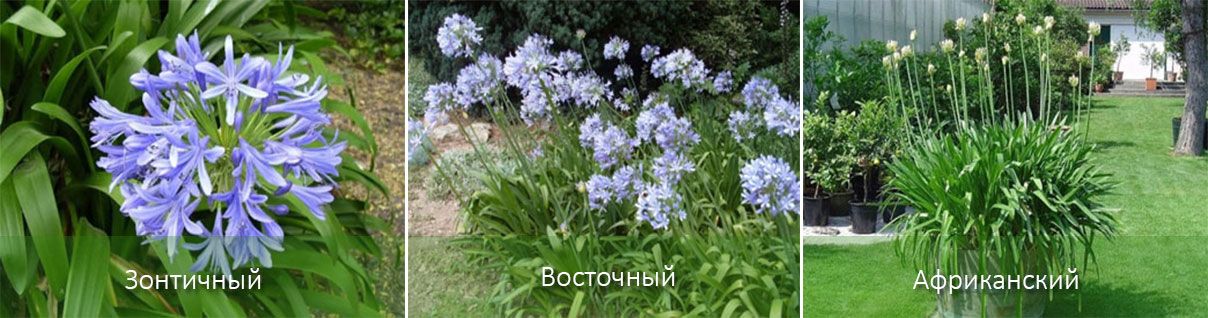
This oriental variety is characterized by early flowering, reaching a height of up to 70 cm, and curved leaves reaching 60 cm in length. The inflorescence is spherical and contains up to a hundred white-cornflower-blue flowers.
The African species features graceful flowers in shades of blue, each petal with a light longitudinal stripe running down the center. These large flowers are clustered in peduncles of 20-30. Plants reach 60-75 cm in height.
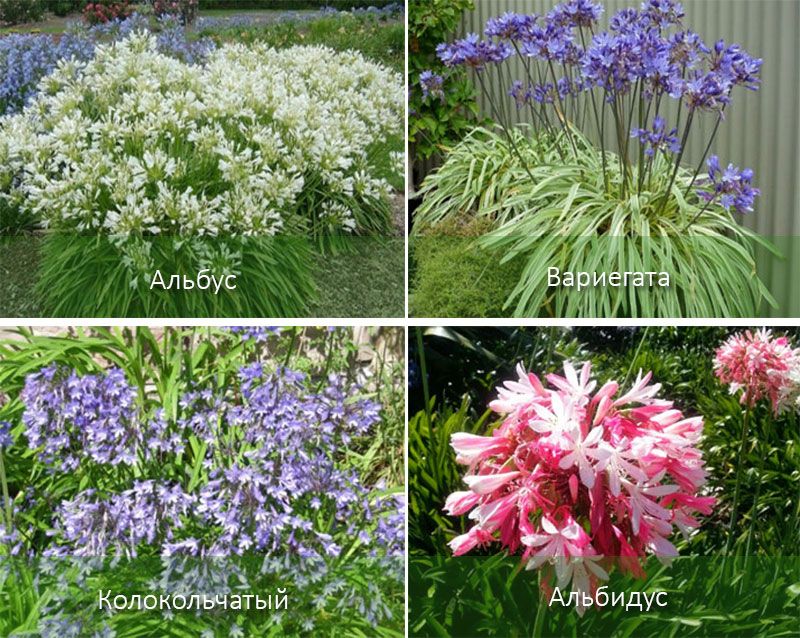
Among the decorative varieties obtained by breeders, the following varieties can be distinguished:
| Variety | Description |
| Variegata | It has very long leaves with a white stripe. |
| Albidus | The perianth is white, with bright red spots. Very decorative. |
| Albus | A low (up to 20 cm) white flower, ideal for indoor growing. |
| Bell-shaped | When cold weather sets in, it sheds its leaves, remaining naturally perennial. It's perfect for a garden bed, lawn, or garden. |
Care and planting of agapanthus
Agapanthus thrives at 10 to 28°C (50 to 82°F) and good lighting. Insufficient light will cause the stem to become excessively elongated and brittle, which may require special support.
Windy or drafty locations are undesirable, as the stems' length can cause them to break. Otherwise, the plant will need to be repotted and protected from the wind by other plants.
The soil should be slightly acidic, with sand or sandstone content, or neutral. Moderate watering is recommended, and regular organic fertilizing is recommended. These requirements apply to both outdoor and indoor growing.
In open ground
Planting and caring for the plant in open ground is within the skill of even a novice gardener. When temperatures drop below 10°C, it is recommended to dig up the plant, plant it in a temporary tray, and bring it to a cooler room.
During winter, the dormant plant requires no care. If the climate is not too cold, it can overwinter outdoors. Cover it with a box (cardboard or wooden), sprinkling it with fallen leaves or sawdust.
If the stems become too stretchy, they need to be supported with stakes. It's best to use a soil that's predominantly sandy, preferably with some leaf mold added. When choosing a location, give preference to well-lit areas of the plot, such as the south, east, and west.
Foliar spraying is not necessary, but if the early summer is dry, watering is necessary, especially before flowering. As autumn approaches, reduce watering. When planting, space plants at least 50 cm apart, as the foliage is quite lush and spreading. Seedlings are planted 10-15 cm deep.
At home
Agapanthus needs space indoors, so a spacious container is essential. Be sure to install a drainage hole in the bottom, using fine gravel, to allow excess water to drain. During winter, the plant goes dormant; the ambient temperature should be around 15°C, and it requires infrequent watering.
With the arrival of spring, it's best to place the pot in a sunny window and water it generously. In summer, daytime "walks" in the fresh air are very beneficial. There's no need to mist the plant, and it tolerates dry air during the heating season. However, fertilizing is highly recommended, at least from the beginning of flowering until the seeds ripen.
Replanting Agapanthus
The plant's roots are very delicate, so replanting must be done very carefully.
Young plants can be repotted annually in spring, before they emerge from dormancy. Older agapanthus should be repotted no more than once every three years. Repotting plants after 10 years is not recommended unless absolutely necessary.
Reproduction of Agapanthus
Agapanthus can be grown from seed, but the first flowers will only appear after 5-7 years. The seeds are soaked for 2-3 hours and planted in a box in early spring, covered with plastic wrap. The plastic wrap is removed 2-3 times a day to allow air to enter.
Carefully regulate the soil moisture, avoiding overwatering or overdrying it. After 1-2 weeks, the seeds will germinate, and the plastic wrap can be removed completely. Once the fourth leaf appears, the flowers are ready for transplanting to their permanent location.
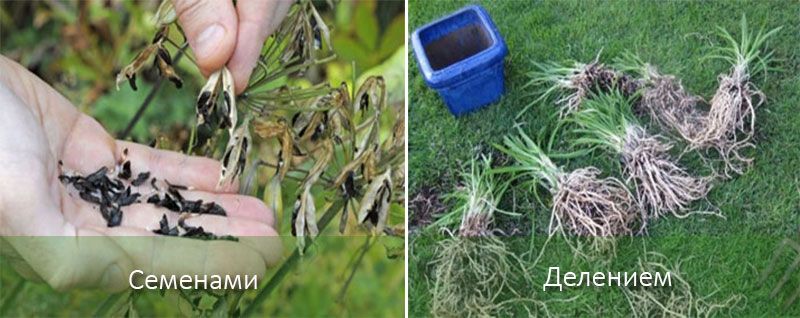
Propagation by division is much easier, and flowering will occur the following year. Division can be done in spring or late fall. Dig up the flower and use a sharp knife to cut off a portion of the tuber, along with the rosette of leaves. Wipe the cut area with activated charcoal. Initially, the divided plants are watered minimally; once growth begins, watering is resumed fully.
Often, if conditions are favorable, so-called daughters appear next to the flower - shoots from the root, they are very carefully (the rhizome is delicate) separated and planted independently.
Pests and diseases of agapanthus
Here are the main health problems of agapanthus and methods for treating them.
| Manifestation on leaves and stems | Cause | Measure of elimination |
| Rotting. | A fungal infection caused by excessive dampness and cold. | Fungicidal treatment. |
| Drying up, falling off. | Insufficient or excessive watering. | Normalization of the watering regime. |
| The appearance of white threads. | Spider mite, scale insect. | Washing with soapy water. |
| Peduncle extension. | Lack of light. | Replanting, moving to a more illuminated place. |
| Snails and slugs. | Manual removal, sprinkling with eggshells. | |