Agave is a perennial plant related to Haworthia, Aloe, and the Mexican cactus. It belongs to the Asparagus family, subfamily Agavaceae.
Native to Mexico and the southern United States, it was introduced to Europe from the mountainous American states. This particular variety is cultivated worldwide as an ornamental and medicinal plant. In Russia, its natural habitat is the southern part of Crimea and the Black Sea coast in the Caucasus.
Description of agave
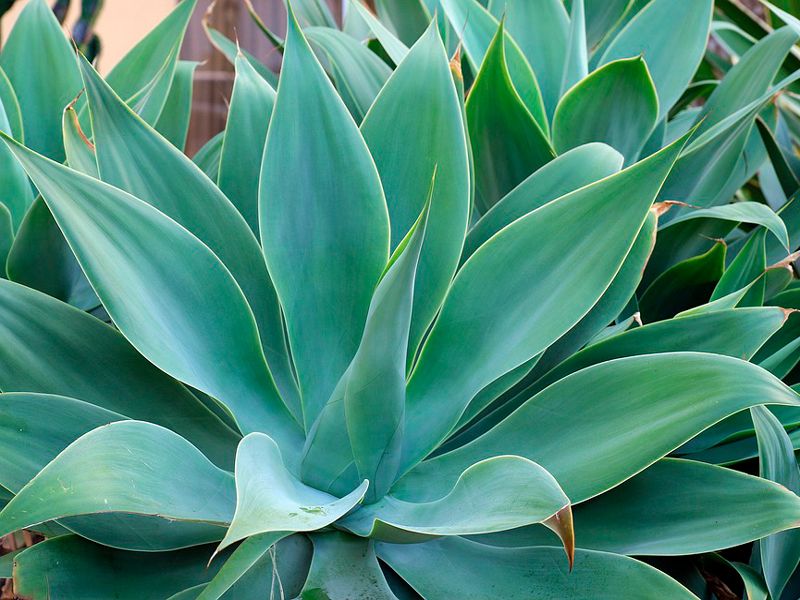
Agave resembles aloe, but its leaves are wider, fleshier, and form a single basal rosette. Their edges are covered with thorns rather than soft spines. Some varieties have woody stems.
Color ranges from blue to dark green and gray. Some species are additionally colored with thin white or yellow thread stripes.
The leaves, broad or lanceolate, end in a straight, thin or slightly curved, hard spine.
Agave blooms very rarely, but it's an unforgettable sight. A large, candelabra-like inflorescence, covered in countless tiny flowers, appears once every 10 years. The blooming period lasts about two months, after which the plant gradually dies, but numerous small basal shoots remain.
Agave varieties
There are approximately 300 different species of agave worldwide. Most are found only in the wild. Only a little over 11 are grown indoors, in greenhouses, and rose gardens.
| Species name | Description |
| Blue | This particular variety is used to make tequila. For this purpose, it is cultivated on a large scale in artificial conditions. In the wild, this species is rare and its properties are radically different from those of cultivated agave. |
| American | It grows up to 2 m in height, with a leaf span of up to 3 m, and a panicle-shaped inflorescence reaching 9 m. The flowers are yellow-green and up to 10 cm in diameter. The leaves are lanceolate with curved serrations. It flowers and bears fruit once every 10 years, then dies, leaving side shoots. |
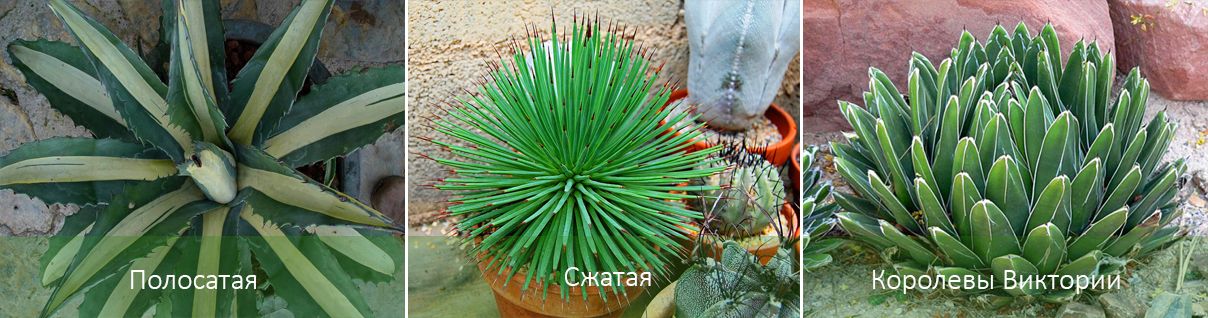
| Yellow-edged | The stem is extremely short, the leaves are up to 2 m long and 20 cm wide at the base. The spine at the end is strong, hard, and sharp. A yellow edge adds decorative appeal. |
| Striped | The leaves are linear, narrow, and up to 70 cm long, with a width of about 0.7 cm at the base. The color is grayish-green with several dark green stripes. The plant's ends have a very sharp brown spine, making it unsuitable for pot cultivation. |
| Compressed | Similar to the striped variety, but with a solid color. With age, it expands considerably, producing several spherical rosettes. The flower stalk grows up to 2.5 m. It is the most decorative variety of agave. |
| Queen Victoria | Best suited for indoor growing. It reaches 60 cm in adulthood and does not grow any taller. Its color is rich green, with light diagonal stripes. It is grown like a large succulent, under the same temperature and lighting conditions. |
| Tumi | An ornamental perennial. With careful care, it grows, but generally maintains a compact size of about 70 cm. Small spines up to 1 cm long are at the ends of the leaves. Long white threads hang along the edges. |
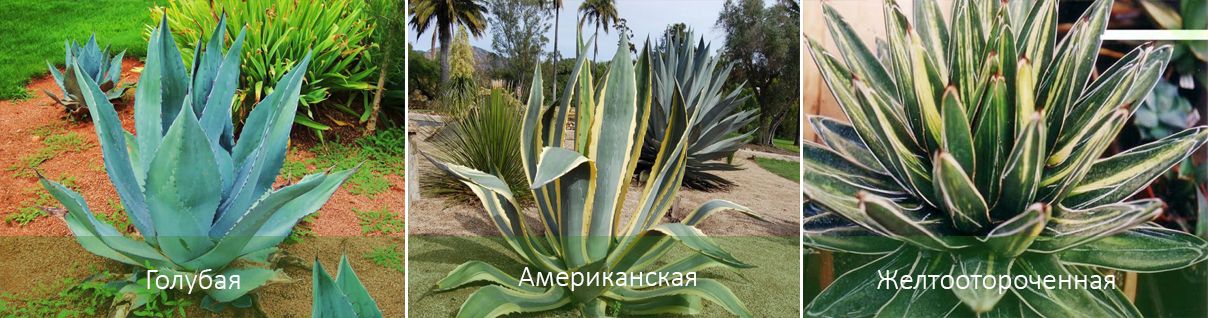
Most cultivated varieties are quite large, making them suitable for growing in parks, squares, gardens, etc. However, specimens up to 60–70 cm are used as houseplants, placed on windowsills and balconies.
Conditions for growing agave at home
Agave is an easy-to-grow plant, perfect for home growing. However, it still requires a minimum amount of attention.
| Parameter | Spring/summer | Autumn/Winter |
| Lighting. | Natural. | Lighting required. |
| Temperature. | No more than +28 °C. | Not less than +18 °C. |
| Watering. | 2 times a week. | Once a month. |
| Top dressing. | During the growing season, once a month. | Rest period. |
When leaving, the following factors are additionally taken into account:
- Succulents, including agave, tolerate both direct rays and diffused sunlight well.
- In winter, illumination is provided only if the plant is on the north side.
- Stagnant air is harmful; in summer, the agave is moved to the balcony, and in winter, regular ventilation is provided.
- Dies at temperatures below + 10 °C.
- The flower does not tolerate humidity well - do not spray it, do not leave water in the tray, and do not place it near humidifiers.
- When watering, moisture is supplied directly to the roots; if it gets into the rosette, it will cause rotting.
- For feeding, use fertilizers and solutions for succulents or cacti.
It is important to remember that the plant has a long dormant period in winter, so during this time it should not be fed, moved, or watered very often.
Correct transplantation
Agaves shouldn't be repotted too often, as they don't tolerate the process well and become "sick" for a long time. A small plant should be repotted annually after three years, only when changing its pot. This should be done exclusively in the spring.
It's important to choose the right soil. Purchase soil mixes for succulents, palms, or dracaenas. Or prepare your own by mixing the following ingredients in a 3:1:1 ratio:
- sod-clay substrate;
- leaf soil;
- sand.
The soil should be loose and turfy. Additionally, add a small handful of fine charcoal, bone meal, and lime. This will help disinfect the soil.
When planting, observe the following rules:
- A small plant is repotted every year, and after 3 years of age, only when changing the pot.
- The root collar is not buried in the ground.
- During flowering, agave should not be replanted, as it will not have the strength to recover.
- Young shoots take root within a few weeks to a month.
- Don't forget about drainage - place about 3 cm of expanded clay (broken brick) on the bottom of the pot.
A square container with the same dimensions as the plant itself should be selected for repotting, with drainage holes. The pot should be slightly larger than the plant itself, allowing for growth.
Reproduction methods
Indoor agave plants rarely bloom, so there's virtually no chance of getting seeds. Even if you do manage to acquire a seed, the process of growing it into a beautiful, full-grown plant is very long and labor-intensive.
There are two more simple methods for propagating agave at home. You can do them yourself without seeds:
- Cuttings from rhizomes. These are obtained during replanting, by pruning from the mother plant. An important requirement is that the cutting must have at least one bud. After cutting, it is dried for several hours and then planted.
- Root and stem shoots. When side shoots appear, remove them with a sharp blade. Dry for 24 hours before planting. Water no sooner than 3 days later.
Using the medicinal properties of agave
The plant's chemical composition at different ages and under different growing conditions has not been fully studied. The juice and pulp of agave leaves at least three years old are used to treat various ailments.
The medicinal properties of the succulent are used for:
- Almost all gastrointestinal problems, to improve the functioning of the digestive tract.
- Diseases of the respiratory system.
- Skin diseases.
- Problems in the genitourinary system.
- Frostbite, swelling, burns.
- Excess weight as a cleansing agent.
The main contraindications are pregnancy, breastfeeding, and allergic reactions. Conventional medicine uses the succulent leaves to produce a hormonal contraceptive on an industrial scale.
Agave is relatively easy to grow, rarely gets sick, and requires virtually no watering. When chosen wisely, it will be a worthy addition to your home plant collection or can be beneficial in treating various ailments.
Reviews of growing agave at home
I have three agaves! I love them very much. I think they're beautiful, interesting plants, not often seen in hobby gardens. That's the whole point: agaves are spectacular, relatively unusual-looking plants, yet very easy to maintain and trouble-free.
The most beloved is the Queen Victoria agave, Agave victoria-reginae:
This species is dedicated to a page on the website www.cactus-art.biz.
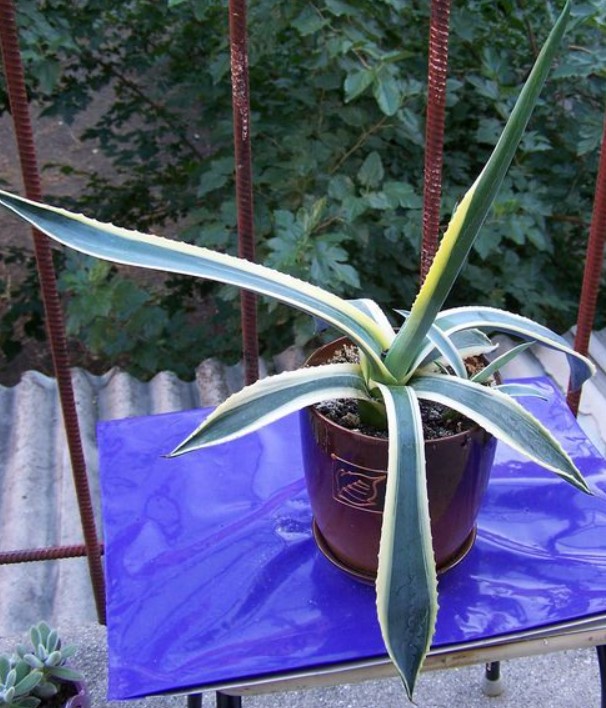
This is an Agave americana, a variegated plant, and the best part is its compact form, suitable for indoor growing! Try keeping an agave with leaves nearly a meter long. This one is perfectly fine:
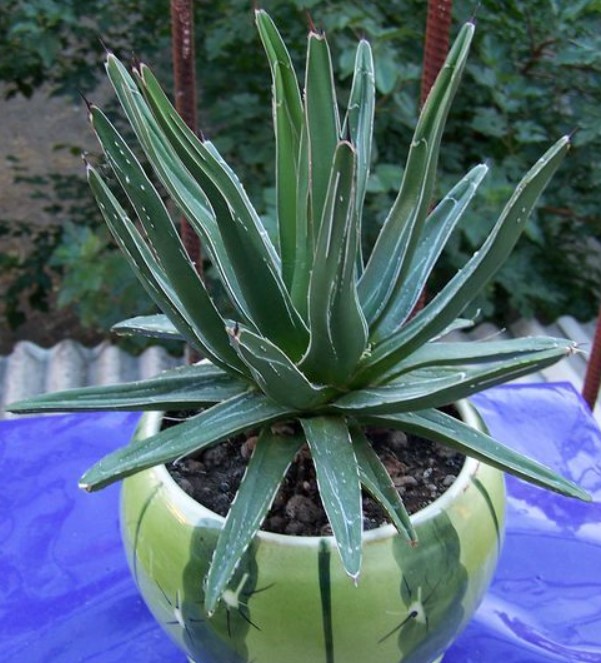
Finally, I suspect it's Agave filifera. (I suspect it's because I recently learned that leaf threads aren't unique to this species.) I grew it from a small seedling (bought in a 5-centimeter pot).
I bought all my agaves at a local flower shop in Feodosia. It's a small town, with only three flower shops, but their selection is practically European.
The thread-leaved agave looked pale in the mix among other small Dutch succulents, but I knew what it was and bought it. I was warned it would grow quickly, and it did! I've had it for about 3-4 years.
But the other two agaves are growing slowly, and that's good.
They're actually a bit difficult to manage: there's not enough space, the plants are crowded together, and they spread out their long leaves with sharp spines at the ends. You could prick yourself, and it'd be a shame to accidentally break off one of those spines...
Agaves need sun! Although they can survive without sunlight for a while. American agaves are often plagued by drooping leaves. Mine was a bit dark in winter, even though the window faces south. A thread-bearing agave once got burned in the spring sun, even to the point of browning, but then recovered and turned green on another window. Queen Victoria agave is the most trouble-free.

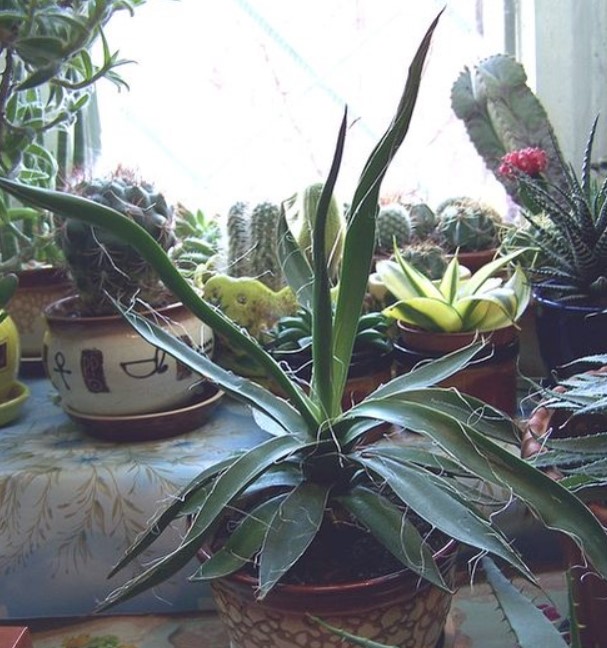
We brought it from Egypt as a three-leafed baby plant. While I was getting into position for the photo shoot, my husband uprooted it (my husband is a barbarian, I know). It was growing next to a huge mother plant and a bunch of other babies. I don't like succulents, so it sat in a jar of water for a few months until the roots rotted. Later, I finally took pity on it, and my husband insisted, so I planted it. At first, I was furious that wherever I went (on the windowsill with other flowers), it was constantly scratching me. I dreamed of giving it to my husband to take to work. Someone wrote here that he almost poked an eye out, and I was constantly covered in scratches, as if a cat lived in the house.
And later I fell in love with my agave and will not give it to anyone.
It grows quite slowly, I water it very rarely, I replanted it twice since 2010 in a regular universal substrate (as I do for everyone: store-bought soil + vermiculite + charcoal).