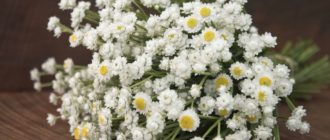
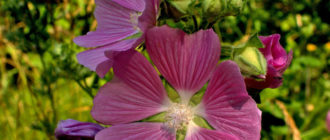
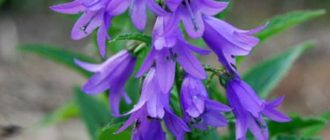
Ageratum is a perennial flowering shrub native to East India. In warmer countries of North America, Russian gardeners grow it as an annual or houseplant.
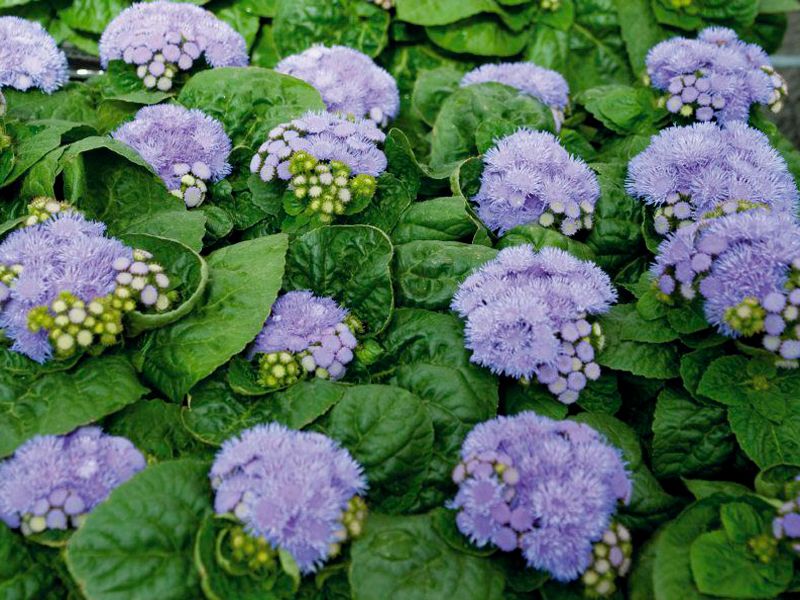
The flower heads, in shades ranging from white to purple, pair beautifully in landscape design with calendula, snapdragons, and marigolds. The fluffy blooms retain their freshness for a long time in a bouquet. Ageratum lives up to its Latin name, which translates as "ageless."
Content
Description and characteristics of ageratum
This plant of the Asteraceae family is a shrub up to 60 cm tall, with triangular or diamond-shaped leaves; in some species, the leaves are oval. Numerous erect, elastic stems are pubescent, each producing a paniculate peduncle. Complex corymbose inflorescences of small buds are gathered into baskets 1 to 1.5 cm in diameter. Depending on the variety, the petals are white, pink, yellow, blue, or purple. When pollinated, the plant produces an elongated, pentagonal, wedge-shaped fruit—an achene—containing about a dozen small seeds.
This perennial does not tolerate subzero temperatures; during the cold season, it continues to grow in a greenhouse or indoors. Flowering begins 2–2.5 months after germination and continues until frost.
Ageratum varieties
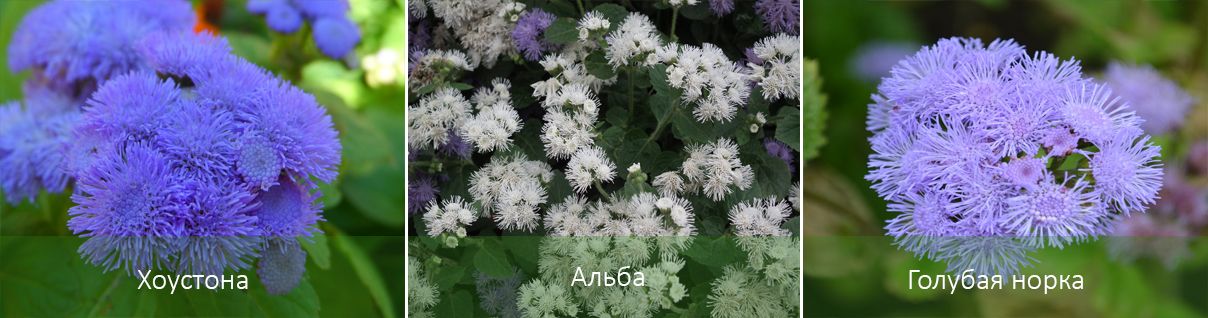
Numerous varieties of this flower have been developed for landscape design. Descriptions of popular varieties in Russia are provided in the table.
| Name of the variety | Bush height (cm)/leaf shape | Color of buds |
| Houston (Mexican) | 50/triangular. | Soft blue. |
| Alba | 20/diamond-shaped. | Snow-white. |
| Blue Mink (dry variety) | 20–25/round. | Rich blue. |
| Bavaria | 30/in the form of a triangle. | The center of the baskets is light blue, with delicate blue buds along the edges. |
| Blue bouquet | 45/triangular. | Light or dark blue. |
| White ball (creeping variety) | 20/round. | Milky white or snow white. |
| Pink fire | 60/oval. | Delicate and bright pink. |
| North Sea | 15/triangular. | Dark purple. |
| Alyssum (golden autumn) | 15/elongated wedge-shaped. | Sunny yellow. |
Growing ageratum from seeds
The plant prefers neutral soil with a low organic content; humus should be no more than a quarter. When preparing the soil for seedlings yourself, mix equal parts of turf, leaf mold, humus, and river sand. For planting, prepare individual pots or a common planting container, or peat pellets up to 15 cm in diameter. Seeds are planted outdoors when the soil warms to 15°C. Seeds mature naturally only in warmer regions.
Sowing ageratum seeds
The seedlings are pre-soaked in a biostimulant solution. These have a disinfecting effect and ensure stable plant growth. Sow to a depth of 1.5 cm in moist soil treated with a weak solution of potassium permanganate. Seedlings appear in 10-14 days. To speed up germination, cover the container with plastic wrap and place it in a warm place for a week. The recommended germination temperature is up to 25°C.
Ageratum seedlings
After three full leaves emerge, the seedlings should be transplanted from the main planting container into individual pots by picking. Pinch the shoot to stimulate branching when it has at least six leaves. Water moderately every three days. If humidity is high, water every five days. Root feeding should be done two weeks before planting.
It's best to use Agricola complex fertilizers for indoor plants or succulents. At this time, prepare the seedlings for planting outdoors.
Harden off the shoots by placing them on a balcony or loggia if the air temperature is 10-12°C. Initially, do this for 15-20 minutes, then increase the time interval. If the nighttime temperature isn't too cool, leave the seedlings out overnight.
Planting ageratum in open ground
Ageratum should be planted in sunny areas with little groundwater. In low-lying areas, drainage should be provided to prevent root rot. In the second half of May, when there is no risk of frost, the seedlings can be transplanted into open ground. Six- to eight-week-old seedlings are planted by transplanting them into prepared holes. The holes are well loosened and watered with a pink solution of potassium permanganate. Space the plants 10 to 15 cm apart. Ageratum can be planted in groups, either linearly or staggered, depending on the landscape design. The flowers thrive alongside vegetable crops and early perennial flowers, which begin their dormant period in late June.
Care for ageratum in open ground
Like all asters, ageratum is undemanding of soil and doesn't require constant care. Basic care guidelines:
- Watering. It's important not to overdo it; many drought-tolerant varieties react poorly to excess moisture and become ill. If the soil dries out, the plant wilts and produces fewer buds.
- Fertilizing. Excess organic matter leads to increased foliage and reduced bud formation. Mineral phosphate, potassium, and calcium fertilizers should be applied no more than once a month. Complex fertilizers are best. Fertilizing with slurry is strictly prohibited; it can kill the plant. In fertile soils, mulching with compost is sufficient.
- Pruning. To ensure abundant flowering, remove any flower stalks that have formed. Each pruned inflorescence will yield new flower stalks. The bush becomes lush and well-shaped.
Ageratum after flowering, growing at home
Ageratum is a heat-loving plant, but when cool nights arrive, when temperatures don't rise above 5°C, the plant dies. It is adversely affected by large contrasts between night and day temperatures. Before the first frost appears on the soil surface, the plant can be moved to a greenhouse, where it will continue to delight with buds. The most beautiful low- and medium-sized bushes are transplanted into pots or planters for winter cultivation. To continue flowering, it is moved to a winter garden or apartment. Choose a well-lit location for it. Repot the plant in a larger pot with a large lump of soil. Place drainage up to 5 cm deep at the bottom.
At home, in a winter garden or greenhouse, ageratum will continue to bloom until the New Year, and sometimes even after the holiday.
When growing ageratum indoors, care consists of regular moderate watering to prevent the soil from drying out.
It's important to avoid stagnant water, especially if the apartment is cool. Three times per season, the plant requires fertilizing with a mineral complex containing minimal nitrogen components. Dilute the fertilizer according to the instructions, doubling the water volume. Use the prepared solution for watering in the spring, during the active flowering period, and in the fall, when next year's buds are forming.
In winter, when daylight hours are short, the plant rests, gathering strength for spring bloom. In spring, it produces buds again and blooms profusely. Indoors, the bush grows for up to three years, after which it must be divided or repotted into a larger container.
For outdoor cultivation, cuttings are taken from overwintered plants. These serve as a complete substitute for seedlings. The plant itself can be planted in the ground for the summer, then repotted in the fall.
Vegetative propagation
Ageratum, dug up in the fall for indoor cultivation, is propagated by cuttings. These are collected in early spring during sanitary pruning. Two to three internodes are left on each cutting. Shoots that have developed roots due to contact with the soil are pruned.

Propagation by cuttings is much more effective than growing seedlings. They root well and bloom early. Here's how to plant cuttings:
- It is advisable to treat the cut with the biostimulator "Kornevin" to accelerate the formation of the root system;
- the shoot is buried in the prepared soil to a depth of 10–15 mm;
- the soil is watered well;
- create tropical conditions - cover the planting with a transparent container (a cut-off plastic bottle or a glass jar);
- When three new leaves appear, the cutting can be transplanted into a garden bed or a flowerpot.
For the first few days after transplanting, the shoots are protected from direct sunlight to retain maximum moisture in the soil.
Top.tomathouse.com informs: diseases and pests of ageratum
Treatment begins at the first sign of disease or insect infestation. Signs of aggregum damage and treatment options are listed in the table.
| Problem | Signs | Cause | Elimination measures |
| Root rot | The plant droops, the leaves wither. | Stagnation of moisture in the soil. | Fitosporin is added to the soil, watering is reduced, and drainage is provided around the plantings. |
| Bacterial wilt | The stem softens and brown furrows appear on it. | High humidity in hot weather. | Treatment with the antifungal drug Fitolavin; watering with potassium permanganate solution; fertilizing with Baikal-EM microfertilizer. |
| Cucumber mosaic | Yellow spots appear on the leaves. | Spread of the virus by insects. | Prevention against aphids, removal of damaged shoots. |
| Whitefly | Small white midges are visible around the bush; they nest on the underside of the leaves. | High humidity in hot weather, confined spaces (whiteflies most often attack aggregums in greenhouses and winter gardens). | Treatment with insecticides and antifungal agents (sooty mold develops on whitefly excrement) |
| Spider mite | Webs appear on the plant; they entwine the tops of young shoots. | Dry, hot weather. | Affected shoots are pinched off and sprayed with pesticides against insects. |
| Nematodes | The flower develops poorly, the internodes thicken, and the affected parts of the stem darken. | Small earthworms of the class nematodes. | The affected bush is dug up to protect the neighboring ones. |
| Winter cutworms | Eaten leaves. | Leaf-eating caterpillars. | Manual collection of cutworms, they become active in the evening, setting up traps. |
Aggregum is susceptible to diseases that affect vegetable crops. For preventative purposes, pest and disease treatments are carried out in the spring.