Achimenes belongs to the Gesneriaceae family. It grows in tropical regions of South and Central America and Brazil. The genus comprises over 50 species. With proper care, the plant will produce beautiful, lush blooms even indoors. Therefore, the flower is often used to decorate apartments and offices.
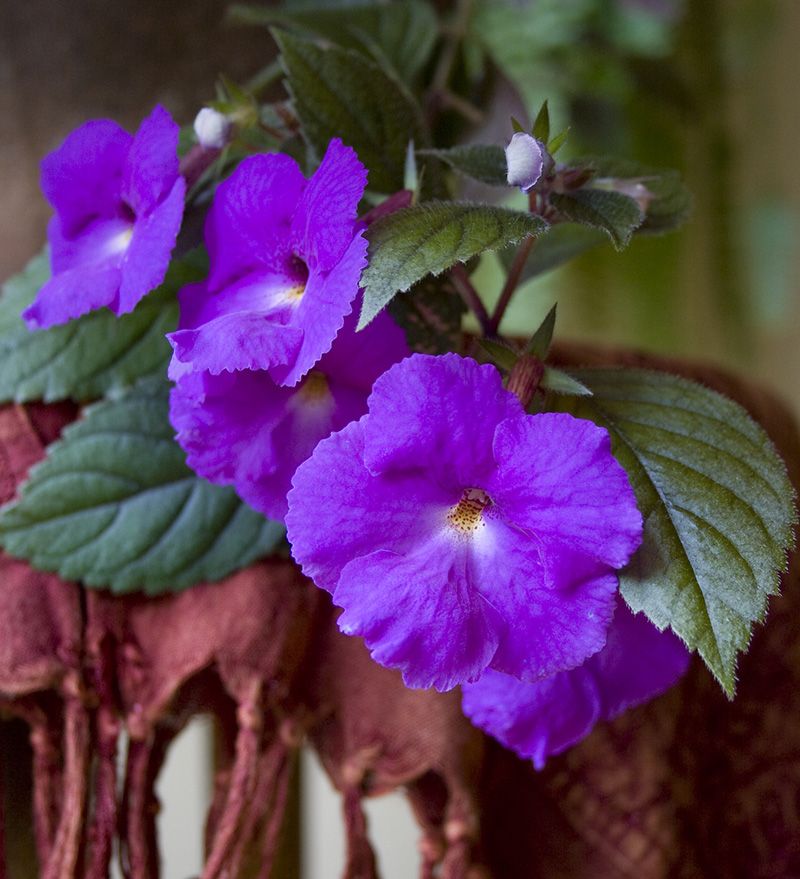
Description of Achimenes
Achimenes is a herbaceous perennial plant, no more than 30 cm tall. The stems are fleshy, branched, and dark green or red. Initially, they grow upward, but droop with age. The rhizome is aboveground, with rhizomes (tubers) covered in fine scales. These rhizomes accumulate nutrients that the plant will use after winter dormancy.
The oblong leaves on pointed petioles are smooth and shiny on the outside. They can be dark green, pink, or purple with prominent veins. The inner surface of the leaf blade is covered with small hairs.
In late spring, numerous flowers begin to form in the leaf axils along the entire length of the stem. Each corolla has a tube and five strongly recurved, double or simple petals, divided at the edges.
Reddish, pink, yellow, snow-white, and purple flowers are borne singly or in groups of 3-6. They reach 3-6 cm in diameter. Flowering continues until the end of September. When grown indoors, it can bloom twice.
Achimenes varieties
Popular varieties:
| Name | Stem (shoots) | Flowers | The period of budding |
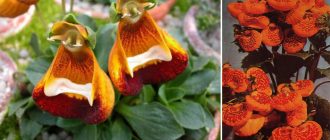
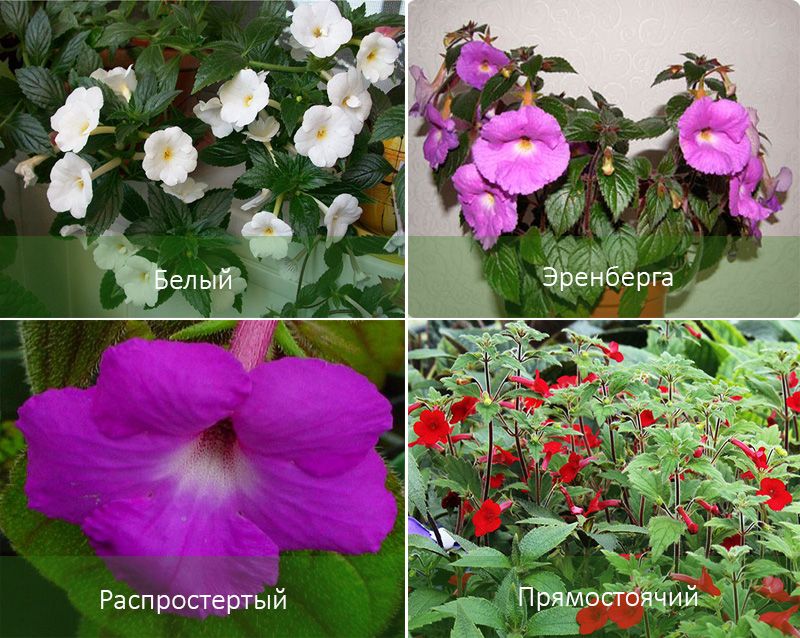
| White | Straight, with green or red shoots. | Small, 1-1.5 cm. The outside is the color of baked milk, with a reddish interior. The corolla tube is yellow with scarlet stripes. | Summer. |
| Ehrenberg | Upright, heavily pubescent and leafy. Regular pinching is required. | Medium-sized, lilac on the outside, gradually fading to pink on the underside. The pharynx (corolla tube) is bright yellow with pink speckles. | Summer - autumn. |
| Outstretched | Grows upwards, brown, less often green. | Pink-purple, up to 2 cm. | June - August. |
| Erect | Upright, medium-sized, reddish in color. | Scarlet, small, up to 1 cm. | |
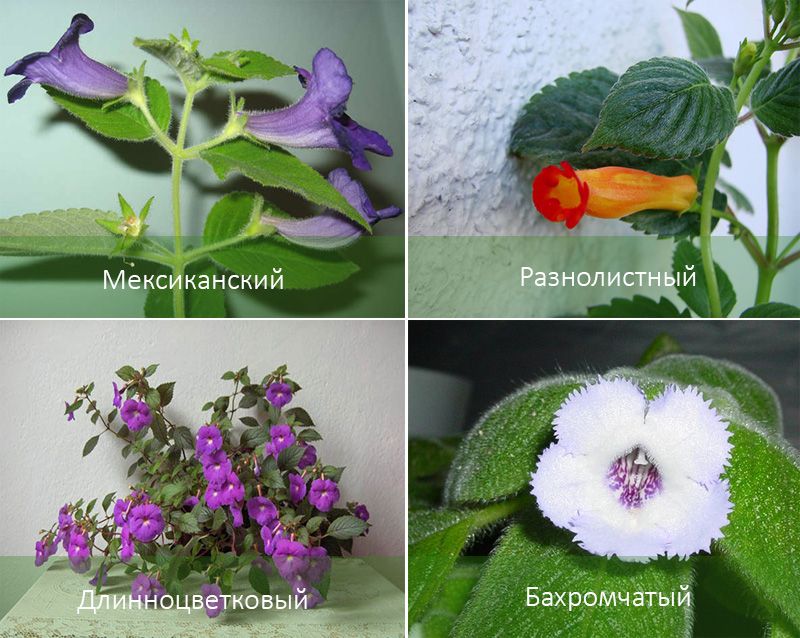
| Mexican | Strongly branching, grown as an ampelous plant. | Up to 3.5 cm, lilac, purple or pinkish with a snow-white tube. | Summer - autumn. |
| Variegated | Reddish, erect. | Burgundy, large, up to 5 cm. The throat is yellow with spots, widened towards the end. | |
| Longiflorum | Deciduous, pubescent, weakly branching, up to 10-30 cm. | Large, up to 6.5 cm. Blue, pink, grey-purple with a yellow or snow-white tube. | |
| Fringed | Drooping, up to 30 cm in length. | Up to 2 cm, white, with fringe along the edges. | |
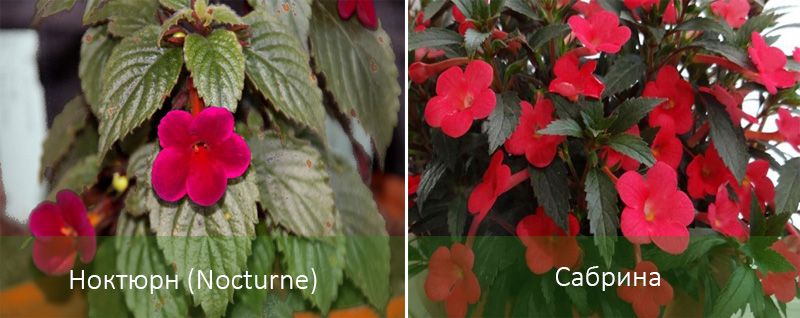
| Nocturne | The shoots are hanging and are grown as an ampelous plant. | Large, up to 4.5 cm. Terry, velvety, dark burgundy on the outside, lighter on the inside. | Summer. |
| Sabrina | At first they grow vertically, but over time they droop. | Coral-pink with a yellow tube. Small, up to 2 cm. | Summer - autumn. |
Achimenes: care and cultivation
In order for the bush to develop well and bloom, it is necessary to provide it with certain conditions:
| Factor | Spring/summer | Autumn/Winter |
| Location | Any windowsill except north-facing ones with shade from midday sun. Place on a terrace or loggia. | Move to a cool, dark storage area for winter dormancy. |
| Lighting | Bright light is essential. Variegated varieties do not tolerate direct sunlight and should be shaded. Dark green varieties can tolerate short-term exposure to ultraviolet light. | Do not use additional lighting; dormant period. |
| Temperature | +22…+23 °С | +15 °C |
| Humidity | 60-65%. Don't spray the plant itself, only the air around it. You can also add damp expanded clay to the tray, place the pot on top, or purchase a humidifier. If water gets on the foliage, large dark spots will appear. The bush will lose its decorative appearance. | |
| Watering | Abundant, every 3 days. | When the soil dries out, apply small amounts around the edge of the pot (2-3 tablespoons once a week). |
| The water temperature should be approximately 2°C above room temperature. Avoid waterlogging. Apply water to the roots or into a tray, avoiding contact with foliage and shoots. | ||
| Top dressing | Three to four weeks after sprouts appear. Subsequently, apply mineral fertilizers every two weeks. | No need. The bush is resting. |
Transfer
Young and mature plants should be repotted annually. Before winter dormancy, rhizomes are not dug up but stored in the old potting soil in a dark room. Repotting should be done before the growing season:
- Lay out drainage from pebbles, expanded clay or broken brick.
- Fill 2/3 of the container with a soil mixture of leaf soil, turf, and sand (3:2:1).
- Remove the tubers from the old soil and place them in a new pot in a horizontal position.
- Pour 5-10 mm of substrate on top and water carefully.
- Cover with glass or plastic to create greenhouse conditions until shoots appear.
Reproduction of Achimenes
The flower is bred:
- rhizomes;
- cuttings;
- seeds.
The first method is the simplest and most effective. A single rhizome can produce several shoots at once, and the young plants retain the varietal characteristics of the parent plant.
Reproduction occurs as follows:
- Carefully separate the tubers from the roots.
- Spread over the surface of pre-moistened soil.
- Sprinkle with dry soil to a depth of 2 cm.
- Make sure that the soil does not dry out, keep it at a temperature of +22 °C.
- The sprouts will emerge in 1-2 weeks. Once the first leaves appear, replant the shoots.
Propagation by cuttings is done in May-June. Here's the step-by-step planting process:
- Divide a healthy, fully formed branch into three parts. Each part should have at least three internodes.
- Remove the lower leaves for better rooting.
- Treat the cut areas with crushed activated carbon.
- Place the lower cutting in a root growth accelerator (for example, Kornevin).
- Plant in moist, warm substrate.
- Cover with plastic wrap or a glass jar for a greenhouse effect.
- Remove the cover daily for ventilation. Remove condensation from the walls.
- The first roots will appear after 10-14 days.
The last propagation method is considered the most difficult and labor-intensive, as the plant's seeds are very small. It is usually used by breeders and experienced gardeners. Step-by-step instructions:
- In March, mix the seeds with a small amount of sand.
- Sprinkle the mixture onto pre-moistened soil.
- There is no need to sprinkle them on top, otherwise there will be no seedlings for a long time.
- Cover with plastic to create a greenhouse.
- Remove the film daily for ventilation and moistening the substrate using a fine spray bottle.
- The first shoots will appear no earlier than in half a month, if you provide bright light.
- Pick at least 3 times during the spring.
Diseases and pests of Achimenes
When properly cared for, the plant is rarely affected by diseases and insect pests. If the conditions for achimenes' development are not optimal, the following problems may arise:
| Manifestation | Cause | Elimination measures |
| The foliage turns yellow and becomes smaller. The buds and leaves become deformed. | Chlorosis due to water hardness. |
|
| Light, round spots appear, which turn brown over time. | Ring spot due to cold watering, drafts, exposure to direct sunlight. | There is no cure for the disease. To prevent its spread, you need to:
|
| The greenery turns brown and falls. A grayish coating is visible on the plates. | Gray mold as a result of high humidity, cold temperature. |
|
| Small (up to 0.5 mm) red insects are visible on the underside of the leaf blade. Microscopic webs, yellow spots, and dots appear on the foliage, eventually turning brown. | Red spider mite. This insect prefers dry, warm air. | Apply medications:
Neighboring plants should also be treated. Repeat the procedure three times, with seven-day intervals. |
| The leaves curl into tubes, and the leaves, flowers, and shoots become deformed. Small, black or green insects may be seen on the bush. | Aphid. | Use chemicals:
|
| Formation of a white waxy coating on the plant, fluffy lumps that look like cotton wool. | Mealybug (hairy louse). |
|