Amaryllis is a bulbous flowering plant of the family of the same name. It is a perennial native to the Olifants River valley in southern Africa. Its distribution is quite wide, including South Africa, Australia, and Japan.
The flower's name is associated with the famous ancient Roman poet Virgil. His works feature the Amaryllis, a beautiful shepherdess. The name translates from ancient Greek as "sparkling."
Content
Description of amaryllis
The dark green, smooth, long leaves are arranged in two rows and resemble a narrow belt. The inflorescence is umbel-shaped.
The root system is a large, round bulb, slightly flattened on the sides. It's 5 cm in diameter and covered with grayish scales, with a dull white rhizome growing from the base. The bulb remains viable for 10–15 years.
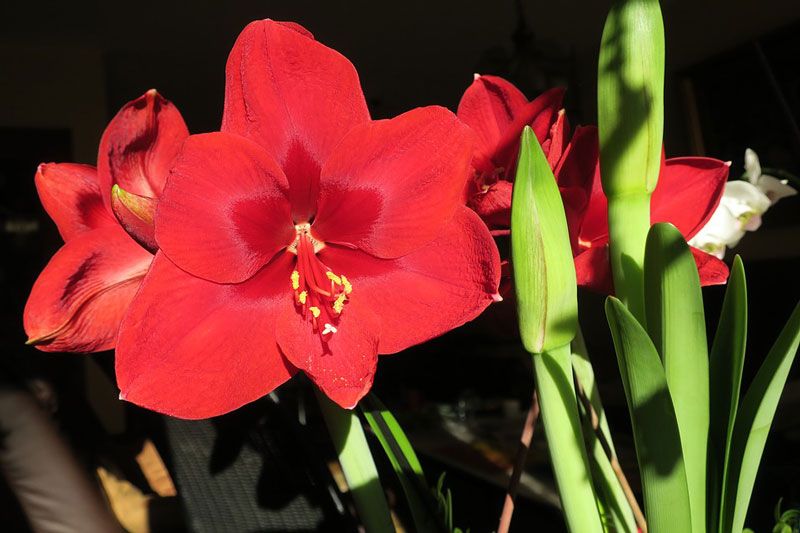
The flowering period begins in mid-spring and lasts for 1.5 months. Initially, a fleshy peduncle 0.6 m tall forms. At the top, an umbrella-shaped inflorescence develops. The six-petaled flowers resemble a bell. Colors include white, cream, pink, yellow, and purple-red. Long stamens and an ovary are located in the center.
After flowering, fruit capsules form, each containing more than six seeds. They ripen within 30 days.
Distinguishing features of amaryllis
Amaryllis and hippeastrum are often confused. Both plants belong to the same biological group. The hippeastrum genus is more numerous, comprising approximately 90 species found in the wild.
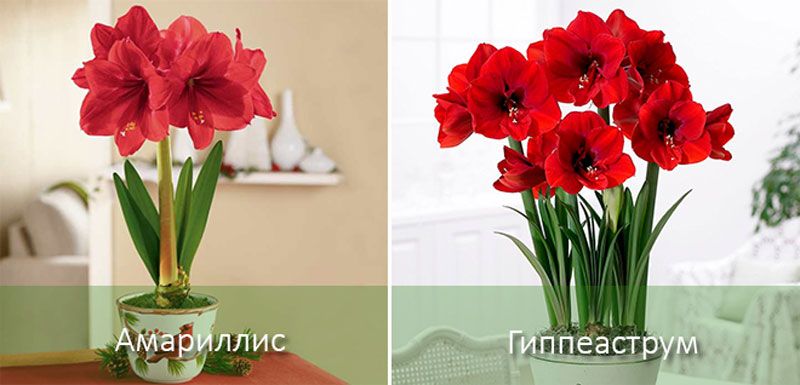
The differences between them are presented in the table:
| Comparison sign | Amaryllis | Hippeastrum |
| Bloom | August – September. | February – March. |
| Aroma | It is clearly evident. | Absent. |
| Flower size (diameter in cm) | 10-12 | 6-8 |
| Number of flowers | 4-6. 12 encounters. | 2-4. Maximum – 6. |
| Color | From white to burgundy, the existence of shades of pink. | Snow-white, lilac, yellow, purple, light green. A varied color palette. |
| Presence of leaves in the flowering phase | Absent. They resume growth after fertilization. | Present. |
| Peduncle | Dense, without voids. Length 0.4-0.6 m. Has a crimson hue. | A green, hollow tube, 70 cm long. It makes a soft crackling sound when pressed. It has a grayish-brown sheen. |
| Onion shape | Pear-shaped. Covered with gray scales. | Round, elongated at the base, slightly compressed at the sides. |
| Homeland | Africa. | South America. |
Types and varieties of amaryllis
For a long time, amaryllis was considered a single plant. Now, two main types of this ornamental flower have been identified:
| View | Description |
| Amaryllis belladonna | It grows from elongated, rounded, pear-shaped bulbs. The green stem grows 0.5 m tall and has a pleasant, delicate aroma. Belladonna blooms in winter and becomes dormant in summer. |
| Amaryllis Paradisicola | It is distinguished by the number of inflorescences: 21. It has a pungent scent. The flowers are pink, the hue becoming more intense as the buds open. It is not widely grown indoors. |
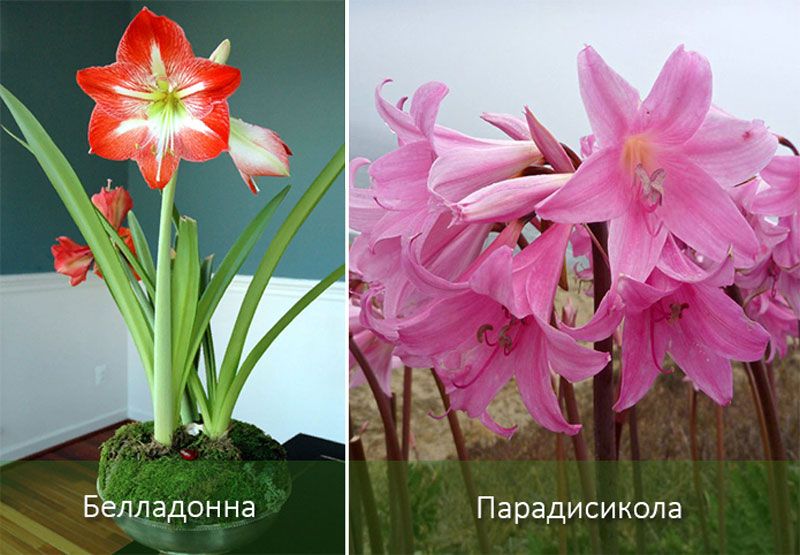
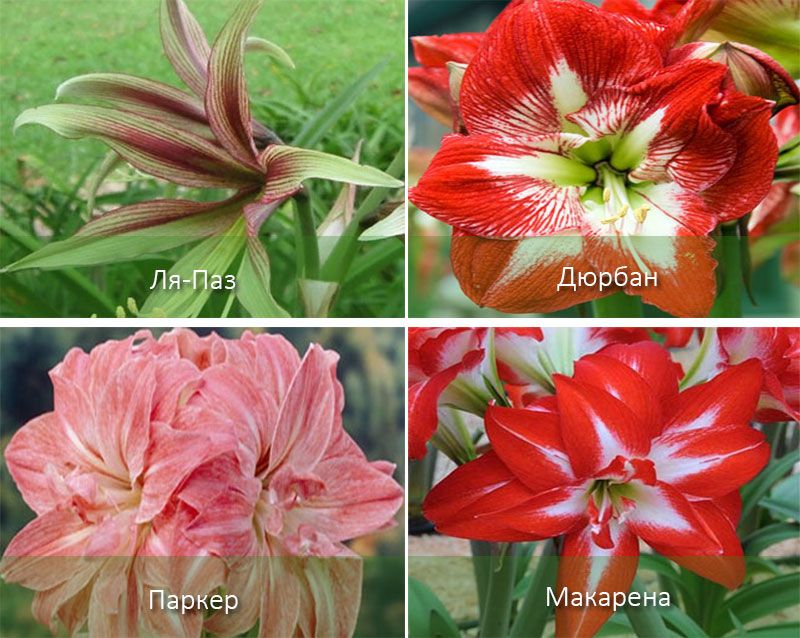
Based on these species, breeders have developed new varieties. They differ in flower color, shape, and size:
| Variety | Flower |
| Durban | Bell-shaped. Red with a light spot at the base. |
| Parker | Pink with a yellow center. |
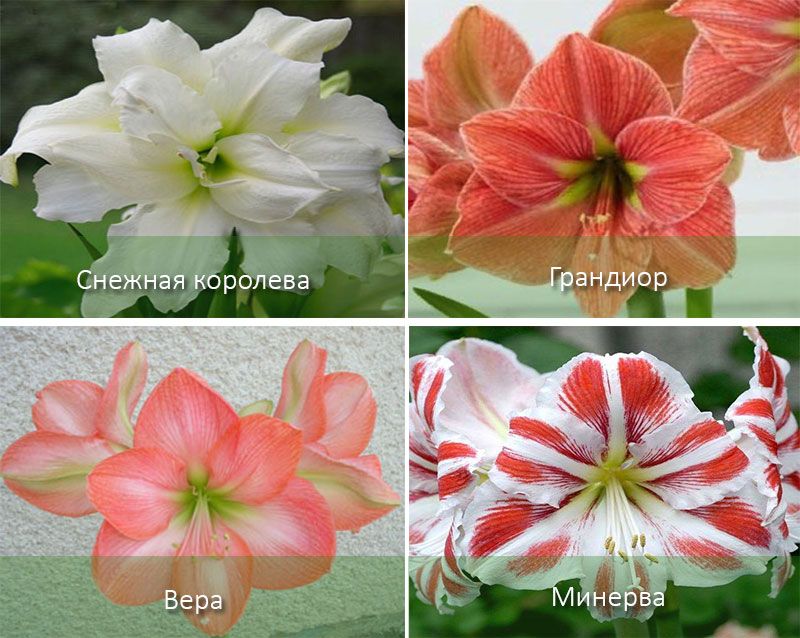
| The Snow Queen | Snow-white glossy flowers with a beige edge. |
| Faith | Light pink with a pearly sheen. |
| La Paz | Green with red border. |
| Macarena | Terry purple with a white stripe. |
| Minerva | Variegated striped petals. |
| Grandior | Gradient transition from soft pink to a more saturated shade. |
You can create an unusual hybrid yourself. During flowering, pollen is collected from the stamens of one variety and transferred to another. From the resulting seeds, a new variety is grown that combines the parent's coloring.
Caring for amaryllis at home
Amaryllis is more demanding in terms of care than hippeastrum. Cultivation depends on the season in which the plant arrives.
| Conditions | Vegetation phase | State of rest |
| Flower location | South facing. Shade from direct sunlight. | A dark, cool place. |
| Lighting | Bright diffused light 16 hours a day. | Not required. |
| Watering | Use settled water. Water twice a week. Before flowering, lightly moisten the buds. Optimal humidity is 80%. | Stop watering. Spray the soil. Maintain humidity at 60%. Resume watering when the flower stalk reaches 12 cm. |
| Ventilation | Keep in a well-ventilated area without drafts. | |
| Temperature conditions | Daytime temperatures: +22…+24 °C, nighttime temperatures: +18 °C. Sudden temperature changes are not allowed. | +10…+12 °C constantly. |
| Top dressing | Once every ten days. Fertilize with Izumrud, Agricola, and Kemira. During the flowering phase, apply once every five days. Fertilizers high in potassium and phosphorus are preferred. | Not used. |
Features of amaryllis planting
The first step is choosing a flowerpot. A sturdy, heavy container is ideal for amaryllis. The diameter depends on the size of the bulb you're planting.
A deep pot with a wide bottom that tapers toward the top is considered optimal. The next step is preparing the soil.
The purchased soil mixture for bulbous plants is processed:
- pour boiling water;
- put in the freezer for 24 hours.
Prepare the amaryllis substrate yourself. Mix garden soil, turf, humus, peat, and river sand in equal proportions. Place a drainage layer of expanded clay, pebbles, gravel, and brick chips at the bottom.
For planting, select high-quality bulbs: bulbs without cracks, dents, signs of fungal diseases, mold, or a sweetish odor. Disinfect them with a solution of hydrogen peroxide, potassium permanganate, and Bordeaux mixture, and let them dry for 24 hours.
Fill the pot halfway with the prepared soil. Place the bulb in the pot, leaving a third of the pot above ground. Firm the soil, moisten it thoroughly, and place it in a sunny window.
Hippeastrum is repotted after flowering. The interval is three years. Water the plant thoroughly a week beforehand.
The flower, along with a lump of soil, is removed from the pot. It is shaken off, the root system is inspected, and any rot is removed. The bulblets are separated from the bulb and used as independent planting material.
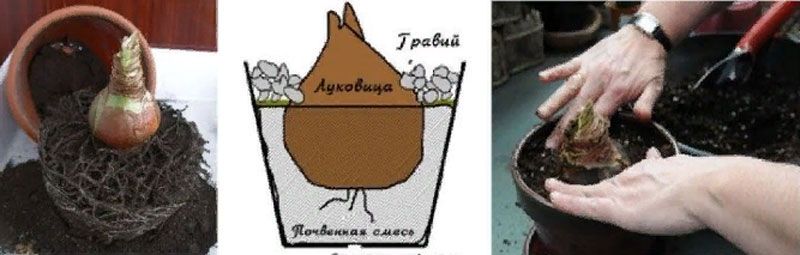
A long-acting mineral fertilizer is added to the soil. Agricola is most commonly used. The remaining steps are the same as for planting. A 4-cm-thick layer of soil is removed annually. Fresh substrate is added to restore the previous level.
Flowering and dormant periods
When the natural flower falls off, the top of the stem is cut off. Nutrients accumulate in the root system. The flower stalk turns yellow. It is then removed with a sharp knife. After this treatment, new leaves grow. During this period, the plant is well watered and fertilized.
At the end of summer, watering is gradually reduced and fertilization is stopped.
The leaves turn soft and yellow. In late autumn, the houseplant is moved to a dark place. Keep it in a cool place for 75 days. After this, the plant will bloom again.
Once the dormant period begins, store the bulb in a dark place at a constant temperature of 10 to 12°C. Do not water the plant until the leaves emerge. Do not use fertilizer.
Reproduction
The culture is propagated in two ways:
- seeds;
- vegetatively.
To obtain seed, cross-pollination is performed. This is easy. Pollen is transferred from one flower to another. After the fruit capsules open, the seeds are collected, which remain viable for 1.5 months.
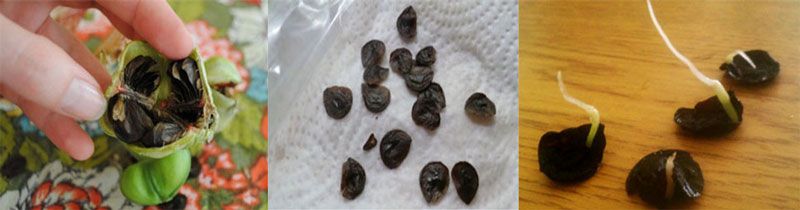
Fill the containers with nutritious soil. Keep the soil well moist. Plant the seeds 5 mm deep and cover with plastic. When two true leaves appear, transplant the seedlings. Flowering occurs after 7 years.
When propagated vegetatively, plants retain their varietal characteristics. Flowering begins in the third year.
Reproduction methods:
| Way | Conducting |
| Children's department | Planting small rooted bulbs. Initially, the foliage is not pruned: this allows nutrients to accumulate and be retained. |
| Dividing bulbs | The selected planting material is divided into sections. The sections are sprinkled with ash. The sections are placed in sand and kept for 30 days at 27°C. Once two true leaves appear, they are replanted in high-quality substrate. |
The poisonous amaryllis bulb can cause skin irritation, so wear protective gloves when handling it.
Problems with growing amaryllis
The easy-to-care-for amaryllis can sometimes cause some difficulties:
| Problem | Methods of elimination |
| Growth retardation | Check the bulb's condition. Failure to develop within 30 days of planting indicates it is not viable. |
| Lack of flowering | Summer vacation, landing in a sunny place. |
| Premature wilting of leaves | Application of fertilizers. |
Diseases, pests
| Disease/pest | Signs of manifestation | Elimination |
| Stagonosporosis | Burgundy spots on bulbs, roots, leaves. | Remove rotten parts, treat with a potassium permanganate solution, and let dry for 24 hours. Spray new bulbs with Maxim. |
| Gray mold | Brown spots on the bulb, foliage loses elasticity. | Cutting out the damaged areas, treating with brilliant green, drying for 48 hours, planting in fresh soil. |
| Thrips | Dry whitish areas on the leaves. | Chemical treatment (Fitoverm, Intavir). |
| Spider mite | Wilting of leaves covered with thin threads. | Spraying with acaricides – Oberon, Neoron, Kleschevit. Alternative methods include soap solution, ash, and onion-garlic infusions. |
| Amaryllis mealybug | Bulb damage. The pest's excrement resembles soot and is located under the scales. | Use of insecticides (Akarin, Arrivo). |
| Aphid | Yellowing of leaves. | Collect visible pests. Treat leaves with soapy water and diluted alcohol. |
| Scale insect | Leaf damage: appearance of sticky secretions from pests. | Using a soap solution. |
| Springtail | The appearance of small worms on the soil. | Replacing old soil with new. Reducing watering. |
Top.tomathouse.com recommends: Amaryllis – the wish-fulfilling flower
According to feng shui, amaryllis is a prominent representative of the fire element. This energy is especially evident in plants with red flowers. The best place for it is the kitchen. This divine flower symbolizes pride, inaccessibility, and masculinity.
The magical properties of the plant are manifested in the ability to fulfill wishes.
A convenient location and loving care will help you realize your dreams of love, travel, and self-improvement. Amaryllis brings peace, well-being, and comfort to your home.