Pineapples belong to the bromeliad family and are the only edible fruit. Native to Paraguay, Colombia, and Brazil, they include eight species, both native to the wild and cultivated in greenhouses as ornamental plants. Pineapples were brought to Holland in the 16th century, and the exotic fruit then spread throughout Europe, arriving in Russia two centuries later. The fruit's pulp contains all the vitamins and minerals essential to humans.
Description of pineapple
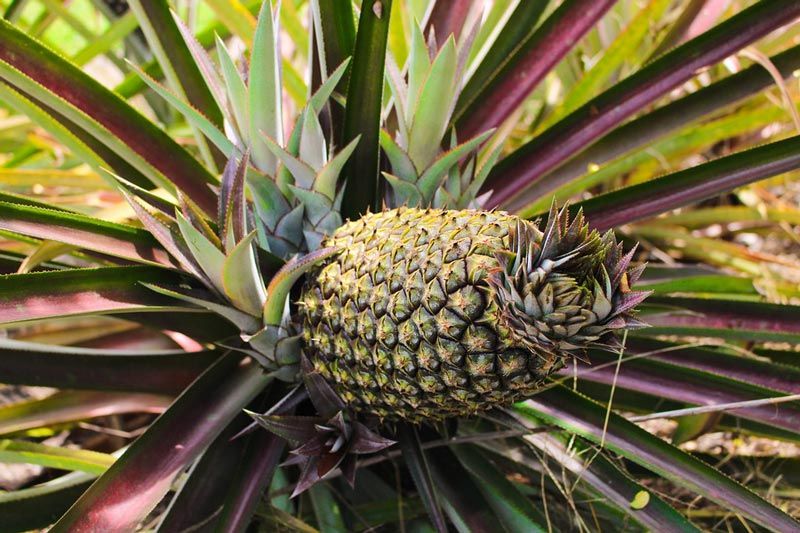
Pineapple is a perennial plant that produces dense, fleshy leaves gathered in a rosette during the growing season. These succulent leaves are capable of storing moisture in their tissues. They range from 30 to 100 cm in length. A dense, massive stem grows from the basal rosette. The flower stalk forms at the top, reaching up to 50 cm in length. The flowers are spike-shaped, and when ripe, a rosette with bracts appears at the top. Mature plants, aged 3-4 years, bloom from May to July. The fruits, weighing up to 5 kg, are juicy, sweet and sour, resembling a large golden pine cone with a tuft of short leaves at the top. The root system is weak, buried 30 cm deep.
Features and types of domestic pineapple
In the wild, the plant reaches a height of one meter and a diameter of two meters. Indoors, it grows only to 70 cm. Adapted species:
| View | Peculiarities |
| Bract | The meter-long leaves are curved and bright green, with white and yellow stripes on their surface. When exposed to sunlight, they turn pink and red. The tricolor variety is popular in indoor gardening. |
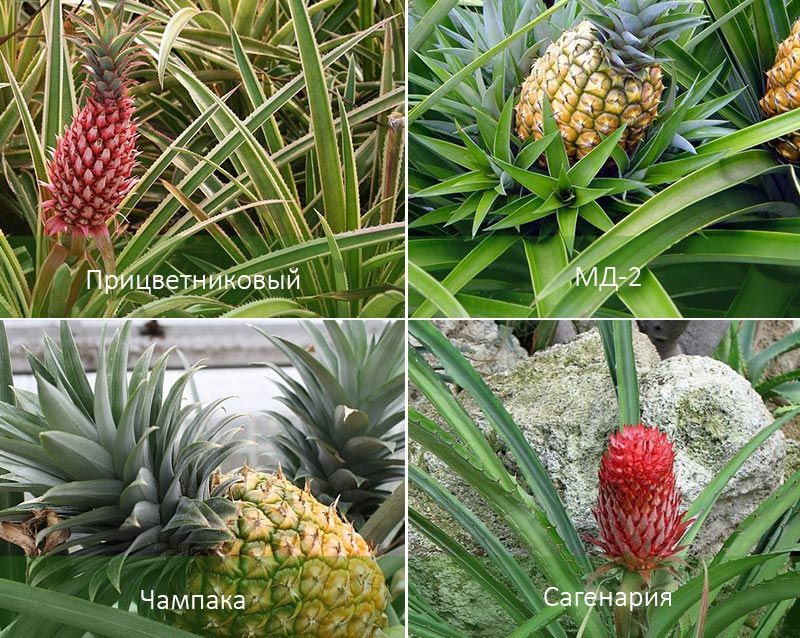
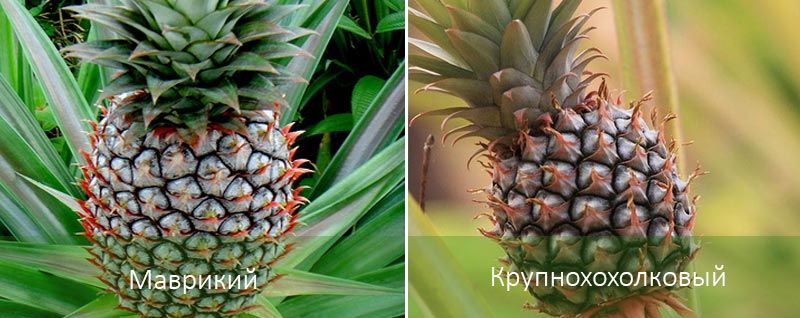
| Large-crested | Linear leaves grow up to a meter, arranged spirally, and form a spike-shaped inflorescence. Flowers come in purple, pink, and red colors. |
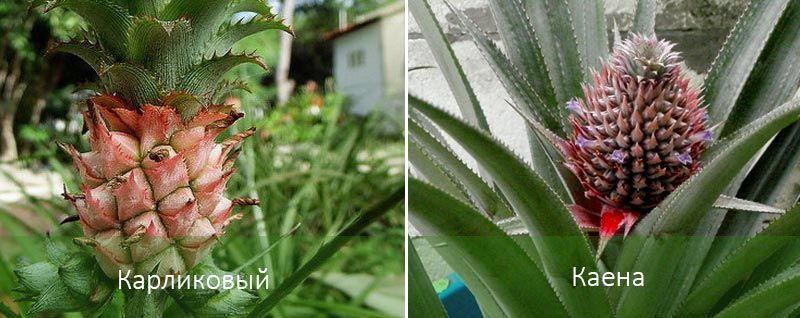
| Dwarf | Dark green, narrow leaves, serrated at the edges, pointed at the end, up to 30 cm. For ornamental cultivation only. |
| Shiny (black) | Long leaves with dark edges and red, brown and bright green shades in the middle. |
| Champaka | Sharp, serrated leaves with conical pink inflorescences. |
| Decorative | Beautiful in appearance with bright bracts and variegated leaves in red shades. |
| Caena | Up to 30 cm tall, on a short stalk, the edible fruits weigh up to 5 kg and are cylindrical. The leaves are prickly and thornless. |
| Sagenaria | Two-meter leaves, bright red fruits. |
| MD-2 | A hybrid with sweet, tasty fruit that is resistant to diseases and pests. It is widely available due to its long shelf life. |
| Mauritius | It has excellent taste qualities. |
Selection and preparation of planting material
The easiest way to grow a pineapple at home is from a crown or rosette of leaves. To plant, use a ripe fruit, free of disease and pests. The leaves should be green without yellow or brown spots, and the skin should be golden-brown and firm to the touch.
It is not recommended to buy fruit purchased in winter; it is better to buy it in summer or early autumn.
Preparing material for planting from the top step by step:
- Carefully cut it with a sharp knife, without touching the core, or unscrew it by gently turning it along the axis.
- Use a knife to remove any remaining pulp.
- The lower leaves are removed.
- The cut site is treated with charcoal.
- The cut part is placed vertically to dry for two weeks.
- Then place it in a container with water or prepared soil.
- The container with water should be dark, the top is placed 3-4 cm deep, but not completely.
- After the roots have formed, place it on a paper towel to dry.
After these steps, plant in loose and nutritious soil.
Planting a pineapple
To plant a houseplant, select a pot with a diameter of 14 cm and place a drainage layer on the bottom. Purchase soil specifically for palm plants. Sometimes, you can prepare your own: equal parts sand, compost, and leaf mold. Pre-steam the soil or treat it with a potassium permanganate solution. Plant in moist soil, leaving a 2 cm gap to the rim of the container. Cover with plastic wrap.
Rooting occurs after two months. During this time, the soil is only sprayed. The formation of new leaves indicates that the plant has taken root. Old, dried leaves are removed. The container is placed in a sunny spot. Water until a funnel of water forms around the leaves. Flowering is expected after two years.
Caring for pineapple at home
Indoor cultivation of pineapple requires special care.
| Parameters | Spring/Summer | Winter/Autumn |
| Temperature | +22…+25 °С. | +18…+20 °С. |
| Lighting | Bright, on the south-eastern windowsill. | Daylight hours up to 10 hours, additional lighting. |
| Watering | After the soil has dried out, water generously with warm water at +30°C. | Moderate, once a week. |
| Spraying | Regular, warm shower. | Not required. |
| Fertilizers | Once every two weeks with an organic mixture or infusion of mullein. | Not needed. |
Pineapples don't require pruning. Use sharp scissors to periodically remove old, dried leaves, avoiding healthy tissue. Young plants are repotted annually, and mature plants are repotted only if the container becomes too small and the roots are exposed. This is done using the transom method.
How to stimulate flowering
If the plant fails to bloom after several years, the process can be accelerated using calcium carbide, which releases ethylene. A tablespoon of the solution is steeped in a sealed glass container for 24 hours, then strained. The rosette of leaves is then poured with 50 grams of the resulting solution for a week. A flower stalk usually appears after a month and a half. If the plant hasn't bloomed, it hasn't reached maturity.
Other methods include placing a bag of apples in a bowl with a pineapple or creating a smoke effect once a week: leaving smoldering paper or a smoking cigarette nearby, and covering the plant. Repeat this process four times a month.
Propagation of indoor pineapple
After fruiting, the plant dies, which can occur after several years. During this time, lateral shoots form and are planted separately. They bloom before the top. The shoots are cut or broken off from the mother rosette when they reach 20 cm. Sprinkle the cut areas with wood ash. After drying, replant.
A layered soil mixture is recommended: sod soil, leaf mold, and river sand. The soil temperature should be 24°C. After planting, the plants are covered to prevent the plastic from touching the leaves (supports are used for this purpose).
Propagating by seed is a difficult method. First, extract the seeds from the ripe pulp. The semicircular seeds, 3-4 cm long and brown or reddish in color, are suitable for germination. Rinse in potassium permanganate and dry. Place on a damp cloth for 24 hours, cover with a second cloth, and place in a warm place for germination. Sow in equal parts leaf mold, peat, and sand to a depth of 1.5 cm. Cover with plastic wrap. Provide bright light, warm, humid air, and regular watering. Ventilate regularly. Seed germination takes a long time, from 2 to 6 months. After sprouting and the formation of the third leaf, fertilize with bird droppings (a teaspoon per liter of water). Prick out when the seeds reach 6 cm in height.
Diseases, pests, and problems in caring for indoor pineapple
Pests almost never attack the plant if all care conditions are met:
| Problem | Cause | Elimination |
| Slow growth. | Cold air in the room. | Move to a warm place and water with warm water. |
| The root system is rotting. | High humidity and cold. | Reduce watering and treat the soil with a solution of malathion. |
| The tips of the leaves are drying out. | Low humidity. | Spray more often, install humidifiers. |
| Mold on the walls of the pot and in the soil. | Abundant watering during the winter period. | Remove mold, reduce watering. |
| Light spots on the leaves. | The pest is a false scale insect. | Treat with a solution of potassium permanganate. |
| White discharge on leaves, slow growth. | Mealybug. | Spray with soapy water. |
| Yellowing and falling leaves. | Aphid. | Treated with Actellic. |
| Cobwebs on leaves. | Spider mite. | Insecticides are used. |