Anemone, windflower, or scaly-flowered anemone is an ornamental garden plant from the buttercup family. Its name derives from its sensitivity to the slightest breeze, causing its stems and flowers to sway and tremble. There was once a misconception that anemone flowers bloom only in the wind.
Content
- 1 Description of anemone
- 2 Types and varieties of anemones
- 3 Reproduction of anemone
- 4 Anemone planting site and soil for it
- 5 Preparation of planting material
- 6 Planting technology
- 7 Caring for anemones in open ground
- 8 Diseases and pests affecting anemone
- 9 Top.tomathouse.com recommends: recommendations for gardeners
- 10 Beneficial properties of anemone
Description of anemone
An herbaceous perennial, growing from 10 to 120 cm in height. Due to the diversity of species, there is no single description. The varieties of anemone share brightly colored bisexual flowers, either borne in umbels or blooming singly, perennial sepals, and achenes.
It is in honor of this flower that the sea anemone polyps are also called “sea anemones.”
Types and varieties of anemones
There are more than one hundred and fifty species that differ in the shape and size of leaves, flower colors, heat-loving and shade-tolerant properties, as well as germination and flowering times.
Based on the characteristics of reproduction, cultivation and care, they can be divided into two groups:
- ephemeroids, bloom in spring and die in summer;
- Autumn anemones bloom in summer and autumn and retain their foliage until frost.
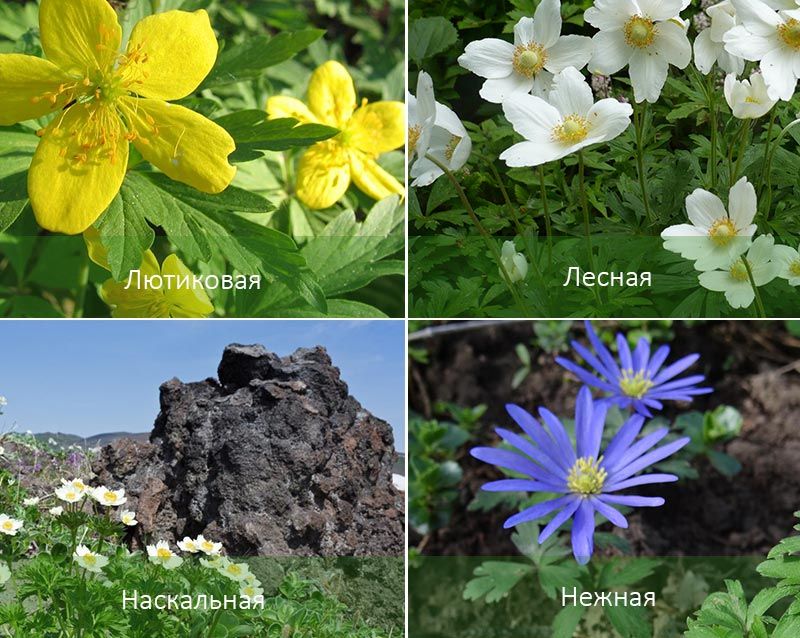
The table shows the main types and their descriptions.
| View | Description | Flowering period |
| Ephemeroids | ||
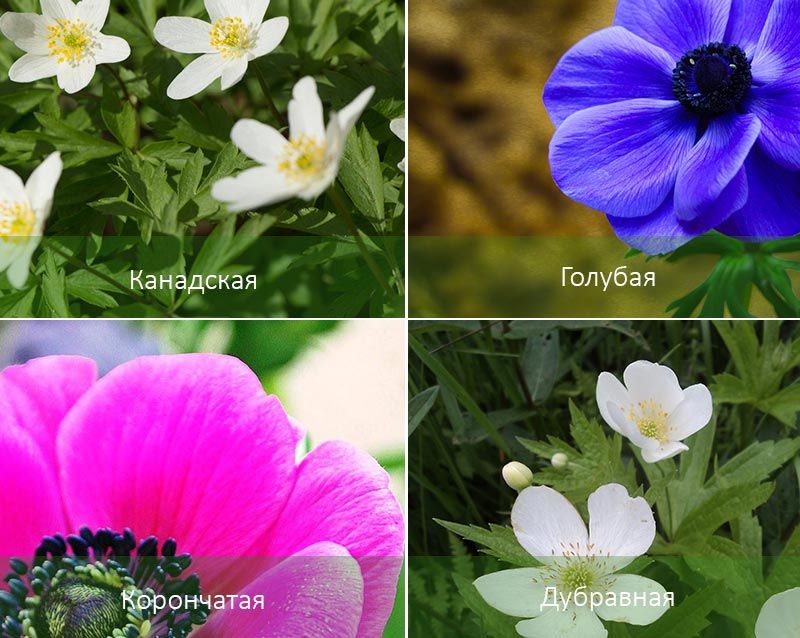
| Dubravnaya (Anemone nemorosa) |
Low-growing – up to 30 cm, with small (about 3 cm) single or semi-double flowers, most often white, but in some varieties pinkish or lilac. Grows quickly. Withers in midsummer. Shade-loving. Moisture-loving. | April and May. |
| Crowned (Anemone coronaria) |
Height: 20-30 cm, flowers are large – up to 8 cm. The most popular varieties are 'De Caen' with single flowers, 'St. Bridget' and 'Admiral' with double flowers, and 'Lord Lieutenant' with its striking coloring. The color range is very diverse, including bright and unusual shades. The shape and number of petals also vary greatly among varieties. The center is always dark. It requires high care and loves light. It's frost-hardy, but blooms poorly after wintering, so it's recommended to plant it in the spring and dig it up for the winter. |
May, June and July. |
| Forest (Anemone sylvestris) |
Up to half a meter tall, the flowers are about 4 cm, single, white, and strongly fragrant, usually hanging to the ground. Varieties with large, double flowers have been bred. The foliage is lush and beautiful even outside the flowering season.
Grows quickly. Shade-loving. Winter-hardy. Easy to care for. Suitable for growing on rocky and infertile soils. |
May and early June. |
| Tender (Anemone blanda) |
Low – up to 10 cm. Flowers are about 3 cm in diameter, simple, with long, narrow petals, like those of daisies. Color varies.
Tolerates both direct sunlight and light shade. Wilts in midsummer. Requires winter protection. |
End of April. |
| Blue (Anemone caerulea) |
Height about 25 cm. Small (up to 2 cm), single flowers, simple, white or blue. Grows quickly. Shade-loving. | May. |
| Canadian (Anemone canadensis) |
Height: about half a meter. Single, simple, white flowers with five petals, up to 3 cm in size. Lush, beautiful leaves. Shade-loving. Frost-resistant, but requires shelter. |
May and June, sometimes again in September. |
| Buttercup (Anemone ranunculoides) |
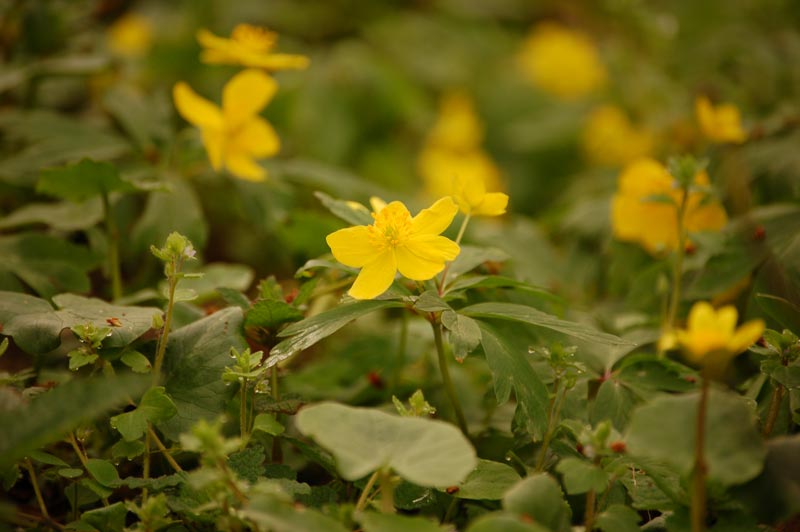
Height up to 30 cm. Bright yellow single flowers up to 3 cm in diameter. Grows quickly. Undemanding in soil and care. Grows in sun and shade. Withers in June. | May. |
| Rock art (Anemone rupestris) |
Up to 30 cm tall. Small white flowers, purple on the outside. Five petals with pointed tips. Undemanding in terms of soil fertility, light, temperature, and watering. However, it is best to cover it for the winter. | May and June. |
| Autumn | ||
| Hybrid (Anemone hybrida) |
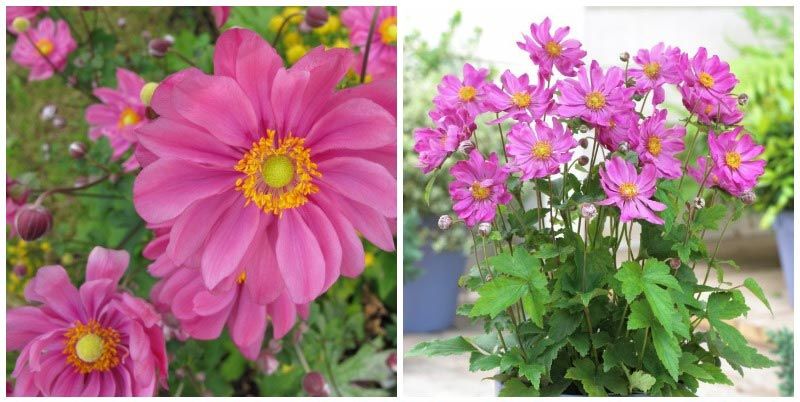
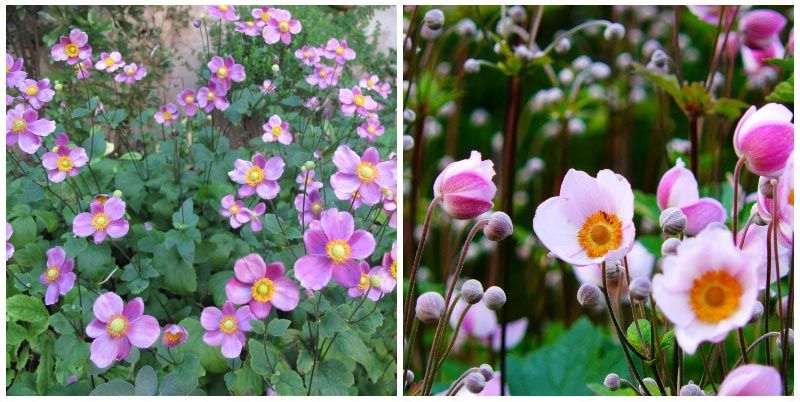
60-120 cm tall, flowers about 5 cm, single or semi-double, white or in various shades of pink and purple. Grows quickly. Wilts with the first frost. Shade-loving. Not frost-hardy – planting site should be protected in winter. | August, September and October. |
| Japanese (Anemone japonica) |
About a meter tall. Flowers are single, semi-double, or double, in a variety of colors. Sun-loving. Cover in winter. | Autumn. |
| Hubei (Anemone hupehensis) |
From 0.5 to 1 meter in height. Flowers are 6 cm in diameter, single, and predominantly pink and crimson. Frost-hardy. Withers in late autumn. | August and September. |
Reproduction of anemone
Anemone reproduces in two main ways:
- Seeds are planting material that is convenient to store, but difficult and troublesome to germinate.
- Tubers or bulbs are a simpler and more reliable method, but require special storage conditions.
Anemone planting site and soil for it
Anemones (especially ephemeroids) are usually grown in shaded areas of the garden—for example, under trees or near shrubs. Autumn species, on the other hand, should be planted in well-lit beds. Anemone also enjoys sunlight, despite being an ephemeroid.
If the planting material is of unknown origin and the variety is difficult to determine, it is better to plant in the shade.
It's important to note that this plant has a strong root system, which branches into numerous offshoots as it grows, and can have a suppressive effect on herbaceous neighbors, crowding them out. In such cases, the resulting clumps need to be replanted.
Many species of anemones thrive in loose, humus-rich soil. The exceptions are wood anemones and rock anemones, which grow well anywhere.
Blue, tender, and rock anemones are accustomed to calcareous soil, so dolomite flour or ash is added to the soil to grow them.
Preparation of planting material
Anemone seeds have a peculiarity: after planting, at most a quarter of them germinate.
To increase this percentage, they undergo stratification in winter. This involves exposing the seeds to cold and moisture before germination.
Store-bought planting material is often already stratified—this information is indicated on the packaging. When working with homemade planting material, you need to do this yourself:
The seeds are mixed with a small amount of sand and sprinkled with water.
- The mixture is placed in a cool (+5…+10 °C) place.
- The moistening procedure is repeated until the seeds swell.
Before planting, the tubers are soaked in a root growth stimulant solution until they swell. If the rhizome of a given species is not nodular, it is cut into cuttings approximately 5 cm long and also treated with a root growth stimulant.
Planting technology
The prepared, soaked seeds are mixed with light, fertile soil in a seedling container, moistened, covered with plastic, and kept in a warm place. Once the sprouts appear (after about a month), the plastic is removed and the seedlings are placed in a bright, warm place, watered occasionally.
As soon as a pair of true leaves appears on each sprout, they are planted in separate pots.
Anemone seedlings are grown in a greenhouse for the first year and are planted in open ground only in the fall or the following spring.
In regions with mild winters, you can sow seeds in the fall, directly into the flowerbed. In this case, the seeds don't need stratification—this process will occur naturally over the winter. Just keep in mind that the planting depth should be very shallow to allow the seedlings to emerge easily.
The sowing area must be covered before wintering.
Planting times for tubers and cuttings include April and May or September and October. They can be planted directly in their permanent location. To do this, dig holes in the soil at least 10 cm apart.
The tubers are placed shallowly into prepared holes, flat side up, and elongated side down. If the shape cannot be determined, they are placed flat. The cuttings are placed vertically, with the top cut level with the soil.
Immediately after planting, the soil must be moistened, but in no case too much.
Caring for anemones in open ground
Ephemeroids require much more care than autumn anemones. While the latter respond to a lack of care with reduced growth and flowering, the former, with their sensitive tuberous root system, can quickly die. Even ephemeroids require continued watering until the first frost.
Anemone dislikes stagnant water, but drought is detrimental. Well-drained soil will prevent overwatering, and mulching the flowerbed can prevent it from drying out. Store-bought mulch mixes or a simple layer of dried fruit tree leaves will work.
Fertilize the soil only during the flowering period. Mineral fertilizers are best for this purpose. This procedure can be eliminated entirely by adding fertilizer to the soil before planting.
In regions with cold winters, it's recommended to remove anemones from flowerbeds in the fall, especially ephemeroid varieties. Store the dug-up roots in a cool place. In mild climates, anemones overwinter well if covered with a double layer of mulch.
Diseases and pests affecting anemone
Thanks to their poisonous sap, anemones are relatively resistant to disease and pest attacks. However, there are a number of problems that can arise when growing them:
- Powdery mildew and white rot are diseases that can be treated with antifungal agents. To prevent infection, it is recommended to avoid overwatering the soil.
- Slugs are pests - to get rid of them, you should collect all the individuals from the foliage and then treat them with metaldehyde.
- Nematodes are roundworms that live inside leaves and feed on sap. These pests are very difficult to eradicate, so if they are discovered, the infested plant, including the root ball, must be destroyed as quickly as possible.
Top.tomathouse.com recommends: recommendations for gardeners
It is best to plant boxwood around anemones – this shrub not only harmonizes well with them, but also protects them from drafts and excess sunlight.
Other ornamental plants and vegetables thrive alongside anemone. It can even be grown in beds between them.
Beneficial properties of anemone
Besides their undeniable aesthetic appeal in flower beds, anemones have several other uses. Folk medicine and homeopathy use anemones for medicinal purposes.
However, they should be used with extreme caution due to their high content of toxic lactones.
Healthcare professionals advise against self-medication due to the increased risk of poisoning. In esotericism and floristry, anemones are considered a symbol of fleeting beauty and fragility.