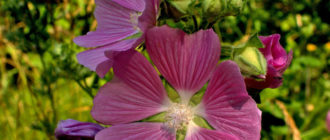
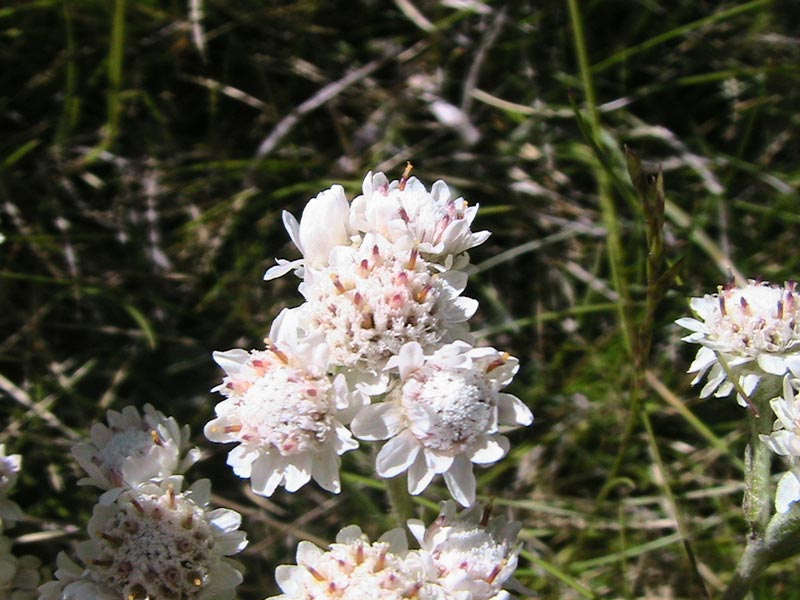
Antennaria belongs to the Asteraceae family. It grows in the mountainous regions of Europe, Asia, and South and North America. Its inflorescences have a soft, fluffy texture. The outline resembles a cat's paw print, which is why flower lovers have nicknamed this unusual plant "cat's paw." Flowering occurs in summer and lasts 1-2 months, after which smooth, 1 mm-long achenes form. Ripening occurs even in cool summers and in regions with low temperatures.
Description of the antenna
Antennaria are herbaceous plants or subshrubs, perennials with a fine root system; their shoots root easily. The basal leaves are neatly gathered and vary in shape, from lanceolate to spatulate. A silvery down covers the leaves and stems, helping to conserve moisture. In summer, flower stalks emerge from the neatly gathered leaves. The flowers themselves are usually small, white, red, or pink, gathered in small flower heads, which in turn form inflorescences. The plant has beneficial properties and is used medicinally. For example, teas and tinctures are brewed for inflammation, pain, and bleeding.
Types of Antennaria
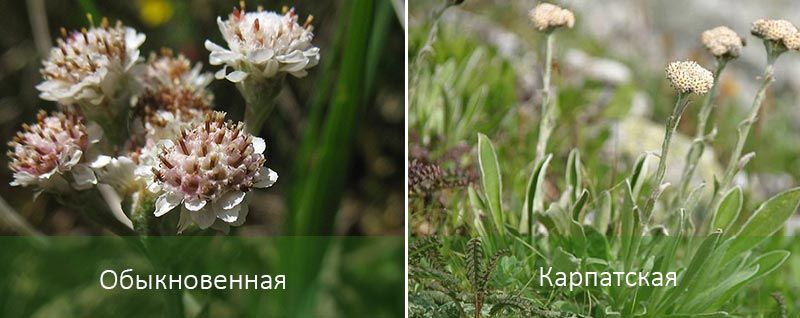
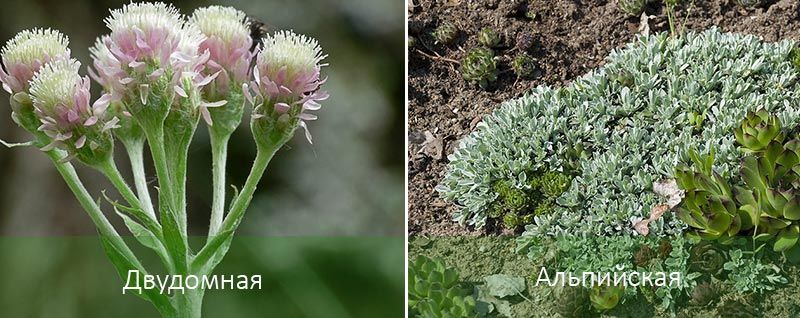
The plant genus comprises over 60 different species, varying in appearance, size, and flowering patterns. The table lists the most popular.
| View | Description /Height (cm) |
Inflorescences /Bloom |
| Alpine | A dwarf form with dense, fluffy foliage. The leaves have a silvery-gray color. More than 5 cm. |
At the beginning of the warm season they grow to a length of 15 cm.
June-August. |
| Dioecious | They have a less thick cover and retain their foliage throughout the winter.
15-25 cm. |
Pink or red tint May-June. |
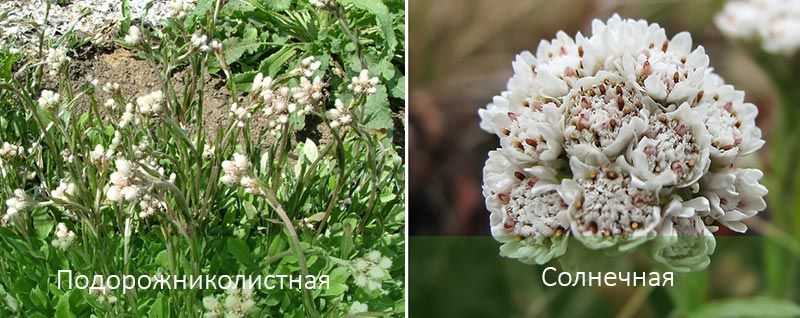
| Plantain-leaved | It resembles plantain, hence its name. The foliage densely covers the shoots. It has a huge advantage: it grows even in unprepared soil and requires minimal care. About 40 cm. |
Larger than the previously discussed species. The petals are dirty pink or white.
Since the beginning of April. |
| Carpathian | Bush. The cover has gray leaves, and the flower stalks have none.
Up to 20 cm. |
They open into small pink petals. |
| Ordinary | Small with greenish-ash leaves.
1 cm. |
Snow-white, with a delicate blush or variegated.
June-July. |
| Solar (large-leaved) | With large silvery leaf blades.
15 cm. |
White. |
Antennaria dioica varieties:
| Variety | Description | Inflorescences |
| Alex Duguid | The bushes grow low, are frost-resistant, and can be used as a lawn on sandy soil. They do not tolerate moisture. | Red or purple. June-July. |
| Alba | Dwarf, dense, and bushy bushes. Requires plenty of sunlight for flowering. | White and pink. |
| Minima | Small, no more than 5 cm. | With a light blush. |
Growing and caring for Antennaria
Growing antennaria is not difficult; even a novice gardener can handle it.
Antennaria propagation methods
To obtain a new plant, several propagation methods are used: vegetative methods (rooting shoots, dividing the rhizome, dividing the bush) and seeds.
To grow from seeds, mix them with sand and sift them into a container under glass. Very small seedlings take a long time to germinate and develop slowly. After a while, only the strongest ones are left. As soon as the first leaves appear, they are separated into separate containers. In summer, the seedlings are planted at intervals of 20-30 cm. Antennaria emerges fairly quickly, with the first flowering expected in about a year. Rooted shoots are planted at the end of the summer season, leaving 20-30 cm between them and scattering crushed stone or gravel over the soil.
The best time to propagate by division is early spring. To do this, dig up the plant and divide it into several parts. The Antennaria will bloom by the following season.
To propagate by layering, separate a creeping shoot from the rosette that has aerial roots. This method can be used throughout the entire vegetative propagation process. Its advantage is that layering produces branching growth in a relatively short time.
Conditions for keeping Antennaria in open ground
You should read the recommendations.
| Factor | Conditions |
| Location/lighting | It does not tolerate excessive moisture well; low-lying areas and runoff should be avoided. Use drainage to remove water from snowmelt and rain. The plant prefers full sunlight, but locations with extreme sun exposure are unsuitable. |
| Soil | It's not picky about soil. Sandy, porous, and light soil is suitable. A slightly acidic soil is preferable. To achieve this, you can add garden sulfur, citric acid, or phosphoric acid and till the soil to a shallow depth. |
| Watering/loosening | During high summer temperatures, watering is required once a week, avoiding overwatering, as the root system is close to the soil surface. Generally, the plant tolerates drought well and continues to grow and develop. Loosening the soil is required in the first few months after planting; after that, the bushes grow together and form a uniform mat. |
| Top dressing | Granular fertilizer is scattered around the trunk. There's a specific combination: nitrogen fertilizers are used in March and April, phosphorus fertilizers are used during bud formation, and potassium fertilizers are suitable in late August and early September. |
Antennaria wintering
Cat's paw easily tolerates frost, and some varieties even remain green.
Pest and disease control
Antennaria is not prone to diseases, but it is susceptible to soil rich in microelements and high humidity.
| Pest | Method of struggle |
| Aphid | An infusion of fermented nettles, ash or tobacco. |
| Spider mite | Acaricides or insectoacaricides, which are harmful to human health, should be used with particular caution. |
| Nematodes and cutworm caterpillars | Potash fertilizers. |