Bacopa, or sutera, is a perennial native to the tropics and subtropics, common in marshy areas of Africa, Asia, America, and Australia. There are aquatic and trailing varieties. Among hobbyists, it is commonly known as sutera.
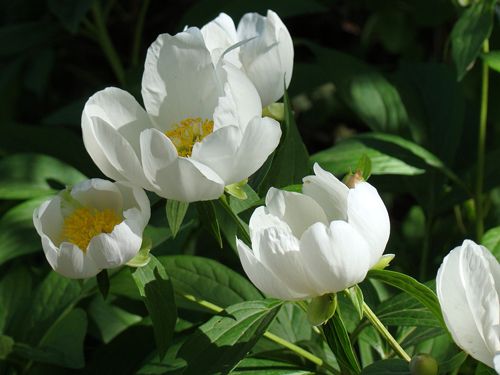
Previously, bacopa was classified as a member of the figwort family, but now it belongs to the plantain family.
Content
Botanical description
Bacopa (Latin name Bacopa) grows as a low, dense bush with a wide base. The stems are thin, either prostrate or recumbent, creeping, and can grow up to 1 meter in length. The bush grows in width.
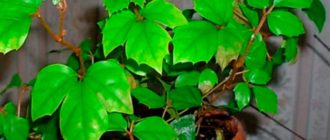
The small leaves are greenish-olive or green in color.
The leaves are arranged alternately on the stems; in submerged species, the arrangement is linear. The leaf is broadly elliptical or ovate.
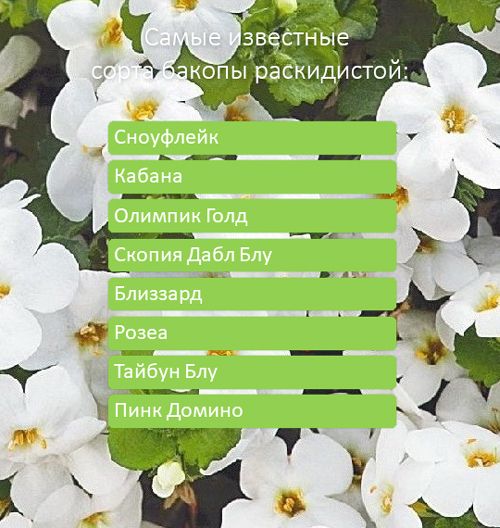
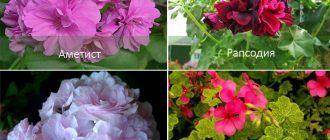
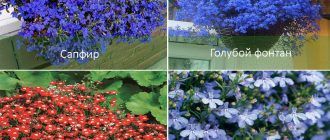
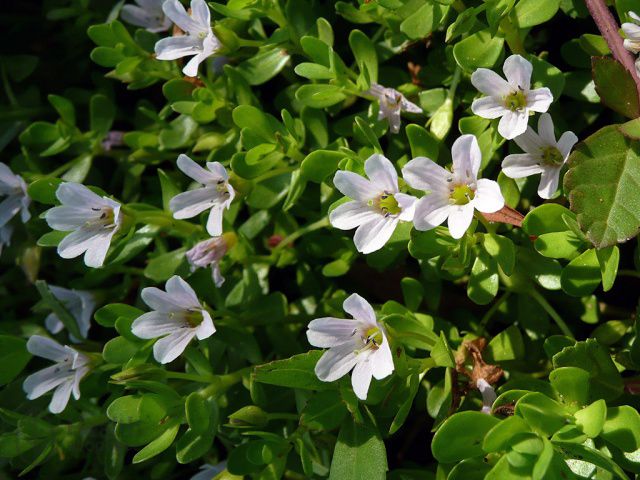
The bush bears numerous small flowers, shaped like bells or tubes. The color range includes white, soft and bright pink, lilac, light blue, and blue. The flower has five or four symmetrical lobes.
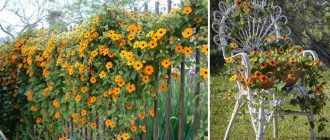
With proper care, the most decorative trailing varieties bloom all summer long and into mid-autumn. The process occurs in waves: the bush is completely covered in flowers, the blooms fade, followed by a period of calm, and then another period of profuse flowering. There's no need to pick faded flowers—the sutera sheds them naturally.
Types and varieties for the home
60 species of perennial plants require a wide variety of growing conditions: aquatic flowers, succulents, moisture-loving subspecies.
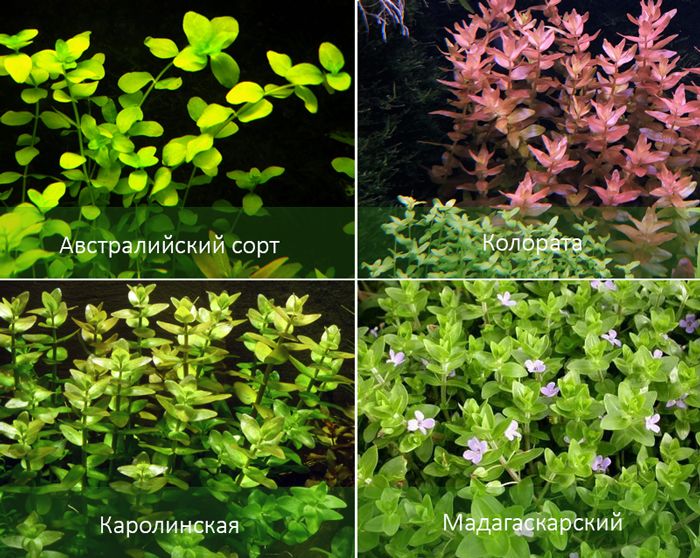
There are many varieties of sutera, for convenience all the information is summarized in a table:
| Name | Growing conditions | Description |
| Caroline | An aquatic variety, kept in aquariums and ponds. | Paired, oval, stiff leaves are located on thick, straight stems. The plant grows to a height of no more than 30 cm. Bright blue flowers are borne at the tips of the stems. The color of the leaves adds a decorative touch—in the sun, they change from light green to copper-red. |
| Australian | A low-growing shrub with slender, branching shoots. Light blue flowers are borne on the above-water portions of fragile stems. Leaves, up to 18 mm long, are oval or round and light green. | |
| Monier, or Monieri (Brahmi) | Succulent, grown on balconies and in aquariums. | The stems are creeping, the leaves are elongated, sessile, and quite fleshy, ranging from 8 to 20 mm in length. Their apex is rounded, and the edges may be slightly toothed. The flowers are located in the leaf axils and are relatively large—the corolla reaches 10 mm—most often white, but blue and purple are also found. The bush reaches a height of 40 cm. Bacopa Monnieri is widely used for medicinal purposes: it improves brain function and combats memory impairment. |
| Heart-shaped | Balconies. | Low herbaceous shrubs reach 15 cm in height. Small to medium-sized green leaves. Flowers in shades of white, pink, and violet-blue have five petals and are located in the leaf axils. |
| Spreading or Beautiful | A large-flowered variety. It forms a large, lush, spherical bush with long (60 cm) shoots. The flowers, 20 mm in diameter, have five petals and are located in the axils of green, lanceolate leaves. In summer and early fall, the bush is completely covered with flowers in shades of pink, blue, and snow-white. | |
| Bluetopia and Snowtopia | Hybrids with abundant flowering. The 30-cm-long stems are densely covered with large flowers: Bluetopia's are blue and lilac, while Snowtopia's are pure white. The leaves are olive green. | |
| Colorata | Aquariums and decorative ponds. | A variety with yellowish-pink foliage, the hue of the foliage changes depending on the light. The paired leaves are pointed and arranged crosswise on the stems. |
| Madagascar | Low aquariums. | A small bush – stems do not grow longer than 15 cm. The shoots are fleshy and weakly branched, lanceolate leaves are arranged oppositely and crosswise. |
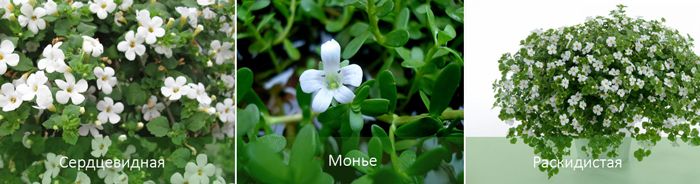
Bacopa ampelous
Bacopa ampelosa has many varieties, the most common of which are:
| Variety | Description | Flowers |
| Typhoon Blue | Large bush | Blue |
| Blizzard | Abundant flowering | Tiny white ones |
| Giant cloud | Rounded bush | Snow-white |
| Blue Souls | Another name for Blue Showers | Very delicate blue |
| Olympic Gold | A tall hybrid with green leaves with a golden tint | White terry |
Growing and care
Planting and caring for bacopa is not very difficult. Just follow a few simple rules, and your bacopa will bloom profusely for several months. The key is regular watering.
Caring for terrestrial plants
Bacopa is very demanding when it comes to light. For abundant flowering, it requires at least 11 hours of daylight; when grown indoors, supplemental lighting is necessary.
Sutera can be grown outdoors in summer in various climates. In the fall, the bush is dug up and moved to a bright, cool area—a glazed and insulated balcony or veranda. The optimal overwintering temperature is 8-15°C. When repotting, the plant should be pruned heavily.
Sutera doesn't like dry air—it shouldn't be placed above a radiator. The plant is native to subtropical climates and thrives on moisture. It should be watered daily, and twice a day in hot weather—morning and evening. Before budding, the plants should be misted twice a day.
During the growing season—summer and the first half of autumn—fertilize with complex fertilizers containing nitrogen, potassium, magnesium, and manganese. Weekly application is ideal. The abundance of flowering directly depends on the feeding. From October to March, the flowers rest—they stop fertilizing and water less frequently.
Bacopa doesn't like drafts. Use slightly acidic soil; you can mix equal parts garden soil and peat, adding a little humus and sand. Ready-made peat-based mixes for flowering plants are also suitable. When growing in pots, drainage is required.
Pruning in early spring or immediately after flowering increases the decorative effect of the flower.
Caring for aquatic plants
In aquaristics, Sutera is slightly more common than terrestrial species, found in gardens and on balconies. Bacopa is not a fussy plant, but it should be kept at a temperature of 22-28°C in an aquarium; otherwise, the leaves will rot and flower growth will be stunted.
The water should be slightly acidic. Add a 2-cm layer of sand or pebbles to the container. The substrate in the aquarium may be silted.
This aquarium plant obtains all its nutrients from the water and requires no additional feeding. Bacopa relies on fish food and waste products, including mud, for its nutritional source. Monnieri species tolerates hard and slightly salty water.
Reproduction
Propagating bacopa isn't particularly difficult. It's best to propagate it annually by cuttings. Vegetative propagation allows you to preserve the varietal characteristics. Furthermore, two-year-old and older plants bloom less readily.
Cuttings are taken in February-March, preferably at least 10 cm long (15 cm for tall varieties). Aquatic plants are planted in pots, with the lower leaves slightly buried, or allowed to float until roots develop.
For drier varieties, cuttings are kept in water until roots appear, then planted in loose, prepared seedling soil. After rooting, they are transferred to pots for their permanent "home." In summer, they can be propagated by layering.
Treatment with heteroauxin, gamma-aminobutyric acid, and epin for several hours promotes rooting of cuttings. It is very important to water the soil frequently and spray the seedlings after planting and replanting.
Sutera can also be propagated by seed: soak for 24 hours and sow under glass in a container with peat substrate for germination. The seeds are simply pressed into the soil and not planted too deeply.
Spray the soil frequently with a water sprayer to prevent it from drying out. Germination temperature is 22-26°C. Seedlings emerge in 19-14 days. All growth phases can be seen in the photo.
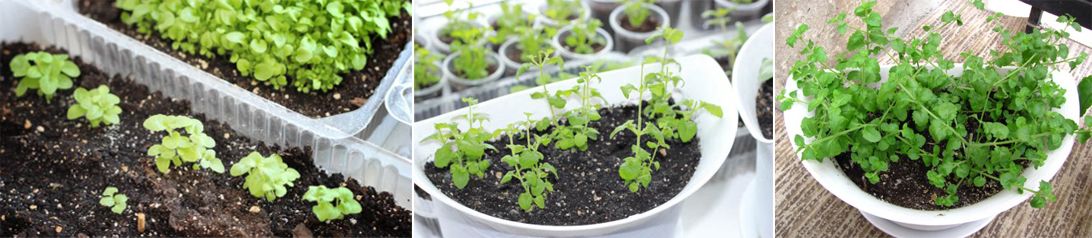
Two transplants are performed: the first when three leaves appear in separate containers, and the second when the containers become too small, with the seedlings being planted slightly deeper. After a week, young seedlings are fed with a complex fertilizer, diluted to half the dosage for mature plants.
In 3-4 weeks, the seedlings will be ready for planting. The seedlings are "hardened off" by being brought into the sun and acclimated to the sunlight. They are planted at intervals equal to the potential cultivar height of the bush.
Diseases and pests
Bacopa is virtually disease-free, and if the plant isn't looking its best, it's due to improper care: insufficient light, infrequent watering, or unsuitable soil. Pests and control methods are described in the table.
| Problem | Solution |
| Aphid. Whitefly. Spider mite. |
Spraying with acaricide. |
| Sooty mold. Mold fungus. Gray mold. |
The cause of the disease is low temperatures. In this case, thin out the crown and treat with a fungicide (three times every seven days). |
Medicinal use
Medicinal properties of sutera:
- anti-inflammatory;
- wound healing;
- painkillers;
- antioxidant;
- tonic;
- astringents;
- diuretics.
Bacopa has a very beneficial effect on the brain and nervous system. It is used for cerebrovascular accidents, Alzheimer's disease, stress, memory impairment, and cognitive decline. Bacopa preparations are widely used in folk medicine.