Bamboo is a fast-growing perennial plant native to tropical and subtropical regions of Asia. It's a misnomer to call it a tree; it's a member of the grass family. In temperate climates, it's grown in conservatories and apartments.
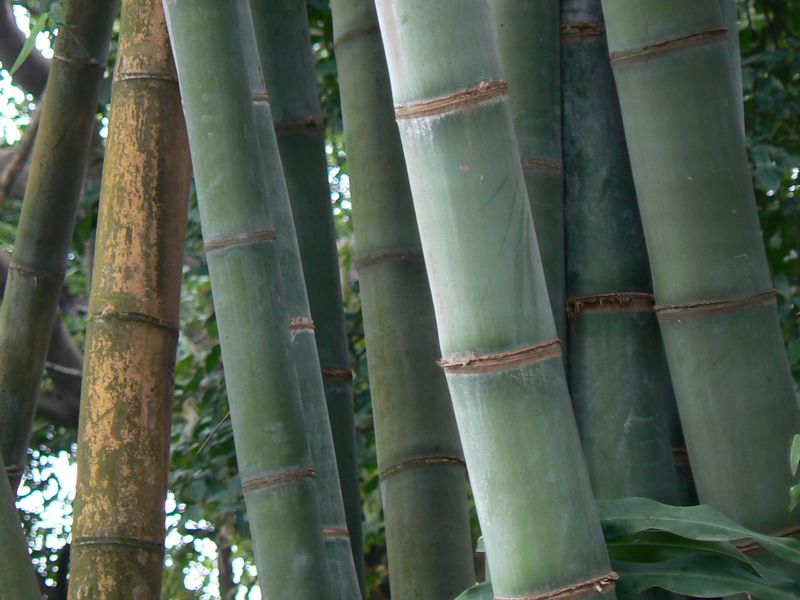
In southern latitudes, it is cultivated in open ground. Due to its vigorous growth and ability to form a strong trunk, common bamboo has become a symbol of endurance and fortitude.
Content
- 1 Description of bamboo
- 2 Types and varieties of bamboo
- 3 Peculiarities of growing bamboo in open ground
- 4 Planting bamboo in open ground
- 5 Caring for bamboo in open ground
- 6 Caring for indoor bamboo at home
- 7 Top.tomathouse.com informs: ways to grow bamboo at home
- 8 Bamboo propagation
- 9 Diseases and pests of bamboo
Description of bamboo
The plant's stems are more accurately called straws. They quickly become woody, branching only at the top. In the wild, shoots grow up to 50 meters. The leaves are long and lanceolate. The spikelets are singly arranged in some species, while in others they grow in clusters. Bamboo flowers rarely, after 10 or more years. After the caryopses mature, they die completely; only under favorable conditions does the living root survive. A distinctive feature of the plant is that most shrubs in the same area bloom simultaneously.
Bamboo has long been used as a building material. Its hollow, lightweight stem (straw) is prized for its decorative qualities and is often used to create unique interiors.
Types and varieties of bamboo
Among the numerous types, several are the most popular:
- Saza is grown in Japanese gardens; there are dwarf and tall varieties, with stems ranging from 25 cm to 2.5 meters tall. The leaves of the Kuril saza are up to 13 cm long and reach 25 mm in width. The Nebulosa saza resembles a palm tree, while the Vichi variety has a golden hue.
- Fargesia, or Chinese bamboo, is a group of medium-sized plants. Leaf blades reach up to 10 cm in length and up to 15 mm in width.
Up to 40 species of Fargesia have been classified for home cultivation and winter gardens:
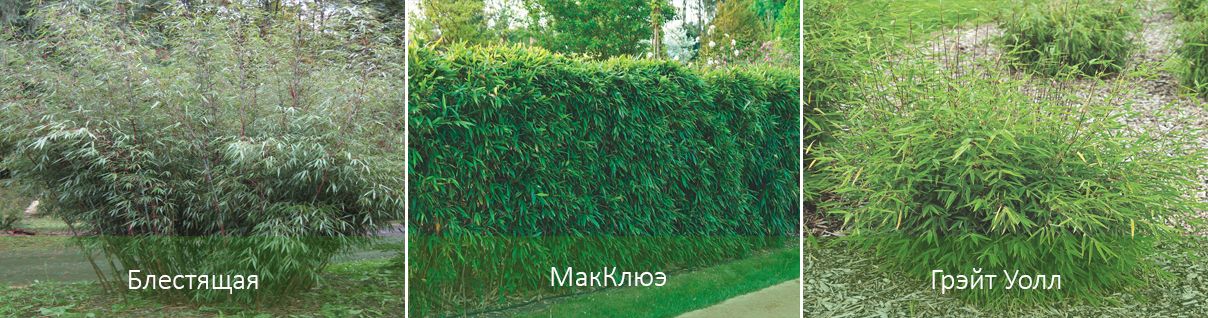
- The shiny one tolerates frosts well, overwinters painlessly in open ground, the stems acquire a pleasant dark brown color when lignified;
- The new collection is valued for its exterior: a dark cherry trunk with a purple tint contrasts with lush greenery;
- McClue grows up to 3.5 meters in height, the variety is used for linear plantings, camouflaging fences and trellises;
- Eisenach, Great Wall - varieties of bamboo with small, thin, dark green leaves, these varieties are used to create hedges;
- Simba, Jumbo, Bimbo – low-growing varieties for indoor growing.
Phyllostachys is a tall species of bamboo with short internodes, flattened or ribbed colored stems:
- black (the trunks begin to darken after two years of growth);
- with golden grooves and purple thickenings;
- light blue, exotic coloring begins to appear when the shoot becomes woody in the second year of life, this heat-loving variety is used in landscape design;
- green, not all bamboo varieties change the color of the stem during the growth process;
- yellow-brown, this is a traditional contrast for bamboo, often combined with a different shade of internodes.
Pleoblastus is a dwarf variety, including some with variegated leaves. This shrub is suitable for indoor cultivation.
Peculiarities of growing bamboo in open ground
Cold-hardy bamboo species grow in temperate climates and tolerate temperatures down to -20°C. Choose well-lit, wind-protected areas for the plants. During winter, snow should linger on the plantings; if it is blown away by the wind, the bamboo will freeze.
The plant is repotted from April to June, during the active root growth phase. The soil should be loose and light. Bamboo will not thrive in clayey, heavy, or poor soils; it will wither and quickly die. The soil should have a neutral or slightly acidic pH. It is preferable to use nutritious soil with a high humus content.
Planting bamboo in open ground
It's recommended to prepare holes for spring plantings in the fall. They should be deep, up to 40 cm. The soil removed from the hole is mixed with compost in a 1:1 ratio. For the winter, the planting hole is filled only to 1/3 of its depth, creating a small mound. The remaining soil is placed next to the hole. If it's not possible to prepare the planting site in the fall, water the hole thoroughly before planting the bamboo, leave it for 3-4 days, and allow the soil to settle.
Before planting, bamboo is specially prepared: the root ball is thoroughly soaked in water, completely submerging the pot. Leave the plant for at least two hours. After this, the plant is carefully lifted out at an angle to avoid damaging the roots. The roots are straightened, the bamboo is planted, and covered with soil. Then, water the soil. After planting, the soil must be compacted and pressed down with your feet to ensure there are no air pockets, leaving only the top 5 cm loose.
Caring for bamboo in open ground
Bamboo cultivation techniques involve regular watering, fertilizing, and thinning to prevent shoots from interfering with each other. Each step is worth discussing in more detail.
Watering
After planting, cuttings require ample watering for the first few weeks. Only during periods of frequent rainfall should the soil not be additionally moistened. To conserve moisture, the soil around young seedlings is sprinkled with dried humus; this allows the soil to warm up more effectively. If frequent watering is not possible for young plants, the soil around them is covered with a dark film. As the film warms, water begins to rise from the depths and reaches the roots. In summer, during heavy dews and rains, watering should be reduced. Mature plants should be watered no more than twice a week (depending on precipitation). If the groundwater table is close, the watering schedule should be individualized. If water stagnates, the leaves will begin to turn yellow. Between waterings, it is advisable to regularly loosen the soil to a depth of 5 cm.
https://www.youtube.com/watch?v=uxpQwBL3DuE
Trimming
Spring pruning involves removing damaged, twisted, and frost-damaged stems. Dense plantings are thinned to allow sun to penetrate deeper. When cutting, stems are removed at ground level, leaving no stump, or at a node. Stems cut above an internode will begin to grow back and will need to be pruned again. In the fall, no more than ¼ of the shoots are removed. The cut stems are usually left to overwinter in the plantings and used to create winter shelters to protect against frost.
Top dressing
In the spring, organic matter is added to stimulate active growth. In addition to nitrogen fertilizers, mineral fertilizers are used; the optimal ratio of phosphates, nitrogen, and potassium is 3:4:2. In the fall, the phosphorus content is increased to 4:4:2. The soil is loosened, dry granules are incorporated into the soil to a depth of 3 cm, and the fertilizer is applied at a rate of 1 tablespoon (a standard box) per 1 square meter.
Wintering
To protect the roots during frosts in areas with little snow, the area around the tree trunk is covered with mulch, 5 to 10 cm thick. Dried wood shavings, hay, or dry grass are used for this purpose. Some gardeners surround the bamboo with dry leaves. In this case, it is advisable to treat them with insecticides first. Dry branches are used for snow protection; they are driven into the ground around the plantings.
It's important for bamboo to survive its first winter, which is the most difficult for the plant. The trunks of heat-loving varieties die at -17°C, and temperatures below -8°C are not recommended for the root system. A 15-centimeter layer of snow will protect the plants from frost.
Caring for indoor bamboo at home
Growing bamboo indoors is very similar to growing it outdoors. For your convenience, the care instructions are summarized in a table.
| Factor | Description |
| Location and lighting | Gardeners recommend placing bamboo on east- or west-facing windows, with a mesh curtain providing diffused light. If the plant doesn't get enough sun, it will shed its leaves. |
| Temperature | The optimal growth temperature is from +18 to 25 °C; the shrub tolerates high temperatures during summer days without stress; a sharp difference between night and day temperatures is undesirable. |
| Priming | Bamboo is easy to grow; it thrives in soil suitable for any flowers, melons, tomatoes, or even all-purpose potting soil. Drainage is added to the bottom when planting. |
| Capacity | It's best to choose a clay pot so it can breathe. It's important to choose a deep and wide container right away; the plant needs plenty of space. |
| Watering | The root ball should not be allowed to dry out; it should be moistened as it dries. Young shoots should be watered generously only during the first month of growth. In winter, it's important to avoid stagnant water. |
| Humidity | It's best to wipe bamboo leaves weekly to prevent dust from accumulating. Misting should be done infrequently, and only in the evenings after hot days should the plant be given a break from the heat. |
| Top dressing | A full range of minerals and organic matter is essential. It's advisable to select fertilizers specifically for dracaenas; if these aren't available, Agricola, a universal fertilizer for indoor plants, can be used. |
Top.tomathouse.com informs: ways to grow bamboo at home
At home, the plant thrives in water. Changing the water once a week is sufficient. Indoor varieties are easy to maintain, quickly gaining mass and producing cuttings. Growth stimulants and fertilizers can be added to the water (1/3 of the recommended amount to avoid stressing the seedling). Indoors or in a winter garden, when grown in the ground, bamboo stems can reach a height of 2 meters. In a short time, gardeners can create a veritable tropical thicket. It's important to feed the plant regularly and avoid allowing the water to become stagnant.
Plastic is not recommended for growing; it's better to choose large glass or stainless steel containers; tall pitchers are also acceptable. Place the containers near a window or light source. The plant grows well under a grow light. Water for bamboo shoots should be left to stand in an open container beforehand to allow the chlorine to evaporate.
Filtered or tap water is not suitable for the plant. The plant responds very well to melted water.
Bamboo propagation
Indoor bamboo practically does not reproduce by seeds; it is too difficult and time-consuming to grow seedlings this way.
Cuttings are considered a more productive method of propagation. Young shoots are used for this purpose; they are cut in the spring from the main stem of a mature plant. The cutting is separated without damaging it and planted in moist soil for rooting.
The soil composition is described above. Drainage is placed at the bottom of the planting container. To avoid repotting the plant every 1-2 years, place the seedling in a larger pot. The size of the cutting is not important.
Cuttings are taken simultaneously with replanting the plant into a new container, 3-5 cm larger in diameter and depth than the original. This is best done in the spring. Cuttings adapt well and root well with proper care. Avoid allowing the damp root ball to dry out.
Diseases and pests of bamboo
Many plant species are disease-resistant and pest-free. Only a few are susceptible to spider mites, which are attracted to the lush foliage. To treat affected stems and leaves, use any acaricide, diluted according to the instructions. Spraying should be done in the evening, in calm weather, using personal protective equipment.
Sometimes scale insects appear; these small insects are afraid of plant or chemical insecticides.
A common fungal disease affecting bamboo is spotted leaf rust, which thrives in cool, damp weather. As a preventative measure, treat the soil with dry phytosporin. If spots appear, use fungicides.
Yellowing of leaves in the fall is not considered a disease; the plant sheds 25 to 50% of its foliage before winter. In the summer, yellowing is caused by chlorosis, where the leaves become translucent and brittle due to a lack of nutrients or excess chlorine in the soil (soil salinity). After fertilizing with nitrogen fertilizer, the yellowing disappears.