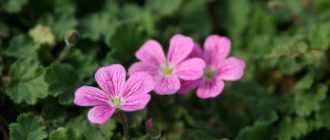
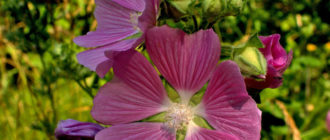
Periwinkle is an evergreen subshrub native to North America. This member of the Apocynaceae family has spread widely across Europe and Asia, finding application in a variety of industries, including pharmaceuticals and decorative arts.
Content
- 1 Periwinkle: Description
- 2 Lesser periwinkle, pink periwinkle, and other species, photos
- 3 Growing from seeds
- 4 Planting periwinkle seedlings in open ground
- 5 Planting periwinkle seeds in open ground
- 6 Vegetative propagation
- 7 Periwinkle: outdoor care
- 8 Indoor periwinkle
- 9 Features of variegated varieties
- 10 Peculiarities of cultivation in Siberia and the Urals
- 11 Mistakes in care
- 12 Pests and diseases
- 13 Periwinkle: medicinal properties
- 14 Top.tomathouse.com recommends: periwinkle in the landscape
Periwinkle: Description
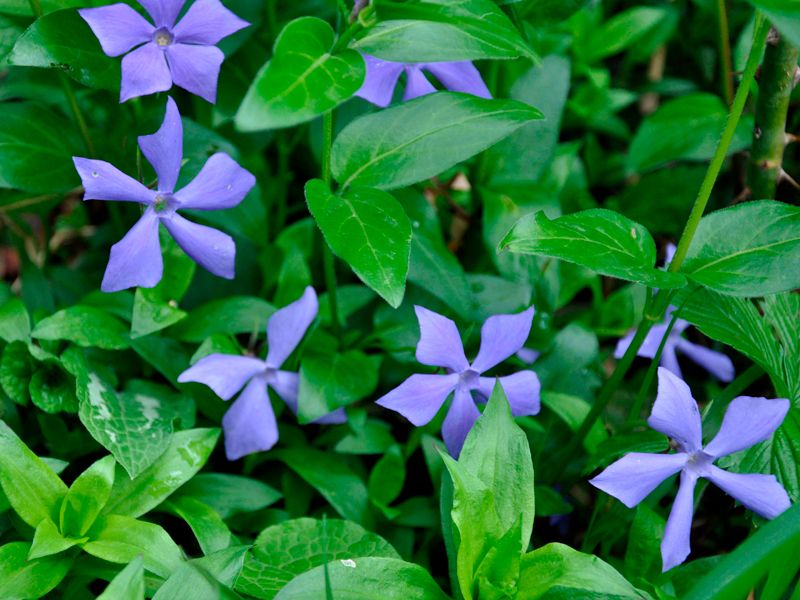
Periwinkle can be grown as a creeping or herbaceous plant with erect, rough stems. The leaves, arranged opposite each other, are small, leathery, dark green, rough blades with a pointed tip and whitish edges. Large, bright flowers emerge from the axils in the spring.
The solitary buds come in a variety of colors, from pink and purple to snow-white and cream. The corolla is twisted into a funnel shape, with an elongated, elliptical tube growing from it. Periwinkle is characterized by tall, elastic flower stalks, some of which can persist throughout the active growing season. The plant's fruit consists of two leaflets that open in the middle, revealing small brownish seeds.
Lesser periwinkle, pink periwinkle, and other species, photos
Periwinkle has a large number of different species and varieties, each of which has its own characteristics.
| View | Description | Varieties | Peculiarities |
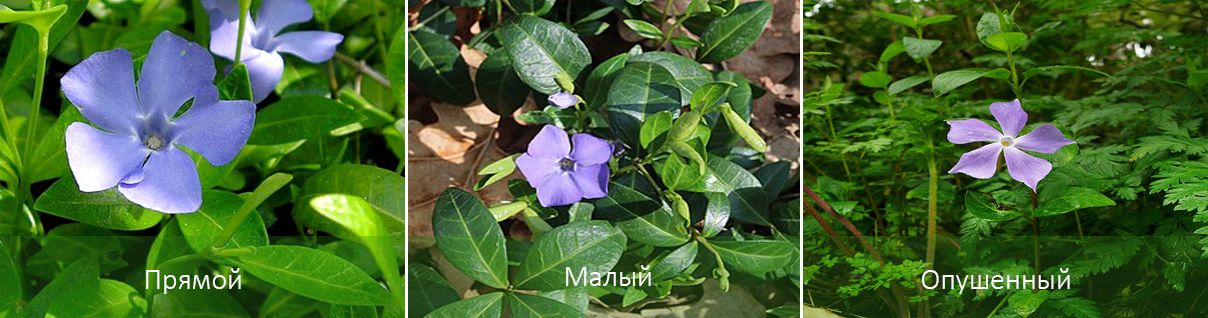
| Direct | Numerous shoots reach 20-80 cm in height. The leaves are opposite, ovate, 3-6 cm long, and have a mosaic pattern with beige edges and prominent veins. The rhizomes are covered with small scales and are woody. The flowers are 3-5 cm, blue or pink with a white tint. The fruit is about 5 cm. | Albo Plena, Purpurea, Sterling Silver, Ralph Shugert. | The rhizomes are widely used in pharmaceuticals and folk medicine. It grows on the rocky and gravelly slopes of the Tien Shan. It is most often propagated vegetatively; the seeds are rarely used. |
| Small | A perennial, branched shrub up to 60 cm long. The leaves are glossy, rounded, slightly elongated, about 0.5 cm long, and covered with vegetable wax. The flower stalks reach 15-20 cm, bearing a single, dense, blue or bluish bud. | Illumination, Moonlit, Ralph Shugert, Valley Glow, Alba Variegata, Golden, Argenteovariegata, Variegata, Azurea Flore Pleno, Double Purple, Atropurpurea, Gertrude Jekyll. | Shade-loving, its natural habitat is forests and rocky slopes. It is widespread in Asia Minor and the Mediterranean. Fruit formation is very rare; it reproduces by branching of the rhizome. Frost-hardy. |
| Pubescent | A compact plant with a well-developed root system and fairly strong, slender stems. The leaf blades are smooth, dark green, elliptical, and pointed. The flowers are medium-sized and come in a variety of colors: purple or bluish petals with white are common. | Bowles, La Grave, Dart's Blue, Sabinka, Marie | Found in the Caucasus forests between placers and on mountain slopes, it is undemanding and adapts well to rooting. |
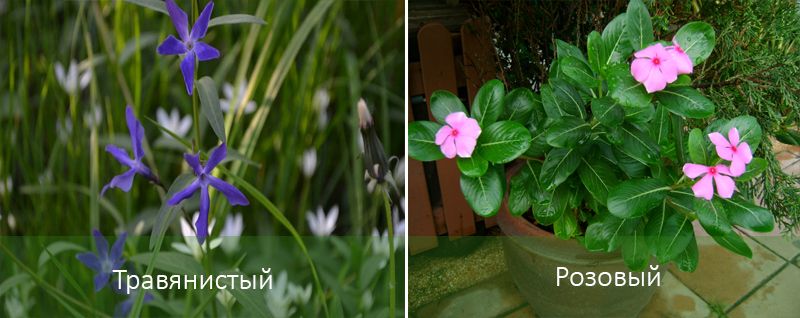
| Grassy | It grows over large areas with its vine-like stem, medium in size. The leaves are elongated, narrow, and rough, with hairy edges and a pointed, rich green color. The buds are borne on small peduncles, with gracefully curved petals, most often white. | Alba, Emily Joy, Gertrude Jekyll, Albo Plena, Illumination. | It's widespread from the slopes of Greece to the Caucasus Mountains. In winter, its stems die back to the base, but in spring they grow back even longer. Due to its branching habit, it's often grown as a trailing plant in individual containers. |
| Pink | An upright, branching shrub about 60 cm tall. The leaves are dark green, oval, and leathery. Flowers are abundant and medium-sized, often pink-red or purple in color; solid white varieties also exist. | Grape Cooler, Peppermint cooler, First Kiss. | Found in Madagascar, India, and China, it also has the common name Catharanthus. It is used in folk medicine to treat tumors. |
Growing from seeds
This is a rather labor-intensive and complex process. Although the seeds are relatively easy to grow, it is necessary to constantly monitor the air temperature and soil moisture, and ventilate the containers daily.
With proper care, the first young periwinkle shoots won't take long to appear. Seeds can be purchased at the store or collected by hand from mature plants.
However, they rarely bear fruit in the garden or at home. There are two methods for planting seeds: seedlings and in open ground.
Planting periwinkle seedlings in open ground
Sowing for seedlings is carried out at the end of February or in mid-March.
- Before planting, soak the seeds in a solution of potassium permanganate to get rid of pathogenic bacteria and fungi.
- Make drainage holes in the container and add soil mixed with peat tablets.
- Leave a distance of 3-5 cm between shallow rows.
- Sowing is done with a pinch.
- Sprinkle the seeds with substrate on top, compact it and moisten it.
- Place the containers with periwinkle in black thick bags and put them in a warm place for 5-7 days.
- Maintain the air temperature at least at +23…+25 °C. Moisten the soil regularly.
- The sprouts will appear in 1 week, then the seedlings need to be removed from the bags and placed in a well-lit place.
- It is advisable to reduce the temperature to +17…+20 °C.
Young periwinkle requires special care:
- Water regularly, but not too often. Make sure the soil does not dry out.
- Three weeks after the first shoots appear, you need to fertilize with nitrogen-containing or phosphorus fertilizers.
- Before planting in open ground, feed the periwinkle once every 2 weeks.
- After 4-5 healthy leaves appear on the sprouts, you need to transplant them: 2-4 roots into one container.
Planting periwinkle seeds in open ground
Seeds are sown in the garden in spring or fall. This should be done before frost sets in to prevent seedlings from dying, or with the arrival of consistently warm weather.
- Prepare the soil thoroughly: loosen and weed the soil, fertilize with sand, ash, wood shavings or peat.
- Make rows at a distance of 5 cm each.
- Disinfect the seeds by soaking them in a potassium permanganate solution.
- Place them in the furrows and cover with a layer of soil.
- Compact the substrate layer, add some sawdust or sand on top.
- Water generously.
Vegetative propagation
There are three different methods for propagating periwinkle: cuttings, layering, and division. Since the plant rarely produces seeds, this method is widely used by most gardeners.
Cuttings
Cuttings should be prepared during pruning or they can be cut from the apical shoots.
- To root, simply place the branches in a container with water so that it occupies a third of the stem.
- All leaves must be removed from the bottom, otherwise rotting will begin.
- You can also use a soil mixture with the addition of root-forming components for rooting.
- It's important to change the water regularly to prevent it from becoming stagnant. It's best to use filtered water rather than tap water.
- In about 2 weeks, young roots will appear.
- When the root system grows by 2-3 cm, the shoots need to be transplanted into the soil.
Layering
The cuttings take root quickly and almost all of them survive.
- You need to carefully examine the creeping shoots of the periwinkle and find the places where they form roots.
- Using a disinfected knife, separate the cuttings from the adult plant, treating the cut areas with charcoal dust or cinnamon.
- If the shoot's root system is well developed and shows no signs of disease or infection, it can be placed in a new, individual location.
- Water the new seedling thoroughly and feed it with mineral fertilizer so that it adapts faster and begins to grow.
Dividing the bush
This method can be used to propagate periwinkle in any season except winter or early spring. Division should be done before the first flower stalks appear, allowing the plant time to establish itself in its new environment.
- Carefully remove the bush from the soil without damaging the root system.
- Remove any remaining soil from the roots.
- Cut off rotten, diseased or dried roots.
- The main bush must be divided in such a way that each part retains the base of the adult plant.
- To speed up the adaptation process, the cuttings should be planted in the same substrate as the mother periwinkle.
- Place the branches in the planting holes, compact the soil and water thoroughly.
Periwinkle: outdoor care
To ensure periwinkle grows vigorously in your garden and delights you with its beautiful flowers, you need to provide it with proper care.
| Factor | Condition |
| Location/lighting | It loves light and grows well in both shaded and sunny areas. It's best planted on a small hill on the south side of the plot. It can spread out or climb along a support, fence, or wall. |
| Soil | The soil should be rich, well-drained, and enriched with mineral and organic additives. It should be neutral or slightly acidic. If the soil is loamy, it should be mixed with sand, crushed stone, peat, or ash. |
| Watering | Regular watering may not be necessary if natural rainfall is sufficient. Care should be taken to ensure the soil does not dry out, and during particularly hot periods, water the periwinkle no more than once a week. |
| Fertilizer | Two to three fertilizing sessions per season are sufficient. If the shrub wilts, turns yellow, or becomes infected, increase the frequency to once every two weeks. Nitrogen, phosphorus, or potassium fertilizers are good choices, especially during the active growing season. Organic matter such as compost, pine needles, sawdust, or humus can also be used. |
| Trimming | Carry out this procedure after flowering has finished. Remove all dried shoots, faded flowers, and sprouts. It is also necessary to trim off any excessively long branches and disinfect the cut areas with chalk. |
Indoor periwinkle
Growing periwinkle indoors is also possible. Certain conditions must be met.
| Factor | Condition |
| Location/lighting | A well-lit location, protected from direct sunlight. Does not tolerate drafts or frequent ventilation, especially during the cold season. Place the pot on a south or southwest-facing windowsill. |
| Temperature | It thrives at temperatures of 18 to 25°C. It tolerates drought well, but humidity levels should be monitored. |
| Soil | It's easy to grow; you can use a general-purpose potting soil for indoor plants, particularly geraniums. Add some peat or sand. Also, place some drainage material at the bottom: broken brick, egg or nut shells, or polystyrene foam. |
| Watering | In summer, watering once every 2-3 days is sufficient; moisture should not stagnate and the substrate should not dry out. Make drainage holes in the pot. In winter, watering should be reduced to once every 4-6 days to prevent the shrub from rotting. |
| Fertilizer | Fertilize every two weeks using indoor rose fertilizer or a general-purpose supplement. Organic matter, such as compost or pine needles, will also work. Avoid fertilizing during winter, as the shrub goes into a state of dormancy. |
| Trimming | To enhance the periwinkle's decorative appearance and lushness, its apical shoots should be trimmed regularly as they grow. This is best done in the spring, and the cut areas treated with cinnamon or charcoal. |
Features of variegated varieties
These varieties require different care than single-color varieties. Their physiological characteristics must be taken into account:
- Place the shrub in a well-lit area, as sunlight plays a key role in the formation of spotting.
- Variegated representatives are best grown in pots.
- They do not tolerate frost and low temperatures well, so it is recommended to transplant variegated specimens into separate containers and bring them into well-insulated rooms for the winter.
Peculiarities of cultivation in Siberia and the Urals
Generally, caring for the shrub is not very different, but due to low temperatures, periwinkle is often grown as an annual. The climate in these regions is sharply continental, which significantly complicates the plant's overwintering. After severe frosts and prolonged cold spells, the shrub dies, and the following year, seeds or seedlings must be replanted.
However, there is an alternative option: in mid-autumn, carefully prune, then carefully dig up the periwinkle without damaging the root system and transplant it into a separate container with a prepared nutrient substrate.
Keep the shrub in a warm, well-lit area until warm weather arrives. In April or May, it can be replanted in its designated area.
Mistakes in care
| Problem | Cause | Elimination measures |
| The leaves turn yellow, dry out, and fall off. | Too dry air in the room, irregular watering, direct sunlight, violation of the temperature regime. | Increase humidity and watering frequency, do not allow the substrate to dry out, remove dried parts of the bush, lower the temperature to normal (+18…+25 °C). |
| Few or no buds at all. | Drafts, unsuitable fertilizers, cold air and sudden temperature changes. | Change the location of the pot, eliminating blowing and do not use nitrogen fertilizers during the period of active flowering and bud formation. |
| Flowers bloom and fall. | Poor lighting, infrequent watering. | Move the periwinkle to provide access to sunlight and water more often. |
| The edges of the leaf blade dry out and turn yellow. | Low humidity. | Spray the bush more regularly. |
Pests and diseases
| Problem | Cause | Elimination measures |
|
High humidity, infestation from vectors (aphids) or another plant. Rust. | Agrolekar, Propi+, boric acid solution. |
|
Infection by vectors or by airborne transmission (spores landing on the outer part of the plant). Powdery mildew. | Raek, Gamair, Fitosporin, Vectra. |
|
Scale insects. | Soapy solution. Manually remove pests and plaque. Insecticides. |
Periwinkle: medicinal properties
Many species and varieties of this shrub are used in folk medicine and pharmaceuticals due to their various active ingredients. This is especially true for the lesser periwinkle, whose sap contains approximately 20 alkaloids, flavonoids, and vitamins, which are used in medications and decoctions against malignant tumors. Preparations based on this plant are also used to treat oral incontinence, sore throat, diarrhea, uterine bleeding, prostate problems, and infertility.
Top.tomathouse.com recommends: periwinkle in the landscape
This shrub is widely used in landscape design. Its creeping stems camouflage bare soil and shallow cracks. Periwinkle is placed in rock gardens or alpine beds to add a more dramatic effect. It's an excellent companion for forget-me-nots and primroses. It can also be planted in a pot on a balcony or veranda.