Browallia is a plant in the Solanaceae family. It is native to Colombia, with solitary species found in southern and central America.
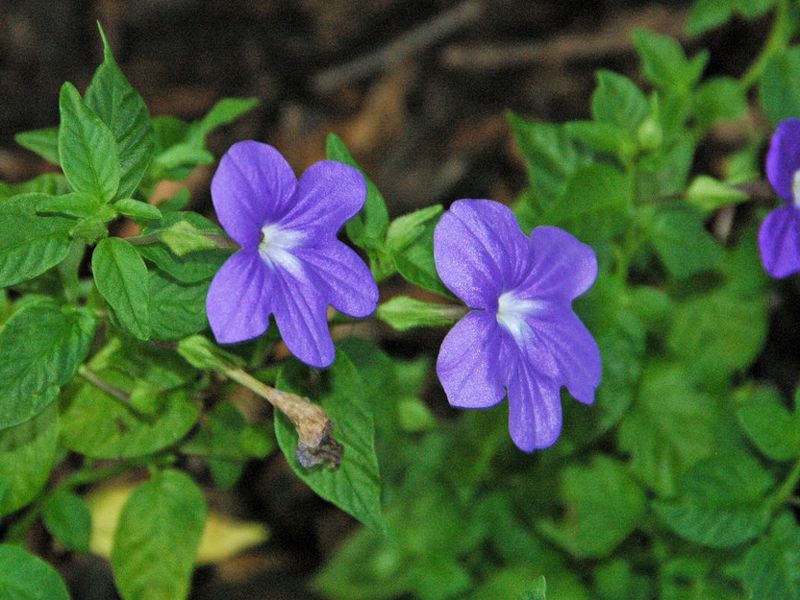
Description of browallia
This indoor plant grows from 40 to 70 cm, with pubescent shoots. The foliage is lanceolate. The flowers are solitary, star-shaped, and come in white, blue, and purple.
The fruits are capsules with dark seeds that spill out through the valves.
The most popular types and varieties of browallia
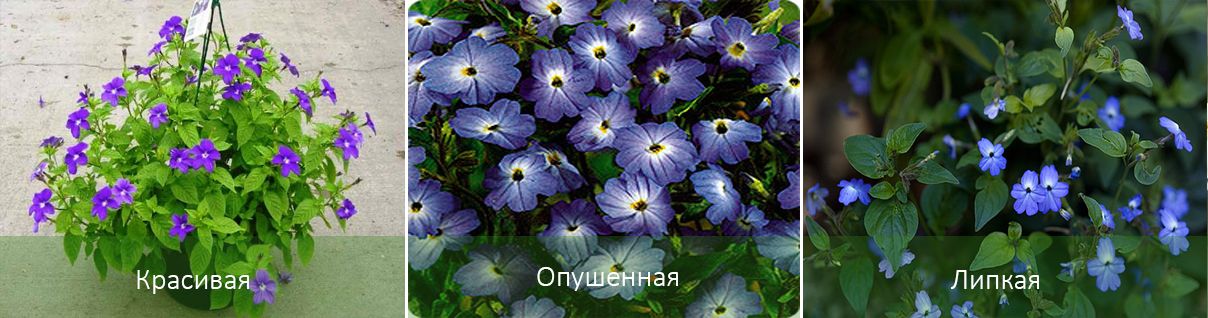
Several types and varieties of browallia can be grown indoors:
| View | Description | Varieties | Flowers. Blooming |
| Beautiful | A compact, herbaceous shrub, growing up to 70 cm in the wild and 40 cm indoors. The shoots are short and glabrous. The leaves are 4-6 cm long, rough, and obovate in shape with pointed tips. | White Bells, Jingle Bells, Blue Bells, Blue Troll. | Bluish-purple, white center. From midsummer until frost. |
| Pubescent (American) | It grows up to 70 cm, with simple or tomentose shoots. The leaves are broadly lanceolate, slightly hairy, and about 5 cm long. | None. | Inversely cordate. Color: blue-violet, lilac, white. Corolla diameter: 1-1.5 cm. July – November. |
| Sticky | Reaches 25 cm. Shoots are sticky. | Sapphire. | Small, sapphire-blue. November – February. |
Caring for browallia at home
When caring for browallia at home, you need to focus on the season of the year:
| Factor | Spring-summer | Autumn-Winter |
| Location/lighting | Place on the west or east side of the house; shade is needed on a south-facing window. In summer, it can be moved to an open loggia or garden. Bright, diffused color. | Bright, can be left in direct sunlight for several hours. Provide supplemental lighting with a phytolamp. |
| Temperature | +18…+25 °С. | +16…+20 °С. |
| Humidity | The level is 60-70%. The pot is placed on a tray filled with moistened pebbles, peat, and moss. Mist the plant daily with room-temperature water (avoid dripping onto the buds). | Level: 55-60%. Spray once a week. Place the pot away from heating appliances. |
| Watering | Every 2-3 days. Do not allow the soil to dry out completely or allow water to stagnate. The liquid should be soft and warm. | Once every 7 days. |
| Top dressing | Once every 14 days, use mineral fertilizers. | |
Growing Browallia indoors and outdoors
When growing browallia indoors, choose a general-purpose soil. You can also make your own substrate by mixing the following ingredients in equal quantities:
- turf and leaf soil;
- sand.
When grown outdoors, the plant should not be planted in overly wet or fertile soil. This is because instead of flowering, it will experience vigorous foliage growth. Garden soil with good drainage and moderate fertility is considered an excellent choice.
When planting this flower in the garden, space the seedlings 30-35 cm apart to form a continuous border. If you want to separate the shrubs a bit, space them 40-45 cm apart.
Growing from seeds
When growing browallia from seeds, follow a specific algorithm:
- The planting material is kept in a warm room for 2 days to swell (a cloth is first soaked in a growth stimulator and the seeds are placed on it), and then dried until it becomes free-flowing.
- Best growth is observed under film. During this period, avoid uncovering the crops to maintain a comfortable temperature and humidity.
- The greenhouse is ventilated 2-3 times a week.
- After the seedlings appear (after a few weeks), bottom watering is carried out through the tray.
- When 3-4 leaves have formed, the plant is transplanted into separate pots, 2-3 pieces at a time (for hanging cultivation) or one at a time (for growing in a garden or room).
- As the seedlings grow, pinch the tops above the 5th-6th leaf; this will increase the branching of the bush.
In mid-May, the seedlings are transplanted into a permanent pot.
Propagation by cuttings
The advantage of propagation this way is that cuttings can be taken throughout the growing season. Most often, stems without buds are used. The upper part of the trunk is used, as it roots more easily.
The resulting shoot is cleared of excess foliage and buried 2-3 cm into the soil. It is then treated with Kornevin or another similar growth stimulant. If you don't have a rooting stimulant for browallia, you can prepare one yourself. Young willow shoots are suitable for this purpose. They are chopped into sticks about 5 cm long and placed vertically in a container of water. The solution is then infused for 24 hours. The cuttings are then placed in the prepared solution for 6-12 hours.
For rooting, select a light, sandy soil. Using a pencil, make 3-4 cm deep depressions in the soil. Place the flower cuttings into these depressions. The cuttings should not touch each other.
To retain moisture, cover the container with plastic wrap. After rooting, transplant the cuttings into soil suitable for mature plants and pinch them to promote branching.
Browallia care mistakes and their correction, diseases and pests
During cultivation, browallia can be subject to attacks from pests and diseases, which are often caused by care errors:
| Manifestation | Cause | Elimination measures |
| Wilting of foliage. | High temperatures, low air humidity, rare watering. | The plant is moved to a room with a temperature of 20°C. Mist it daily and increase the humidity. Adjust the frequency of watering, ensuring the soil never dries out completely. |
| Thinning and elongation of shoots, pale leaves. | Poor lighting. | Provide the plant with bright, diffused light. During winter, supplemental lighting is provided with fluorescent or LED lamps. |
| Yellow spot on foliage. | Burns. | The browallia is removed from the windowsill and shaded during midday hours. |
| Lack of flowering. | Poor quality care. | Move to a brighter location, prune before growth begins, and feed with fertilizers containing phosphorus and potassium. Remove wilted plants promptly. |
| Formation of a white coating on the trunk and leaves. Wilting of the affected areas. | Powdery mildew. | Remove affected flowers and leaves. Treat with Topaz or iodine solution. |
| Plant wilting against the background of moist soil. | Root rot. | The plant is removed from the pot and the root system is carefully examined. If most of the rhizome is firm and white, treatment is possible. All soil is washed away under the tap, and the affected areas are trimmed with a knife. Wilted foliage and shoots are removed. The browallia is repotted in a new container and treated with Fitosporin. Place it in a warm, bright location. Do not water the plant until new growth begins to form. |
| Dark spots of rot at the bottom of the trunk and on the leaves. | Stem rot. | Inspect the root system. If it's healthy and the stem isn't affected near the ground, prune it. Treat the cut with sulfur or charcoal. Spray the remaining potted plant with a growth stimulant and cover with a plastic bag. If the damage is severe, discard the plant and treat its neighbors with fungicides. |
| The elastic foliage turns pale and yellow. | Chlorosis. | Spray and water with Iron Chelate and Ferrovit until new leaves form. Replant in new soil. |
| A thin white web appears on the leaves. | Spider mite. | They are treated with systemic insecticides such as Actellic or Derris. |
| The leaves are wilting and greenish larvae are present on their inner side. | Whiteflies. | The soil is watered with a solution of Aktara, repeating the process at least three times, with a weekly interval. The plant itself is sprayed with Confidor, covered with a plastic bag, and left overnight. This treatment should be performed outdoors due to the product's distinctive odor. |
| Poor growth, wilted foliage even after watering. White lumps resembling cotton wool are present. | Mealybug. | Isolate the plant from its neighbors. Remove insects manually with a damp cloth. Spray and wash with a soap-alcohol solution. If the infestation is severe, treat with Aktara or Actellic. |
Browallia is quite susceptible to insects and diseases, so it's important to prevent them. To do this, water moderately, using only demineralized and settled water, humidify and ventilate the area, and apply nutrients promptly.